

TL;DR:
Trade execution speed measures the milliseconds between order submission and confirmed fill, directly impacting slippage and trade accuracy. Factors like proximity to broker servers, execution model, platform efficiency, and network stability influence latency, with tail latency (p95, p99) revealing performance issues. Improving speed through VPS hosting, ECN/STP brokers, and continuous monitoring enhances trading outcomes, especially for scalpers and high-frequency strategies.
Trade execution speed is defined as the elapsed time, measured in milliseconds, between submitting a trade order and receiving a confirmed fill from the market or broker. For traders on MetaTrader 4, MetaTrader 5, or any direct-access platform, this interval determines whether you enter or exit at your intended price or absorb slippage that erodes your edge. Infrastructure choices drive execution time from as low as 1 millisecond on a co-located VPS to over 200 milliseconds on a standard home connection. Understanding what shapes this number, and how to measure it properly, is the difference between a strategy that performs as designed and one that leaks value on every trade.
What is trade execution speed and why does it matter?
Trade execution speed, known in professional circles as order latency, is the total round-trip time from the moment your platform sends an order to the moment the confirmed fill returns. It is not a single number. It is a pipeline with three distinct stages: outbound order transmission, venue matching and queue processing, and confirmation receipt. Institutional analysis separates these legs because the fill price reflects market conditions at the matching moment, not when the acknowledgment arrives. That distinction matters enormously for backtesting accuracy and live risk management.
For retail traders, the practical consequence is straightforward. Every millisecond of delay is a window during which the market can move against your order. In calm conditions, this window is negligible. During news releases, earnings events, or liquidity gaps, that same window can mean the difference between filling at your target price and absorbing significant slippage. Execution speed is not a vanity metric. It is a structural input to every trade you place.
MiFID II, the European regulatory framework governing financial markets, formally recognizes speed as a measurable component of best execution. Firms must report execution quality quarterly, including duration metrics alongside price, cost, and fill probability. That regulatory acknowledgment confirms what experienced traders already know: speed belongs in the same conversation as spread and commission.
What factors influence trade execution speed?
Several layers of infrastructure sit between your click and your confirmed fill, and each one contributes latency.

Hands typing on keyboard with trading platform and latency data
Broker execution model. ECN and STP brokers route orders directly to liquidity providers with raw spreads plus commission, which reduces internal processing delays and eliminates requotes. Market makers internalize orders, which introduces an additional decision layer and the possibility of deliberate delay. For latency-sensitive strategies, ECN or direct market access is the correct starting point.
Server proximity. Physical distance between your machine and the broker’s matching engine is the single largest controllable latency variable. A home internet connection in a typical residential location produces round-trip times of 50 to 200 milliseconds. A VPS hosted in the same data center as your broker’s server can reduce that figure to 1 to 3 milliseconds. That is not a marginal improvement. It is a structural change in how your orders interact with the market.
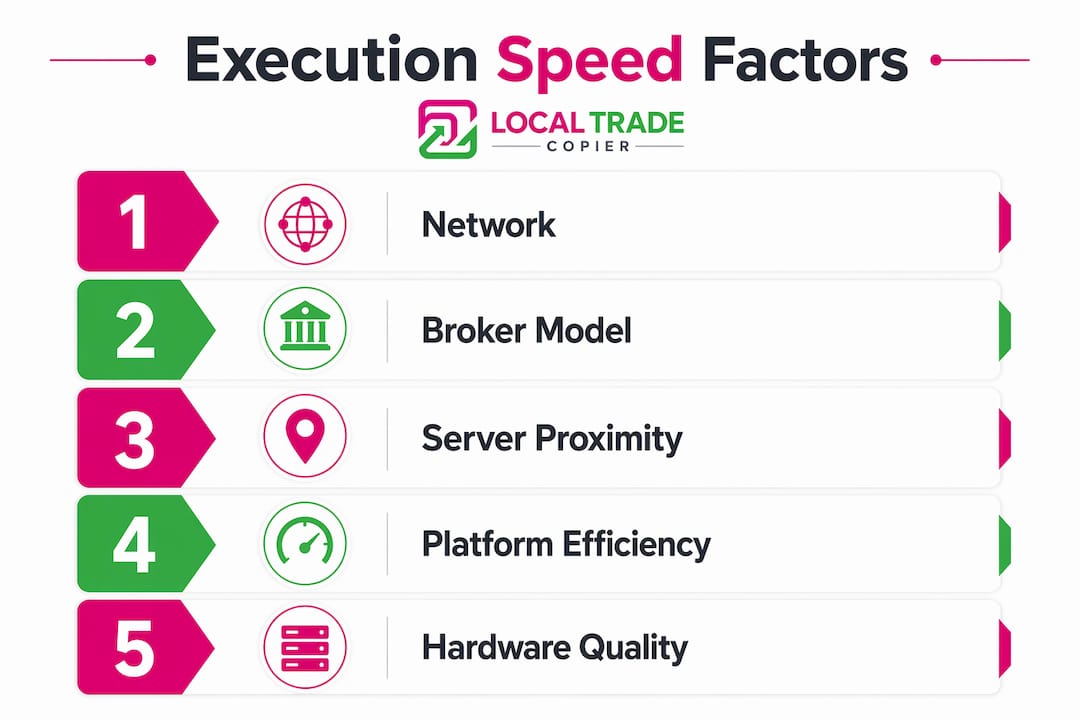
Infographic showing key factors influencing trade execution speed
Platform efficiency and hardware. MetaTrader 4 and MetaTrader 5 both process orders through their internal order management layer before transmission. RAM optimization and reducing the number of active indicators directly reduce the time the platform spends preparing an order for dispatch. A terminal running 40 indicators on 10 charts is slower than one running a clean, minimal setup.
Network quality. Bandwidth matters less than stability. Packet loss and jitter, which are irregular spikes in transmission time, cause tail latency events that average speed figures never reveal. A connection averaging 20 milliseconds but spiking to 300 milliseconds during peak hours is more dangerous than a consistent 35-millisecond connection.
Pro Tip: Run a continuous ping test to your broker’s server IP during your active trading hours. If you see spikes above three times your median latency, your network is generating tail latency risk that your average speed figure is hiding.
How does execution speed affect slippage, stops, and fill probability?
The practical impact of execution speed shows up in three specific trading outcomes, each with a direct effect on your P&L.
- Slippage. When your order arrives at the venue after the price you targeted has moved, you fill at the next available price. Small latency differences can convert a full fill at your intended price into a partial fill or a miss entirely. In fast-moving markets, even 50 milliseconds of additional delay can produce slippage that exceeds the spread you paid to enter.
- Stop-loss timing. Stop orders are not guaranteed fills at the trigger price. They become market orders when triggered, and the fill depends on available liquidity at that moment. In volatile conditions, stop-loss fills can lag the trigger price significantly, increasing your actual risk exposure beyond what your position sizing assumed. A stop set at 20 pips of risk may fill at 28 pips if execution is slow during a spike. Past results do not guarantee future performance.
- Queue positioning and fill probability. Exchanges and ECN venues match orders by price and then by time of arrival. A slower connection means your order joins the queue later than a faster competitor’s order at the same price level. Queue positioning directly affects whether you receive a full fill, a partial fill, or no fill at all during periods of limited liquidity.
Execution speed is not just about entering faster. It is equally about exiting at the price your risk model assumed you would exit at. This is why scalpers and short-term traders feel the impact of latency far more acutely than swing traders holding positions for days.
For strategies with tight profit targets relative to the spread, like scalping, even modest execution delays can flip a positive expectancy strategy into a losing one. The scalping setup guide from Mt4copier covers this dynamic in detail for traders running copied strategies across multiple accounts.
How is trade execution speed measured and reported?
Most traders look at average latency and stop there. That is a mistake.
| Metric | What it measures | Why it matters |
|---|---|---|
| Mean latency | Average round-trip time across all orders | Useful baseline but hides variability |
| Median latency (p50) | The midpoint of the latency distribution | More representative than mean for skewed data |
| Tail latency (p95) | Latency at the 95th percentile of orders | Reveals how bad your worst 5% of fills are |
| Tail latency (p99) | Latency at the 99th percentile of orders | Exposes extreme outliers that damage P&L most |
Tail latency benchmarks reveal stress bottlenecks that average figures completely obscure. A system with a 5-millisecond average but a p99 of 400 milliseconds is a system with a serious execution problem that only surfaces during the market conditions where precision matters most. Professional latency-sensitive strategies treat execution as a distribution management problem, not a single-number optimization.
Transaction cost analysis, commonly called TCA, is the formal framework for measuring execution quality across all dimensions. TCA tools compare your actual fill prices against the market price at the time of order submission, the midpoint at fill, and the arrival price. The gap between these figures quantifies your execution quality in dollar terms. MiFID II best execution requirements push regulated firms to publish this data, but retail traders can apply the same logic manually by logging order timestamps and fill prices over time.
Venue-specific rules also affect what speed alone can achieve. Matching and queue priority rules differ across liquidity venues, meaning a simple speed improvement does not guarantee better fills if the venue’s matching logic favors other order types or sizes. Effective execution requires calibration by venue and instrument, not just a faster connection.
Pro Tip: Ask your broker for their execution quality report or order fill statistics. Any ECN broker worth using can provide average fill time, slippage distribution, and rejection rates. If they cannot, that tells you something important about their execution model.
What practical steps can traders take to improve execution speed?
Improving trade execution efficiency does not require institutional infrastructure. These steps produce measurable results for retail traders.
- Use a VPS near your broker’s servers. VPS proximity reduces network latency by eliminating the physical distance between your order origin and the broker’s matching engine. Providers like Beeks Financial Cloud, Liquidity Connect, and ForexVPS offer data center hosting specifically designed for MetaTrader environments.
- Choose ECN or STP execution. ECN brokers route orders directly to liquidity providers, removing the internal processing layer that market makers add. This reduces both average latency and the risk of requotes during fast markets.
- Optimize your trading platform. Run MetaTrader 4 or MetaTrader 5 on a machine with adequate RAM, close unused chart windows, and remove indicators that are not required for your active strategy. Platform sluggishness delays order transmission before the order even reaches the network.
- Stabilize your network connection. Use a wired Ethernet connection instead of Wi-Fi. Contact your ISP about a dedicated business line if you trade actively during high-volatility sessions. Measure jitter, not just speed.
- Test limit orders versus market orders. Limit orders guarantee your price but risk non-fill. Market orders guarantee a fill but expose you to slippage. The right choice depends on your strategy’s sensitivity to price versus fill certainty.
- Monitor execution metrics continuously. Log your order submission timestamps and fill timestamps. Review slippage distribution weekly. Patterns in your data reveal whether your broker, network, or platform is the primary latency source.
The importance of execution speed compounds when you are managing multiple accounts simultaneously, because each additional account multiplies the execution demands on your infrastructure.
Key takeaways
Trade execution speed is a distribution metric, not a single number, and tail latency at the p95 and p99 levels determines real-world trading performance more than average latency alone.
| Point | Details |
|---|---|
| Core definition | Execution speed is the millisecond interval from order submission to confirmed fill. |
| Tail latency matters most | Mean latency hides dangerous spikes; always benchmark p95 and p99 alongside averages. |
| VPS cuts latency dramatically | Hosting near broker servers reduces round-trip time from 50-200 ms to 1-3 ms. |
| Broker model shapes your baseline | ECN and STP brokers deliver faster, more transparent routing than market makers. |
| Slippage and stops are directly linked | Execution delays increase slippage and cause stop-loss fills to lag trigger prices under volatility. |
Why average speed is the wrong thing to optimize for
I have watched traders spend weeks chasing a broker with a slightly lower advertised average execution time while ignoring the p99 latency on their existing setup. That is optimizing the wrong variable. The trades that hurt you are not the ones that fill in 5 milliseconds instead of 3. They are the ones that fill in 800 milliseconds during a news spike because your VPS is three continents away from your broker’s matching engine.
The more uncomfortable truth is that execution speed is not separable from strategy design. A swing trader holding positions for days can tolerate 200-millisecond execution without meaningful performance impact. A scalper targeting 5-pip moves on EUR/USD cannot. Before you invest in infrastructure upgrades, you need to know which category your strategy falls into. Spending money on co-location for a strategy that does not require it is a cost with no corresponding benefit.
What I consistently recommend is this: measure first, then optimize. Log your fills for two weeks. Calculate your actual slippage distribution. Identify whether your worst fills cluster around specific sessions, news events, or instruments. That data tells you exactly where your execution is leaking and whether the fix is a better VPS, a different broker, or a platform configuration change. Continuous monitoring, not one-time setup, is what keeps execution quality from degrading silently over time.
— Rimantas
How Mt4copier supports fast, reliable trade execution
If you are managing trades across multiple MetaTrader accounts, execution speed compounds with every additional account you run. Mt4copier’s Local Trade Copier operates entirely on your local Windows machine or VPS, with no cloud routing between accounts. That architecture means copy times of 1 second or faster between your master and client accounts, with all trade data staying on one machine and one IP address.
For prop firm traders and account managers who need on-machine execution without external server latency, the local setup removes the cloud routing layer that introduces unpredictable delays. You can review the full Local Trade Copier installation guide to see exactly how the software integrates with MetaTrader 4, MetaTrader 5, and DXTrade. Mt4copier has served 3,000+ traders since 2010, with 492 Trustpilot reviews backing its track record as the most established locally-installed trade copier available.
FAQ
What is trade execution speed in simple terms?
Trade execution speed is the time in milliseconds between placing a trade order and receiving a confirmed fill. Faster execution reduces slippage and improves the accuracy of stop-loss and take-profit orders.
What causes slow trade execution?
The main causes are physical distance between your machine and the broker’s server, market maker execution models that add internal processing layers, unstable network connections with high jitter, and overloaded trading platforms running too many indicators.
How do I measure my own execution speed?
Log the timestamp when you submit an order and the timestamp on the confirmed fill. Calculate the difference across 50 to 100 trades and build a distribution. Focus on your p95 and p99 figures, not just the average, since tail latency spikes cause the most damage to P&L.
Does execution speed matter for swing traders?
Execution speed matters less for swing traders holding positions for hours or days, because the latency window is small relative to the trade’s target and stop distance. It matters most for scalpers, day traders, and anyone copying trades across multiple accounts where delays multiply.
What is the fastest way to improve execution speed?
Using a VPS located in the same data center as your broker’s servers is the single highest-impact change most retail traders can make, reducing latency from 50 to 200 milliseconds down to 1 to 3 milliseconds.
Recommended
- Boost Trading Efficiency with Automated Trade Copying
- Network Connection Latency Impact to MT4 Trade Copier Speed
- What Is Trading Resource Optimization for Forex Traders
