

TL;DR:
Organizing multiple trading accounts by strategy and risk profile ensures consistent execution and simplifies performance analysis. Broker-native tools like linked and Financial Advisor accounts provide strategy isolation, automated allocation, and streamlined reporting, reducing operational errors. Implementing disciplined, written risk rules and utilizing normalized metrics like R-Multiple across accounts enhances accurate performance comparison and effective management.
Trading account organization is the practice of grouping and managing multiple forex accounts by strategy, risk profile, or client type, using clear rules and technology tools to support consistent execution and accurate performance analysis. Without a deliberate structure, retail traders and account managers face compounding problems: duplicate entries, blurred risk exposure, and performance data that tells you nothing useful. The ideas below address all three. They draw on broker-native tools like Interactive Brokers’ Financial Advisor accounts, risk frameworks from Benzinga Pro, and journaling standards from Traders Second Brain to give you a working system, not a checklist.
1. Best ways to organize trading accounts using broker-native structures
The most underused trading account organization ideas are already built into your broker. Interactive Brokers supports linked accounts that maintain separate margin, positions, and reporting while remaining accessible through a single login. That separation matters because it lets you run a scalping strategy and a swing strategy in complete isolation without opening two browsers or managing two passwords.

Trader using broker software for account organization
Financial Advisor (FA) accounts take this further. An FA master account can manage unlimited client sub-accounts with automated trade allocation by proportion, equal shares, or custom ratios. This is the structure independent account managers need when copying trades to multiple clients with different capital bases. It also generates consolidated reporting, which simplifies compliance.
For traders who want even more granular control, Interactive Brokers offers institutional structures like Multiple Trading Advisors and Separate Trading Limit accounts. These suit situations where different strategies require distinct capital allocations and operational boundaries.
Key benefits of broker-native structures:
- Strategy isolation: Each account runs its own rules without cross-contamination.
- Simplified reporting: Consolidated statements reduce reconciliation time.
- Reduced login friction: Single authentication across all accounts saves time and reduces error.
- Compliance support: FA accounts include built-in allocation records for audit trails.
Pro Tip: Never reuse your primary login for API-based automation. Dedicated API users prevent session conflicts that can disconnect active trading terminals mid-session.
2. Trading plan rules that enforce discipline across multiple accounts
A written trading plan is the structural backbone of any multi-account setup. Rule-based position sizing with automated alerts removes the emotional interference that causes traders to bend their own rules during live sessions. When you manage three accounts simultaneously, that protection multiplies in value.
A practical risk system for multi-account traders looks like this:
- Maximum risk per trade: Cap each trade at 1% of the account balance. This is the most widely cited threshold in layered risk systems designed to prevent catastrophic drawdowns. Past results do not guarantee future performance.
- Daily loss cap: Stop trading any account that hits a 3% daily loss. This prevents a bad morning from becoming a blown account.
- Open position limit: Define the maximum number of simultaneous trades per account. Three to five is a common ceiling for retail traders running trend-following strategies.
- Stop-loss and take-profit rules: Every trade requires a pre-set stop and target before entry. Automate these where possible so execution does not depend on your attention.
- Weekly drawdown threshold: If an account loses more than 6% in a week, reduce position size by half until performance recovers.
A well-structured trading plan specifies all of these in writing, not just in your head. Writing them down externalizes the decision, which means you are enforcing a rule rather than making a judgment call under pressure.
Pro Tip: Apply your risk rules to each account independently. A 3% daily loss on Account A should not affect Account B. Keeping accounts operationally separate prevents one bad strategy from contaminating your entire portfolio.
You can find a deeper breakdown of multi-account risk techniques that apply these principles across funded and personal accounts.
3. How to build a trading journal that works across multiple accounts
Most traders journal inconsistently because their system does not scale past one account. A proper multi-account journal tracks the same fields for every trade, regardless of which account it came from.
The core fields every entry needs:
- Date, instrument, and direction (long or short)
- Entry and exit price, plus lot size
- P&L in both dollars and pips
- Setup type and session tag (London, New York, Asian)
- Spread at entry and swap fees paid
- Notes on execution quality and emotional state
The last two items are where most traders fall short. Forex journals that track spread and swap costs reveal the true cost of a strategy, not just its gross return. A setup that looks profitable in pips can be a net loser after spread and overnight fees, especially on longer-hold positions.
The metric that makes cross-account comparison possible is the R-Multiple. R-Multiple converts trade outcomes into units of risk taken, so a $200 gain on a $10,000 account and a $50 gain on a $2,500 account both read as 2R. This is the only way to compare strategy performance across accounts of different sizes without distorting the analysis.
| Field | Why it matters |
|---|---|
| Pips and dollar P&L | Reveals true cost after spread and fees |
| R-Multiple | Normalizes results across account sizes |
| Session tag | Identifies which market hours favor each strategy |
| Spread at entry | Exposes execution cost per setup type |
| Swap fees | Tracks overnight holding costs on longer trades |
Monthly statement archiving is the final piece. Download and store broker statements every month, then verify them against your journal records. Broker tax summaries can contain conversion errors, and catching them early prevents problems at year-end.
4. Technology tools that simplify managing multiple trading accounts
The right tools reduce the manual work of running multiple accounts without replacing the discipline that makes them perform. Four categories matter most for trading account efficiency.
Trade copiers are the most direct solution for account managers and traders running identical strategies across multiple accounts. Local Trade Copier software replicates trades across MT4 and MT5 accounts with local execution in 1 second or faster under normal market conditions, eliminating manual re-entry. This is particularly relevant for prop firm traders who need on-machine execution to avoid cloud IP detection.
Broker APIs like the Interactive Brokers TWS API and Client Portal API allow programmatic control of all linked accounts from a single interface. You can build custom dashboards that display real-time P&L, margin usage, and open positions across every account simultaneously. This is the most scalable approach for traders managing more than five accounts.
Separate browser profiles solve a simpler problem. Running Chrome profiles or dedicated containers for each broker session prevents cookie conflicts and keeps each account’s interface clean. Tools like Firefox Multi-Account Containers or dedicated virtual machines work well for this.
Automated alerts are the enforcement layer. Set alerts for drawdown thresholds, margin warnings, and position size violations. Most platforms including MetaTrader 4, MetaTrader 5, and TradingView support custom alert conditions that fire via email or push notification.
Pro Tip: When using APIs for multi-account automation, create dedicated API users for each session scope. Reusing your primary login disconnects other active terminals and can trigger unintended order behavior.
5. How different multi-account structures compare
Choosing the right structure depends on how many accounts you run, whether you manage client capital, and how much automation you need. This comparison covers the three most common configurations.
| Structure | Best for | Key advantage | Key limitation |
|---|---|---|---|
| Linked accounts | Personal strategy separation | Simple setup, single login | No automated allocation |
| FA master account | Client portfolio management | Automated allocation, compliance tools | Requires broker approval |
| Institutional accounts | Multi-advisor trading teams | Granular capital control | High operational complexity |
| Trade copier software | Retail traders, prop firm accounts | Fast local execution, no cloud routing | Requires Windows PC or VPS |
Linked accounts work well when you are separating two or three personal strategies and do not need centralized automation. FA accounts are the right choice the moment you start managing other people’s capital, because they provide the allocation records and compliance infrastructure that client relationships require. Institutional structures are overkill for most retail traders but become necessary when multiple advisors manage distinct capital pools under one entity.
Trade copier software fills the gap that broker-native tools leave open. It handles cross-account position sizing automatically and works across MT4, MT5, and DXTrade without requiring a broker-specific API setup. For retail traders running funded accounts alongside personal accounts, this is often the most practical path.
Key takeaways
Effective trading account organization requires separating accounts by strategy, enforcing written risk rules per account, and using normalized metrics like R-Multiple to compare performance across different account sizes.
| Point | Details |
|---|---|
| Use broker-native structures | Linked and FA accounts provide isolation, reporting, and allocation without extra software. |
| Write down every risk rule | A 1% per-trade cap and 3% daily loss limit applied per account prevents compounding losses. |
| Journal with normalized metrics | R-Multiple and session tags make cross-account performance comparison accurate and honest. |
| Archive statements monthly | Verify broker records against personal journals to catch conversion errors before tax season. |
| Match technology to account count | Trade copiers suit retail traders; APIs and FA accounts scale for client management. |
Why most traders overcomplicate this (and what actually works)
A common mistake in trading portfolio organization is adding complexity before establishing the basics. Weeks spent building elaborate spreadsheet systems and custom dashboards often happen before the trader has defined what question they are trying to answer. A six-account structure with API automation is not necessary when running two strategies on two accounts. Start with linked accounts and a single journal template. Get that working consistently for 90 days before adding anything.
Journaling is not primarily a performance tool. It is an emotional awareness tool. When you record your state of mind alongside every trade, patterns emerge that no P&L chart will show you. The worst trades tend to cluster around specific sessions, follow a string of winners, or happen when execution deviates from the setup criteria. That information is worth more than any indicator.
Technology is an enabler, not a substitute for discipline. A trade copier like Mt4copier removes the friction of manual re-entry across accounts, but it copies whatever you trade. If your entries are undisciplined, the copier replicates that across every account simultaneously. The organization system you build around your accounts is only as good as the trading plan it enforces.
The practical recommendation: pick one structure, one journal format, and one risk rule set. Apply them without exception for three months. The clarity you gain from that consistency will tell you exactly what to add next.
Automate your multi-account workflow with Mt4copier
Running multiple MT4 or MT5 accounts manually is where organization systems break down. Mt4copier’s Local Trade Copier replicates trades from a single master account to as many client or personal accounts as you need, with configurable lot sizing per account and local execution in 1 second or faster under normal market conditions.
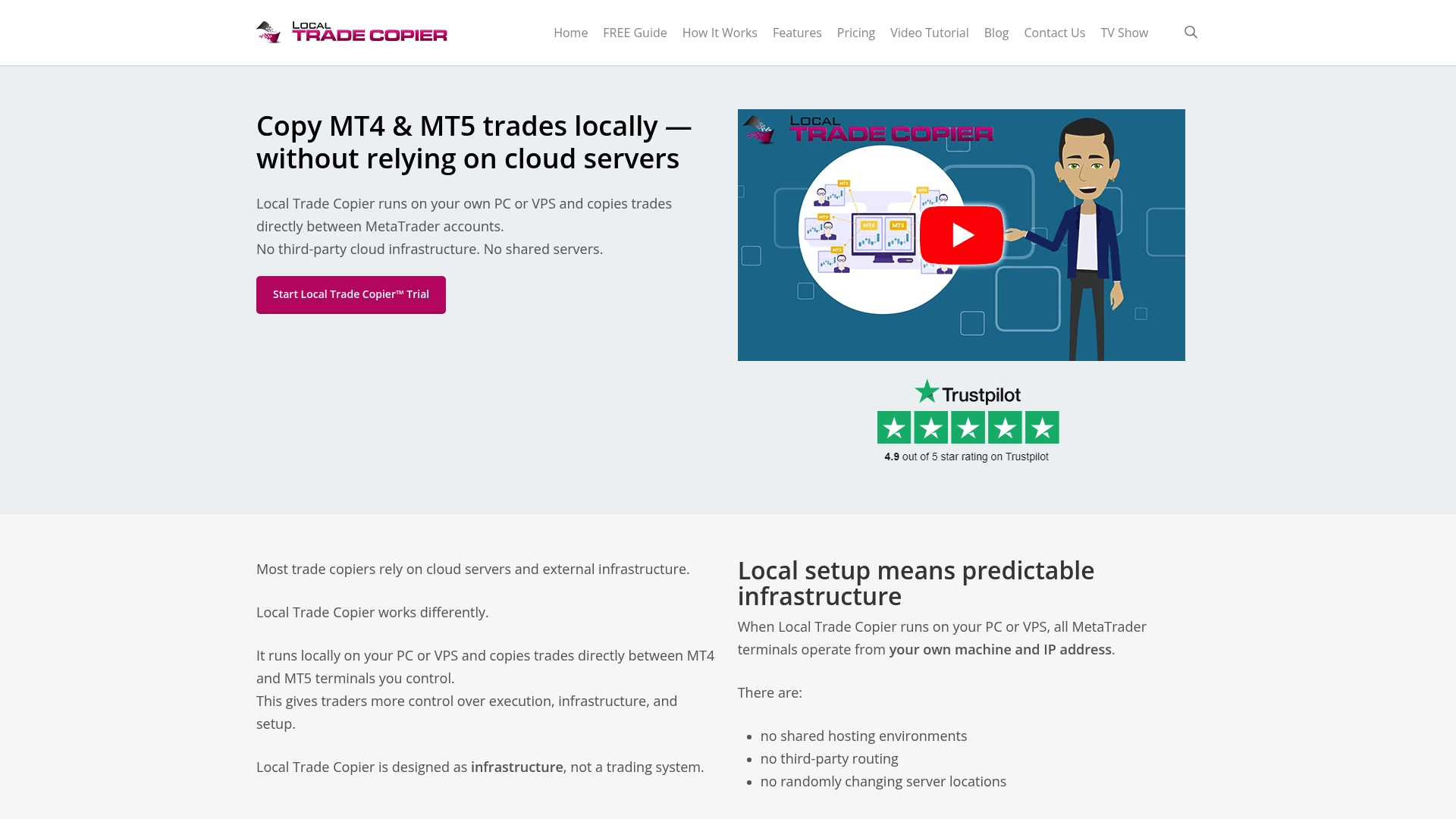
The software runs entirely on your Windows machine or VPS, with no cloud routing. That means one IP address, no external server latency, and no cloud detection risk for prop firm accounts. It also copies stop loss and take profit values from the master account to all client accounts automatically, using the built-in automated stop loss and take profit feature, so every copied trade carries the same risk parameters without manual re-entry. Mt4copier has been active since 2010, serves 3,000+ users, and includes a 7-day free trial. It is the most established locally-installed trade copier for MT4, MT5, and DXTrade.
FAQ
What is trading account organization?
Trading account organization is the practice of grouping and managing multiple trading accounts by strategy, risk profile, or client type, using defined rules and tools to maintain consistent execution and accurate performance tracking.
How many accounts should a retail forex trader manage?
Most retail traders operate effectively with two to four accounts, separating strategies by timeframe or risk level. Beyond five accounts, broker-native tools like FA accounts or trade copier software become necessary to avoid operational errors.
What is the best metric for comparing performance across accounts?
The R-Multiple is the most reliable metric for cross-account comparison. It normalizes trade results by dividing the outcome by the risk taken, making accounts of different sizes directly comparable.
How do I prevent session conflicts when using APIs across multiple accounts?
Create dedicated API users for each automation session rather than reusing your primary login. This isolates each session’s scope and prevents one connection from disconnecting another active terminal.
Do I need a trade copier if my broker already supports linked accounts?
Linked accounts handle login consolidation and reporting but do not automate trade replication or lot scaling. A trade copier is the right addition when you need identical trades executed across multiple accounts simultaneously with account-specific position sizing.
Recommended
- Benefits of Forex Account Management | Local Trade Copier
- Master forex trading terms for efficient account management
- What is a trade master account? Unlock efficient forex copying
- FX Account Cloning™ Setup: Trade Forex On Many Accounts
