
TL;DR: Trade synchronization automatically copies trades across multiple forex accounts with real-time, proportional execution to ensure consistency and risk control. It reduces manual errors, slippage, requotes, and partial fills by standardizing execution timing and adapting strategies to different broker specifications. Implementing low-latency, automated solutions built for precise control enhances multi-account trading safety and efficiency.
Managing multiple forex accounts without synchronization is like conducting an orchestra where each musician reads from a different score. The results are chaotic. Traders who manually copy trades across accounts face timing gaps measured in seconds, not milliseconds, inconsistent position sizes that distort risk exposure, and missed fills that turn a winning strategy into a losing execution. Understanding why synchronize trades matters is not optional for serious multi-account traders. It is the foundation that separates consistent, disciplined execution from the kind of operational noise that quietly drains your edge over time.
Key Takeaways
| Point | Details |
|---|---|
| Reduce execution noise | Synchronizing trades minimizes timing and routing differences that cause inconsistent fills across accounts. |
| Focus on consistency | The goal of synchronization is consistent behavior aligned to your risk plan, not perfect identical fills. |
| Adapt to broker differences | Synchronization normalizes trades to accommodate varied contract specs and order types among brokers. |
| Control risk effectively | Using synchronization enables proportional sizing and unified risk limits across multiple accounts. |
| Implement with monitoring | Combine low latency tools with regular reconciliation and error handling to maintain accurate synchronization. |
What trade synchronization means for retail forex traders
Trade synchronization is the process of automatically replicating trades from a master account to one or more follower accounts in real time, with position sizing adjusted to match each account’s capital. It removes the human in the middle. No manual re-entry. No copy-paste errors. No three-second delay while you switch terminal windows.
The technical side matters more than most traders realize. Professional-grade synchronization requires sub-100-millisecond execution delays to maintain proportional fills across accounts. Once you go beyond that threshold, you start seeing execution discrepancies: the master fills at one price, the follower fills somewhere else, and your risk calculations are already off before the trade even develops.
Here is what proper trade synchronization delivers in practice:
- Simultaneous execution across all accounts, not sequential clicks
- Proportional lot sizing scaled to each account’s equity, not a flat copy of the master
- Consistent strategy intent translated into each broker’s execution environment
- Reduced manual error by removing the human step entirely
Understanding MetaTrader multi-account synchronization also means recognizing that sync is not just about speed. It is about preserving the logic behind your trades. A strategy built on a 1% risk per trade on a $10,000 account should not blindly copy 0.1 lots to a $1,000 account and a $50,000 account without adjustment. Real synchronization adapts the intent, not just the action.
Common execution problems without synchronization and how syncing helps
With trade synchronization defined, it is worth examining the specific execution problems it addresses, because these problems are more common and more damaging than most traders acknowledge.
- Requotes occur when your broker cannot fill the order at the requested price and offers a revised price instead. Manually copying trades across accounts compounds this by adding human delay on top of natural requote exposure.
- Slippage is often blamed on market volatility, but slippage complaints mostly result from execution-path delays rather than actual market movement. If your order takes an extra two seconds to reach the broker because you typed it manually, that is avoidable slippage.
- Partial fills happen when the market cannot absorb the full order size at the requested price. Without synchronized timing, different accounts end up with different fill percentages, creating uneven exposure.
Synchronization addresses these problems by standardizing the execution path and compressing the timing window. When all orders fire from the same machine at the same moment, you remove the layered delays of manual entry. The impact of trade copier latency on fill quality is well documented and directly tied to how far the execution signal has to travel before reaching each broker.
Pro Tip: Break your execution path into segments: signal generation, order transmission, broker processing, and fill confirmation. Monitor each one separately. The delay is almost always in the transmission segment, and that is exactly where synchronization helps most. You can read more about why speed matters in trade copying and how milliseconds translate to real money.
The goal of synchronization: consistency over perfection
Understanding execution challenges helps clarify what synchronization realistically aims to achieve. And the honest answer is: not perfection.
No synchronization system will give you identical fills on every account every time. Spreads differ between brokers. Server processing times vary. Order routing paths are not identical. The goal is consistency that supports a predefined risk plan, where small differences stay within acceptable limits rather than blowing up your position sizing.
Here is how to think about it practically:
- Acceptable variance: A two-pip fill difference on a 50-pip trade. Your exposure is still aligned. Your risk is still controlled.
- Unacceptable variance: A 0.5-lot size discrepancy on a 0.1-lot master order because the synchronization scaled incorrectly. That is a risk problem.
- Order type choice: If you need consistent market presence, use market orders. If exact entry price matters more than presence, use limit orders. The sync system should support both based on your strategy logic.
- Predefined risk limits are your guardrail. Set them before you trade, not after you see a bad fill.
Reviewing trade copying best practices consistently shows that traders who focus on exposure matching rather than price matching get better long-term outcomes. The market will always introduce variance. Your job is to make sure that variance does not compound into systemic risk.
How synchronization adapts trades across different brokers and accounts
Achieving consistent risk behavior requires adapting trades effectively across diverse trading environments, and this is where synchronization earns its complexity.
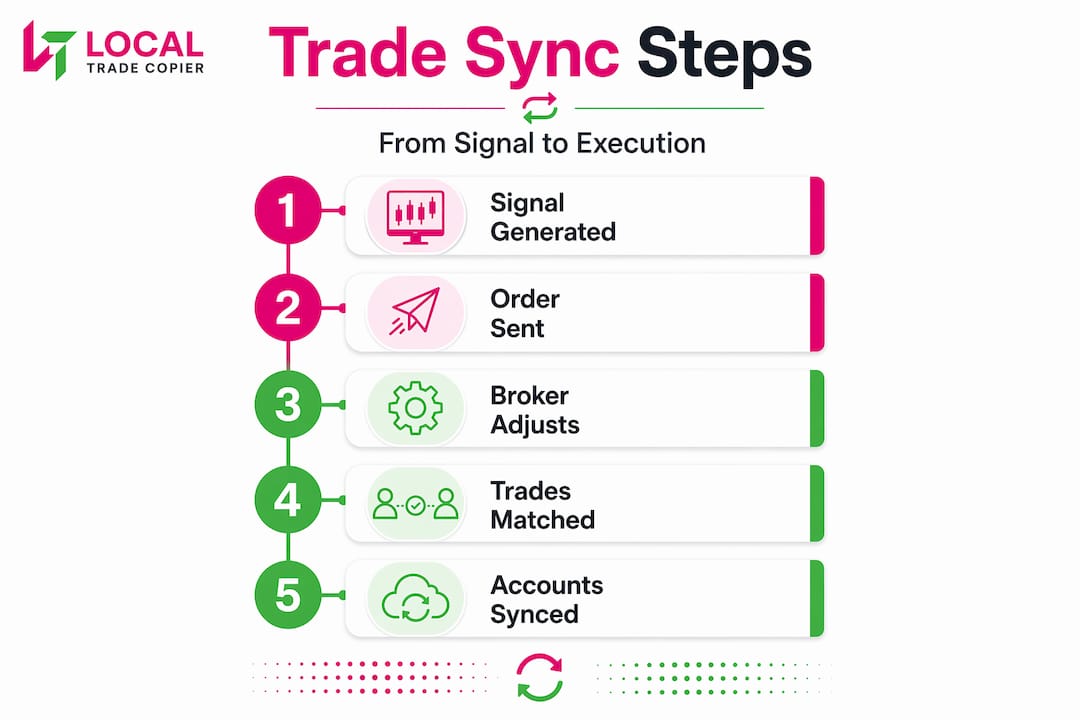
Infographic of trade synchronization steps in forex
No two brokers are identical. They differ in tick size, contract specifications, minimum order sizes, available order types, and whether they use netting or hedging position systems. A 0.01-lot trade on one broker may not even be possible on another. A stop-loss order type available on MT5 may not be available in the same form on MT4. Synchronization translates strategy intent into broker-specific execution, handling these differences automatically.
Here is a quick comparison of broker variables that synchronization must account for:
| Variable | Example broker A | Example broker B | Sync adjustment |
|---|---|---|---|
| Minimum lot size | 0.01 lots | 0.1 lots | Round up to minimum |
| Tick size | 0.00001 | 0.0001 | Normalize price precision |
| Position system | Hedging | Netting | Merge or split logic |
| Available order types | Market, limit, stop | Market, limit only | Fallback order type |
| Contract size | 100,000 units | 10,000 units (mini) | Lot size recalculation |
Without this normalization, the same trade behaves differently across accounts in ways that are not obvious until you look at your actual exposure. Handling position systems is especially critical. If one account uses netting (where opposing trades cancel each other) and another uses hedging (where they coexist), an unsynchronized copy can close a position you intended to keep open.
Pro Tip: Before adding a new account to your sync setup, document that broker’s contract specs and compare them to your master account. You can also review guidance on copying across mismatched CFDs to understand the specific adjustments needed when asset specifications differ. This five-minute check prevents hours of reconciliation later. The goal of automated trade copying efficiency depends entirely on these upstream inputs being correct.
Implementing effective synchronization for better risk and trade management
Now that you understand synchronization’s benefits and how it adapts across brokers, the focus shifts to practical implementation. Getting this right from the start saves you from the kind of silent account drift that only surfaces during a drawdown.
Core requirements for optimal trade synchronization:
- Choose a sync solution with sub-100ms local latency. Cloud-routed systems add server hops that compound delay.
- Implement proportional position sizing based on each follower account’s current equity, not a fixed ratio.
- Reconcile actual positions against intended positions at least once per session to catch drift early.
- Set per-account risk limits: maximum open exposure, daily loss caps, and maximum lot size per trade.
- Build in error handling that pauses copying and sends an alert when abnormal behavior occurs, such as an order stuck in pending or a fill that falls outside your variance threshold.
Step-by-step setup checklist:
- Map all master and follower account credentials and confirm connectivity to each broker.
- Define lot sizing rules per follower account (fixed lot, balance-proportional, or equity-proportional).
- Set order type preferences and fallback behavior for each broker’s supported types.
- Configure risk filters including maximum lot size, symbol restrictions, and daily loss limits.
- Run a test trade on a demo or small live account and verify execution time, fill price, and lot size across all followers.
- Enable logging and set up monitoring so you can review execution history per account.
Effective synchronization combines low latency, proportional allocation, error handling, and continuous reconciliation into a single managed process. You can also review resources on automated trading workflow optimization and efficient trade copying practices for deeper implementation detail tailored to MT4 and MT5 environments.
Why synchronization is the unsung hero in multi-account forex trading
Most traders think of synchronization as a convenience feature, a way to save time on manual entry. That framing misses the point almost entirely.

Trader updating forex trade log on laptop
Synchronization is a risk governance tool. When you manage multiple accounts, whether personal accounts, client accounts, or funded prop firm accounts, you are making a promise about consistency. Every account should reflect the same strategy logic, the same risk exposure, and the same trade decisions made at the same moment. Without synchronization, that promise falls apart the moment you have more than one terminal open.
Manual execution errors in multi-account trading are not random. They are systematic. Traders are faster on their primary account, slower on the others. They miss exits on follower accounts. They apply different lot sizes under pressure. These patterns accumulate into meaningful performance divergence between accounts, and most traders do not realize it is happening until the numbers are already off.
Synchronization also creates transparency. Every trade action is logged, timed, and traceable. If a follower account has a different outcome than the master, you can see exactly where the divergence happened: was it latency, a lot size rounding issue, or a broker rejection? Without that audit trail, you are guessing.
For prop firm traders specifically, multi-account synchronization insights carry an additional layer of importance. Cloud-based copy services route your trade data through external servers, which can expose your IP address across multiple accounts. Local synchronization keeps everything on one machine, one IP, one execution path. That is not just fast. It is structurally safer for funded account rules.
The traders who get multi-account management right are not the ones with the most complex setups. They are the ones who treat synchronization as a non-negotiable foundation and build everything else on top of it.
Streamline your multi-account trading with local trade copier solutions
Having explored synchronization’s why and how, the next step is finding a tool that actually delivers on these principles without requiring a systems engineer to configure it.

Local Trade Copier has been doing exactly this since 2010, with 3,000+ active users and 491 Trustpilot reviews backing it up. It runs as an Expert Advisor directly on your Windows PC or VPS, copying trades across MT4, MT5, and DXTrade accounts in 1 second or faster under normal market conditions, with no cloud routing and no external server risk. The installation process is straightforward, and the platform includes eight money management modes so you can match each follower account’s exposure precisely. For prop firm traders, local execution means one IP address and zero cloud routing exposure. Review the security setup recommendations and stop-loss and take-profit handling options to configure protection from day one. A 7-day free trial is available.
Frequently asked questions
What is trade synchronization in forex trading?
Trade synchronization automates copying trades simultaneously across multiple accounts to ensure consistent execution timing and proportional risk exposure. Trading synchronization technology enables real-time execution across multiple accounts while maintaining proportional fills and risk management settings.
Why is low latency important for trade synchronization?
Low latency minimizes the delay between the master account firing a trade and the follower accounts receiving and executing it, directly reducing fill discrepancies and slippage. Professional synchronization requires sub-100-millisecond delays to maintain consistent fills across accounts during fast market moves.
Can trade synchronization eliminate slippage completely?
No. Synchronization reduces execution-path delays that cause avoidable slippage, but small price differences from live market movement and broker spreads are a normal part of trading. The goal of synchronization is behavioral consistency within a predefined risk plan, not identical fills on every order.
How does synchronization handle different broker specifications?
Synchronization normalizes trade intent by adjusting for each broker’s contract specs, minimum order sizes, tick sizes, and position systems so the same strategy applies correctly across all accounts. Correct synchronization translates strategy intent into broker-specific execution, reducing discrepancies that would otherwise distort your risk exposure.
What practical steps should traders take when implementing synchronization?
Choose a low-latency local sync solution, define proportional position sizing rules per account, set clear risk limits, run a test trade before going live, and monitor execution logs regularly. Effective synchronization depends on combining latency control, proportional allocation, error handling, and continuous reconciliation into your ongoing workflow.
Recommended
- MetaTrader synchronization explained: Multi-account copying
- Automate forex trade synchronization: complete how-to tutorial
- How to synchronize MT4 accounts: guide for forex managers
- How to Copy Trades Between Two or More MT5 Trading Accounts
