

TL;DR:
- Managing multiple forex accounts without a structured risk plan increases exposure and potential losses during market shocks. Implementing fundamental risk tools like stop-loss orders, position size calculators, and correlation tracking is essential for protecting capital across all accounts. Automated trade copying software streamlines risk enforcement, ensuring disciplined sizing and exit strategies, which are vital for long-term trading survival.
Running multiple forex accounts feels like progress until one bad week wipes out months of gains across all of them simultaneously. It happens more often than traders admit: a surprise central bank announcement, a flash crash, or an overlooked currency correlation triggers the same painful loss on every account at once. Managing multiple accounts without a structured risk mitigation plan does not multiply your opportunity; it multiplies your exposure. This article walks you through the precise tools, formulas, and frameworks that keep your capital alive when markets turn ugly.
Key Takeaways
| Point | Details |
|---|---|
| Risk small per trade | Limiting risk to 1-2% per position lets your account survive long losing streaks. |
| Aggregate risk matters most | Always measure risk across your whole portfolio, not just individual trades. |
| Watch leverage and margin | Keep leverage low and ensure margin use stays within safe limits to prevent margin calls. |
| Automate risk controls | Use stop-loss orders and trade copying software to enforce disciplined risk mitigation. |
| Correlations are deceptive | Highly correlated forex pairs can multiply risk despite apparent diversification. |
Essentials for effective forex risk mitigation
Before you layer on advanced tactics, you need the fundamentals locked in. Think of this as your trading infrastructure. Without it, every clever strategy becomes a house built on sand.
The single most important habit is placing a stop-loss on every trade, without exception. Stop-loss orders automate your exits and put a hard ceiling on losses. Without them, a forex position has theoretically unlimited downside. Traders who skip stop-losses because they “watch their screens closely” eventually discover that markets move faster than human reaction time during high-impact news events.
Understanding your broker’s leverage rules is equally critical. US NFA regulations cap retail forex at 50:1 on major currency pairs. That sounds generous, but it means a 2% adverse move wipes out your entire margin on a fully leveraged position. European traders get extra protection: EU brokers often provide negative balance protection, which means you cannot lose more than your deposit even if the market gaps sharply against you. Knowing these rules shapes how aggressively you can trade within each account.
The essential toolkit for multi-account risk mitigation includes:
- Position size calculators to compute exact lot sizes before every entry
- Margin level monitors to track available cushion across all open positions
- Trade journals or spreadsheets that log account balances, open risk, and correlation exposure
- Automation software to enforce sizing rules consistently without manual re-entry errors
You can explore forex risk management strategies in detail to build a complete framework, and reviewing account management benefits helps clarify what structure actually looks like across multiple accounts.
| Risk tool | Primary function | Best for |
|---|---|---|
| Stop-loss orders | Hard exit automation | Every trade, every account |
| Position size calculator | Lot size computation | Pre-trade preparation |
| Margin level monitor | Account health tracking | Active monitoring |
| Trade copier software | Multi-account synchronization | Scaling across accounts |
| Correlation tracker | Exposure analysis | Portfolio-level oversight |
Pro Tip: Keep effective leverage at 10:1 or lower even when your broker offers much more. The theoretical maximum leverage available and the leverage you should actually use are two very different numbers.
The mindset piece is often skipped in technical guides, but it matters enormously. Survival comes before rapid growth. A 50% drawdown requires a 100% gain just to break even. Protecting capital is not a conservative option; it is the mathematically necessary foundation for compounding wealth over time.
Position sizing: Your number one defense
Precise position sizing is the single most powerful lever you control as a trader. It determines how much any individual trade can damage your account, regardless of how the market behaves.
The core formula every multi-account trader should memorize: Lot Size = (Account Balance × Risk %) / (Stop Loss Pips × Pip Value). This formula converts your abstract “risk tolerance” into a concrete number of lots. Let’s walk through a real example.

Say your account balance is $10,000 and you want to risk 1.5% per trade. Your stop-loss is 30 pips, and the pip value for a standard lot on EUR/USD is $10. Plugging in: ($10,000 × 0.015) / (30 × $10) = $150 / $300 = 0.5 lots. You trade half a standard lot. That calculation removes guesswork entirely.
Risking 1-2% per trade means a trader survives 25 to 50 consecutive losses before hitting a 50% drawdown. If you jump to 10% risk per trade, that same drawdown arrives in just 5 consecutive losers. The math is brutal and unforgiving. String 10% risk trades together in a bad streak and your account is gone before you realize what happened.
To apply this across multiple accounts, follow these steps:
- Calculate each account’s risk amount by multiplying its current balance by your chosen risk percentage.
- Determine the stop-loss distance in pips for the specific trade setup you are entering.
- Find the pip value for the currency pair in each account’s base currency.
- Run the formula for each account separately, since balances differ.
- Use copy position size settings to replicate the correct lot size automatically to each account without manual recalculation.
For volatile market conditions, static stops create inconsistent risk. Using Average True Range (ATR) to set stop-loss distance lets you widen stops during high volatility periods while proportionally shrinking your position size to maintain the same fixed percentage risk. During a low-volatility period on EUR/USD, the ATR might be 40 pips. During a high-impact news week, it could jump to 120 pips. Your stop-loss follows the ATR, but your dollar risk stays constant because the lot size shrinks accordingly.
| Account balance | Risk % | Risk amount | Stop (pips) | Pip value | Lot size |
|---|---|---|---|---|---|
| $5,000 | 1.5% | $75 | 30 | $10 | 0.25 |
| $10,000 | 1.5% | $150 | 30 | $10 | 0.50 |
| $25,000 | 1.5% | $375 | 30 | $10 | 1.25 |
| $10,000 | 1.5% | $150 | 60 | $10 | 0.25 |
Pro Tip: Recalculate lot sizes after every significant change in account balance. A winning streak that grows your account from $10,000 to $14,000 means your 1.5% risk amount increases too. Keep risk parameters updated so your sizing always reflects current equity, not the balance from three weeks ago.
You can also allocate account size differently across accounts based on their purpose. A funded prop account might warrant more conservative sizing than a personal account you are testing a strategy on. And for strategies that require multiple entries, learning to split trades into positions helps you scale in and out while keeping aggregate risk within your defined limit.
Managing aggregate risk across multiple accounts and trades
Here is a trap many multi-account traders fall into: they apply smart per-trade risk rules on each individual account but never look at the total picture. When you run three accounts and each has a 2% open risk on EUR/USD, your actual exposure to that single pair is 6% of your combined capital. That is not diversification. That is concentration with extra steps.
Treat aggregate risk across all accounts as one combined portfolio and keep total open risk below 5 to 6% of your total equity across all running positions. This ceiling forces you to triage. You cannot keep adding positions indefinitely because every new trade draws down on that shared budget. It also protects you from the scenario where one event tanks every open trade at the same time.
Currency pair correlations create the sneakiest risk multiplication problem in multi-account trading. EUR/USD and GBP/USD carry correlations above 0.8 most of the time, meaning they move in the same direction roughly 80% of the time. If you are long EUR/USD on account one and long GBP/USD on account two, you are not diversified. You are holding a synthetic double-sized position on USD weakness.
The diversification illusion is real. Spreading trades across many pairs feels like risk reduction. But if those pairs share a common driver (USD direction, risk sentiment), they collapse together. True diversification means uncorrelated exposure, not just different ticker names.
Practical ways to cap single-theme exposure:
- Map each trade to its primary currency driver before entry. Is this a USD trade, a EUR trade, or a commodity-currency trade?
- Limit total net exposure to any single currency or theme to 2 to 3% of combined capital, not per account but across all accounts together.
- Use a simple correlation matrix weekly. Free correlation tools show current pair relationships, which shift over time.
- Review open positions before adding new ones. If you already have USD exposure across two accounts, adding a third USD-directional trade breaks your limit even if each individual trade looks small.
You can configure different risk per symbol when using trade copying tools, which lets you automatically weight position sizes based on each pair’s volatility and correlation profile. If you manage client accounts, copying trades to multiple clients while maintaining distinct risk rules per client requires exactly this kind of systematic thinking. A deeper look at multi-account management principles helps you formalize your process before scaling.
| Currency theme | Max exposure (% of total capital) | Correlated pairs to watch |
|---|---|---|
| USD direction | 3% | EUR/USD, GBP/USD, AUD/USD, NZD/USD |
| EUR sentiment | 2% | EUR/USD, EUR/GBP, EUR/JPY |
| Risk-on/off | 2% | AUD/JPY, NZD/JPY, CHF pairs |
| Commodity currency | 2% | AUD/USD, CAD/USD, NZD/USD |
Mastering leverage and stop-losses for disciplined trading
With sizing and aggregate risk under control, the next layer of protection comes from disciplined leverage use and systematic stop-loss placement. These two elements turn a good risk plan into one that actually executes under pressure.
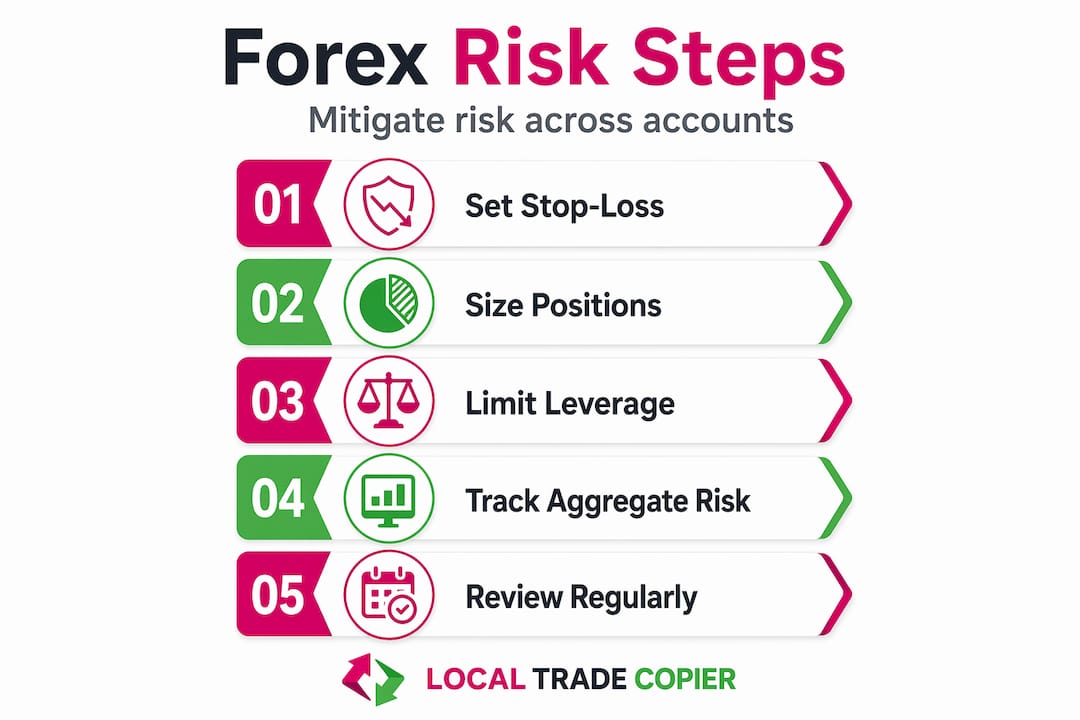
Start with leverage. The regulatory caps are a ceiling, not a target. US traders can use up to 50:1 on major pairs, but most professional traders operate at effective leverage of 5:1 to 15:1. That range gives you meaningful position sizes while keeping margin cushion large enough to survive intraday volatility without forced liquidation. When margin level drops below 100%, some brokers start closing your positions automatically. That is the worst possible exit timing: when positions are at their most painful, not their most strategic.
Here is a step-by-step process for disciplined stop-loss management:
- Set your stop-loss before you enter the trade, not after. Deciding where you are wrong must happen before the emotional pull of a live position.
- Never move a stop-loss further from entry to avoid being stopped out. That is the most common discipline failure in retail trading.
- Use broker or platform automation to place stops immediately at order entry so that a platform crash or internet disconnect does not leave you exposed.
- Review stop-loss levels after major news events that change the fundamental picture. The original invalidation point may no longer make sense.
- Automate stop-loss and take-profit placement across all copied accounts so the same discipline applies everywhere without manual intervention.
No stop-loss means unlimited downside. A trade without a stop-loss is not a trade; it is an open-ended liability. The market does not care about your opinion on where it should go.
For EU-based traders, negative balance protection adds a regulatory safety net: your account cannot go below zero even during a gap or flash crash. That protection is valuable, but it should never be your primary risk control. Relying on broker protections as your main defense means you have already failed your own risk management process.
Pro Tip: Monitor margin level across all open accounts at least once per trading session. A margin level below 200% is a yellow flag. Below 120% is a red flag that demands immediate position review or reduction.
Why risk mitigation is more about survival than system perfection
After years of watching traders build and blow accounts, the pattern is clear: the traders who last are not the ones with the best entry signals. They are the ones who treated every single week as a week where the market might try to wipe them out.
The obsession with finding the perfect strategy is itself a risk factor. Traders spend enormous energy optimizing for maximum returns and almost no energy stress-testing for catastrophic failure. But markets change regimes. A strategy that worked flawlessly during a trending 2023 environment can produce five consecutive losing months when markets turn choppy in 2024. The traders who survive that transition do so because their position sizing and aggregate risk rules kept losses small enough to absorb.
Risk mitigation is not a static checklist. It is an iterative practice that needs regular updating as your portfolio, market conditions, and broker environment change. The ATR-based stops that served you in one volatility regime will underfit or overfit in another. The correlation assumptions you built your diversification around shift after major macro events. Reviewing and adjusting your framework monthly is not optional; it is the practice.
What actually separates survivors from blowups is less about technical tools and more about emotional discipline. Managing three funded accounts while watching a drawdown is psychologically harder than any technical problem. The temptation to widen a stop “just once,” to add a trade that exceeds your correlation limit because the setup looks perfect, or to double down after a loss defines most blown accounts. More risk management strategies can help structure your thinking, but the discipline to follow the plan is yours alone to develop.
Tools matter. Rules matter more. And the habit of following your rules when it is most uncomfortable is what trading longevity actually looks like.
Effortlessly integrate risk mitigation tools with professional trade copying
Managing risk across multiple accounts manually is time-consuming and error-prone. Every time you recalculate lot sizes, re-enter stop-losses, and monitor margin levels across separate terminals, you introduce human error into a process that should be systematic.
Local Trade Copier automates the enforcement of your risk rules across MT4, MT5, and DXTrade accounts simultaneously. With 18 lot sizing and risk management options, automatic lot scaling per account balance, and sub-0.5-second local execution, it removes the gap between your risk plan and your actual trades. You can automate stop-loss and take-profit placement on copied trades so every account follows the same disciplined rules without manual re-entry. All execution runs locally on your Windows machine or VPS, keeping your data on one secure IP address with no cloud routing risk. Getting started is straightforward: the installation process is well-documented, and a 7-day free trial lets you test your risk framework in a real environment before committing.
Frequently asked questions
What is the safest amount to risk per forex trade?
Most experts recommend risking 1 to 2% of your account balance per trade; this allows you to survive dozens of consecutive losses without catastrophic damage to your capital.
How does leverage impact my overall trading risk?
High leverage magnifies losses as much as gains, so even though US regulations allow up to 50:1 on major pairs, using lower effective leverage gives you more margin cushion and fewer forced liquidations.
How do I handle risk when trading multiple correlated currency pairs?
Correlated pairs create synthetic positions that multiply your actual exposure; limit your total net exposure to any single currency or directional theme to 2 to 3% of your combined capital across all accounts.
Are stop-loss orders necessary for every trade?
Yes, absolutely. Without a stop-loss, your maximum potential loss on any trade is theoretically unlimited, and no level of market monitoring reliably replaces automated exit protection.
Can automation tools help enforce risk controls?
Yes. Trade copiers and portfolio management tools allow you to apply consistent position sizing, stop-loss placement, and aggregate risk rules across every account you manage without relying on manual execution each time.
Recommended
- Benefits of Forex Account Management | Local Trade Copier
- What is forex account management: optimize multi-account trading
- Copy Forex trades from one MT4 master into 3x MT4 clients
- Copy Forex Trades with Different Risk Settings for Each Pair
