

TL;DR:
- Many traders mistakenly view trading educators as providers of winning strategies, but they actually teach risk, process, and execution discipline. Their core role is to build frameworks that adapt to changing markets, especially for multi-account scaling, emphasizing risk management, order mechanics, and psychological control rather than specific tactics. Genuine educators focus on process over quick profits, enabling traders to manage multiple accounts safely and efficiently through disciplined frameworks and automation.
Most traders assume a trading educator is simply someone who hands out winning strategies. Pay a fee, get a setup, trade the signal, repeat. That mental model is dangerously incomplete, especially if you’re managing multiple forex accounts or copying trades across several terminals. Genuine educators reshape how you think about risk, process, and execution quality. This guide breaks down what trading educators actually do, how their approach differs from retail courses, and why that distinction matters enormously when you’re scaling across multiple accounts.
Key Takeaways
| Point | Details |
|---|---|
| Beyond strategies | Trading educators teach essential skills like risk awareness and process discipline, not just tactics. |
| Retail vs. professional focus | Retail courses prioritize strategies, while professional education centers on adaptability and frameworks. |
| Multi-account efficiency | Educators enable safer, scalable trade copying by imparting process and risk management know-how. |
| Foundational pillars | Effective trading education builds on Method, Money/risk, and Mind for lasting performance. |
What is a trading educator?
With misconceptions out of the way, let’s clarify what trading educators actually do and why their approach matters.
A trading educator is a practitioner or specialist who teaches traders how markets work, how risk accumulates, and how to execute with discipline and repeatability. The role goes well beyond showing someone a chart pattern or a moving average crossover. Real educators build frameworks, not just playbooks.
Their core responsibilities typically include:
- Teaching market mechanics, including how spreads, margin, and leverage affect every position
- Building risk awareness so traders understand drawdown before they experience catastrophic losses
- Developing execution quality, covering order types, slippage, and timing
- Creating decision frameworks that hold up during volatile or unfamiliar market conditions
- Coaching psychological discipline, including how to react when a trade goes against you
Notice that “here’s a profitable strategy” isn’t even on that list. That’s deliberate. The best educators know that a strategy without process is just a guess with extra steps.
Trading education in retail forex contexts commonly emphasizes execution mechanics — margin, leverage, spreads, and how orders behave — because leverage and order execution quality directly affect risk. A trader who understands these mechanics makes fundamentally different decisions than one who doesn’t.
This framing matters for multi-account operators in particular. If you’re copying trades across terminals with different lot sizes, balance levels, and risk profiles, the execution mechanics your educator built into your thinking will directly affect how safely and efficiently you scale.
The problem with most retail “courses” is that they compress this process. They front-load strategy content because it’s marketable. “Learn my 5-pip scalping system” sells better than “learn margin mechanics over 12 weeks.” But the traders who stick around long-term, who manage accounts successfully for years, are almost always the ones who got the foundational process right first.
Retail vs. professional trading education: Key distinctions
Now that we’ve defined trading educators, it’s important to understand how their teachings differ depending on whether you’re getting professional or retail training.
The gap between professional and retail trading education isn’t just about price or prestige. It’s about what gets prioritized. Professional trading education builds process, risk discipline, and decision-making frameworks, while retail courses more often focus on tactics and strategies that may not survive changing market conditions.
Here’s a clear side-by-side comparison:
| Dimension | Professional education | Retail course |
|---|---|---|
| Primary focus | Risk process and decision frameworks | Specific strategies and entry signals |
| Adaptability | Teaches you to adjust as markets change | Often tied to current market conditions |
| Risk management | Central to every lesson | Usually a module or afterthought |
| Time horizon | Long-term sustainable performance | Often targets quick results |
| Outcome measurement | Drawdown control, consistency | Win rate, profit per trade |
| Psychology coverage | Integral to the curriculum | Minimal or optional |
| Multi-account relevance | High. Process scales | Low. Tactics rarely scale |
Skills emphasized in professional education:
- Capital preservation across varying market conditions
- Position sizing relative to account balance and overall exposure
- Building and auditing a personal trading process
- Recognizing when not to trade, not just when to enter
- Reviewing and improving execution quality systematically
Skills emphasized in retail courses:
- Specific chart patterns or indicator setups
- Entry and exit signals for a particular market or session
- Platform mechanics and order placement basics
- Backtesting a fixed strategy on historical data
Neither list is useless. But if you’re managing multi-account teaching resources or running client capital, the professional education framework is what protects you when the market shifts. Tactics break down. Process adapts.
One of the most overlooked aspects of professional education is how it handles forex risk strategies across different account types and sizes. A professional educator teaches you to think in terms of percentage risk per trade, not fixed lot sizes. That mindset is what makes it possible to scale from one account to five without blowing up a client account because you forgot to adjust sizing.
How trading educators optimize multi-account trading
With those distinctions in mind, let’s examine how educators directly help traders and managers who are juggling several forex accounts.
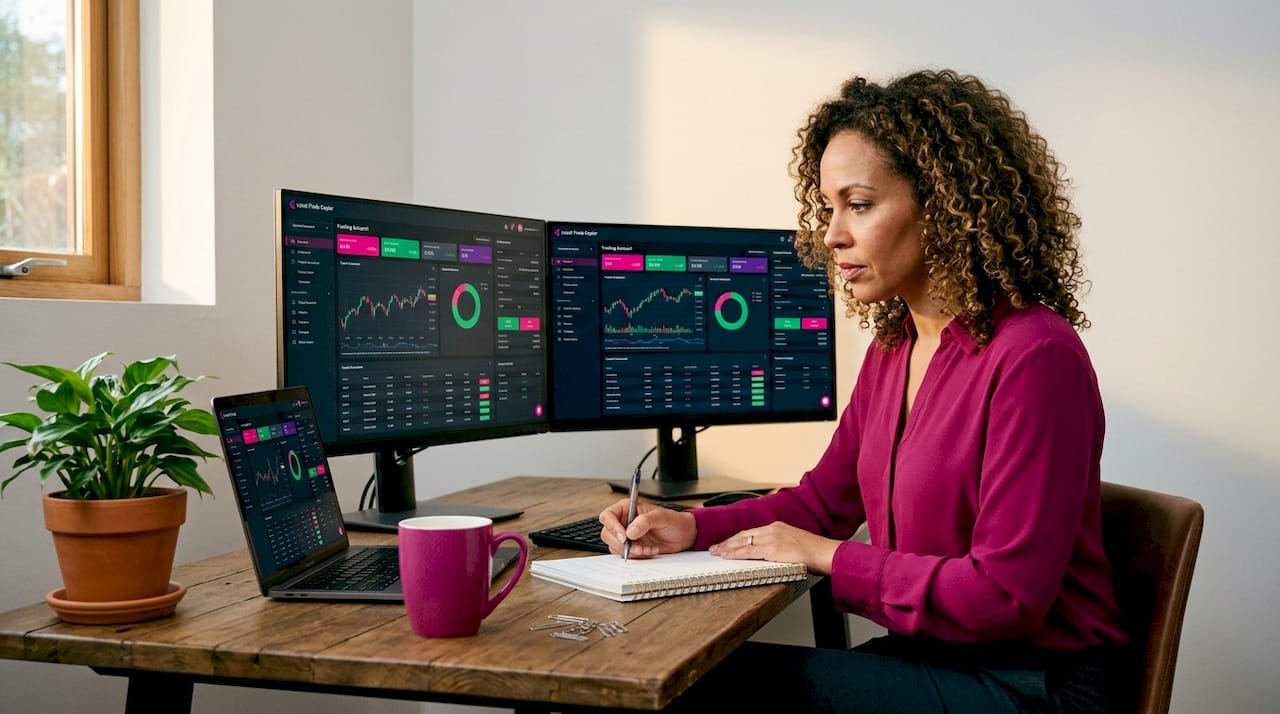
Managing multiple accounts without a solid process framework is like driving five cars at once without knowing the braking distance of any of them. Trading educators solve this by giving you a repeatable, scalable process that doesn’t fall apart when complexity increases.
Here’s how educator-led guidance directly impacts multi-account performance:
| Area of impact | Without educator input | With educator guidance |
|---|---|---|
| Lot sizing across accounts | Manual and inconsistent | Systematic, scaled to balance |
| Risk per trade | Fixed and arbitrary | Percentage-based and deliberate |
| Execution consistency | Varies trade to trade | Standardized across all accounts |
| Drawdown management | Reactive | Pre-defined rules per account |
| Copying efficiency | Prone to error and delay | Process-driven and automated |
| Performance review | Sporadic and emotional | Scheduled and data-based |
A quality trading educator will typically recommend the following steps for setting up and running a multi-account operation:
- Define risk parameters per account before placing a single trade. Know the maximum drawdown tolerance, daily loss limit, and position sizing formula for each account individually.
- Build a master trade checklist that applies consistently regardless of how many accounts are live. This eliminates discretionary shortcuts that sneak in when you’re busy.
- Automate where possible using a structured copy trades workflow to reduce manual errors across terminals.
- Separate your master account logic from client account execution. Your master account should reflect your cleanest decision-making, while copying from a master account to clients should be governed by pre-set rules, not real-time judgment calls.
- Review performance by account, not just in aggregate. Problems in individual accounts get masked when you only look at the overall portfolio.
- Revisit and adjust your process quarterly. Markets evolve. An educator-trained mindset means you update the process, not just the strategy.
Pro Tip: Traders MBA’s framework emphasizes three foundational pillars for trading performance: Method (your strategy and edge), Money/risk management (how you size and protect positions), and Mind (discipline and emotional control). When optimizing for multiple accounts, map each account against all three pillars separately, not just the Method. What’s your risk tolerance for this specific account? What’s the drawdown limit? That’s where most traders make mistakes.
Core skills and frameworks trading educators teach
Building on practical applications, let’s break down the core skill set and frameworks trading educators actually teach.
The real curriculum of a serious trading educator isn’t a list of strategies. It’s a set of skills that become more valuable the more complex your trading operation becomes. This is especially true for traders running multiple MetaTrader accounts or copying to client accounts with different balance levels.
The foundational skills include:
- Market mechanics: Understanding how spreads widen during news events, how margin requirements change with leverage, and how execution quality affects risk in ways that no strategy can compensate for
- Order behavior: Knowing the difference between market orders, limit orders, and stop orders in practice, not just in theory, including how slippage manifests in live markets
- Leverage fluency: Recognizing how leverage amplifies both gains and losses and calibrating your exposure accordingly rather than defaulting to maximum leverage
- Risk quantification: Calculating your actual risk per trade in dollar terms across multiple accounts simultaneously, not just in pips
- Process auditing: Reviewing trades systematically to identify execution errors, not just outcome errors. Did you follow your rules? That matters more than whether the trade won.
The three-pillar framework that serious educators return to repeatedly is Method, Money/risk management, and Mind. Let’s be specific about what each means in a multi-account context.
Method is your trading strategy, the setups you take, the timeframes you use, the markets you focus on. For multi-account traders, the Method must be clearly defined enough that it can be applied identically across all accounts through a trade copying system without requiring real-time modification.
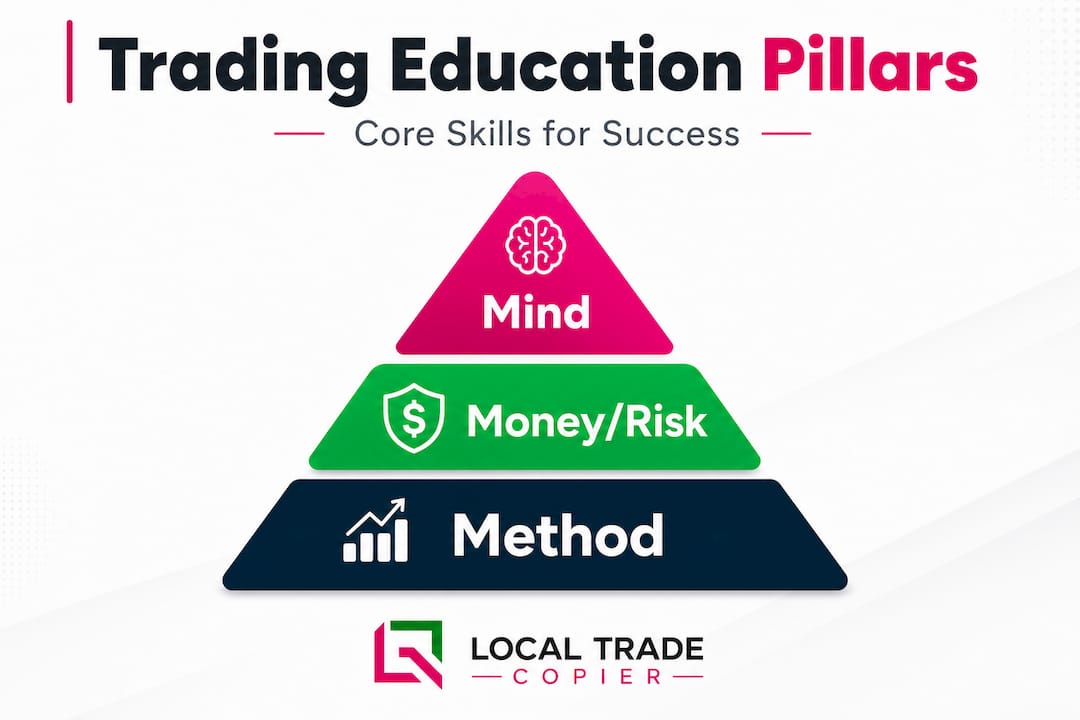
Money/risk management is where most retail traders underinvest their attention. This pillar covers prop trader risk mitigation, position sizing relative to account balance, drawdown limits, and how to think about correlated positions when you’re running multiple accounts simultaneously. A loss in one account that mirrors a loss in three others is not four separate small losses. It’s a systemic risk event.
Mind is the discipline to follow the process even when your gut says otherwise. This is harder to teach but the most decisive factor in long-term performance. An educator who doesn’t address psychology is giving you a car without a steering wheel.
Pro Tip: Execution quality is one of the fastest ways to reduce avoidable losses without changing your strategy at all. Account management performance consistently improves when traders shift their review focus from “did this trade win?” to “did I execute this trade correctly?” Those are very different questions, and the second one is the one that compounds over time.
What most people miss about trading educators
After mapping out the frameworks and practical impact, it’s time to get candid about what the industry, and most traders, often overlook.
Here’s the uncomfortable truth: most traders who seek out a trading educator are looking for someone to make trading easier. They want better entries, cleaner signals, a smarter system. And some educators have built entire businesses selling exactly that fantasy.
But the traders who genuinely transform their performance — who go from inconsistently profitable to consistently managing multiple accounts with controlled drawdown — almost never credit a strategy they learned. They credit a process shift. They stopped thinking about what to trade and started thinking about how they trade.
This distinction is lost in the way education is marketed. Webinars advertise setups. Courses promise monthly returns. Social media educators post winning trades. None of that reflects what durable trading skill actually looks like from the inside.
The real value of a genuine trading educator shows up in moments of pressure. When the market gaps against you across three accounts at once. When you’ve hit your daily loss limit and the market is screaming that this next trade is different. When a client’s account is close to its maximum drawdown and you have to make a cold decision. In those moments, tactics are useless. Process is everything.
We’ve seen this play out specifically in trade copying contexts. Traders who approach educator resources for multi-account trading with a process mindset adapt their copying parameters thoughtfully. They size lots per account balance. They set per-account drawdown rules. They test changes before deploying live. Traders who skip the educator-built foundation tend to copy their master account’s risk profile directly onto client accounts with different balances, different tolerances, and often catastrophic results.
The industry doesn’t talk about this enough because it doesn’t sell. “Spend six months building your risk process” is not a compelling marketing hook. But it is, without question, the most accurate description of what separates traders who last from those who don’t.
Unlock trade copying solutions for educators and managers
With a deeper understanding of trading educators, here’s how you can use proven trade copying solutions to apply these concepts efficiently.
Understanding the framework is the first step. Executing it across multiple accounts without manual errors is where the right tools make all the difference.
Local Trade Copier has supported over 3,000 traders since 2010, providing locally installed trade copying across MT4, MT5, and DXTrade with sub-0.5-second execution. For traders and educators who’ve built a solid process framework, the software automates the execution layer. You can configure stop loss and take profit copying per client account, scale lots automatically to each account’s balance, and run everything on your own Windows machine or VPS with no cloud routing. The installation guide walks you through setup from start to live copying in a structured way, and you can explore the full feature set directly on the MT4 and MT5 trade copier page. Start with a 7-day free trial and see how quickly the manual overhead disappears.
Frequently asked questions
What does a trading educator actually do?
A trading educator teaches both market mechanics and risk management, guiding traders toward disciplined, sustainable approaches. According to forex education resources, retail education specifically emphasizes execution mechanics like margin, leverage, and order behavior because these directly determine real-world risk.
How is professional trading education different from retail trading courses?
Professional education focuses on building risk discipline and adaptable process frameworks, while retail courses tend to emphasize specific strategies and tools. Professional training ecosystems prioritize decision-making frameworks that hold up as markets change, not tactics that work only in one regime.
How can trading educators help with multi-account trade copying?
Trading educators provide the process, framework, and risk control methodology that make multi-account trade copying safe and repeatable. Without that foundation, professional trading frameworks warn that copying trades mechanically across accounts with mismatched risk profiles leads to systemic drawdown events.
What are the pillars of modern trading education?
Effective trading education consists of three pillars: Method, Money/risk management, and Mind, with each supporting consistent performance across varying market conditions. The three-pillar roadmap is specifically designed to scale with a trader’s operation, making it highly relevant for anyone managing multiple accounts.
Recommended
- How trade copiers empower educators to teach forex
- Top forex trading educator resources for multi-account strategies
- Event Trading in Forex: Capitalizing on News Releases | Trade Copier for MT4 & MT5
- How forex tutorials build real trading skills
