

TL;DR:
- Foundational tutorials teach core skills essential for long-term success, unlike strategy-specific courses.
- Effective tutorials include live demonstrations, platform practice, and risk management, not just theory.
- Combining tutorial learning with demo practice and critical thinking leads to better, sustainable trading results.
Thousands of retail forex traders pour money into expensive “strategy courses” every year, expecting a shortcut to consistent profits. It rarely works out that way. The uncomfortable reality is that strategy-specific courses often become outdated as markets evolve, and some have drawn criticism from retail traders for overpromising outcomes that do not materialize in live trading. What actually builds lasting competence is something far less glamorous: well-structured tutorials focused on foundational skills, platform fluency, and disciplined risk management. This article shows you exactly how to use tutorials strategically to improve your trading outcomes, whether you are a retail trader managing personal accounts or an account manager running client portfolios on automated platforms.
Key Takeaways
| Point | Details |
|---|---|
| Foundation first | Effective forex tutorials prioritize core concepts like analysis and risk management over quick profits. |
| Practice matters | Using demo accounts with tutorials helps traders develop real skills before risking money. |
| Avoid the hype | Strategy-selling courses often lack evidence and can be risky; focus on broker-provided or expert-led tutorials. |
| Risk controls are vital | Top tutorials integrate hands-on lessons about position sizing, stop-losses, and volatility awareness. |
| Continuous learning | Revisit interactive tutorials regularly to adapt to new market tools and conditions. |
Why tutorials matter in modern forex education
Most traders who struggle in forex share one common mistake. They skip the foundation. They jump straight into scalping strategies or automated systems without first understanding how currency markets actually move, how to read a price chart correctly, or how to protect their capital when a trade goes wrong.
Effective tutorials exist to prevent exactly this kind of costly shortcut. Structured forex academies and tutorials provide essential knowledge across forex basics, technical and fundamental analysis, risk management, and platform usage. That is not a narrow set of topics. It is the complete toolkit every serious trader needs before placing a single live trade.
Here is what a genuinely useful tutorial curriculum covers:
- Forex market structure: How currency pairs are quoted, what drives exchange rates, and how liquidity affects spreads.
- Technical analysis: Reading candlestick charts, applying indicators, and identifying price patterns. You can explore analysis methods in forex trading to understand the difference between technical and fundamental approaches.
- Fundamental analysis: Economic data releases, central bank policy decisions, and geopolitical events. If you want to go deeper, fundamental analysis in forex is worth studying separately.
- Platform operation: Executing orders, setting stop losses, managing open positions, and using automation tools like Expert Advisors.
- Risk management: Position sizing, drawdown limits, and portfolio-level exposure.
Now, compare that to a typical strategy-selling course. Those usually focus on one pattern or one system, presented as if it works in all market conditions. They skip the foundational context that would help you understand why the strategy might work, and more importantly, when it stops working.
Structured forex education does not aim to hand you a ready-made strategy. The goal is to help you read the market, evaluate approaches critically, and know when to step back.
This is the core reason tutorials matter. They build your ability to evaluate any strategy critically, rather than follow instructions blindly. For account managers in particular, that critical thinking skill is non-negotiable. You are managing other people’s money, often across multiple accounts simultaneously. A narrow, strategy-only education leaves you dangerously exposed to market shifts.
What makes an effective forex tutorial?
Not all tutorials are created equal, and knowing how to spot the difference saves you a lot of wasted time. Quality forex tutorials share several distinct characteristics that separate them from low-value content flooding YouTube, Udemy, and paid membership sites.
Here is what to look for when evaluating any tutorial:
- Credibility of the source: Is the tutorial created by a regulated broker, a professional trader with verifiable track record, or an established financial education platform? Vague “trading coaches” with no audited performance history are a red flag.
- Step-by-step demonstrations: Good tutorials show you exactly what to do on a live or demo platform. Static slides and abstract theory without screen demonstrations produce little practical learning.
- Self-paced progression: As experienced traders confirm, self-paced learning from skilled practitioners outperforms guru-style content, especially in complex areas like high-leverage automated trading where rushing produces expensive mistakes.
- Integration with real tools: Tutorials that connect directly to broker platforms or trading software create immediate practice opportunities. Those that stay purely theoretical leave a frustrating gap between learning and application.
- No guarantee of returns: Any tutorial that promises specific profit percentages is not education. It is a sales pitch dressed up as a lesson.
Here is a direct comparison between the two main types of forex tutorial resources available to retail traders today:
| Feature | Broker academy tutorials | Paid strategy courses |
|---|---|---|
| Focus | Foundational skills and platform use | Single strategy or “system” |
| Cost | Usually free with account | $200 to $5,000+ |
| Longevity | Relevant as markets evolve | Often outdated quickly |
| Credibility | Backed by regulated entities | Varies widely, often unverified |
| Demo integration | Yes, direct platform access | Rarely included |
| Risk coverage | Usually included | Frequently omitted |
| Best for | Building durable competence | Narrow tactic testing |
The evidence here is clear. Broker academies from established platforms offer structured, free, and credible education that puts you in front of actual trading tools. Paid strategy courses carry far more risk with far less consistent payoff.
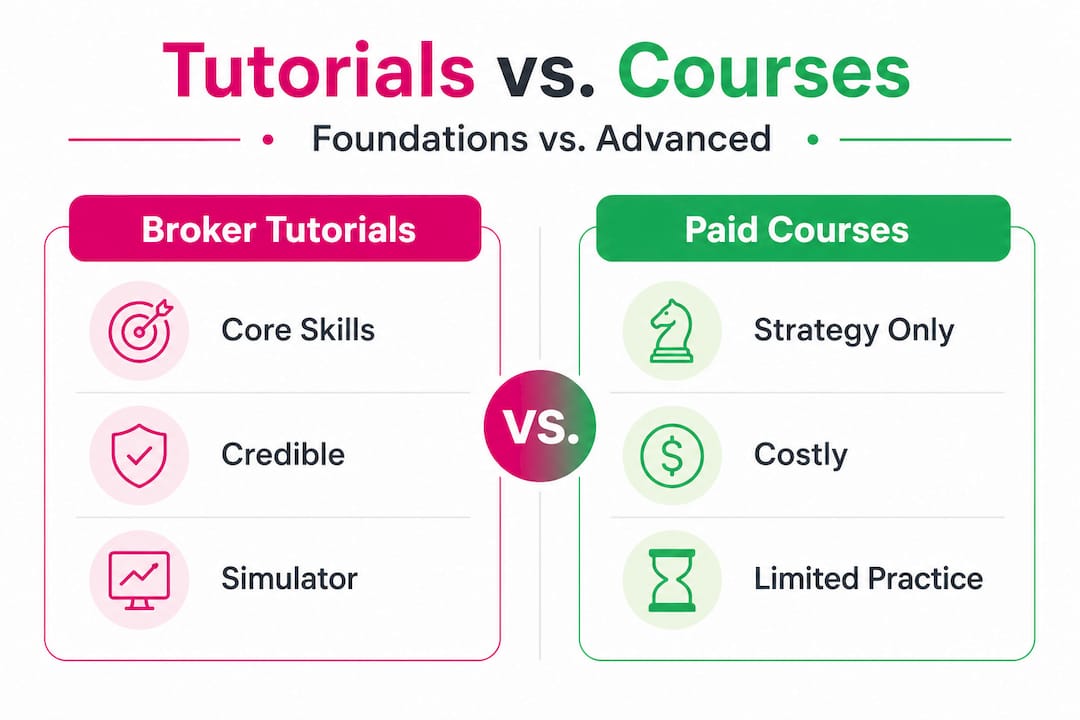
Infographic comparing broker tutorials and strategy courses
Pro Tip: Always choose tutorials that include a simulator or demo account component over those that are purely theory-based. Watching a video about drawing support and resistance levels is useful. Actually drawing those levels on a live chart and watching price interact with them is how real understanding forms.
Hands-on learning: The power of demo accounts and simulators
Here is something that does not get said enough: most traders learn the wrong lesson from their first demo account. They use it to confirm that trading is easy, rack up simulated gains by taking outsized risks, then blow up their first live account within months. That is not how demo practice is supposed to work.
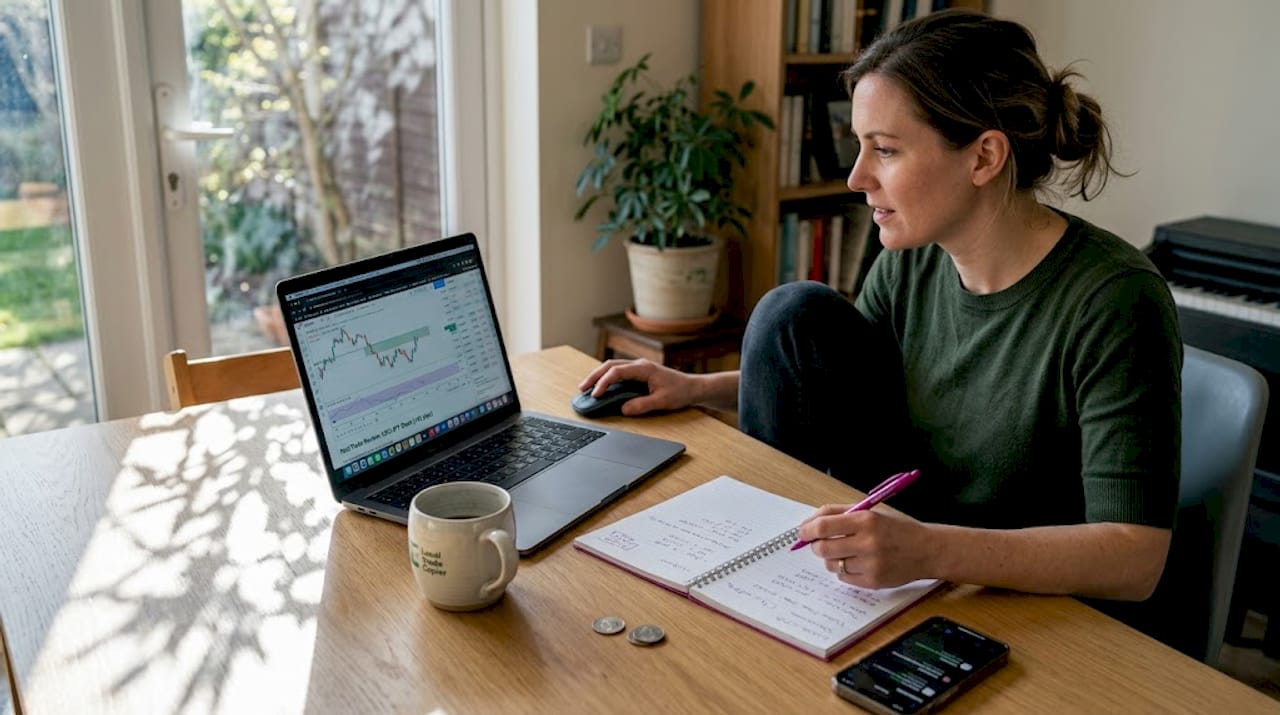
Woman practicing forex skills with demo platform
The real purpose of a demo account in tutorial-based education is to build disciplined habits under zero financial pressure. Established forex education platforms consistently emphasize demo accounts and simulators as essential tools for practicing strategies on MT4, MT5, and other platforms without risking capital. For account managers optimizing automated systems, this is especially critical. You need to verify that your EA behaves as expected across different market conditions before it touches a live account.
Here is how to actually maximize learning from a tutorial when using a demo account:
- Set your demo balance to match your intended live account size. Trading a $100,000 demo when you plan to go live with $5,000 builds completely wrong intuitions about position sizing and risk.
- Follow the tutorial step by step before clicking anything. Watch the full section, understand the concept, then replicate it on your demo. Do not try to learn and trade simultaneously.
- Track every trade with a journal. Record your entry reason, your expected outcome, and your actual result. Pattern recognition only develops through documented review, not memory.
- Introduce realistic rules. Treat your demo account like it is real money. Use proper stop losses. Limit daily drawdown. Stick to your position sizing formula. Practice the discipline, not just the mechanics.
- Use the demo to test tutorial concepts specifically. If a tutorial teaches you a moving average crossover setup, test only that setup for two weeks. Isolated testing creates clearer feedback.
You can watch how the MT4 and MT5 platforms behave in real conditions using a trade copier demo video to understand platform mechanics before you start live copying. And when the time comes to take the next step, understanding the process of transitioning to live trading will help you do it without the common emotional and mechanical mistakes that derail most traders.
Here is how major trading platforms compare for demo account use in tutorial-based learning:
| Platform | Demo account availability | Simulated execution | EA testing support | Copier compatible |
|---|---|---|---|---|
| MetaTrader 4 | Yes, via most brokers | Yes | Yes, full EA support | Yes |
| MetaTrader 5 | Yes, via most brokers | Yes | Yes, full EA support | Yes |
| DXTrade | Yes, select brokers | Yes | Limited | Yes (via copier) |
| cTrader | Yes, via most brokers | Yes | Partial (cBots) | No direct support |
Pro Tip: After completing any major tutorial module, spend at least two weeks applying that concept exclusively on a demo account before moving forward. Rushing through tutorials without practice locks you into passive understanding. Passive understanding evaporates when live money is on the line.
Integrating risk management in tutorial-based forex education
Ask any trader who has consistently survived in forex for more than three years what the most important skill is. Almost universally, the answer is risk management. Not chart reading. Not strategy selection. Risk management. Yet most strategy-selling courses dedicate a single slide to it, bury it at the end, or skip it entirely.
This is the knowledge gap that structured tutorials fill. Comprehensive forex academies treat risk management as a primary topic, not an afterthought. And for good reason. The majority of retail traders who lose their accounts do not lose because their strategy failed. They lose because they did not control how much they risked per trade, held losers too long, or added to losing positions without a structured rationale.
A quality forex tutorial must cover these specific risk management topics:
- Position sizing formulas: How to calculate lot size based on account balance, risk percentage per trade, and stop loss distance. This is the single most practical skill a tutorial can teach.
- Stop loss placement: Where to put stops based on market structure, not arbitrary pip counts. Fixed pip stops ignore volatility. Tutorials should show you how to account for forex volatility when placing protective orders.
- Risk-to-reward ratios: Why a 1:2 risk-to-reward minimum changes your profitability equation even with a 40% win rate.
- Drawdown management: Setting daily and weekly loss limits, and knowing when to stop trading during adverse conditions.
- Diversification and correlation: How running multiple positions in correlated pairs multiplies your actual risk exposure beyond what your position sizes suggest.
For account managers, these skills connect directly to your professional responsibility. You can explore specific risk control strategies for managing exposure across multiple accounts, and understand how hedging strategies in forex can serve as a second layer of portfolio protection when integrated thoughtfully.
Risk management is not the boring part of forex education. It is the part that determines whether you still have an account to trade next year. Any tutorial that glosses over it is incomplete.
Forex trading carries a high level of risk and is not suitable for all investors. The risk management principles described here are educational in nature and do not constitute financial advice. Past trading results do not guarantee future outcomes.
The practical outcome of solid risk education within tutorials is that you develop automatic behavioral guardrails. You stop making emotional position sizing decisions. You stop revenge trading after a loss. You start treating each trade as one data point in a long series, rather than a make-or-break event.
The truth about forex tutorials: What most traders get wrong
Here is an honest take that most education articles skip entirely. Tutorials are not magic. They are a structured starting point, and the majority of traders misuse them in one of two ways: they either ignore them entirely in favor of “real experience,” or they treat them as a substitute for independent thinking.
The “real experience” camp gets burned fastest. They mistake early wins (often luck in favorable market conditions) for genuine skill, then face a drawdown they have no framework to manage. The second group is subtler but just as problematic. These traders complete every tutorial, absorb every lesson, and then wait for permission to trade. They look for tutorials that will tell them exactly what to do, rather than tutorials that build their capacity to make good decisions independently.
The Reddit trading community regularly surfaces this concern: strategy-specific tutorials become ineffective as markets shift, and some are designed primarily to generate revenue for the seller rather than genuine competence in the buyer. The traders who build lasting success use free foundational resources, develop their own edge through data and practice, and treat paid content with appropriate skepticism.
What actually works is combining tutorial-based foundations with active critical thinking. Use tutorials to learn the framework: how to read markets, how to build and test a hypothesis, how to manage risk. Then develop your own approach within that framework. Study core analysis methods to understand what you are actually observing in price data, not just how to apply indicators mechanically.
One more thing worth saying. Markets change. A tutorial that was accurate and relevant in 2019 may describe platform features that no longer exist, reference economic conditions that have shifted significantly, or teach indicator settings that performed well in one market regime and poorly in another. Make a habit of revisiting your foundational tutorials periodically, especially after major market shifts or when you upgrade your platform. This is not a one-time activity. It is ongoing professional development.
Elevate your trading education and automate success
Understanding forex tutorials at this level puts you ahead of most retail traders. The next logical step is putting that education to work in a real, efficient trading setup.
Local Trade Copier has supported retail forex traders and account managers since 2010, giving you the tools to move seamlessly from learning to live execution. Once you understand how MT4, MT5, and DXTrade work through demo practice and tutorials, you can use our trade copier demo to see exactly how trade replication operates across multiple accounts in real time. When you are ready to set up your own system, the MT4/MT5 copier installation guide walks you through every step. With local execution of 1 second or faster under normal market conditions, eight money management modes, and no cloud routing risk, your education translates directly into professional-grade practice. A 7-day free trial gets you started with zero commitment.
Frequently asked questions
Do I need paid courses or are free tutorials enough in forex trading?
Free tutorials from reputable brokers and platforms that cover fundamentals and platform use are often sufficient for most retail traders. Broker academies from established platforms like IG and FOREX.com provide integrated tools and interactive content that outperform most paid strategy courses.
How can tutorials help account managers using automated forex platforms?
Tutorials allow account managers to practice and optimize strategies using demo accounts and simulators before implementing them on live automated systems. Demo-based practice on MT4 and MT5 is especially valuable for verifying that Expert Advisors behave as intended across different market conditions.
Which topics should a good forex tutorial cover?
Comprehensive tutorials should cover trading basics, analysis methods, platform operations, and practical risk management. Structured forex academies that include all of these areas give traders the full toolkit needed for consistent, informed decision making.
Are strategy-selling forex tutorials trustworthy?
Most strategy-selling tutorials should be approached with significant caution, and many should be avoided entirely. As community experience shows, strategy-specific courses frequently become outdated, lack empirical backing, and sometimes function more as marketing products than genuine education. Focus on reputable sources that emphasize core skills and independent thinking instead.
