

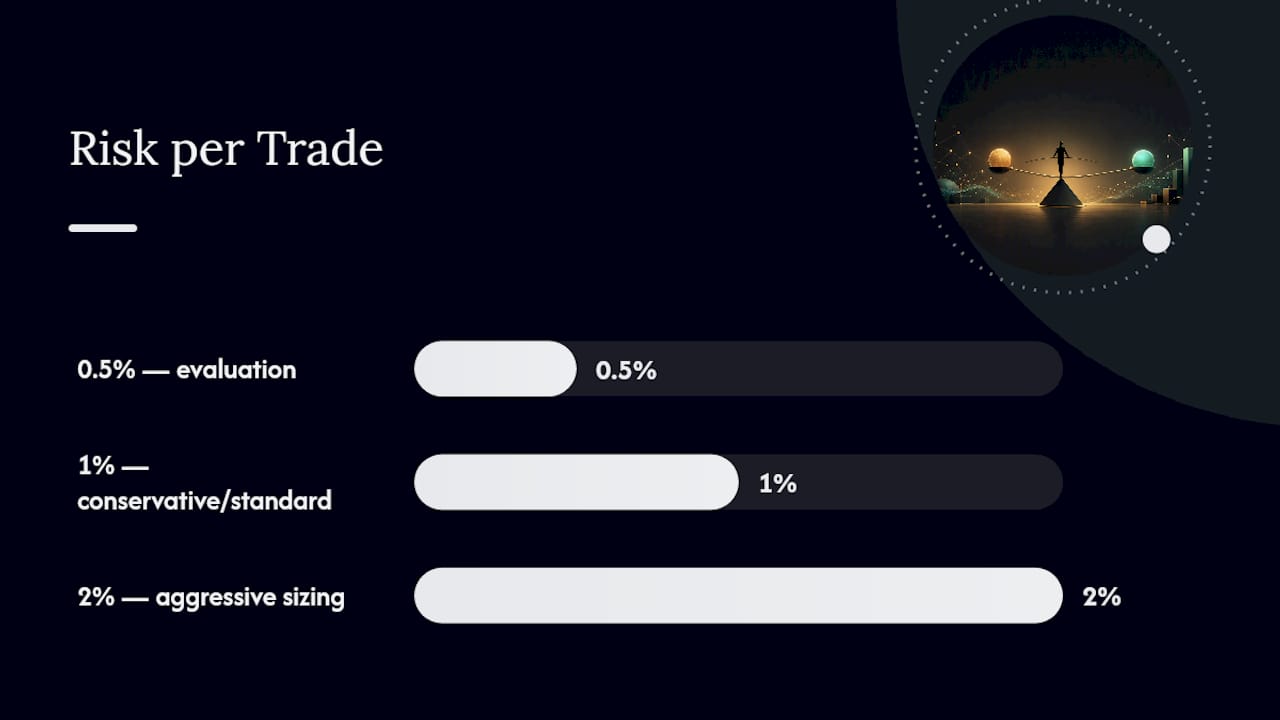
Risk 0.5% to 1% of your account on any single trade. That range is the working default for most traders, whether you’re proving out a new strategy or trading a funded account. Only move up toward 2% once you have a documented edge across a real sample of live trades, not a hunch or a good week.
The logic is survival, not caution for its own sake. A trader risking 1% needs a string of roughly 20 straight losers to wipe out a fifth of their account. That math changes how you make decisions under pressure, and decision quality under pressure is most of what separates traders who last from traders who don’t.
- A low percent risk (around a half percent) is appropriate for new live accounts, prop-firm evaluations, and during high-volatility event days
- A moderate percent risk is the standard baseline for most funded, experienced traders
- A higher percent risk should be used only when there is a verified edge and a sufficiently large live sample to justify it
Past performance is not a guarantee of future results.
Key Takeaways
| Point | Details |
|---|---|
| Default to 0.5% to 1% | Start new accounts and prop-firm evaluations at 0.5%, move to 1% once execution is proven. |
| Calculate, don’t guess | Divide dollar risk by stop distance in dollars per unit to get exact position size every time. |
| Verify before raising risk | Require a documented win rate, risk-reward ratio, and roughly 50 to 100 live trades before considering 2%. |
| Recalculate on every account | Update dollar risk from current equity, not a stale balance, especially after growth or withdrawals. |
| Preserve percent risk across accounts | Tools like Local Trade Copier apply automatic lot scaling per account balance to keep percent risk consistent when copying trades to multiple accounts. |
What Risk Per Trade Percent Actually Means
Risk per trade percent is the dollar amount you stand to lose if your stop gets hit, expressed as a share of your account equity. The formula is simple: percent risk equals your planned dollar loss divided by account equity, times 100. Everything else in position sizing flows from that one relationship.
Here’s the sequence professional traders run before every entry:
- Pick your percent. Decide 0.5%, 1%, or another figure based on your track record and current conditions.
- Calculate dollar risk. Multiply account equity by that percent. A $20,000 account risking 1% puts $200 on the line.
- Set your stop. Place it where the trade thesis is actually invalidated, not at a round number that feels comfortable.
- Find the per-unit loss. Measure the distance from entry to stop in pips, cents, or points, then convert to dollars per unit.
- Divide to get quantity. Dollar risk divided by per-unit loss gives you lots, shares, or contracts.
This works the same way for a forex pair, an equity position, or a futures contract. The only variable that changes is how you price a “unit” of movement. Where traders get burned is skipping the friction: spread, commission, and slippage all eat into that planned $200.
Guides that model real fills show transaction costs inflate realized percent risk above what the raw calculation suggests, sometimes meaningfully on tight stops. A trade with a 20-pip stop and a 2-pip spread is already carrying 10% more risk than the number on your calculator. Build a small buffer into your stop math on shorter time frames, where spread and slippage represent a larger fraction of the total distance.

Should You Use the 0.5%, 1%, or 2% Rule?
These three numbers show up constantly in trading education, and each one fits a specific situation rather than being a universal answer.
Detailed sizing guides recommend this lower band specifically for evaluation accounts, since it maximizes the number of trades you can take before hitting a drawdown limit, which matters when a single breach can end the challenge.
It’s conservative enough to absorb a rough month without threatening the account, and aggressive enough to compound meaningfully over time.
It only makes sense once you can point to real evidence: a large enough sample of live trades, a documented win rate, a consistent risk-reward ratio, and fills that behave the way your backtest assumed. Professional guidance generally points to 50 to 100 live trades as a reasonable floor before you trust a strategy enough to size it up.
Pro Tip: *Keep a simple trade log with entry, stop, result, and R multiple for every trade.
Reduce risk, rather than increase it, when any of these show up:
- You’re in a drawdown deeper than your normal variance
- You just changed strategies or timeframes
- A high-impact economic release is on the calendar
- You’re inside a prop-firm evaluation with a hard daily loss limit
Do not raise your percent risk unless you meet every verification condition above. One good week is not data.
How Do You Calculate Position Size Step by Step?
Position sizing is arithmetic, and treating it that way instead of sizing “by feel” is what separates traders who survive variance from those who get blown out by it.
- Choose your percent risk. Say 1% on a $10,000 account.
- Compute dollar risk. $10,000 × 1% = $100.
- Set your stop distance. Based on the chart, not on how much you’re willing to lose.
- Convert stop distance to dollars per unit. This step differs by instrument.
- Divide dollar risk by per-unit loss. The result is your position size.
Forex example: You’re trading EUR/USD with a 25-pip stop, and each pip is worth $10 per standard lot. Your $100 dollar risk divided by (25 pips × $10) means you can trade 0.4 standard lots.
Stock example: You’re buying a stock at $50 with a stop at $47, a $3 per-share risk. Your $100 dollar risk divided by $3 per share allows roughly 33 shares.
Before you send any order, run through a short verification pass: does the stop distance match your actual chart level, does the pip or tick value match the instrument and lot size you’re entering, and have you padded the stop slightly for spread on tight timeframes? Skipping that last check is the single most common reason traders end up risking more than they planned.
How Do You Convert Percent Risk Into Dollar Risk?
Converting percent into dollars is the step that turns an abstract rule into a real trade. Multiply your current account equity by your chosen percentage, and that figure becomes the maximum you’re willing to lose on that specific trade.
Notice that doubling the percent doubles the dollar figure exactly. There’s no rounding or judgment call here, which is exactly the point: this number should never move once you’ve calculated it, no matter how confident you feel about the setup.
The dollar figure you calculate is the ceiling, not a target. If your stop placement and position size only require $180 of a possible $250, that’s fine. Don’t stretch the position to use up the full risk budget just because it’s available. The dollar amount exists to cap downside, not to be spent in full on every trade.
One detail traders miss: recalculate the dollar figure fresh for every trade, using your current equity at that moment, not the balance from last week or last month. Using a stale balance either understates or overstates your real exposure, and the gap compounds the longer you go without updating it.
How Do You Determine Your Own Risk Tolerance First?
Your risk tolerance isn’t a feeling, it’s a function of three concrete inputs: your capital base, your strategy’s statistical behavior, and how you actually react under a real losing streak, not how you imagine you’ll react.
Start with capital. A trader with $5,000 and no other income source needs a tighter percent than a trader with $200,000 and a separate salary, even if both have identical strategies. The smaller account has less room to absorb a bad month without the loss becoming personally significant, which changes behavior even when the math says otherwise.
Next, look at your strategy’s statistical profile. If you don’t know your strategy’s actual win rate and average R multiple across a real sample, you’re guessing at tolerance rather than calculating it.
Finally, test yourself honestly against a real drawdown, not a hypothetical one. Traders often discover their true risk tolerance only after living through five or six consecutive losses. If that experience triggers rule breaking, stop moving, or a revenge trade, your percent risk was set too high for your actual psychology, regardless of what the math on paper suggested.
Why Risk-Reward Ratio Matters Alongside Percent Risk
Percent risk controls how much you can lose on one trade. Risk-reward ratio controls whether winning trades actually justify the losses over time. Setting one without the other leaves a hole in your math.
The percent risk figure is identical in both cases. The outcome is not.
This is why professional traders talk about percent risk and risk-reward ratio in the same breath rather than as separate topics. The percent number alone tells you almost nothing about whether the strategy behind it works.
Before locking in a percent risk figure, calculate your strategy’s expectancy: (win rate × average win) minus (loss rate × average loss). If that number is negative, no percent risk setting fixes the underlying problem. Position sizing manages downside on a strategy that already has positive expectancy; it doesn’t create expectancy that isn’t there.
Adjusting Risk for Scalping, Swing Trading, and Everything Between
Percent risk isn’t a single number you set once. It should shift with the mechanics of the strategy you’re actually running.
Scalpers trade frequently, often dozens of times a day, with tight stops measured in a handful of pips or ticks.
Swing traders hold positions for days, with wider stops that account for normal price noise. A wider stop at the same percent risk means a smaller position size, which naturally throttles exposure.
You’re running something closer to one large, correlated position.
The instrument matters as much as the holding period. Highly volatile assets require either a wider stop at the same percent or a reduced percent at the same stop distance, since volatility inflates the odds of a normal price swing hitting your stop before your thesis has time to play out.
Adjusting for Account Growth, Drawdowns, and Withdrawals
Your account balance moves constantly, and your dollar risk should move with it rather than staying pinned to whatever the balance was when you opened the account.
The cleanest approach is recalculating dollar risk before every trade, or at minimum daily, using current equity rather than a fixed reference balance. This naturally scales your risk down during a drawdown and up during a growth phase, without requiring you to remember to manually adjust anything.
Some traders prefer a “high-water mark” variation: risk is calculated off the account’s peak balance rather than its current balance, which keeps position sizes from shrinking during a normal pullback. This works for traders with a strong track record who want to avoid getting overly conservative after a routine string of losses, but it removes some of the natural protection that current-balance sizing provides during a genuine deterioration in performance.
Withdrawals need the same discipline.
For anyone running the same strategy across multiple accounts of different sizes, whether personal accounts or copied trades across a fund of client balances, this recalculation has to happen per account, not once at the master level.
The Psychology Behind Why Smaller Risk Protects Your Process
Over-risking doesn’t just threaten your account. It threatens your ability to think clearly, which is a bigger problem than any single loss.
Traders who risk 3% to 5% per trade routinely describe the same pattern: one bad loss triggers a revenge trade, which triggers a bigger loss, which triggers moving a stop “just this once.” Industry observers note that risking above 2% frequently correlates with irrational decision-making under stress, while risk kept at or below 1% tends to preserve the emotional stability needed to follow a plan through a normal losing streak. Past performance is not a guarantee of future results.
Conservative sizing works because it changes what a loss means.
- Cut your normal risk in half during any drawdown deeper than your typical variance
- Default to 0.5% during prop-firm evaluations and major event days
- Never adjust a stop after entry to “give the trade more room”
- Log every trade and require a real live sample before raising your percent
Pro Tip: Before increasing your percent risk, pull up your trade log and count. If you can’t point to at least 50 logged live trades supporting the change, the increase is a guess, not a decision.
Traders who study their own psychological patterns under losing streaks tend to catch the revenge-trade impulse earlier, before it turns one loss into three.
Keeping Percent Risk Consistent Across Copied Accounts
Traders who replicate a single strategy across multiple accounts face a specific version of this problem: the percent risk that’s correct for the master account isn’t automatically correct for a client account with a different balance.

Maintaining consistent percent risk across accounts of different sizes requires automatic lot scaling tied to each account’s current balance, rather than copying the exact lot size from the master trade.
Stop-loss mapping matters just as much. If a stop distance doesn’t translate correctly to the client account’s instrument specification and pip value, the realized percent risk drifts from the intended figure even when the lot scaling is correct.
A few operational factors quietly distort real percent risk in multi-account setups:
- Execution latency between master and client accounts, which can shift entry price and effective risk
- Partial fills that leave a position smaller or larger than the sizing calculation intended
- Slippage on stop execution, which matters more during fast-moving markets
Local execution, where trade data doesn’t route through an external server, reduces the latency window that causes these discrepancies.
A Publisher’s Note on Playing It Safe First
If you manage more than one account, that same discipline needs to hold across every account, which is where tools built for multi-account risk consistency actually matter. Past performance is not a guarantee of future results.
— Rimantas
Keep Your Risk Settings Consistent With Local Trade Copier

The software runs locally on your Windows PC or VPS with sub-0.5-second execution, which matters when you’re trying to preserve a percent-risk figure that depends on tight, predictable fills. It doesn’t generate signals, pick trades, or influence strategy in any way. It replicates the trades you or your master account already place. Past performance is not a guarantee of future results.
If you want to see the lot-sizing and risk options in action before committing to anything, watch the product demo or start the 7-day free trial and test it against your own accounts.
