
TL;DR:
- Execution speed profoundly impacts profit by minimizing slippage during trade copying.
- Using a local VPS near the broker reduces latency and improves trade fill accuracy.
- Monitoring and optimizing latency ensure consistent account performance and strategy validity.
Most traders obsess over strategy and ignore the one factor silently eating their profits: execution speed. When you copy trades across multiple accounts, even a 50-millisecond delay can cost you real money every month. That gap between what your master account fills at and what your follower accounts actually get is called slippage, and it compounds fast. This guide breaks down exactly how trade copying speed affects your bottom line, why latency is a bigger risk than most traders realize, and what you can do right now to fix it.
Key Takeaways
| Point | Details |
|---|---|
| Speed cuts slippage | Every millisecond gained in trade copying preserves more profit and limits losses. |
| Consistency protects strategy | Fast, synchronized copying ensures all accounts get the same execution, essential for compliance and trust. |
| Optimization is practical | Moving your copier to a VPS near your broker is a simple upgrade that delivers reliable, fast results. |
| Measurement matters | Regularly test and monitor your trade copying latency to keep your performance edge. |
What is trade copying and why does speed matter?
Trade copying is the process of automatically replicating trades from one master account to one or more follower accounts using software. When your master account opens a buy on EUR/USD, the copier detects that signal and places the same trade on every linked account, adjusting lot sizes based on your settings. It sounds simple. The problem is that “automatic” does not mean “instant.”
Every step in that chain takes time. The copier reads the master trade, calculates lot sizes, sends the order to each follower broker, and waits for confirmation. That entire process takes milliseconds, but in forex, milliseconds matter.
Slippage is the difference between the price your master account filled at and the price your follower accounts actually got. If your master fills at 1.0850 and your follower fills at 1.0853, that three-pip gap is slippage. Multiply that across 50 trades a day and the cost becomes significant.
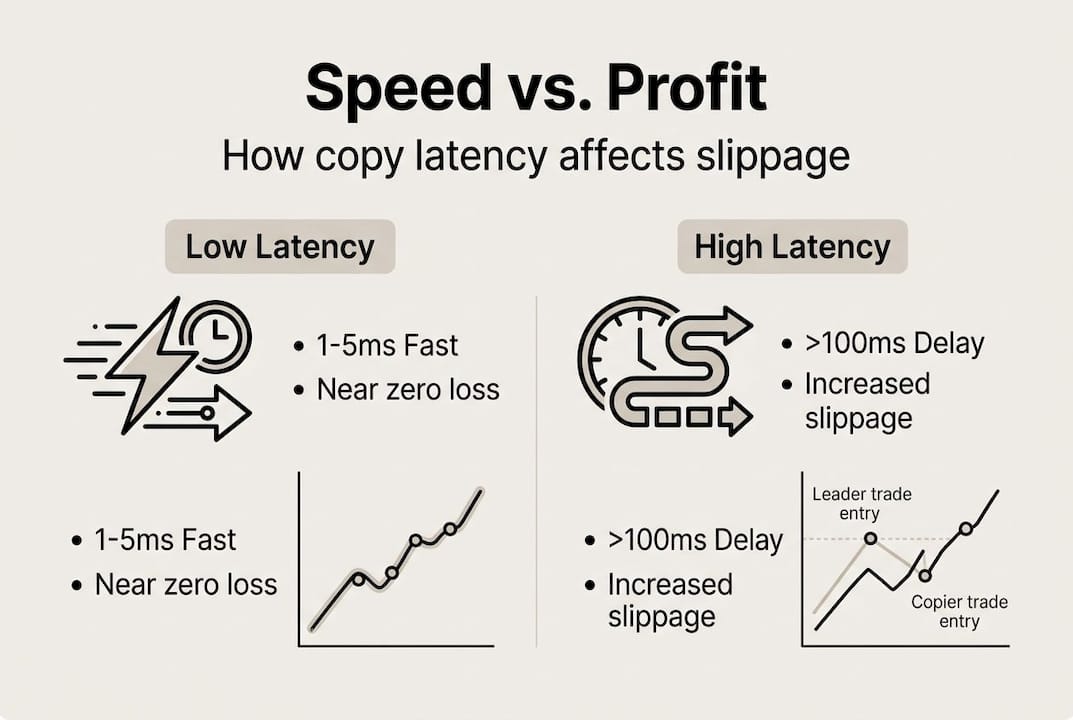
Latency is the delay in that replication process, measured in milliseconds. A home internet connection typically delivers 50 to 200ms of latency. A VPS located near your broker can bring that down to 1 to 5ms. That difference is not trivial.
Here is what slow copying actually affects:
- Fill prices on follower accounts diverge from the master
- Stop-loss and take-profit levels trigger at different points
- High-speed strategies like scalping become unprofitable on follower accounts
- Results across accounts become inconsistent and hard to explain
Pro Tip: Before you scale to more accounts, always benchmark the network latency impact between your copier and each broker. A slow link to one broker will drag down your entire operation.
“Low latency is not a luxury feature. It is the baseline requirement for any trade copying setup where latency and slippage directly affect follower account profitability.”
The hidden costs of slow trade copying: Slippage and lost profits
Once you understand how latency creates slippage, the financial damage becomes clear. Let’s put real numbers on it.

At 1 to 5ms latency, slippage is near zero. Your follower accounts fill at essentially the same price as your master. At 50 to 100ms, you start seeing 0.2 to 0.3 pips of average slippage per trade. That sounds tiny. But at 50 trades per day, slippage costs can reach $3,000 per month. That is $36,000 per year, gone, not because your strategy failed, but because your infrastructure was slow.
| Trade volume (daily) | Latency | Avg slippage | Monthly profit impact |
|---|---|---|---|
| 10 trades | 1 to 5ms | ~0 pips | $0 |
| 10 trades | 50 to 100ms | 0.2 to 0.3 pips | ~$600 loss |
| 50 trades | 1 to 5ms | ~0 pips | $0 |
| 50 trades | 50 to 100ms | 0.3 pips | ~$3,000 loss |
Slippage does not just reduce profit. It creates a cascade of problems:
- Erodes your edge: A strategy with a 1.2 reward-to-risk ratio can become unprofitable after consistent 0.3-pip slippage
- Creates inconsistent fills: Some accounts fill better than others, making performance analysis unreliable
- Breaks scalping setups: A scalping copy trading setup with tight targets of 3 to 5 pips loses all its edge when slippage eats 0.3 pips per trade
- Triggers prop firm limits: If a follower account hits its maximum daily loss because of slippage the master never experienced, you fail a challenge that your strategy actually passed
Pro Tip: If you run a scalping or high-frequency strategy, treat anything above 20ms as unacceptable. Even 30ms of consistent delay will visibly degrade your slippage statistics over time.
“The traders who lose money to slippage rarely know it’s happening. They blame the strategy, the broker, or bad luck. The real culprit is often the 80ms delay sitting between their master and follower accounts.”
Consistency across accounts: Why latency can kill your strategy
Slippage is expensive, but inconsistent execution across accounts is arguably worse. When latency varies between follower accounts, each account starts behaving differently, even though they are supposed to mirror the same strategy.
Here is a real-world scenario. Your master account closes a trade at a 20-pip profit. Follower Account A, on a low-latency VPS, closes at 19 pips. Follower Account B, running on a home PC with a congested connection, closes at 16 pips. Follower Account C misses the take-profit trigger entirely because the order arrived after the market moved. Three accounts, three different outcomes, one strategy.
| Account | Latency | Execution result | Monthly P&L impact |
|---|---|---|---|
| Master | 0ms | 20 pip profit | Baseline |
| Follower A (VPS) | 3ms | 19 pip profit | Minimal loss |
| Follower B (home PC) | 80ms | 16 pip profit | Moderate loss |
| Follower C (congested) | 150ms+ | Missed TP | Significant loss |
This inconsistency causes real problems beyond just money:
- Failed prop firm challenges: As noted in research on managing multiple prop firm accounts, inconsistent execution across accounts due to latency leads to varying P&L, with some accounts hitting drawdown limits while others do not
- Client complaints: If you manage accounts for others, explaining why Account A made 4% this month while Account B made 2.1% is a difficult conversation
- Regulatory exposure: Unexplained discrepancies between managed accounts can attract scrutiny
- Strategy invalidation: If you cannot replicate results consistently, you cannot actually evaluate whether your strategy works
The fix starts with understanding your actual execution environment. Review prop firm copying best practices before scaling, and if you are already seeing discrepancies, learn how to improve MT4 copier speed and review how others are managing prop accounts with copier software effectively.
“Small execution delays lead to large differences in P&L across accounts. What looks like a strategy problem is almost always an infrastructure problem.”
Solutions: Optimizing local trade copying for superior speed
The good news is that execution speed is entirely within your control. You do not need to change your strategy or switch brokers. You need to fix your infrastructure.
Here is a prioritized action list:
- Move to a VPS near your broker’s server. This is the single highest-impact change you can make. Local solutions on VPS near broker are the preferred setup for retail forex multi-account managers, delivering sub-100ms execution and ensuring prop compliance in volatile conditions. Most major brokers use data centers in New York (NY4/NY5) or London (LD4). Match your VPS location to your broker.
- Use a locally installed trade copier, not a cloud-based one. Cloud copiers route your trade data through external servers, adding 20 to 100ms of latency before the order even reaches your broker. A local copier runs on the same machine as your MetaTrader terminals, keeping the entire process on one IP address with no external routing.
- Test and monitor execution time regularly. Do not assume your setup is fast. Measure it. Most professional traders check execution logs weekly. If you see latency creeping up, investigate before it costs you.
- Avoid home networks for live trading accounts. Residential internet is shared, variable, and unreliable during peak hours. A dedicated VPS gives you consistent uptime and predictable latency.
- Audit your MetaTrader setup. Too many indicators, outdated EA versions, or bloated chart templates can slow down the terminal itself. Review optimizing MetaTrader performance and follow trade copying best practices to keep your setup lean.
Pro Tip: For swing or long-term strategies, 100ms latency is generally acceptable. But for scalping or any prop firm challenge, treat reducing latency as a non-negotiable baseline, not an optional upgrade.
Our take: The real edge in trade copying isn’t tools, it’s execution speed transparency
Most traders shopping for a trade copier focus on features: how many accounts, how many lot sizing options, which platforms it supports. Those things matter. But we have seen traders with feature-rich setups consistently underperform because they never once measured their actual execution latency.
Here is the uncomfortable truth: if you cannot see your latency numbers, you are almost certainly paying hidden costs. Invisible milliseconds silently erase your edge across hundreds of trades. You will blame your broker, your strategy, or market conditions, but the real problem is sitting in your infrastructure.
The traders who compound small advantages into consistent results are not the ones with the most features. They are the ones who obsess over measurement. They check execution logs. They know their average slippage per strategy. They notice when latency creeps from 4ms to 12ms and they fix it before it costs them.
As we see it, “What you don’t measure, you can’t improve, and in trade copying, invisible milliseconds can silently erase your edge.” Monitoring real-world execution delays is not paranoia. It is professional practice.
Speed up your trade copying with trusted tools
If latency is costing you money, the fix is closer than you think. Local Trade Copier runs entirely on your Windows machine or VPS, with no cloud routing and no external server delays. Sub-0.5-second local execution means your follower accounts get filled at prices that actually match your master.
Explore the fastest trade copier setup to see how local execution compares to cloud-based alternatives. Review the secure VPS usage guide to harden your setup, and follow the step-by-step trade copier installation guide to get running fast. A 7-day free trial is available, so you can measure the speed difference yourself before committing.
Frequently asked questions
What is the optimal latency for trade copying?
Latency under 10ms is ideal for minimizing slippage, especially in scalping or prop firm strategies. A VPS near your broker can bring latency down to 1 to 5ms compared to 50 to 200ms on a home connection.
How does trade copying speed affect profit?
Even slight delays add up to thousands of dollars in slippage over hundreds of trades. Slippage costs can reach $3,000 per month at 50 trades per day with just 0.3 pips of average delay.
Is cloud-based trade copying fast enough for high-frequency trading?
Cloud copiers typically add 20 to 100ms of latency, which is acceptable for swing or long-term trades but insufficient for scalping. Cloud latency overhead makes local execution the only practical choice for high-frequency strategies.
How does speed impact compliance with prop firm rules?
Higher latency causes inconsistent execution across accounts, which can push some follower accounts into drawdown limits the master never hit. Inconsistent execution across prop firm accounts due to latency leads to varying P&L outcomes that can fail a challenge.
What is the best way to minimize trade copying latency?
Use a VPS located near your broker’s server combined with a locally installed trade copier. Local VPS setups are the preferred solution for sub-100ms execution in retail forex multi-account management.
Recommended
- Trade copying best practices for efficient forex management
- Trade copier security: protect accounts & minimize risks
- Prop trading best practices: Multi-account copying in 2026
- Cross-broker trade copying: efficient forex replication guide
