
TL;DR:
Structured trading education shapes behavior by improving risk management, decision-making, and discipline. Interactive formats and peer learning foster deeper understanding and lasting behavioral change beyond passive knowledge. Regular deliberate review and tailored resources are essential for consistent trading success.
Most traders underestimate how much structured learning shapes their results. The assumption that trading success comes from intuition or market instinct is one of the most costly myths in the field. Understanding why traders use educational resources goes beyond knowing which chart patterns to read. The research is clear: education changes your behavior, reshapes how you manage risk, and builds the decision-making framework that separates consistent traders from reactive ones. This article breaks down the evidence, the resource types that actually work, and how to use them effectively.
Key takeaways
| Point | Details |
|---|---|
| Education changes behavior | Structured learning reshapes risk tolerance and reduces impulsive decisions, not just knowledge gaps. |
| Interactive formats outperform passive reading | Simulations, quizzes, and scenario exercises drive deeper retention than articles alone. |
| Paper trading requires structure | Journaling, risk limits, and performance review make simulated practice genuinely educational. |
| Financial literacy links to better decisions | A meta-analysis across 57 studies found a correlation of 0.357 between financial literacy and investment quality. |
| Ongoing learning compounds over time | Traders who adapt their educational approach to market conditions continuously build a compounding skill advantage. |
Why educational resources shape trading outcomes
The phrase “educational resources in trading” is a broad one. In practice, it refers to what finance professionals call trader development or structured market education: any deliberate, organized method of building trading knowledge, skill, and behavioral discipline. That can mean books, courses, webinars, simulation tools, or peer learning cohorts.
What makes education powerful in this context is not just the facts it delivers. It is the behavior change it produces.
A 2026 study published in PLOS ONE found that experiential peer investment advice had measurable effects on how subsequent traders allocated capital. Participants who received advice framed around prior cohorts’ gains or losses changed their risk exposure significantly. The framing alone shifted behavior. This matters because it tells you that the structure and delivery of educational content is just as important as the content itself.
The PLOS ONE study found that positive or negative advice passed between cohorts produced a 19% difference in risky asset allocations, confirming that the framing and source of advice changes investor behavior independently of the underlying information.
This aligns with what many experienced traders eventually recognize: the difference between knowing a strategy and actually executing it under pressure is almost entirely psychological. Education that addresses the behavioral layer, not just the technical one, is where the real impact of training on trading shows up.
Social learning adds another dimension. When traders learn alongside peers, discuss outcomes, and hear how others framed decisions, their confidence and risk preferences adjust in ways that solo study cannot replicate. Past results do not guarantee future performance, but traders who develop behavioral discipline through structured learning consistently make fewer reactive errors.
Types and formats of trading education that work
Not all educational formats deliver the same value, and the format often matters more than the content source.

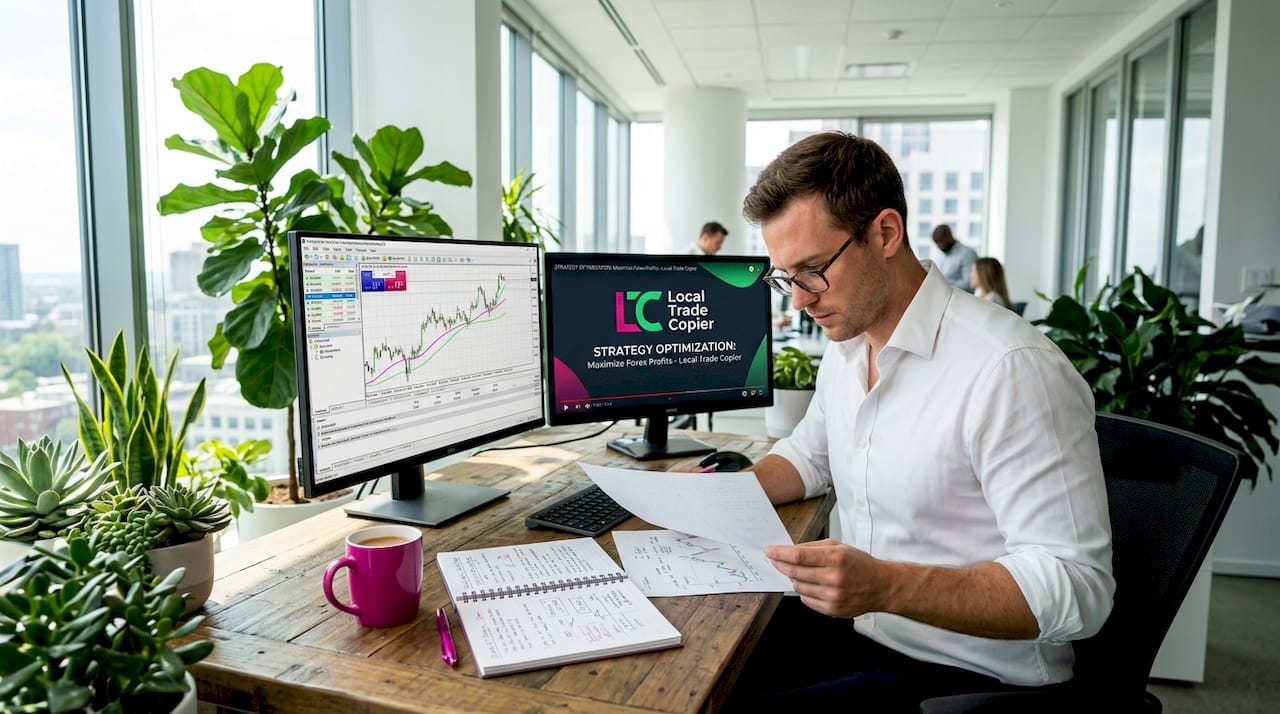
Trader engaging with interactive trading simulation session
Books and written articles provide foundational knowledge. They are useful for understanding market mechanics, terminology, and broad strategy frameworks. But passive reading has limits. You can read about risk management principles without ever internalizing them in a way that holds under real market pressure.
Interactive formats close that gap. A Springer Nature 2026 study analyzed 20 education platforms and found that learners consistently prefer dynamic, decision-oriented formats over static text. Quizzes, scenario-based exercises, and simulations all ranked higher for perceived learning value and retention.
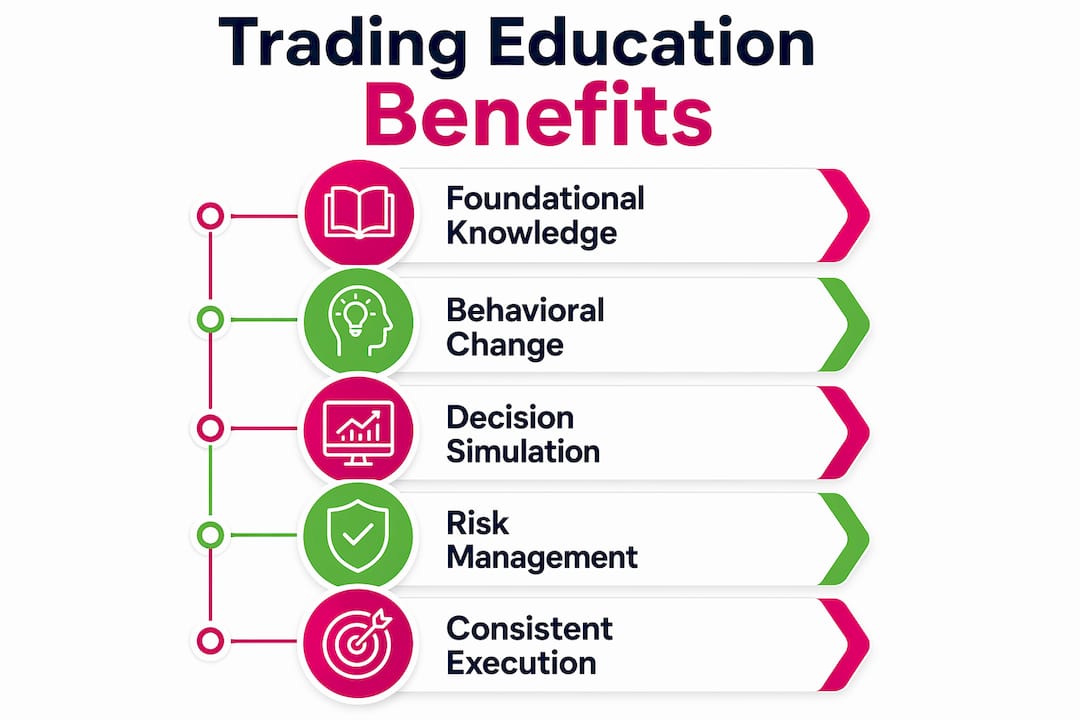
Infographic illustrating key benefits of trading education
Here is a breakdown of the most common resource categories and what each does well:
| Resource type | Format | Primary benefit |
|---|---|---|
| Books and articles | Passive reading | Conceptual foundation and terminology |
| Webinars and coaching | Live, interactive | Real-time guidance and Q&A |
| Simulations and paper trading | Experiential | Decision practice with zero capital risk |
| Courses with quizzes | Structured and dynamic | Knowledge retention and progress tracking |
| Peer discussion groups | Social and collaborative | Behavioral feedback and confidence building |
Webinars and live coaching sessions deserve more credit than they typically get. They are among the few formats where you can ask a specific question about your exact situation and get a response calibrated to your experience level. A good trading educator’s role is not to hand you a strategy but to help you understand why certain decisions work under certain conditions.
Pro Tip: If you are choosing between two educational resources, default to the one that requires you to make decisions, not just absorb information. The act of committing to a choice, even a simulated one, activates a different kind of learning than reading ever will.
For traders looking to explore structured course libraries, platforms like Verdant Institute offer organized learning tracks across finance topics.
The real value of paper trading
Paper trading is often dismissed as “playing pretend.” That framing misses the point entirely.
Paper trading is a simulated environment where you execute real trades with virtual capital. The IBKR Student Trading Lab, for example, offers up to $1,000,000 in virtual equity alongside the full toolset that live traders use, including real market data, analytics, and performance benchmarking. The goal is not to avoid loss. The goal is to build the habit of making deliberate, process-driven decisions before real money is on the line.
Here is how to use paper trading as a genuine learning environment rather than a sandbox:
- Set real risk parameters. Decide in advance how much virtual capital you are willing to risk per trade, per day, and per week. Treat those limits as hard stops.
- Journal every trade. Write down why you entered, what you expected, and what actually happened. The journal creates the feedback loop that makes simulation educational.
- Benchmark your performance. Compare your results against a relevant index or strategy baseline. Without benchmarking, you cannot distinguish a good period from a lucky one.
- Review weekly, not just per trade. Pattern recognition happens at the aggregate level. Weekly reviews reveal behavioral tendencies that per-trade notes cannot.
- Debrief after losing streaks. Research on trading simulation design shows that excessive trading in simulation corresponds to worse outcomes. A structured debrief after a losing period forces you to slow down and analyze rather than react.
Pro Tip: Treat your paper trading account exactly as you would treat a live account with $10,000 of your own money. The behavioral discipline you build or break in simulation transfers directly to live trading.
Financial literacy and investment decision quality
The value of trading knowledge is not theoretical. It is measurable.
A meta-analysis published in the Journal of Accounting, Economics, and Finance reviewed 57 empirical studies on financial literacy and investment decision quality. The summary correlation was 0.357, a statistically meaningful relationship showing that higher financial literacy consistently links to better investment choices.
What this tells you practically:
- Traders with stronger foundational knowledge make fewer costly errors in position sizing and entry timing.
- Education reduces the kind of over-trading and revenge trading that bleeds accounts over time.
- Segmented and contextualized learning, meaning programs designed for specific experience levels and market contexts, outperform generic content.
- Ongoing education builds compounding competence. A trader who studies consistently for two years develops market intuition that actually has a structural foundation rather than being pure guesswork.
The Springer Nature research also found that learner preferences shift with experience level and market context, suggesting that educational programs need to evolve alongside the traders they serve. That finding has a practical implication for how you choose educational resources. A beginner needs foundational literacy. An intermediate trader benefits more from behavioral and strategy-specific programs. An advanced trader gains the most from peer discussion, case-based review, and live market analysis. Matching the resource to the level is one of the most underused principles in trading success through learning. Past results do not guarantee future performance, but reducing structural errors through education is one of the most reliable ways to protect capital.
How to choose and use trading resources effectively
The sheer volume of available content is its own problem. Here is how to cut through it.
- Match the format to your learning style and experience level. If you learn by doing, prioritize simulation tools and scenario-based courses over long-form reading. If you are a conceptual thinker, start with structured books or courses that build frameworks before moving to application.
- Prioritize active over passive learning. Four distinct learner personas studied by Springer Nature all preferred interactive, decision-oriented formats over static articles. This preference held regardless of experience level.
- Use education to reinforce risk management habits. The most expensive forex trading mistakes almost always trace back to behavioral failures, not knowledge gaps. Good educational resources address both.
- Build peer feedback into your routine. Learning in isolation limits your growth. Seek out forums, communities, or cohorts where you discuss decisions and hear how others reason through similar situations.
- Track your learning progress with metrics. Set monthly goals around what you are studying, and measure the behavioral outcomes, not just the content consumed. Are your journal entries more detailed? Is your average risk per trade more consistent?
Pro Tip: Avoid the trap of consuming more content as a substitute for making decisions. Education that never reaches the practice stage is just expensive entertainment. After every course module or webinar, identify one behavior you will change in your next trading session.
My perspective on structured trading education
I have spent years watching traders approach the market with confidence built on pattern recognition they picked up from short videos and social media threads. They knew the vocabulary. They could identify a head-and-shoulders formation on sight. But the moment a trade went against them, the behavioral scaffolding was not there. They had information without education.
What changed my own approach was realizing that the best traders I have worked with did not just know more. They responded differently under pressure. That kind of composure comes from experiential learning, from having made mistakes in structured environments with feedback loops, not from memorizing rules.
What I see traders most often miss is the behavioral change aspect. The PLOS ONE research that shows how peer cohort framing alters investment behavior is not a curiosity. It is a window into why group-based learning and mentored cohorts produce traders who actually apply what they learn. Reading alone does not rewire how you respond to a drawdown.
The practical advice I give is this: spend at least as much time reviewing your decisions as you do consuming new content. That review process, especially when it is systematic and tied to your trading journal, is where real competence builds. The structured learning roadmap matters less than the habit of deliberate reflection. Most traders skip that step. That is exactly why they stay stuck at the same level for years.
— Rimantas
How Mt4copier supports disciplined trade execution
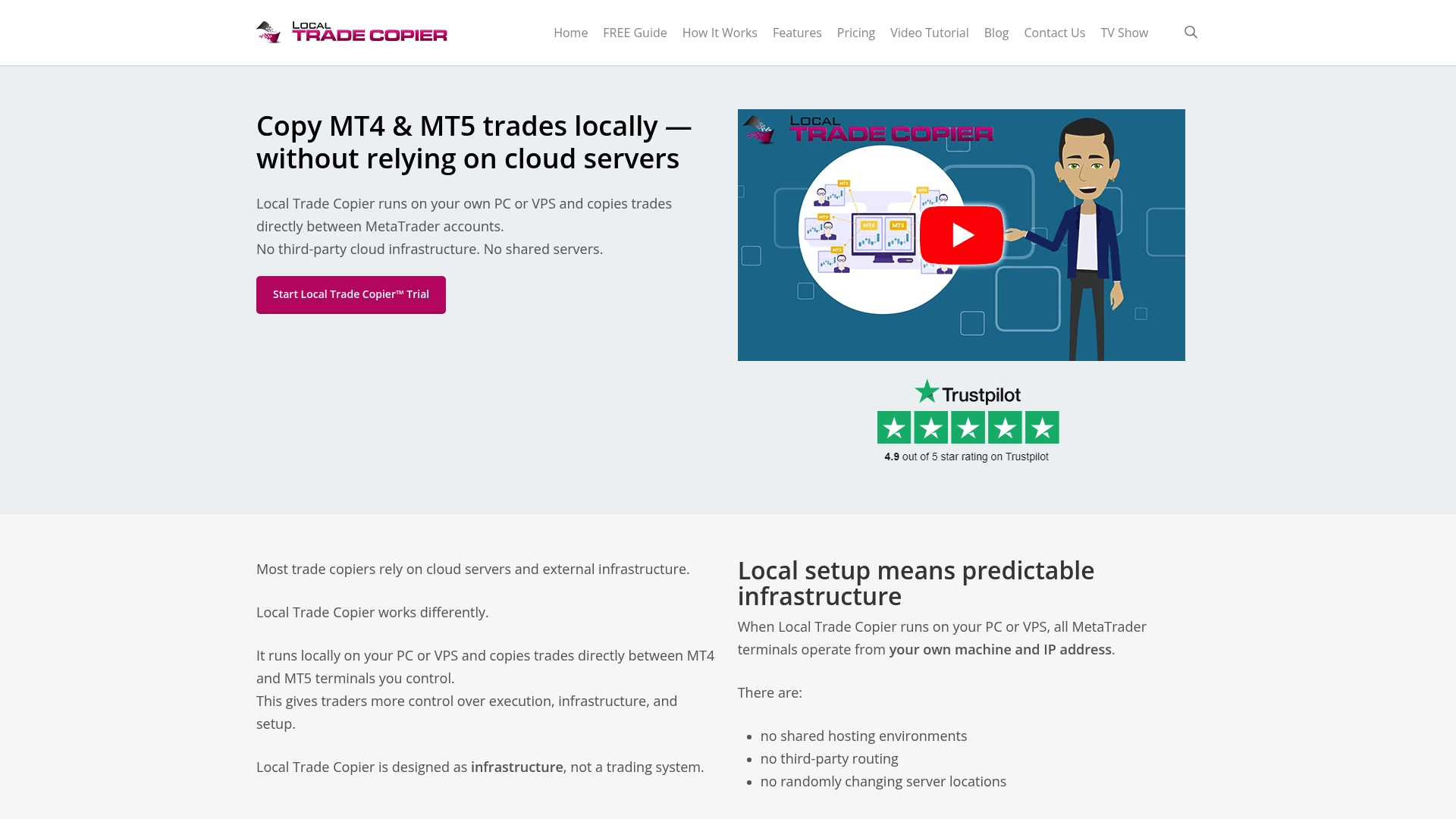
Understanding strategy is one thing. Executing it consistently across multiple accounts is another challenge entirely. Mt4copier is a locally installed Expert Advisor that copies trades from a master account to one or more client accounts across MetaTrader 4, MetaTrader 5, and DXTrade, with execution speed of 1 second or faster under normal market conditions and no cloud routing.
For traders who have done the educational work and developed a disciplined strategy, Mt4copier handles the mechanical side of replicating that strategy precisely, with eight money management modes and automatic lot scaling per account balance.
Watch the product demo to see how trade replication works in practice, or review the account security setup to protect the accounts you are trading. A 7-day free trial is available.
FAQ
Why use educational resources instead of just trading live?
Live trading without structured preparation amplifies costly behavioral errors. Educational resources build the decision-making framework and risk discipline that protect capital from the start.
What is the most effective format for trading education?
Research consistently shows that interactive, decision-oriented formats like simulations and scenario-based exercises outperform passive reading for both retention and behavioral change.
How does paper trading help build real trading skills?
Paper trading with full market tools and systematic journaling lets you practice entries, exits, and risk management without capital exposure, building discipline before real money is involved.
Does financial literacy actually improve trading decisions?
A meta-analysis of 57 studies found a correlation of 0.357 between financial literacy and investment decision quality, confirming that structured education consistently links to better outcomes. Past results do not guarantee future performance.
How often should traders engage with educational resources?
Ongoing, regular learning is more effective than single-course completion. Matching resources to your current experience level and market conditions keeps the learning relevant and applicable.
Recommended
- What is a trading educator? Role, skills, and impact
- What Is Trading Resource Optimization for Forex Traders
