

TL;DR: Low latency in Forex trading minimizes delays between trade signals and execution, reducing slippage. It is crucial for scalpers and automated traders but less impactful for long-term strategies. Using a nearby VPS and monitoring network stability improve execution speed and consistency.
Low latency in Forex trading is defined as the minimal delay between a trade signal and its execution on the broker’s server. That delay, measured in milliseconds, directly determines whether your order fills at the price you intended or at a worse one. For scalpers, Expert Advisor users, and anyone running automated systems, the importance of low latency in trading is not theoretical. It is the difference between a clean fill and a slipped entry that quietly erodes your edge over hundreds of trades. Understanding why low latency is important in forex starts with understanding what causes it and what it actually costs you.
Why low latency is important in forex trading
Latency is the round-trip time for your order to travel from your terminal to the broker’s server and back. The industry term for this is round-trip latency, and it is the standard metric brokers and VPS providers use to describe execution speed. Every millisecond of unnecessary delay increases the chance your order fills at a price different from the one you requested. That gap is called slippage.
Traders can lose 0.1–0.3 pips per trade due to latency in fast-moving markets. That sounds small, but across hundreds of trades per month, it compounds into a measurable drag on performance. Past results do not guarantee future performance, but the mechanical relationship between latency and slippage is consistent and well-documented.
The impact of latency on Forex is sharpest during high-volatility moments, such as NFP releases or central bank announcements. Prices move faster than most home internet connections can respond. Traders who are slower than market speed receive worse prices consistently. That is not bad luck. It is a structural disadvantage built into their setup.
What causes latency in Forex and how does it affect order execution?
Latency has several sources, and most traders only address the obvious one: internet speed. Physical distance is the largest single factor. A trader in London routing orders through a broker server in New York adds geographic delay that no internet upgrade can fix.
The main contributors to round-trip latency are:
- Physical distance between your terminal and the broker’s matching engine
- Network routing through multiple internet hops, each adding delay
- Broker server processing time, including risk engine checks before order acceptance
- Software overhead on your local machine, including MetaTrader’s own processing loop
The numbers tell a clear story. VPS co-location near a broker achieves 0.5–2ms round-trip latency, while a home internet connection typically delivers 30–150ms. For general Expert Advisor workflows, sub-30ms is the practical target. Scalpers need sub-10ms to execute their strategies reliably.
| Connection type | Typical round-trip latency | Best suited for |
|---|---|---|
| Home broadband | 30–150ms | Swing and position trading |
| Forex VPS (distant) | 10–30ms | General EA automation |
| VPS co-located near broker | 0.5–2ms | Scalping, high-frequency EAs |
Pro Tip: Test your actual round-trip latency using your broker’s ping tool or a third-party network monitor before choosing a VPS. Advertised speeds often differ from real-world performance under load.
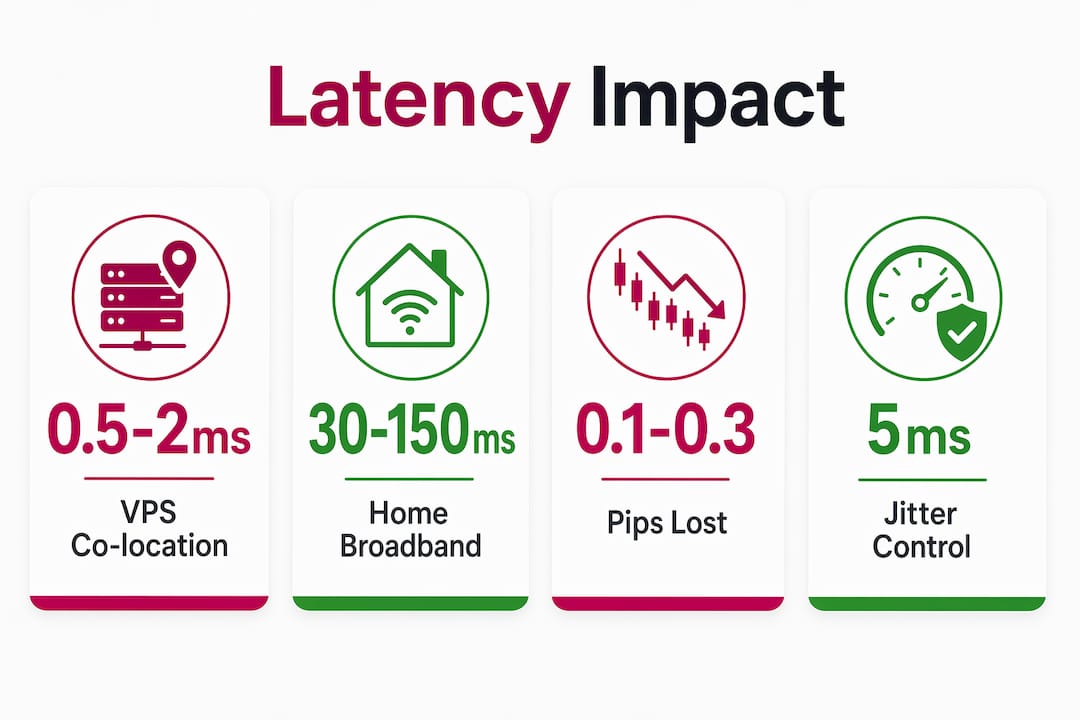
Infographic showing latency impact key stats
Broker-side processing adds its own layer. Every order passes through a risk engine before it reaches the matching engine. That internal check takes time. Traders have no control over it, which makes minimizing every other source of delay even more important.
How does low latency benefit different Forex trading strategies?
Not every trading style is equally sensitive to latency. The low latency benefits in Forex are largest for strategies that depend on precise entry timing and smallest for strategies that hold positions for days or weeks.

Hands holding phone reviewing trading strategies
Scalpers are the most latency-sensitive traders. A scalper targeting 2–3 pips per trade cannot absorb 1–2 pips of slippage without destroying the trade’s logic entirely. Sub-10ms execution is not a luxury for this group. It is a requirement.
Expert Advisor users running automated strategies face a similar constraint. An EA fires orders based on exact price conditions. If the order arrives at the broker 80ms after the signal triggers, the price has already moved. The EA’s logic was correct, but the execution was not.
Low latency improves execution reliability but does not create a trading strategy edge by itself. It enhances pre-existing edges by delivering stable, consistent fills and reducing slippage variability.
Swing and position traders holding trades for hours or days are far less affected. A 50ms delay on a trade you plan to hold for three days is irrelevant. The entry price difference from latency is noise compared to the trade’s total range.
The practical takeaway: if your strategy depends on entering within a specific pip range, latency is a core infrastructure concern. If your strategy tolerates wide entries, it is a minor one. The best scalping and copy trading setup for avoiding delay and slippage reflects this distinction directly.
What practical steps can traders take to reduce latency?
Reducing latency follows a clear hierarchy. Geographic proximity to the broker’s data center is the most impactful step, followed by network routing, and then software-level tweaks. Most retail traders get the order backwards.
- Choose a VPS near your broker’s matching engine. Major Forex brokers host their servers at data centers like Equinix LD4 in London or NY4 in New York. A Forex VPS near the broker cuts round-trip latency from 50–100ms to under 5ms in many cases.
- Verify the VPS provider’s actual ping to your broker. Ask the provider directly or test it yourself. Some VPS services advertise “low latency” without specifying which data centers they connect to.
- Minimize hops in your network path. Use a VPS with a direct fiber connection to the broker’s data center where possible. Each additional network hop adds 1–5ms of delay.
- Keep your trading terminal lean. Running unnecessary indicators, scripts, or background processes on the same machine increases software overhead. Internal system jitter from OS thread pre-emption or resource contention can add more delay than geographic distance.
- Monitor latency continuously, not just at setup. Network conditions change. A VPS that delivered 2ms latency in January may deliver 15ms in June after a routing change. Use your broker’s built-in ping display in MetaTrader or a dedicated monitoring tool.
Pro Tip: Practical latency optimization for retail traders comes primarily from VPS proximity. Advanced OS or code-level tweaks offer microsecond gains that rarely justify the cost or complexity for individual traders.
The network latency impact on trade copier speed follows the same hierarchy. If you are copying trades across multiple accounts, the copier’s execution speed is only as good as the underlying network connection it runs on.
What are the common misconceptions about low latency in Forex?
Low latency is widely misunderstood. Traders often treat it as a profit lever rather than an execution tool. That framing leads to poor decisions and misplaced expectations.
The most common misconceptions:
- “Low latency will make my strategy profitable.” Execution speed does not fix a flawed strategy. A bad entry signal executed at 1ms is still a bad entry. Low latency enhances pre-existing edges. It does not create them.
- “Average latency is what matters most.” Average latency is misleading. Tail latency spikes during volatility are more damaging than a high average. A system averaging 50ms that spikes to 150ms during an NFP release will miss trades and receive poor fills at exactly the worst moment.
- “Better technology eliminates all execution risk.” No setup eliminates slippage during major news events. Latency cannot overcome poor fills caused by liquidity withdrawal or widened spreads. When a broker’s liquidity providers pull back, no amount of speed helps.
- “OS tweaks are worth the effort for retail traders.” Kernel-level optimizations and custom network stacks are standard in institutional high-frequency trading. For retail traders, these tweaks deliver microsecond gains that are irrelevant compared to the millisecond improvements available from simply moving your VPS closer to your broker.
Jitter control matters more than chasing a lower average. A system with consistent 5ms latency outperforms one that averages 3ms but spikes unpredictably. Stability is the real target.
Key Takeaways
Low latency in Forex trading is an execution efficiency tool that reduces slippage and improves fill quality, but it requires the right infrastructure and a sound strategy to deliver real value.
| Point | Details |
|---|---|
| Latency directly causes slippage | Traders can lose 0.1–0.3 pips per trade from latency, which compounds across high-volume strategies. |
| VPS proximity is the biggest lever | Co-located VPS near broker servers achieves 0.5–2ms latency versus 30–150ms on home internet. |
| Strategy type determines sensitivity | Scalpers and EA users need sub-10ms execution; swing traders are largely unaffected by latency. |
| Tail latency beats average latency | Spikes during news events cause more damage than a high average, so stability matters more than speed. |
| Latency does not fix poor strategy | Execution speed enhances existing edges. It cannot create profitability where none exists. |
Latency is a tool, not a shortcut
Traders sometimes spend weeks focused on shaving 2ms off their average ping while running a strategy with a negative expectancy. That is the wrong priority order. Latency optimization is infrastructure work. It belongs in the same category as choosing a reliable broker or keeping your VPS updated. It is maintenance, not alpha.
Traders who benefit most from low latency setups are the ones who already had a working edge. Moving to a VPS near the broker’s data center and cleaning up the terminal typically produces cleaner fills. The strategy does not change. The fills do.
The nuance most articles skip is jitter. A trader with a 10ms average latency that spikes to 120ms during London open is in worse shape than one running a steady 15ms. Consistency is what automated systems need. Unpredictable delays break EA logic in ways that are hard to diagnose because the strategy looks correct in backtesting.
The practical recommendation: get your VPS within the same data center as your broker’s matching engine, then stop. The returns on further optimization diminish fast. Spend the remaining time on strategy, risk settings, and trade execution workflow. That is where the real edge lives.
How Mt4copier supports low-latency trade execution
Traders who run multiple accounts face a compounded latency problem. Every account that receives a copied trade adds another execution step. Cloud-based copiers introduce external server routing, which adds latency and creates a single point of failure.
Mt4copier’s Local Trade Copier runs entirely on your local Windows machine or VPS, with no cloud routing. All trade data stays on one machine, one IP address, and copies execute in 1 second or faster under normal market conditions. That architecture keeps latency low and eliminates the cloud routing risk that matters especially for prop firm traders. Mt4copier has served 3,000+ traders since 2010 and carries 491 Trustpilot reviews. A 7-day free trial is available, and the plan covers MT4, MT5, and DXTrade copying under one subscription. You can also review the VPS security setup guide to protect your accounts while maintaining continuous, low-latency execution.
FAQ
What is latency in Forex trading?
Latency in Forex trading is the round-trip time for an order to travel from your terminal to the broker’s server and back. Lower latency means faster execution and less slippage.
How much latency is acceptable for Forex EAs?
Sub-30ms round-trip latency is the practical target for most Expert Advisor workflows. Scalping strategies require sub-10ms to execute reliably without significant slippage.
Does a Forex VPS reduce latency?
A VPS co-located near the broker’s data center reduces round-trip latency to 0.5–2ms, compared to 30–150ms on a standard home internet connection.
Can low latency make a losing strategy profitable?
No. Low latency improves fill quality and reduces slippage on existing edges. It does not create profitability where a strategy has none. Past results do not guarantee future performance.
What is tail latency and why does it matter?
Tail latency refers to latency spikes at the high end of the distribution, such as P99 or P99.9 percentiles. These spikes during volatile news events cause missed trades and poor fills, making them more damaging than a high average latency.
Recommended
- Network Connection Latency Impact to MT4 Trade Copier Speed
- How technology sharpens your edge in forex trading
- Scalping and Copy Trading on MT4 and MT5 (Best Setup to Avoid Delay and Slippage)
- Why speed matters in trade copying: boost profits & cut risk
