

TL;DR: Efficient trade execution involves rapid order submission, routing, and filling at the best prices with minimal delay and cost. Automating workflows, utilizing smart order routing, and implementing algorithmic order splitting significantly reduce slippage, spread costs, and latency for forex traders managing multiple accounts across platforms. Regularly measuring and reviewing key execution metrics ensures continuous improvement and optimal trade outcomes over time.
Efficient trade execution is defined as the process of submitting, routing, and filling orders at the best available price with the least possible delay and cost. For forex and financial traders managing multiple accounts across MetaTrader 4, MetaTrader 5, and DXTrade, knowing how to streamline trade execution is the difference between capturing a signal and watching it expire. The core tools include algorithmic order splitting strategies like VWAP and TWAP, smart order routing, event-driven architectures, and workflow automation platforms. Execution quality is measured by slippage, fill rate, spread cost, and time-to-fill. Each of these metrics tells you something specific about where your process is losing ground.
How to streamline trade execution: foundational tools and systems
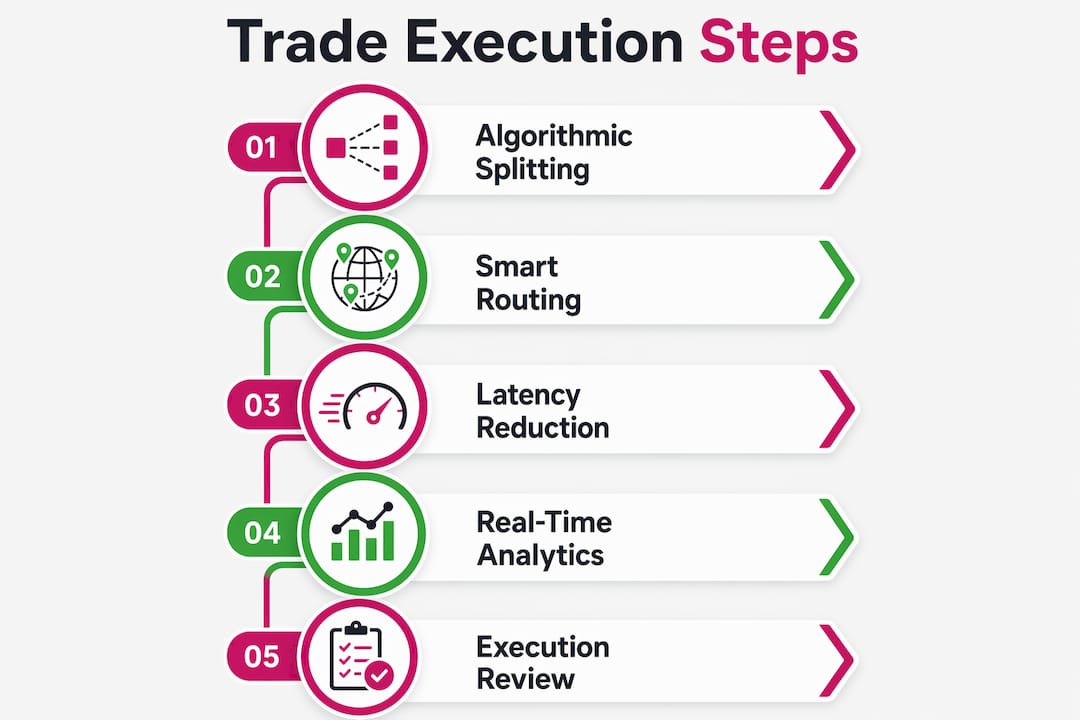
Infographic illustrating trade execution process steps
Automated execution platforms are the starting point for any trader serious about improving order management across multiple terminals. Platforms integrating MT4, MT5, and DXTrade under a single workflow eliminate the manual re-entry that introduces both delay and error. Trading firms use 4 to 8 separate applications per trade cycle, and automating that workflow reduces errors, cuts costs, and accelerates execution. That figure explains why so many traders feel friction even when their strategy is sound. The bottleneck is operational, not analytical.

Hands using automated trading platform tools
Smart order routing (SOR) technology selects the best available venue dynamically at the moment of order submission. Rather than defaulting to a single broker’s internal pool, SOR evaluates price, liquidity, and latency across multiple venues and routes accordingly. For retail forex traders, this matters most during high-impact news events when broker internalization can produce adverse fills. Pairing SOR with real-time market data feeds gives you the visibility to act before a fill completes rather than reviewing damage afterward.
Workflow automation reduces the manual steps between signal generation and order submission. This includes automated lot sizing, exception handling, and algo selection. Automation in order staging and exception handling reduces latency and operational risk, freeing traders for higher-value decisions. The practical result is fewer missed entries and fewer fat-finger errors during fast markets.
| Tool/Platform | Core execution feature | Best use case |
|---|---|---|
| MT4/MT5 Expert Advisors | Automated order submission and management | Retail multi-account traders |
| Smart order routing systems | Dynamic venue selection at submission | High-frequency and news traders |
| Execution management systems (EMS) | Real-time analytics and compliance tracking | Active traders needing post-trade data |
| Local trade copiers | Cross-platform replication in 1 second or faster | Account managers and prop firm traders |
| VWAP/TWAP schedulers | Algorithmic order splitting over time | Large order traders minimizing market impact |
The table above reflects the most common infrastructure layers. Most retail traders need at least two of these working together. An Expert Advisor handling order logic combined with a local trade copier for cross-account replication covers the majority of multi-platform execution needs without requiring institutional infrastructure.
How to optimize order execution with algorithmic order splitting
VWAP and TWAP are the two most widely used algorithmic execution schedules, and they solve different problems. VWAP (Volume-Weighted Average Price) distributes your order in proportion to historical volume patterns throughout the trading session, concentrating fills during high-liquidity windows. TWAP (Time-Weighted Average Price) splits the order into equal time slices regardless of volume. VWAP is better when you want to blend into natural market flow. TWAP is better when you need predictable, evenly distributed execution across a fixed window.
Splitting large orders using algorithmic schedules like VWAP or TWAP cuts expected transaction costs by 20 to 40% compared to simple market orders. That cost reduction compounds significantly over a high-frequency trading week. For traders running multiple funded accounts, the savings in spread and slippage across dozens of daily trades are material.
Here is a practical sequence for implementing algorithmic order splitting across your trading day:
- Identify your order size relative to market volume. Research shows that RL execution edges only appear for orders above 20% of 10-minute volume. Below that threshold, simple TWAP scheduling performs comparably to complex models.
- Select your algorithm based on market regime. In trending, high-volume sessions like the London-New York overlap, VWAP aligns fills with natural liquidity. In low-volume or ranging conditions, TWAP prevents you from chasing volume that isn’t there.
- Set your execution window. Define the start and end time for your schedule. Avoid spanning major news releases unless your strategy specifically requires it.
- Configure participation rate limits. Cap your order’s share of market volume per interval to avoid moving price against yourself.
- Review fill quality after each session. Compare your average fill price against the VWAP benchmark for that period. Consistent underperformance signals a parameter adjustment is needed.
Pro Tip: Set execution parameters based on market regime and liquidity conditions rather than using a single fixed schedule. A VWAP schedule calibrated for the London session will produce poor results if applied unchanged to the Asian session, where volume patterns differ significantly.
Soft allocation strategies that blend multiple execution approaches based on probabilistic models reduce costs and avoid fragile sudden shifts between algorithms. This is more advanced but worth understanding as your execution volume grows.
What techniques reduce latency and improve execution speed?
Latency in trade execution comes from two sources: network architecture and workflow design. Addressing both is necessary for traders who need fills within milliseconds of signal generation.
Event-driven order management using webhooks and streaming data reduces latency compared to REST polling. Polling-based bots check for updates at fixed intervals, which means they can miss a price move between checks. Streaming architectures push updates the moment they occur. For scalping strategies or copy trading setups where a 200-millisecond delay changes the fill price, this architectural choice is not optional.
Practical techniques to reduce execution latency:
- Use a local VPS close to your broker’s server. Physical proximity reduces round-trip time. A VPS in London connecting to a London-based broker server will consistently outperform a home connection routed through multiple ISP hops.
- Avoid batching for time-sensitive orders. Batching delays execution and is unsuitable for live, time-critical order flow. Process each order individually when speed matters.
- Set hard spread tolerance thresholds. Default broker routing risks adverse fills. Setting a maximum spread of 0.5 pips for EUR/USD, for example, rejects wide quotes during liquidity events and prevents poor fills from entering your account.
- Separate your execution terminal from your analysis terminal. Running charting software, news feeds, and order management on the same machine creates resource competition that adds latency.
- Monitor venue latency and adjust routing dynamically. A venue that performs well during London hours may slow during the Asian session. Build latency checks into your weekly review process.
Pro Tip: Monitor venue latency on a per-session basis, not just as a daily average. Session-level data reveals patterns that daily averages hide, and those patterns directly inform which venues to prioritize at specific times.
The best execution standard requires real-time visibility into order staging and venue routing. Relying on post-trade review alone is insufficient. Traders who can intervene during an order, not just after it, consistently achieve better fill quality.
How do you measure and improve execution quality over time?
Execution quality measurement is the practice of systematically comparing your actual fills against objective benchmarks to identify where your process is losing value. Most traders skip this step and wonder why their strategy underperforms its backtest. The gap is almost always in execution, not signal quality.
Follow this process to build a continuous improvement loop:
- Track four core metrics every week: slippage (difference between expected and actual fill price), spread cost (total spread paid per trade), fill rate (percentage of orders filled at or better than requested), and time-to-fill (elapsed time from order submission to confirmation).
- Run a weekly execution report review. Pull your trade log and sort by slippage. Flag any trade where slippage exceeded your threshold. Investigate the time, venue, and market conditions for each flagged trade.
- Use time and sales data to identify high-liquidity windows. Scheduling your larger orders during peak liquidity periods reduces both slippage and spread cost. For EUR/USD, the London-New York overlap between 8 AM and 12 PM EST consistently offers the tightest spreads.
- Adjust your slippage buffer dynamically using ATR. Retail traders applying a 1.5x ATR dynamic slippage buffer can control spread costs during volatile periods. During a high-ATR session, your tolerance widens automatically. During calm conditions, it tightens to protect fill quality.
- Separate execution quality from trade outcome quality. Traders who separate execution quality from outcome quality gain an edge by conducting systematic post-mortems on fills and timing. A trade can be profitable despite poor execution, which masks the underlying problem until it compounds.
Real-time execution analytics embedded in trading workflows are necessary for maintaining best execution standards. Reviewing fills three days after the fact tells you what happened. Monitoring them in real time lets you fix it before the session ends.
Key takeaways
Faster, lower-cost trade execution requires combining algorithmic order splitting, event-driven architecture, hard spread tolerances, and weekly fill quality reviews into a single repeatable workflow.
| Point | Details |
|---|---|
| Algorithmic order splitting saves cost | VWAP and TWAP reduce transaction costs by 20 to 40% versus simple market orders. |
| Event-driven architecture cuts latency | Streaming data and webhooks outperform polling-based systems for time-sensitive orders. |
| Hard spread tolerances prevent poor fills | Setting a maximum spread threshold rejects adverse quotes during liquidity events. |
| Weekly execution reviews close the feedback loop | Tracking slippage, fill rate, and time-to-fill weekly identifies problems before they compound. |
| Separate execution quality from trade outcomes | Systematic fill post-mortems reveal execution inefficiencies that profitable trades can hide. |
Why execution quality deserves its own process
Many traders treat execution as a byproduct of their strategy. They focus on entry signals, risk-reward ratios, and drawdown management, then assume the broker handles the rest. That assumption is expensive. The traders who consistently perform well over time are the ones who treat execution as a separate discipline with its own metrics, review cadence, and improvement process.
The counterintuitive part is that better execution doesn’t always feel different in the short run. A 0.3-pip improvement in average fill quality on 50 trades a week is invisible on any single trade. Across a year, it’s a meaningful number. The same logic applies to latency. Shaving 200 milliseconds off an average time-to-fill won’t change how a single trade feels. It will change the fill rate on fast-moving setups over hundreds of trades.
What actually works is treating an execution setup the way a strategy is treated: test it, measure it, and adjust it based on data rather than intuition. Traders who automate their trade management across platforms and then monitor execution metrics weekly are the ones who close the gap between backtest performance and live results. Technology handles the speed. Process handles the quality. Both matter.
How Mt4copier removes execution friction across platforms
If you’re managing trades across MT4, MT5, and DXTrade accounts, manual re-entry between terminals is the single largest source of execution delay and error in your workflow. Mt4copier’s Local Trade Copier replicates orders from a master account to multiple client accounts in 1 second or faster under normal market conditions, running entirely on your local Windows machine or VPS with no cloud routing. That means one IP address, no external server latency, and no cloud detection risk for prop firm accounts.
Mt4copier includes eight money management modes for lot sizing and risk management, automatic lot scaling per account balance, and full cross-platform support under a single subscription. Whether you’re copying from MT4 to DXTrade or replicating an EA strategy across funded accounts, the trade copier for MT4 and MT5 handles the execution layer so your strategy runs consistently across every account. A 7-day free trial is available with no commitment required.
FAQ
What is the fastest way to improve trade execution quality?
Set hard spread tolerance thresholds, switch to event-driven order management using streaming data, and run weekly slippage reviews. These three changes address the most common sources of poor fill quality for retail forex traders.
When should you use VWAP versus TWAP for order splitting?
Use VWAP when you want fills to align with natural market volume patterns during active sessions. Use TWAP when you need evenly distributed execution across a fixed time window regardless of volume.
How does a local trade copier reduce execution latency?
A locally installed trade copier like Mt4copier runs on your machine or VPS with no cloud routing, which eliminates external server latency and delivers replication in 1 second or faster across MT4, MT5, and DXTrade accounts.
What metrics should you track to measure execution performance?
Track slippage, spread cost, fill rate, and time-to-fill on a weekly basis. These four metrics identify where your execution process is losing value relative to your expected entry and exit prices.
Does algorithmic order splitting work for small retail orders?
For orders below 20% of 10-minute market volume, simple TWAP scheduling performs comparably to complex reinforcement learning models. Algorithmic complexity adds measurable value only when order size is large enough to move price.
Recommended
- What Is Trade Execution Speed? A Trader’s Guide
- Why speed matters in trade copying: boost profits & cut risk
- Boost Trading Efficiency with Automated Trade Copying
- What Is Trading Resource Optimization for Forex Traders
