

TL;DR:
- Subscription models in trading tools determine access to market data, features, and automation capabilities critical for active trading. Retail traders typically start with free or low-cost tiers, upgrading only when specific needs are unmet, while institutional providers offer enterprise-level data solutions with customized delivery and stricter usage controls. Managing subscription renewals, understanding hidden costs, and aligning features with workflow needs are essential to controlling expenses and operational risks.
Subscriptions in trading tools are the primary mechanism through which traders gain controlled, tiered access to market data, analytics, charting software, and execution automation. The role of subscriptions in trading tools extends far beyond a simple payment model. It determines what data you see, how fast you see it, which features you can use, and whether your automated systems keep running without interruption. Whether you trade on TradingView, rely on Bloomberg for institutional data, or use a journal like Tradervue to track performance, every layer of your trading setup is shaped by subscription economics.
How subscription models structure access to trading features
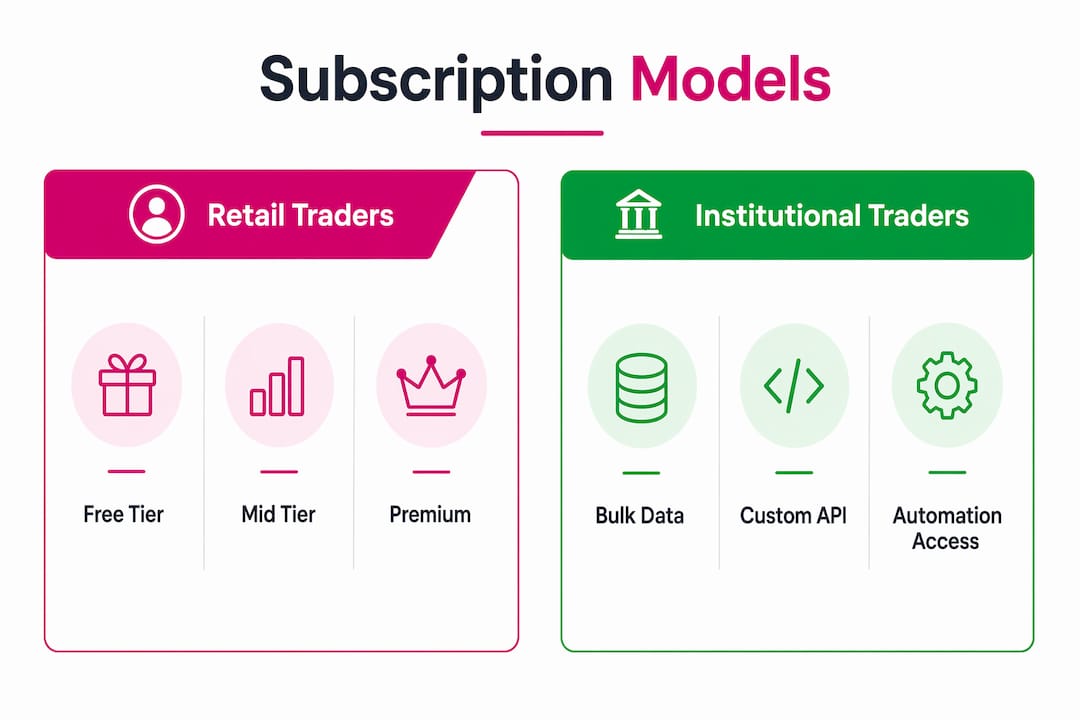
Subscription models in trading divide access into tiers, and the tier you pay for determines the quality and speed of your data. Delayed market data typically runs 15 to 20 minutes behind real-time feeds, and while it is free or near-free, it is unsuitable for active intraday trading. Real-time data requires a paid subscription, and professional-grade feeds cost 3 to 10 times more than non-professional equivalents. That gap reflects exchange monetization strategy, not arbitrary pricing.

For retail traders, the entry point is usually a charting platform. Retail charting upgrades typically cost $15 to $30 per month, with real-time data scanners adding further cost on top. This means a retail trader running a basic active setup can easily spend $50 to $80 per month before adding any automation layer. Free tiers from platforms like TradingView offer genuine capability for beginners, but they gate features like multiple chart layouts, custom indicators, and real-time alerts behind paid plans.
Institutional traders operate under a different model entirely. Bloomberg Data License provides customizable bulk data feeds delivered via REST API or cloud providers, covering ESG data, pricing, fundamentals, and risk management. These are enterprise contracts, not monthly subscriptions, and they are priced accordingly. The focus at the institutional level is not just data quality but delivery consistency and workflow integration.
The table below shows how subscription tiers typically compare across trader profiles:
| Tier | Data type | Typical cost | Key features |
|---|---|---|---|
| Free | Delayed (15-20 min) | $0 | Basic charting, limited indicators |
| Retail standard | Real-time | $15–$30/month | Full charting, alerts, scanners |
| Retail professional | Real-time + extras | $50–$100/month | Advanced analytics, API access |
| Institutional | Bulk feeds, API | Enterprise pricing | Custom delivery, multi-asset, cloud |
Pro Tip: Before upgrading from a free tier, identify the specific feature blocking your workflow. Upgrading for vague “better tools” wastes money. Upgrading because delayed data cost you a trade entry is a justified business decision.
How subscriptions enforce licensing in trading automation
Automated trading tools introduce a different dimension to subscription models. Here, subscriptions are not just about data access. They are operational controls that determine whether your Expert Advisor or trade copier runs at all. License profiles in MT4 and MT5 automation tools enforce account limits, activation windows, and time-based expiry, validated at startup through encrypted verification.
This matters because a lapsed subscription on an automated system does not just mean you lose access to a dashboard. It means your live positions may stop being managed. The subscription is woven into the execution layer itself. Developers use this model for two reasons: to protect intellectual property and to maintain a recurring revenue structure that funds ongoing development.
Key elements that subscription licensing typically controls in automation tools include:
- Account binding: The license ties to a specific account number or terminal, preventing unauthorized copying to other machines.
- Activation limits: A single subscription may allow one or two active terminals, with additional activations requiring a higher tier.
- Expiry enforcement: Runtime license validation checks expiry at startup and can halt execution if the subscription has lapsed.
- Time windows: Some tools restrict usage to specific trading sessions or calendar periods tied to the subscription tier.
- Fail-safe behavior: Well-designed systems define what happens at expiry, whether the EA pauses, closes positions, or simply stops opening new trades.
Institutional automation tiers priced around $99 per month typically add multi-account support, automated execution from API signal feeds, and portfolio-level reporting. These features do not just expand capability. They change the operational workflow from manual signal review to fully automated execution, which carries its own risk management requirements.
Pro Tip: Set a calendar reminder 7 days before any automation subscription renews or expires. An unexpected lapse on a live account is an operational risk, not just an inconvenience. Treat subscription renewal as part of your trading system maintenance.
What does the cost of trading tool subscriptions actually include?
The headline price of a trading tool subscription rarely reflects the total cost. Hidden costs such as premium data add-ons, priority API access, overage charges, and execution fees routinely inflate actual trader expenses well beyond the base subscription rate. A retail trader who signs up for a $29/month charting platform may find that real-time options data, extended hours scanning, and a second device login each carry separate fees.
For retail traders, the practical budgeting approach is to start with free or delayed data tiers and upgrade only when a specific workflow gap appears. This is not about being frugal. It is about avoiding the common trap of paying for features you do not use because the marketing made them sound necessary.
Institutional traders face a different cost structure. Data usage constraints such as per-display limits and internal versus external distribution rights can trigger costly renegotiations if exceeded. A firm that starts distributing a licensed data feed to additional internal desks without updating its contract may face retroactive fees. This is a real operational risk that finance teams often underestimate.
Common cost components that basic subscriptions typically exclude:
- Real-time data for specific exchanges (often sold separately from the platform subscription)
- Premium news feeds and earnings calendars
- API call volume beyond a monthly threshold
- Additional user seats or terminal activations
- Historical data downloads beyond a set date range
- Priority customer support or dedicated account management
Tradervue’s free plan caps trade imports at 100 per month, which is sufficient for swing traders but limiting for active day traders who may execute dozens of trades daily. The paid tier removes that cap and adds advanced analytics. This is a clear example of how subscription tiers directly shape workflow capacity, not just feature access.
Best practices for selecting and managing trading subscriptions
The most effective approach to managing trading tool subscription services is to treat your subscription stack the same way you treat a trading position: with defined entry criteria, regular review, and a clear exit plan if it stops delivering value.
- Start with free tiers and trials. TradingView, Thinkorswim, and similar platforms offer substantial free capability that is sufficient for most beginners. Use the free tier until you hit a specific, named limitation that affects your trading.
- Audit your subscriptions quarterly. List every active subscription, its monthly cost, and the last time you used a feature exclusive to that paid tier. Cancel anything where the answer is “more than 30 days ago.”
- Match the subscription to a workflow constraint. If real-time scanning is not part of your strategy, paying for real-time data is waste. Subscription value maximizes when tied to a quantifiable workflow need, not a general desire for better tools.
- Evaluate automation tiers by operational impact. A higher automation tier that enables multi-account execution changes your risk exposure and requires updated risk management procedures. Factor that into the cost-benefit analysis.
- Negotiate enterprise pricing when volume justifies it. Institutional data providers and automation platforms often have unpublished pricing for multi-seat or multi-account arrangements. Asking directly costs nothing.
Pro Tip: When comparing two subscription tiers, calculate the cost per trade or cost per signal rather than the monthly fee. A $99/month plan that supports 500 trades costs $0.20 per trade. A $29/month plan capped at 100 trades costs $0.29 per trade. The cheaper plan is often the more expensive one.
Key takeaways
Subscription models in trading tools control data access, feature availability, and execution rights simultaneously, making them one of the most consequential cost decisions a trader makes.
| Point | Details |
|---|---|
| Tiered data access | Real-time data costs 3 to 10 times more than delayed feeds; match the tier to your strategy speed. |
| Automation licensing risk | Lapsed automation subscriptions can halt live execution; treat renewal as a system maintenance task. |
| Hidden cost exposure | Base subscription prices exclude data add-ons, API overages, and extra seats; budget for the total stack. |
| Start lean, upgrade with intent | Free tiers from TradingView and similar platforms cover most beginner needs; upgrade only when a specific gap appears. |
| Institutional complexity | Enterprise data licenses carry usage constraints and distribution limits that require active compliance management. |
What I’ve learned about subscription costs the hard way
I have watched traders make the same mistake repeatedly: they subscribe to every tool that sounds useful, then wonder why their trading costs are eating into their results. The subscription stack creeps up quietly. A $15 charting upgrade here, a $29 scanner there, a $49 journal with advanced analytics, and suddenly you are spending $150 a month on tools before placing a single trade. Past results do not guarantee future performance, but unnecessary fixed costs are a guaranteed drag on any trading account.
The part that surprises most traders is how subscription enforcement in automation tools can create operational risk they never anticipated. A license expiry on a trade copier running across multiple accounts is not a minor inconvenience. It is a live operational failure. I have seen traders miss the renewal window and wake up to accounts that stopped copying hours earlier. The license activation system in any automation tool deserves the same attention as your broker’s margin requirements.
My honest recommendation is to think of your subscription stack as a second trading system. It needs a defined structure, regular review, and clear criteria for what stays and what gets cut. The traders who manage this well are not necessarily the ones spending the most. They are the ones spending with precision, knowing exactly what each subscription does for their specific workflow. That discipline, applied to costs, reflects the same thinking that separates consistent traders from those who are always searching for the next tool to fix their results.
— Rimantas
Trade automation with clear subscription terms
If you are managing trades across multiple MetaTrader 4, MetaTrader 5, or DXTrade accounts, Mt4copier’s Local Trade Copier gives you sub-0.5-second local execution with no cloud routing and no external latency. The subscription covers the MT4 copier, MT5 copier, and DXTrade components under one plan, with a 7-day free trial to test it against your actual workflow.
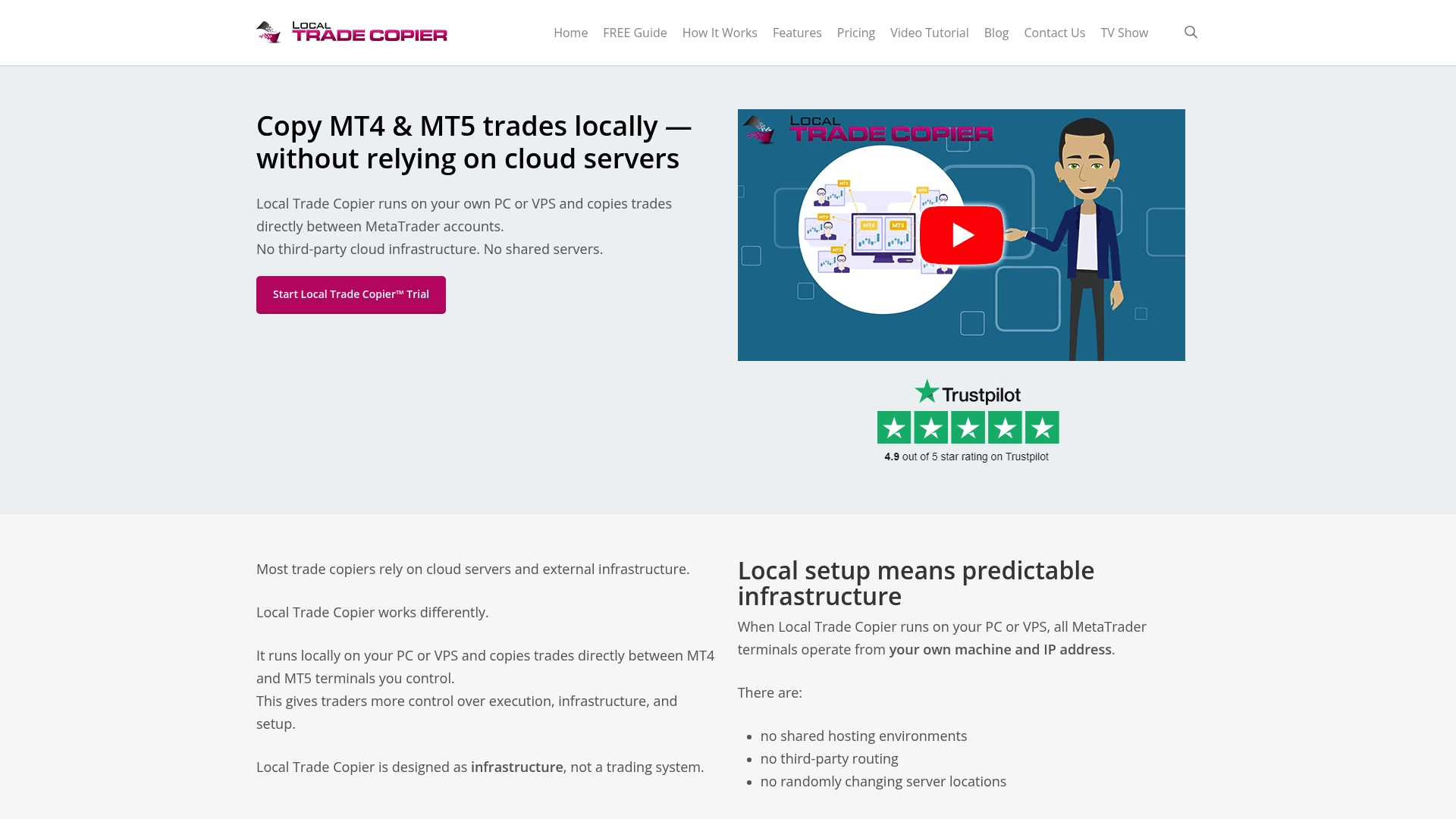
Mt4copier has been active since 2010, serves 3,000+ users, and holds 491 Trustpilot reviews. The pricing plans are structured to fit both single-account retail traders and independent account managers copying to multiple client accounts. All trade data stays on your machine, which matters for prop firm traders who need to avoid cloud IP detection. Review the full plan options and start your trial without a credit card commitment.
FAQ
What does a trading tool subscription typically include?
A trading tool subscription typically includes access to charting software, market data at a specified latency tier, and platform features gated by plan level. Add-ons like real-time data for specific exchanges, API access, and additional terminal activations are usually priced separately.
Why does real-time data cost so much more than delayed data?
Professional real-time feeds cost 3 to 10 times more than delayed equivalents because exchanges charge premium rates for low-latency access, and brokers pass those costs through to traders. Delayed data is subsidized as a loss leader to attract users to paid tiers.
Can a lapsed subscription affect live automated trading?
Yes. Automation tools that use runtime license validation check subscription status at startup and can halt execution if the license has expired. Traders running live EAs or trade copiers should treat subscription renewal as a critical operational task.
How should retail traders budget for trading tool subscriptions?
Start with free tiers and identify specific workflow gaps before upgrading. Retail charting upgrades typically cost $15 to $30 per month, and the total stack including data feeds and journals can reach $100 to $150 per month for an active trader. Audit usage quarterly and cancel tools that no longer serve a defined function.
What is the difference between retail and institutional subscription models?
Retail subscriptions are monthly, self-serve, and feature-gated by plan level. Institutional models like Bloomberg Data License are enterprise contracts with custom bulk data delivery, API integration, and usage constraints tied to distribution rights. Exceeding those constraints can trigger costly renegotiations.
Recommended
- How To Copy Forex Signals | MT4Copier.com
- Why Use Educational Resources in Trading for Better Results
- Local Trade Copier for MT4 & MT5 Under One Subscription
- Trade Copier for MT4 and MT5 – Forex Copy Trading Software
