

TL;DR:
- Copy trading automatically replicates trades from a master account to follower accounts using various platforms.
- Proper risk controls, symbol mapping, and testing are essential for safe and effective copy trading.
- Successful copy trading relies more on disciplined risk management than on automation alone.
Copy trading sounds like a shortcut to profits, but the numbers tell a more complicated story. A 90-day study of crypto copy trading platforms found a 48.48% win rate for followers across 100,236 outcomes — a pattern of follower underperformance consistent with findings across copy trading research — even when most signal providers are profitable. This shows that automation alone doesn’t guarantee results. For retail forex traders and account managers, the difference between a smooth, scalable operation and a costly mistake often comes down to understanding the mechanics, choosing the right platform, and applying disciplined risk controls from day one. This guide walks you through exactly how copy trading works, how MetaTrader and DXTrade stack up, and what you need to do to protect your capital while scaling efficiently.
Key Takeaways
| Point | Details |
|---|---|
| Copy trading automation | Copy trading automatically replicates trades from a master to follower accounts, saving time for forex traders. |
| Risk is not eliminated | Performance varies and followers often see lower returns than masters because of platform and execution differences. |
| Platform choice matters | MetaTrader and DXTrade offer different tools for copying trades, which impacts usability and risk controls. |
| Best practices boost safety | Demo testing, diversified providers, and strong risk controls make copy trading safer and more effective. |
What is copy trading and how does it work?
At its core, copy trading is an automated process where trades from a master account are replicated in real time to one or more follower accounts. The master account, also called the signal provider, places a trade, and that signal is instantly transmitted to every connected follower account. No manual entry, no delay from watching charts, no missed fills because you stepped away from your desk.
The two main roles in any copy trading setup are straightforward:
- Master account (signal provider): The account generating the trades. This is the source of truth for the entire operation.
- Follower account (slave or sub-account): The account receiving and replicating those trades automatically.
The platforms most commonly used for this are MetaTrader 4, MetaTrader 5, and DXTrade. Each supports copy trading through different mechanisms, which we’ll cover in the next section.
Once the connection is established, the system handles three core tasks: signal generation, trade syncing, and allocation. Allocation is where things get interesting. Most platforms and copier tools offer multiple methods:
- Fixed lot: Every follower copies the same lot size regardless of account balance.
- Proportional: Lot size scales relative to the follower’s account balance compared to the master.
- Hybrid: A combination of both, often with additional risk caps or drawdown triggers.
The allocation method you choose has a direct impact on risk exposure. A fixed lot that works fine for a $50,000 account can wipe out a $5,000 follower account in a single bad trade.
Why do traders use copy trading? The reasons go beyond convenience. Account managers use it to run dozens of client accounts from a single master position. Prop firm traders use it to replicate a strategy across multiple funded accounts without re-entering every trade. EA developers use it to deploy one licensed strategy across several terminals simultaneously. A solid forex trade copier handles all of this without the manual overhead.
If you want a deeper look at the mechanics before diving into platform comparisons, the guide to trade copying covers the full workflow in detail.
MetaTrader vs. DXTrade: Platform differences for copy trading
With copy trading defined, the next step is choosing the right platform and tools for your needs. MetaTrader and DXTrade approach copy trading very differently, and that difference matters depending on your workflow.

Woman comparing trading platforms laptop screens
MetaTrader (MT4 and MT5) relies on Expert Advisors (EAs) and third-party copier software. There’s no built-in copy trading hub, but the ecosystem is massive. You get wide broker support, cross-broker copying, and the flexibility to configure nearly every parameter. Tools like Local Trade Copier plug directly into the terminal and handle everything on your local machine or VPS. The tradeoff is that setup requires more configuration upfront.
DXTrade takes a different approach. It includes a built-in copy trading hub with a provider and follower directory, multiple allocation modes, and integrated risk controls. The setup is more streamlined for brokers and their clients, but the cross-platform flexibility is more limited unless you use a specialized bridge tool.
| Feature | MetaTrader (MT4/MT5) | DXTrade |
|---|---|---|
| Copy trading mechanism | EAs and third-party copiers | Built-in hub and directory |
| Allocation modes | Fixed, proportional, hybrid (via copier) | Fixed, proportional, hybrid (native) |
| Cross-broker support | Strong | Limited natively |
| Risk controls | Configurable via EA settings | Native drawdown and risk modes |
| Cross-platform copying | Supported via bridge tools | Supported via specialized EAs |
| Setup complexity | Moderate to high | Low to moderate |
MetaTrader uses EAs or API copiers like Local Trade Copier, while DXTrade has a built-in directory with varied allocation modes. For traders who need to move positions across both ecosystems, cross-platform solutions exist that let you sync MT4 with DXTrade in real time.
Key differences to watch for when copying across platforms:
- Symbol mapping: EUR/USD on MT4 might be labeled differently on DXTrade. Mismatches cause missed or failed copies.
- Slippage controls: Each platform handles order execution differently. Check whether your copier tool lets you set slippage limits.
- Latency: Local execution eliminates cloud routing delays. If you’re using a cloud-based solution, factor in the extra milliseconds.
Pro Tip: Before going live on any cross-platform setup, verify symbol names on both ends and run a test trade in a demo environment. A single symbol mismatch can silently block every copy. Review the trade copier installation process to understand how mapping is configured from the start, and check how trade copier works to see the full execution flow.
Benefits and risks of copy trading
Comparing platforms reveals feature differences, but the real-world outcome depends on the benefits and risks you accept going in.
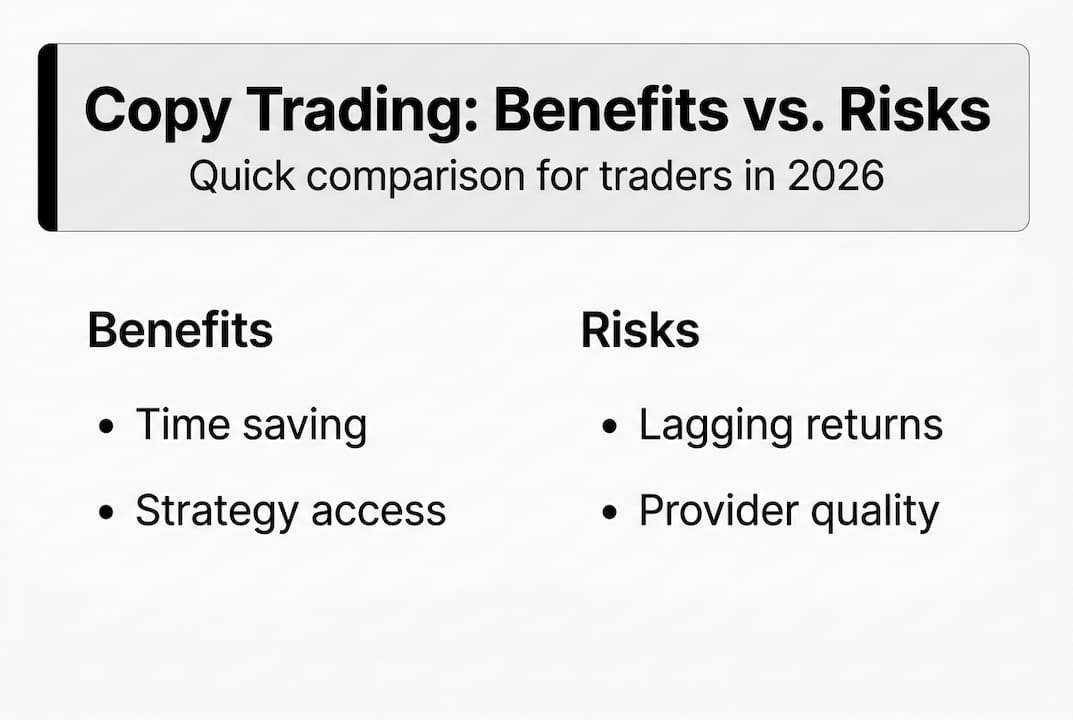
Infographic comparing copy trading benefits and risks
| Benefits | Risks |
|---|---|
| Saves time on manual trade entry | Follower performance lags master |
| Scales strategies across accounts | Copy lag causes slippage |
| Automates multi-account management | Strategy mismatch between accounts |
| Diversifies across multiple providers | Hidden costs (spreads, fees) |
| Accessible for less experienced traders | Overexposure from poor allocation |
Empirical data shows mixed profitability: a 90-day study of crypto copy trading platforms found a 48.48% win rate for followers — a pattern consistent with copy trading research more broadly — with returns heavily concentrated among a small group of top performers. Most followers didn’t see proportional gains.
That concentration effect is the part most traders overlook. The headline number looks good. The distribution underneath it is far less encouraging.
The main risk scenarios you need to plan for:
- Drawdown amplification: A master account experiencing a 20% drawdown can cause a much larger percentage loss in a follower account with different capital levels and fixed lot sizing.
- Slippage accumulation: Every copied trade introduces a small execution gap. Across hundreds of trades, that slippage adds up and erodes returns.
- Overexposure to one provider: Concentrating all capital behind a single master account means one bad streak affects everything simultaneously.
- Strategy mismatch: A scalping strategy designed for a fast-execution master account may perform poorly when copied to a follower with slower order processing.
- Hidden costs: Spreads, swap rates, and platform fees on the follower side may not match the master’s cost structure, reducing net profitability.
The efficiency gains are real. Optimizing your trading workflow through automation genuinely reduces manual overhead and human error. But efficiency only helps if the underlying strategy and risk controls are solid. Reviewing copying best practices before scaling is time well spent.
Risk disclosure: Copy trading involves the risk of loss, including the possible loss of capital. Past performance of any trader or strategy is not indicative of future results. Trade with capital you can afford to lose.
Best practices for safe and effective copy trading
Understanding both sides of the equation helps you take proactive measures. Here are proven strategies for doing copy trading right.
Start with a structured setup process:
- Test in demo first: Run every new master account or provider connection in a demo environment for at least two to four weeks before committing real capital.
- Choose providers with verified track records: Look for consistent performance over at least three to six months, not just recent spikes.
- Set hard risk controls: Define maximum drawdown limits, position size caps, and daily loss limits before going live.
- Map symbols carefully: Confirm that every instrument on the master side has a matching symbol on the follower side.
- Start with smaller lot sizes: Scale up allocation only after confirming the copy is working as expected across several trade cycles.
Expert guidance emphasizes prioritizing risk-adjusted metrics like the Sharpe ratio and maximum drawdown over raw return percentages. A provider showing 30% monthly returns with a 40% drawdown is far more dangerous than one showing 8% returns with a 5% drawdown.
The Sharpe ratio measures return per unit of risk. A ratio above 1.0 is generally considered acceptable. Above 2.0 is strong. If a provider can’t show you their Sharpe ratio and drawdown history, that’s a red flag.
Pro Tip: Never copy a strategy you don’t understand well enough to explain in plain terms. If you can’t describe the logic behind the entries and exits, you won’t know when to pull the plug during a losing streak.
Ongoing monitoring matters as much as the initial setup. Review your active subscriptions at least once a week. Markets change, and a strategy that worked well in trending conditions may fall apart in a ranging environment. Diversify across at least two to three independent master accounts to reduce single-provider risk.
The MT4 to MT5 setup guide walks through the technical steps for cross-version copying, and the trade copier demo shows the full workflow in action before you commit to any configuration.
Why copy trading’s real power is risk management, not just automation
Applying best practices will set you up for success, but let’s cut through the hype with a perspective few people talk about openly.
Most traders come to copy trading looking for automation. They want to set it up and walk away. That mindset is exactly what causes the biggest losses. Automation doesn’t remove risk. It amplifies whatever is already there, good or bad. A well-managed strategy scales beautifully. A poorly managed one compounds losses faster than any manual trader could.
The traders who consistently succeed with copy trading treat it as a risk management system first and an automation tool second. They obsess over drawdown limits, position sizing, and provider diversification. They audit their subscriptions regularly and cut underperformers without hesitation. They use metrics like the Sharpe ratio not as optional extras but as the primary filter for every decision.
Automation is the vehicle. Risk management is the driver. Focusing on efficient copying strategies means building the discipline before you build the scale. The technology is ready. The question is whether your risk framework is ready to match it.
Take your copy trading further with proven solutions
The right mindset sets a disciplined foundation. Now, powerful tools can help you put these ideas into action swiftly and safely.
Local Trade Copier runs entirely on your local Windows machine or VPS, with no cloud routing and sub-0.5-second execution. It covers MT4, MT5, and DXTrade under one subscription, with 18 lot sizing and risk management options built in. Whether you’re managing client accounts, running multiple funded accounts, or replicating a single EA strategy across terminals, the setup is straightforward.
](https://mt4copier.com)](https://csuxjmfbwmkxiegfpljm.supabase.co/storage/v1/object/public/blog-images/organization-20479/1773294400737_mt4copier.jpg)
You can follow the easy trade copier setup guide to get running in minutes, explore MetaTrader-DXTrade integration for cross-platform workflows, or watch copier demo to see exactly how it works before starting your 7-day free trial.
Frequently asked questions
Do all copy trading accounts deliver the same results?
No, follower performance often lags behind master accounts due to slippage, latency, and provider quality. According to a study by Yieldfund, a crypto quantitative trading firm, followers averaged a 48.48% win rate even in periods when the majority of leaders were profitable.
Can I copy trades from MT4/MT5 to DXTrade?
Yes, specialized EAs and software allow copying trades from MetaTrader accounts to DXTrade in real time. Cross-platform copying via specialized EAs is a supported and commonly used workflow.
How can I reduce risk when copy trading?
Test strategies in a demo account first, set tight risk controls, and prioritize diversified providers. Diversifying providers and testing in demo are the two most consistently recommended steps by experienced practitioners.
What allocation methods do copy trading platforms offer?
Common allocation methods include fixed, proportional, and hybrid, with additional risk controls like drawdown triggers. DXTrade offers fixed, proportional, and hybrid allocation natively, while MetaTrader platforms handle this through EA configuration.
Is copy trading only for beginners?
No, both new and experienced traders use copy trading to streamline management and scale strategies across accounts. Copy trading is widely used by retail forex traders and independent account managers to run efficient multi-account operations.
Recommended
- Prop trading best practices: Multi-account copying in 2026
- 5 Best Copy Trading Forex Brokers in 2023
- Trade copying best practices for efficient forex management
- Ghost trades in copy trading and how to remove them
