

Yes, locally installed MT4, MT5, and DXTrade trade copying is legal in the United States, provided the activity stays non‑discretionary and every dollar remains in the account holder’s own regulated brokerage account. The line that separates a compliant setup from a regulatory problem is simple: custody and discretion. The moment you hold someone else’s money or make trading decisions on their behalf without their per‑trade approval, you’ve crossed from automation into territory that can trigger registration requirements.
TL;DR:
- Copy trading remains legal in the US when conducted on accounts with full custody and control, without giving third parties discretionary trading authority.
- Records, account independence, and explicit client authority are crucial to staying compliant and preventing regulators from classifying the activity as discretionary management.
- Broker restrictions such as hedging bans, cloud execution prohibitions, and pre-trade risk limits can impact the functionality and legality of a copy setup.
- Using a locally installed trade copier with on-machine execution and detailed logs helps demonstrate non-discretionary activity and aids in compliance.
- Managing only your own accounts without transferring control or managing client funds avoids registration obligations, but managing others’ money demands proper licensing and legal consultation.
Is Copy Trading Legal in the US? What CFTC and NFA Rules Actually Say
The short answer is that federal regulators care about what you’re doing with a copier, not whether you’re using one at all. The Commodity Futures Trading Commission and the National Futures Association oversee retail forex and commodity‑interest trading in the U.S., and neither agency treats automated trade replication as inherently problematic.
What actually matters is registration status, and that depends on your role. The CFTC’s 2010 final rule on retail forex established registration, disclosure, recordkeeping, and minimum capital requirements for firms acting as counterparties in retail forex transactions. That rule created the modern framework for Retail Foreign Exchange Dealers (RFEDs), and it’s why every U.S. forex broker you’ve ever opened an account with is a registered entity, not a random counterparty.
Separately, CFTC Regulation §5.18 sets trading and operational standards that retail forex counterparties must meet, covering order handling and supervision. If securities, rather than forex or futures, enter the picture, the Investment Advisers Act and SEC rules take over instead, since the instrument type changes which regulator has jurisdiction.
Registration obligations generally kick in when one or more of these apply:
- You take custody of client funds instead of leaving them in the client’s own account
- You exercise discretionary trading authority over someone else’s account
- You manage pooled funds from multiple investors
- You receive compensation specifically for advising or trading on behalf of others
Once registered, whether as a Commodity Trading Advisor, Introducing Broker, FCM, or investment adviser, you take on disclosure duties, recordkeeping obligations, and in some cases minimum capital standards. Running a copier on your own accounts, or on accounts where the owner retains full control, avoids all of that.
How Do You Keep a Local Copier Non‑Discretionary and Compliant?
Configuration and paperwork are what actually protect you here, not intent. A copier that’s technically capable of managing someone else’s account without their input creates exposure even if you never planned to abuse that capability. Here’s how to structure things so the setup stays clean.
- Confirm each account is separately funded and regulated. Every account in the copy chain should hold its own capital and sit with a CFTC‑registered U.S. broker. Never route client money through an account you control.
- Preserve the account owner’s authority. The person whose account is being copied should retain the ability to change lot sizing, symbol selection, and strategy parameters at will. Any change a third party makes should require the owner’s explicit sign‑off.
- Log everything with timestamps. Keep records showing exactly when a trade originated on the master and when it executed on each client terminal. This is your audit trail if a broker or regulator ever asks questions, and it’s the same principle covered in trade copying best practices for efficient forex management.
- Put agreements in writing before touching anyone else’s money. If you ever manage funds for another person, even informally, a written disclosure and client agreement isn’t optional. Consult a securities or commodities attorney before that arrangement starts.
- Be careful with EA distribution. Selling a standardized Expert Advisor generally falls under a “publisher” exclusion, but customizing that EA for individual clients can eliminate the exclusion entirely, according to legal analysis from LegalClarity. Compiled EA files also carry copyright and DMCA protection, so redistributing someone else’s code without permission is its own separate risk.
Pro Tip: Screenshot your account settings and copier configuration the day you set it up. If a broker or regulator ever questions your setup months later, having a timestamped record of the original, non‑discretionary configuration saves you a lot of explaining.
What Broker and Prop Firm Rules Could Break Your Copier Setup?
Regulation is one layer. Your broker’s own rulebook is another, and it’s usually the one that bites first. The NFA requires forex dealer members to maintain written supervisory procedures over electronic trading systems, covering security, capacity, and risk controls, according to NFA guidance. In practice, that means your broker has the final say over whether a copied order executes at all.
A few operational realities to plan around:
- Hedging restrictions. Many U.S. brokers and most prop firms prohibit simultaneous long and short positions on the same symbol, so a copier that mirrors a hedged master strategy can trigger automatic rejections.
- IP and cloud restrictions. Prop firms frequently ban cloud‑routed execution outright, which is exactly why running the copier locally on your own machine or VPS matters for staying inside the rules.
- Automated‑strategy limits. Some funded‑account programs cap how much automation is allowed before a human has to confirm trades, so read your funding agreement closely.
- Pre‑trade risk controls. Broker‑dealers executing equities operate under SEC Rule 15c3-5, and forex brokers run comparable checks. Either way, the broker is the last line of defense, and it will reject anything that breaches margin or exposure limits.
Test every configuration on a demo account first. Symbol mapping errors and mismatched lot scaling are the most common causes of margin cascades, and a demo run catches them before real capital is on the line.
How Local Trade Copier’s Features Support Compliant Automation
A locally installed copier doesn’t grant legal status on its own, but the right technical setup makes it far easier to demonstrate that your activity is automation, not discretionary management. Local Trade Copier runs entirely on your Windows machine or VPS, with trades copied from a master account to client accounts in under 0.5 seconds and no cloud routing involved.
That local‑only architecture matters for a specific reason: a single, fixed IP address and on‑machine execution help prop firm traders avoid cloud‑routing exposure that many funding programs explicitly prohibit. A few features line up directly with the compliance checklist above:
- 18 lot size and risk management options, letting each account owner keep granular control over their own exposure
- Automatic lot scaling per client balance, so sizing adjusts to each account’s own funds rather than a shared pool
- Cross‑platform support across MT4, MT5, and DXTrade, useful if you or your clients run different platforms
- Local execution logs, which build the audit trail brokers and, if it ever comes to it, regulators expect to see
You can test the full setup, including installation, demo/live switching, and rejection handling, during a 7‑day free trial before committing to anything.
What I’d Actually Do Before Running a Copier on Client Money
Test in demo first, on all three platforms if you’re mixing MT4, MT5, and DXTrade, and keep the logs from that test. That record becomes your baseline proof of what “normal” looks like before you ever touch a live account. Second, call your broker and ask, in writing, what their policy is on automated trading and, if it applies, prop‑firm hedging rules. Verbal assurances from a support rep don’t hold up later. Get it in an email.
The real dividing line comes down to money and control. If you’re only automating your own accounts, you’re almost certainly fine. The moment you take on someone else’s capital or get paid to manage their trades, stop and talk to a securities or commodities attorney before you configure anything. Registration requirements exist for a reason, and the cost of ignoring them is far higher than the cost of one consultation.
— Rimantas
Ready to Test a Compliant Copier Setup in Your Own Environment
Local Trade Copier gives U.S. traders exactly what the compliance checklist above calls for: on‑machine execution with no cloud routing, per‑account lot scaling, and detailed logs that hold up when a broker or regulator asks how your setup actually works. Unlike cloud‑based alternatives, everything runs on one IP address you control, which matters if you’re operating under prop‑firm restrictions or simply want a clean audit trail for your own accounts.

Every plan, from the PERSONAL Plan at €29/month up to the VIP Plan at €199/month, includes the MT4 copier, MT5 copier, and both DXTrade bridge components, so you’re not piecing together separate tools for cross‑platform copying. Past results do not guarantee future performance, and Local Trade Copier makes no claim about improving trading outcomes. It replicates trades that already exist; it doesn’t generate strategy or market signals.
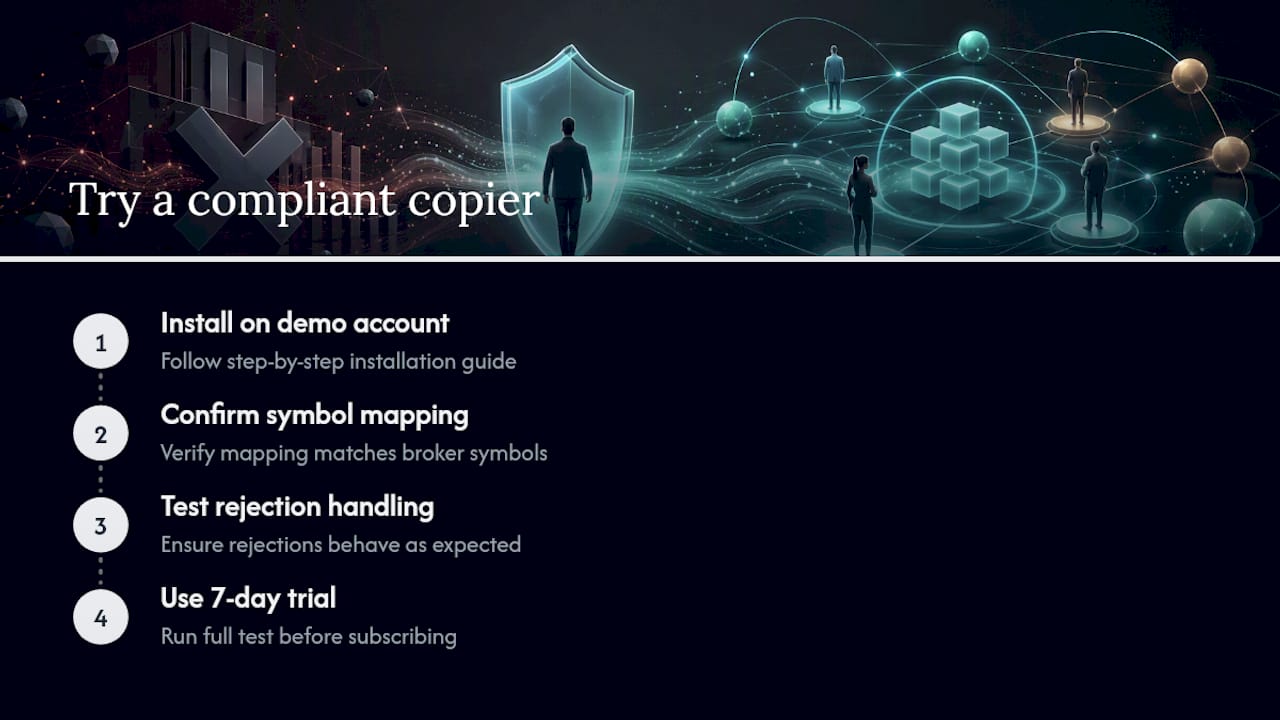
Start with the step‑by-step installation guide on a demo account, confirm your symbol mapping and rejection handling behave the way you expect, and watch the demo video walkthrough if you want to see the configuration screens before you install. The 7‑day free trial gives you enough time to run that full test before any subscription charge applies.
This article is general information, not a substitute for advice from a qualified financial advisor. Consult a qualified financial professional about your own circumstances before acting on anything here.
Sources
- Federal Register: Retail Forex final rule (2010)
- NFA member resources — forex regulatory guide
- MetaTrader Expert Advisors: Legal and Regulatory Rules – LegalClarity
FAQ
Is Copy Trading Allowed in the US?
Yes. Automating your own trades or replicating trades across accounts you fully control is allowed, as long as funds stay in each account holder’s own regulated brokerage account and no third party exercises discretionary control.
Is Copy Trading Legal in the US If I Manage Client Accounts?
It can be, but managing other people’s money typically requires registration as a Commodity Trading Advisor or investment adviser, depending on the instrument, plus written disclosures and client agreements.
Do I Need to Register With the CFTC or NFA to Use a Local Copier?
Not for automating your own accounts. Registration becomes relevant only if you take custody of client funds, trade with discretion on their behalf, or get paid specifically for managing their trades.
Does Local Trade Copier Guarantee Compliance With US Copy Trading Regulations?
No software guarantees legal compliance. Local Trade Copier provides local execution, per‑account controls, and logs that support a non‑discretionary setup, but your account structure and broker agreements determine your actual legal standing.
How Much Does Local Trade Copier Cost?
Plans start at the PERSONAL Plan for €29 per month, with MANAGER at €89/month and VIP at €199/month, and annual billing options are also available on the pricing page.
Are There Tax Implications for Using a Copier in the US?
Trade replication itself doesn’t change how forex gains and losses are taxed. Each account holder still reports their own trading activity to the IRS under the tax treatment that applies to their account type, so consult a tax professional for your specific situation.
Recommended
- Copy Forex Trader: Safe Options for U.S. Retail Traders
- Local Trade Copier installation on MT4 and MT5
- Local Trade Copier DEMO on MT4 and MT5
- Scalping and Copy Trading on MT4 and MT5 (Best Setup to Avoid Delay and Slippage)
