

Reduce size or close positions before the weekend unless your account rules and stop distance can genuinely absorb a gap. If you must hold and copy trades into Sunday’s open, configure copier filters, lot scaling, and wait-for-SL/TP settings before Friday’s close, not after. The checklist below walks through both the trading decision and the exact settings to check.
TL;DR:
- Most weekend gaps tend to fill within 24 hours, but those that do not are often larger and can cause significant slippage beyond intended stop levels.
- When placing trades, ensure stops are set beyond the maximum expected weekend move and reduce position size if high-impact events are scheduled.
- Proper testing of trade copier setups on demo accounts and VPS before weekends with major news can prevent unexpected slippage and order delays.
- Disabling auto-copy at session open, applying lot scaling, and using wait-for-SL/TP settings help manage risk during reopening volatility.
- Account rules and weekend event calendars should be checked beforehand, especially for prop firm limits and high-impact geopolitical or economic events.
What Causes Weekend Gaps in Forex?
A weekend gap forms because retail forex trading stops for roughly 48 hours, from around 5:00 PM ET on Friday to 5:00 PM ET on Sunday, while the world keeps generating news. When trading resumes, brokers reprice every pair at once to reflect everything that happened while the market was closed, and that repricing often lands away from Friday’s final quote. FX Foundations breaks down the session mechanics behind this pause and why it produces a clean price jump rather than a gradual move.
The size of that jump depends on what happened during the break. Common triggers include:
- Geopolitical shocks (elections, conflict escalation, surprise sanctions)
- Central bank commentary dropped outside normal hours
- Unscheduled economic data revisions or emergency policy statements
- Broker-specific quote adjustments as liquidity providers reconnect
Sunday’s reopen is thin. The first ticks come from a small number of Asia-Pacific liquidity providers, so spreads widen and price can whip before enough participants log on to stabilize it. That thin window is exactly where copied trades and pending orders get filled at prices nobody planned for, and it’s the reason so much weekend gap copying advice centers on timing, not prediction.
How Big Is the Risk From Slippage and Gaps?
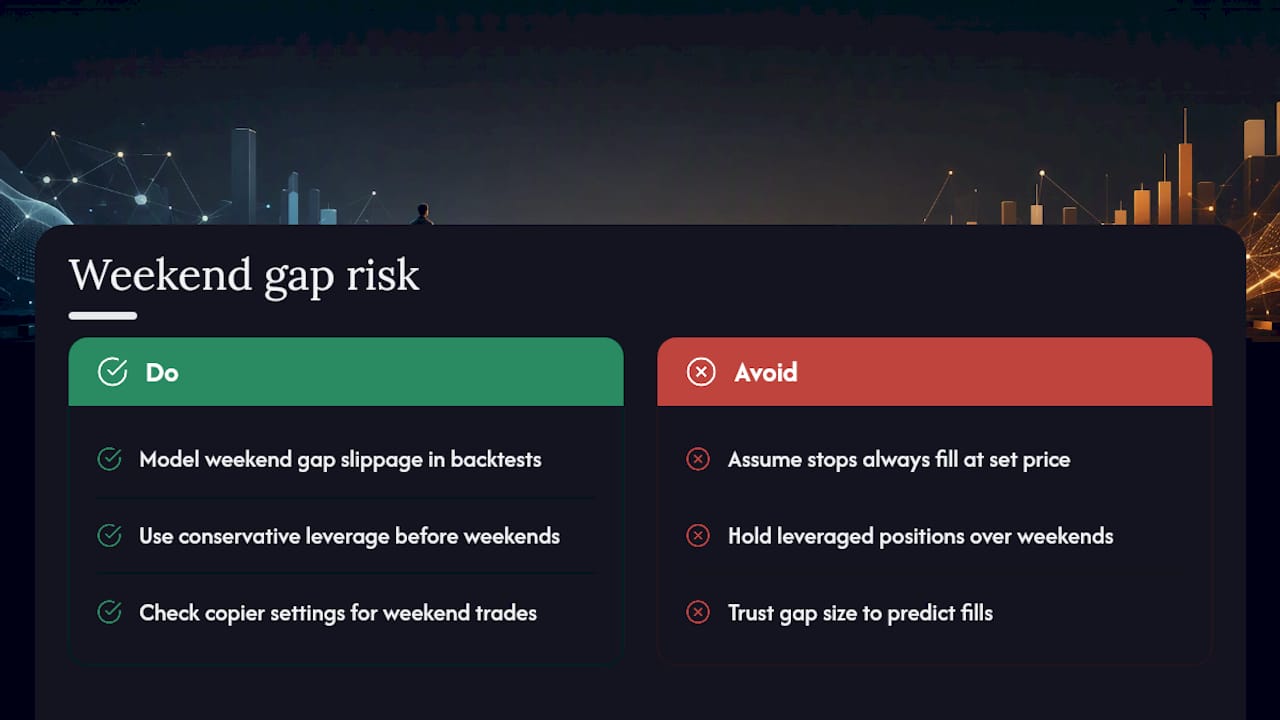
A stop-loss order does not execute at your chosen price during a gap. It converts to a market order the moment trading resumes and fills at whatever price is available, which can be well beyond your intended exit. That gap between the stop price and the fill price is slippage, and it’s the single biggest reason traders get burned holding positions over a weekend they didn’t plan to hold.
The empirical picture is more forgiving than the horror stories suggest, but it’s not a green light. A reproducible study using MetaTrader 5 data and a Python analysis pipeline found that a high share of weekend gaps in the sample closed, or “filled,” within 24 hours of the reopen, with a short median time-to-fill. Gap size alone, however, was not a reliable predictor of whether a given gap would fill quickly. The MQL5 research is worth reading in full if you want the methodology, not just the headline number.
Statistic callout: Most weekend gaps in the MQL5 sample filled within a day, but gap size didn’t predict which ones would stall. Past results do not guarantee future performance.
That “most” is doing a lot of work. A meaningful minority of gaps did not fill quickly, and those are the ones that matter for anyone holding a leveraged position with a hard stop nearby. K.M.F.’s analysis of weekend gap risk makes a point that deserves more attention than it gets: most backtests quietly assume your stop fills at the exact price you set. Live weekend gaps don’t respect that assumption, so a strategy that looks fine in a historical test can bleed far more in real conditions. If your backtest doesn’t model gap slippage, treat its weekend numbers as optimistic guesses, not results.
Your Pre-Weekend Trading Checklist
Run this every Friday before you step away, whether you trade manually or through a copier.
- Check account rules first. Prop firm agreements and personal risk limits often cap weekend exposure or ban it outright. Know the rule before you know the trade.
- Compare stop distance to plausible gap size. If your stop sits closer than a pair’s typical weekend move, a gap can skip straight past it.
- Scan the weekend event calendar. Central bank meetings, elections, and known geopolitical flashpoints raise gap odds; a quiet calendar doesn’t guarantee a quiet reopen.
- Cut size on anything borderline. Reducing a position by half cuts your gap exposure by half. It’s the simplest lever you have.
- Clean up pending orders. Cancel or widen OCO orders that could trigger on a wild first tick, and remember that a stop-loss is not a gap shield. It’s a market order in disguise once the gap has already happened.
- Confirm your copier’s master status and VPS connection. A dropped connection Friday night means silence Sunday night.
- Set lot scaling and trade filters so copied positions match each client account’s risk tolerance, not just the master’s.
- Enable wait-for-SL/TP behavior if your copier supports it, so orders don’t fire blind into the first volatile ticks.
Pro Tip: Do this checklist on Thursday night, not Friday afternoon. You’ll think more clearly about position size before the week’s news cycle starts pressuring your judgment.
How Do Copiers Handle Weekend Reopens?
A trade copier mirrors whatever the master account does, including orders that were open when the market closed. When Sunday’s reopen hits, the copier forwards new fills, adjusts pending orders, and applies stops and targets to every connected client account, all within whatever lag the software carries. If the master account gapped and filled at a slipped price, that slippage passes through to every client account copying it. The copier doesn’t cause the gap. It just replicates whatever happens, faster or slower depending on the setup.
A few settings materially change your weekend gap copying exposure:
- Disable auto-copy for trades the master opens right at session open, when the first prints are least reliable.
- Set per-account lot scaling so a client account with a smaller balance doesn’t inherit the master’s full position size.
- Use trade filters to skip orders opened within a set window of Sunday’s open, giving spreads time to normalize.
- Turn on wait-for-SL/TP handling where available, so stops and targets get applied deliberately rather than instantly against a volatile first tick. Local Trade Copier’s documentation on this behavior covers the exact mechanics.
Local execution matters here in a narrower way than marketing usually implies. A copier running entirely on a local Windows machine or VPS keeps trade data on one IP address instead of routing through an external cloud server, which removes one category of failure: a cloud outage or IP flag delaying your copied orders right when the market reopens. Local Trade Copier has documented sub-0.5-second local execution on that architecture, though that speed is a description of how the software processes orders, not a claim about trading results.
“Backtesting often ignores gap slippage because simulated stop orders assume execution at the exact price set.” That gap between simulation and live fills is exactly why testing copier behavior on a demo account before a busy weekend earns its place on the checklist.
Before any weekend with known event risk, test your setup on a demo account, check the copier’s logs for missed or delayed trades from the prior week, and update the software if a new version has shipped. Reviewing installation and VPS setup ahead of time catches most of the problems traders discover the hard way on Sunday night.
A Quick Friday Decision Framework
Run three checks before the close:
- Account limits: Does your prop firm or personal risk policy allow weekend exposure? If no, close or hedge.
- Stop distance vs. gap risk: Is your stop closer than the pair’s typical weekend swing? If yes, reduce size or close.
- Event calendar: Is a high-impact event scheduled over the weekend? If yes, treat every open position as higher risk regardless of stop distance.
A swing trade with a wide stop on a major pair might pass all three and hold as-is. An intraday position on a prop firm account almost never should. Log your reasoning either way. It builds a record you can review, which matters more after a losing weekend than a winning one.
What Support Cases Actually Teach About Weekend Risk
The recurring mistake isn’t ignorance of gap risk. It’s assuming a copier setup that worked fine on a demo will behave identically on a live VPS under real Sunday volatility. It often doesn’t, because contract specifications, swap rates, and even spread behavior can differ between the demo environment and the live broker feed.
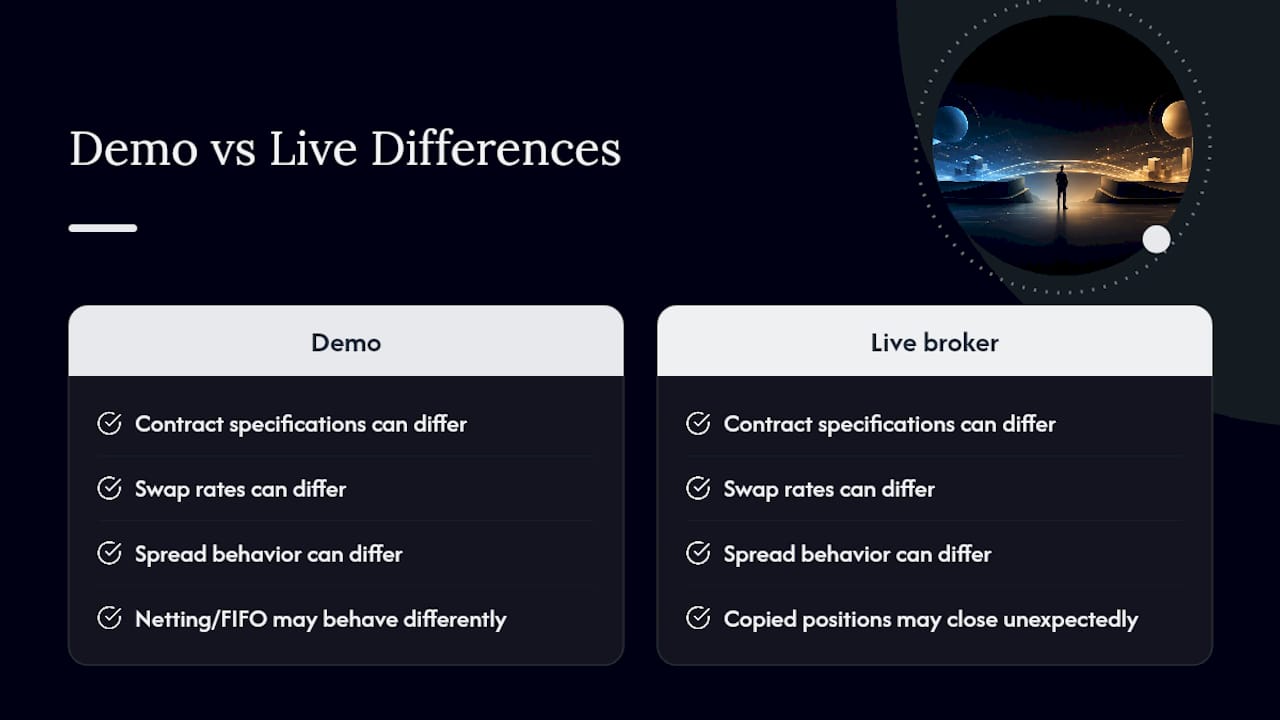
The second mistake is running a netting account under FIFO assumptions and being surprised when copied positions close in an order nobody expected. Neither mistake is about market prediction. Both are about verifying configuration before the market forces the issue.
Three habits separate traders who handle weekends cleanly from those who don’t: they test copier connections on the actual VPS they’ll use live, they reconcile contract specs between master and client brokers before scaling into more accounts, and they treat every Friday checklist item as non-negotiable rather than optional when the week has felt calm.
— Rimantas
Managing Weekend Exposure With Local Trade Copier
Trade copier software offers settings to manage copied positions over weekends in one place, rather than scattered across broker platforms and manual spreadsheets. Such software runs on a Windows machine or VPS across MT4, MT5, and DXTrade, with configurable lot scaling per client account, trade filters, and wait-for-SL/TP behavior allowing control over how copied positions handle a Sunday reopen.

If you manage more than one account, or copy trades to clients, the practical next step is to test the setup before you need it. Watch the demo walkthrough to see the filters and lot scaling in action, then check the pricing page for the PERSONAL, MANAGER, and VIP plans, which start at 29 € per month or 290 € per year for the PERSONAL Plan. A 7-day free trial lets you configure and test everything against a live weekend before committing. Local Trade Copier is trade replication software. it copies existing trades and carries no strategy layer or market logic of its own, so past results do not guarantee future performance.
Primary Sources for Weekend Gap Research
The gap-fill statistics cited above come from a reproducible MQL5 study using MetaTrader 5 data and Python. Session mechanics are covered by FX Foundations, risk framing by K.M.F., and trader rules by WeMasterTrade. For liquidity mechanics specifically, this partner guide on currency liquidity adds useful depth.
This article is general information, not a substitute for advice from a qualified financial advisor. Consult a qualified financial professional about your own circumstances before acting on anything here.
Sources
- From Novice to Expert: Weekend Gap Size Effect Research Using MQL5 and Python – MQL5 Articles
- Weekend Gaps & Gap Strategies | Free Intermediate Forex Lesson | FX Foundations
- Weekend Gap Risk: The Silent Account Killer You’re Ignoring Every Friday | K.M.F.
- Weekend Gaps in Forex: Causes, Risks and Trader Rules
FAQ
What Is Weekend Gap Copying?
It refers to how a trade copier replicates open positions, pending orders, and stop/target levels across accounts through the Friday close and Sunday reopen, including whatever price gap occurs between them.
Should I Close All Trades Before the Weekend?
Not always. Close or reduce size when your stop distance is tight relative to typical gap size, when a major event is scheduled, or when your account rules require it; otherwise a wide-stop swing position can often stay open.
Do Most Weekend Gaps Fill Quickly?
A reproducible MQL5 study found a high share of sampled gaps filled within 24 hours, but a meaningful minority did not, and gap size alone didn’t predict which ones would stall. Past results do not guarantee future performance.
Can a Stop-Loss Protect Me From a Weekend Gap?
No. A stop-loss becomes a market order once trading resumes, so it fills at the next available price rather than your chosen level, which is the source of gap slippage.
How Much Does Local Trade Copier Cost?
The PERSONAL Plan starts at 29 € per month or 290 € per year, with MANAGER and VIP plans available at higher tiers; full pricing details are on the pricing page.
Recommended
- What to do when Local Trade Copier does not copy trades
- Max Open Trades Copy: What Controls the Limit
- Why Spread Differences Happen When Copying Trades (and How to Fix Them)
- Avoid Opening Six Stale Trades: Ignore Existing Positions Setting
