

Protecting the capital comes first, every time. Enforce your firm’s rules without exception, keep a cash buffer instead of withdrawing to zero, and trade only the system that got you funded in the first place. A simple journal and a few hard guardrails will catch problems long before they cost you the account.
TL;DR:
- Maintaining a cash buffer above the firm’s drawdown limit is crucial, with a personal “floor” set a few percentage points higher to prevent breaches.
- Enforcing strict operational guardrails, such as pre-trade checklists and automated risk controls, significantly reduces the risk of account revocation.
- Consistent execution across multiple funded accounts is best achieved through local trade copying, which eliminates timing errors and manual input mistakes.
- Regular journaling and review of behavioral tags and execution metrics can identify risky patterns before they lead to rule breaches or account losses.
- The main causes of funded account revocations are preventable process failures like hitting drawdown limits and rule violations, not market conditions.
What Does Funded Account Management Actually Mean?
Funded account management is the set of habits, rules, and controls a trader uses to protect capital after passing a prop firm evaluation. It has almost nothing to do with finding new trades and everything to do with not losing the ones you’re allowed to keep.
Passing the challenge was the easy part, statistically speaking. The hard part is the next ninety days, when the pressure to perform meets a completely different rule set: daily drawdown limits, restrictions on holding trades overnight, bans on trading around news releases. A funded account is capital a prop firm gives you to trade after you clear its evaluation, and how that capital pays out, and under what conditions it gets pulled, varies by firm and is spelled out in the firm’s own terms. Read those terms before you place a single live trade, not after your first drawdown warning.
The mindset shift matters more than any single rule. You’re no longer trading your own money looking for upside. You’re managing someone else’s capital under a strict compliance framework, and the firm’s capital-preservation guidance is consistent across the industry: buffers, conservative targets, and rule discipline beat aggressive scaling almost every time.
Capital Preservation: Mindset and Operational Rules After Funding
Treat the funded account like a business asset you’re leasing, not a lottery ticket you finally cashed. That reframing changes decisions in small but important ways. A business owner doesn’t blow the operating budget testing a new idea on a whim. Neither should you.
The single biggest mistake funded traders make is tinkering with the strategy that just proved itself. If it passed the evaluation, it works well enough. Save experimentation for a demo account or a separate personal account, never the funded one.
A few operational rules keep that discipline from depending on willpower alone:
- Trade only during the session windows where your strategy has an actual edge, and skip setups outside them even when they look tempting.
- Never introduce a new indicator, timeframe, or entry rule directly on the funded account.
- Log every deviation from your evaluation strategy, even small ones, so patterns show up before they become habits.
- Keep a cash or equity buffer above the firm’s drawdown floor at all times, not just after a good week.
That buffer is the part traders underrate most. A cushion above the drawdown line isn’t wasted capital sitting idle. It’s runway. It’s the difference between a normal losing streak and a revoked account, and buffer discipline is one of the clearest predictors of who keeps their funded status past the first quarter.
Pro Tip: Set your personal “floor” a few percentage points above the firm’s actual drawdown limit and treat that floor as the real line. By the time you’d hit the firm’s number, you should already be in de-risk mode.
Monthly Targets and Withdrawal Strategy
Modest, repeatable months protect funded status far better than one spectacular month followed by a blowup. Firms don’t revoke accounts for being unexciting. They revoke them for breaching drawdown limits, and drawdown limits get breached almost exclusively by traders reaching for a bigger number than their edge supports.
Withdrawal habits matter just as much as the target itself. The instinct after a good payout is to withdraw everything down to the starting balance, resetting the buffer to nearly nothing. That’s backwards. A better approach is to withdraw conservatively, leave a working cushion above the firm’s floor, and let that cushion absorb the inevitable rough patch that follows almost every strong month.
A practical withdrawal routine looks like this:
- Withdraw on a fixed schedule rather than reactively after a good week, which removes the emotional decision-making.
- Stagger withdrawal amounts so a portion of profit always stays in the account as a buffer.
- Recalculate your buffer target after every payout instead of assuming last month’s cushion still applies.
- Treat any withdrawal that would drop you close to the firm’s drawdown limit as off-limits.
This buffer-first habit is what actually keeps traders funded through the second and third month, when the routine after a payout matters more than the payout itself. Past results do not guarantee future performance, and no target, buffer size, or withdrawal cadence changes that. Every number here is a risk-management framework, not a return projection.
Risk Controls and Operational Guardrails You Must Enforce
Rules you remember under pressure are rules you’ll eventually break under pressure. The fix is converting every firm rule into something that gets enforced mechanically, before you’re emotionally invested in a trade.
Start with a pre-trade checklist that has to pass before an order goes live:
- Confirm current daily and overall drawdown against the firm’s stated limits, not your memory of them.
- Check the economic calendar for restricted news windows if your firm bans trading around releases.
- Verify the instrument is on the firm’s permitted list.
- Confirm position size matches your current risk tier, not yesterday’s tier.
- Check for open positions that would violate an overnight-holding restriction before the session closes.
Most funded-account failures trace back to rule breaches and behavioral slips rather than bad market conditions, which is exactly why operational gating logic beats relying on discipline alone.
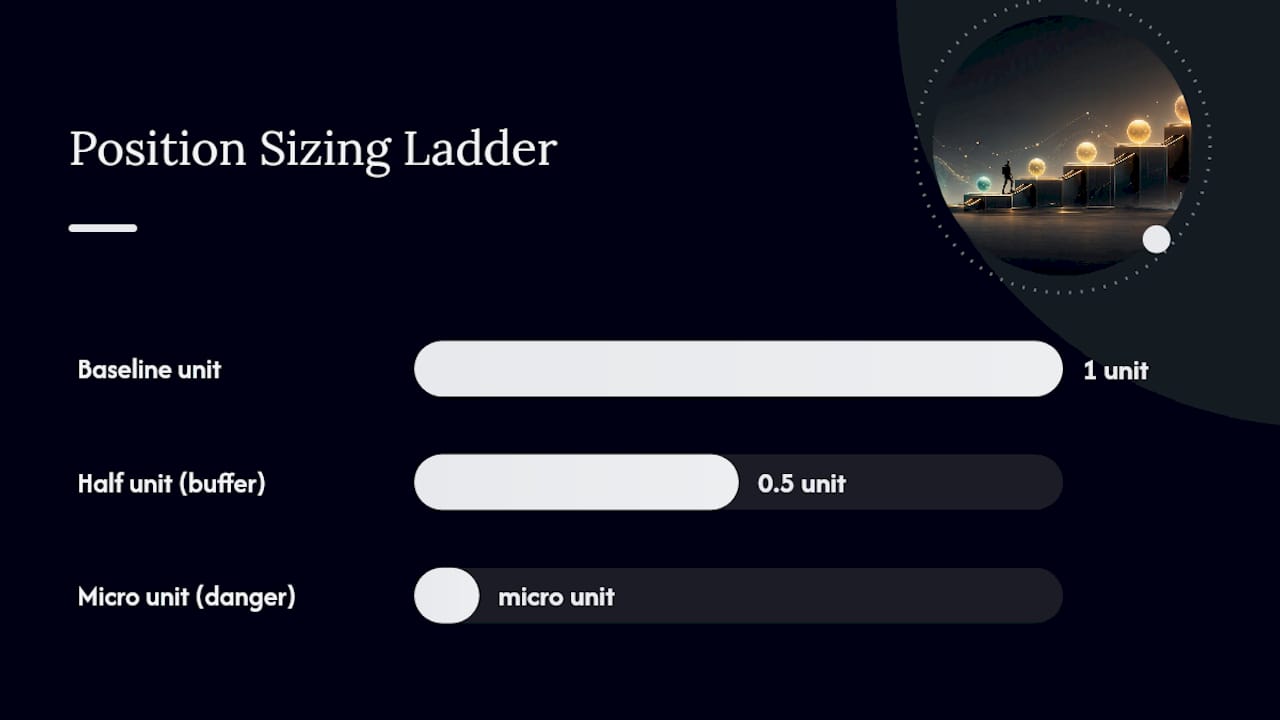
Build a sizing ladder so stepping down isn’t a debate you have mid-drawdown: a baseline unit for normal conditions, a half-unit once you’re partway through your personal buffer, and a micro-unit once you’re inside the danger zone near the firm’s limit. Decide the triggers in advance, on a calm day, not while staring at a red equity curve.
Where the platform allows it, automate the guardrails directly: hard stop-losses on every order, OCO brackets instead of manual exits, and permission locks that block trading outside approved hours or instruments.
Pro Tip: If your platform supports it, set a cooldown timer that locks new entries for a fixed period after two consecutive losses. That single rule breaks more revenge-trading cycles than any amount of self-control.
What Gets Funded Accounts Revoked: The Common, Preventable Causes
Almost every revocation traces back to a small number of repeatable causes, and nearly all of them are preventable with the guardrails above.
- Hitting the maximum or daily drawdown threshold, usually after a size increase that wasn’t planned in advance.
- Breaking explicit rules like holding positions overnight, trading during banned news windows, or using restricted instruments.
- Sudden changes in position size or strategy that trigger a manual compliance review.
- Revenge trading after a loss, often paired with abandoning the sizing ladder entirely.
- Withdrawing the buffer down to the firm’s floor right before a losing streak, leaving no room to absorb it.
- Fatigue trading late in a session or after a string of losses, when judgment is already compromised.
None of these are market problems. They’re process problems, and rule compliance failures are the leading driver of account loss across the industry, not bad luck or unfavorable conditions. The traders who keep their accounts longest are rarely the most skilled at reading price. They’re the ones who never let a single bad hour turn into a rule breach.
Managing Multiple Funded Accounts and Workflow for Scale
Running several funded accounts multiplies opportunity, but it also multiplies the ways you can accidentally break a rule. The traders who scale successfully specialize rather than replicate the same trade five times manually.
Assigning a specific session or strategy variant to each account reduces cross-account risk in a way most traders don’t expect. If account A trades London session breakouts and account B trades New York session reversals, a bad signal in one strategy never bleeds into the other. Trading the identical setup across every account, by contrast, means one wrong call gets amplified five times over.
- Assign each account a defined session, strategy, or instrument set instead of mirroring the same trades everywhere.
- Track aggregate exposure across all accounts together, not per account, especially when strategies are correlated.
- Size positions with correlation in mind. Five accounts each risking 1% on the same currency pair is a 5% correlated bet, not five independent 1% bets.
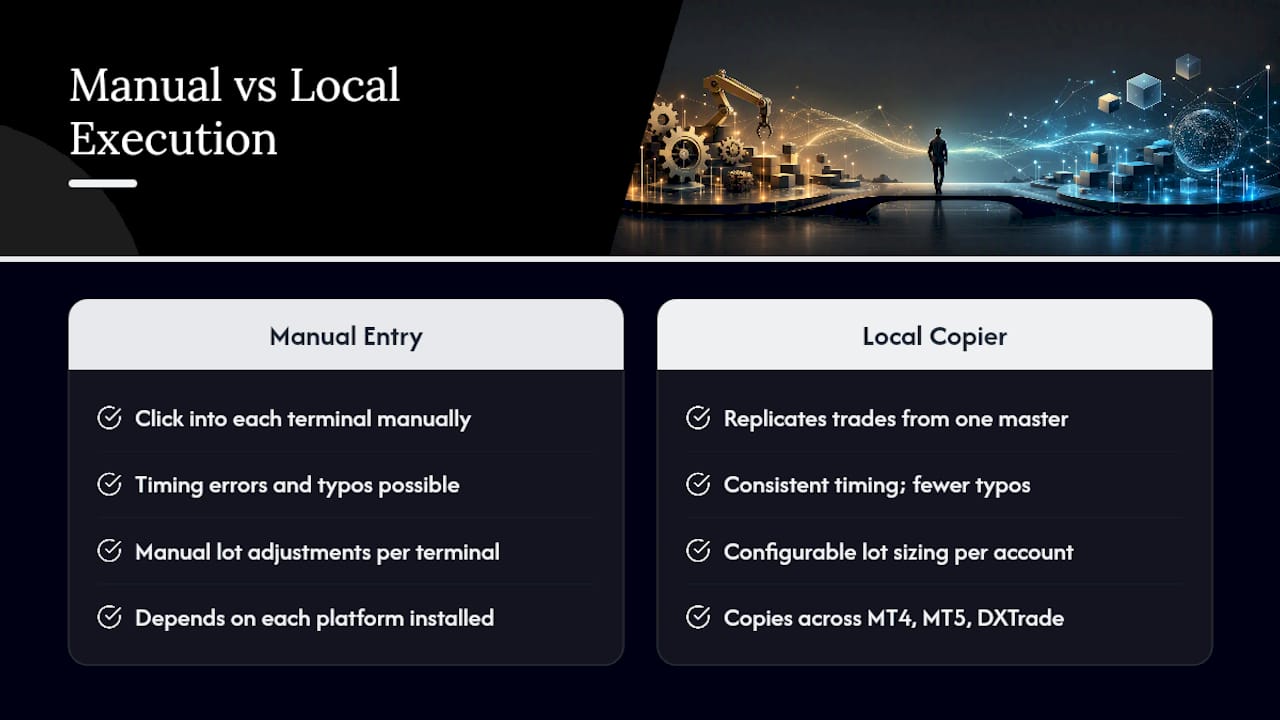
- Re-entering the same trade manually across multiple terminals is slow and error-prone, and a mistyped lot size on one account is a rule breach waiting to happen.
Local trade replication tools solve the manual re-entry problem directly by copying trades from one master account to multiple client accounts with configurable lot sizing, executed entirely on-machine. Local trade replication also keeps execution running from a single IP address across accounts, which can help avoid the kind of inconsistent-execution flags that some platform monitoring systems watch for. A solid execution stack for scaled trading pairs a dedicated VPS with pre-trade gating and secure local replication, so speed and consistency don’t depend on manually clicking through five terminals during a fast market.
Journaling, Review Cadence, and Early-Warning Metrics
A journal only earns its keep if it captures enough detail to catch a problem before the firm does. At minimum, log the timestamp, your rationale for the trade, whether it passed your pre-trade checklist, execution notes, and a behavioral tag (rushed, revenge, fatigue, plan-followed).
- Run a weekly review of tag frequency to spot a behavioral pattern forming before it becomes a habit.
- Run a monthly review of slippage and execution timing across accounts, especially if you’re running several at once.
- Let the journal trigger automatic action: three “rushed” tags in a week should force a size step-down, not just a note to self.
- When several problems show up at once, fix the one tied to rule compliance first. That’s the one that ends accounts overnight.
Journaling that tracks behavioral tags and execution metadata consistently catches failure patterns weeks before they show up as a drawdown breach.
Author Perspective: Operational Reliability and Local Execution
Most funded-account guides focus on psychology and risk math, which matter, but they skip the mechanical failure point: manual execution across multiple terminals during a fast market is where good rules quietly break. A missed entry on one account or a mistyped lot size on another isn’t a discipline failure, it’s an execution failure, and it looks identical to a rule breach on a compliance report.
Local, on-machine trade replication removes that variable by copying trades instantly with fixed lot logic, no cloud routing involved. If you’re managing more than one funded account, tightening execution consistency is often the faster win over tightening willpower.
— Rimantas
Local Trade Copier: Consistent Execution Across Every Funded Account
A locally-installed trade copier is a practical fix for the execution gap that manual multi-account trading creates. Instead of clicking the same trade into three or four terminals and hoping the lot sizes and timing line up, Local Trade Copier software replicates trades from one master account to multiple client accounts locally, with configurable lot sizing per account.

The software runs entirely on a Windows machine or VPS, copying across MT4, MT5, and DXTrade with no cloud routing. For traders managing multiple funded accounts under different firms or rule sets, a local execution model means one consistent IP address and execution path, rather than manual re-entries that can introduce timing errors and typos. It’s worth being direct here: this is trade replication software. It copies the trades you already decided to take. It has no strategy layer and does not generate signals or improve trading outcomes, nor does it change past results do not guarantee future performance.
If you’re managing two or more funded accounts and want to see how the copying logic and lot sizing controls actually behave before committing, watch the demo walkthrough or head straight to the installation guide to get it running on your own setup with a 7-day free trial.
Sources
For deeper detail on the ideas covered here, see the capital preservation framework, the prop firm rule-compliance tips, and the funded account glossary entry for payout mechanics that vary by firm.
- Funded Account Management: Keep Your Capital After You Pass
- 7 Expert Tips for Prop Firm Account Management
FAQ
How Much Does a $50,000 Funded Account Cost?
Evaluation fees for funded accounts vary widely by firm and account size, and firms publish their own current pricing directly on their websites. Always confirm the exact fee and any reset costs on the firm’s official pricing page before purchasing an evaluation.
What Are the Disadvantages of Funded Accounts?
Funded accounts come with strict rules around drawdown limits, permitted instruments, and sometimes overnight or news-trading restrictions, and breaching any of them can end the account regardless of overall profitability. Traders also don’t own the capital, so payout timing and profit-split terms are set entirely by the firm’s own policies.
How Much Should I Risk on a $25,000 Funded Account?
Risk per trade should stay small enough that a normal losing streak never approaches the firm’s daily or maximum drawdown limit, with room left over for the personal buffer discussed earlier in this guide. The exact percentage depends on your firm’s specific drawdown rules, so calculate it against those limits rather than a generic industry number.
How Does a Funded Account Pay You?
Payout structures, including profit-split percentages and payout frequency, differ by firm and are stated in that firm’s own terms, so the only reliable way to know how you’ll get paid is to read the specific policy for your account. Past results do not guarantee future performance, and no payout structure changes that.
Recommended
- Prop Firm Account Management Tips: Maximize Efficiency
- Prop Firm Account Manager Copier Setup Guide
- The Role of Account Managers: 2026 Complete Guide
- What Are Account Management Risks and How to Mitigate Them
