

TL;DR:
- Risk scaling in trading automation involves proportionally adjusting risk controls as systems become more complex and faster. Without built-in escalation gates and tiered oversight, automation can amplify errors through feedback loops and emergent behaviors. Effective governance relies on early architecture decisions, outcome-focused metrics, and proactive risk management to ensure safety and operational speed.
Risk scaling in automation is defined as the practice of adjusting risk controls proportionally as automated trading systems grow in complexity, scope, and decision speed. The role of risk scaling in automation is not cosmetic. It is the difference between a system that survives expansion and one that compounds errors into account-level failures. Traders managing multiple accounts across MetaTrader 4, MetaTrader 5, or DXTrade face this challenge directly: automation multiplies both opportunity and exposure at the same time. The frameworks, metrics, and governance principles covered here reflect 2026 research and apply specifically to individual traders building or scaling automated systems. Past results do not guarantee future performance.
Why does risk scale non-linearly with automation complexity?
Automation risk does not grow in a straight line. Risk grows geometrically through feedback loops, not linearly with task complexity. That distinction matters enormously for traders. One system’s output feeds directly into another system’s input, and the chain reaction that follows can produce behaviors no human red-teaming exercise would catch in advance.

Consider a multi-account setup where a master EA triggers entries based on a momentum signal. If that signal misfires, every connected account executes the same bad trade simultaneously. The error does not stay isolated. It compounds across accounts, timeframes, and open positions. Traditional linear risk models treat each trade as a separate event. Automated pipelines treat them as a cascade.
Several failure modes appear repeatedly in complex trading automation:
- Feedback amplification: A losing position triggers a stop-loss, which shifts the account balance, which changes the lot-size calculation for the next trade, which opens a position too large for the new equity level.
- Emergent behavior: Two individually safe rules interact in an unanticipated way under specific market conditions, producing a sequence no developer intended.
- Compounding errors: A data feed delay causes a stale price read, which causes a mispriced entry, which causes a drawdown that triggers a risk rule, which halts the entire system.
- Latency-driven divergence: In multi-account copying, execution timing differences cause one account to fill at a different price than the master, creating unequal risk exposure across the group.
Escalation design is the control mechanism that addresses these failure modes directly. It converts reactive damage control into proactive governance by defining exactly when a system must pause, alert, or hand off to a human before continuing. Without escalation design built into the architecture from the start, traders discover these failure modes only after they have already caused harm.
Pro Tip: Map every automated decision point in your system and ask: “What happens if this output is wrong?” If the answer is “the next step fails too,” you have a feedback loop that needs an escalation gate.
What are effective frameworks and metrics for scaling automation risk in trading?
The most reliable framework for managing automation risk at scale is tiered governance calibrated to the reversibility and autonomy of each decision. Governance proportional to execution risk lowers compliance cost by 3x and improves safety outcomes compared to uniform controls. That finding reflects a core principle: not every automated action carries the same consequence, so not every action should carry the same oversight burden.
Tiered human-in-the-loop design
The practical version of this framework divides automated decisions into three tiers by impact level:
- Low impact: Fully automated with logging only. Example: routine lot-size recalculation based on balance changes.
- Medium impact: Automated execution with real-time dashboard alerts and a short review window. Example: opening a position above a defined size threshold.
- High impact: Requires explicit human authorization before execution. Example: closing all open positions on a funded prop account during a drawdown event.
Tiered human oversight reduces AI-related incidents by 47% and speeds adoption by 2.3 times compared to uniform controls. The implication for traders is direct: applying the same level of oversight to every automated action wastes attention on low-stakes decisions while leaving high-stakes ones under-supervised.
Measurement layers that actually matter
Most traders measure activity. They count trades copied, positions opened, and workflows completed. Only 5% of organizations successfully scale automation by measuring outcome integrity instead. The distinction is critical.
| Metric type | What it measures | Trading example |
|---|---|---|
| Activity metrics | Volume of automated actions | Number of trades copied per session |
| Outcome integrity metrics | Quality and accuracy of results | Error rate, audit trail completeness, incident remediation time |
| Business impact metrics | Effect on capital and risk exposure | Drawdown per account, lot-size deviation from target |
Hybrid risk assessment models push this further. FMEA combined with machine learning models like Random Forest achieved an F1-score of 0.972 in automated manufacturing risk prediction. Applied to trading, this approach means using failure mode analysis to identify where your automation is most likely to break, then training a predictive layer to flag those conditions before they trigger.
Pro Tip: Build a weekly outcome integrity review into your process. Check error rates and audit logs, not just trade counts. The number of trades copied tells you nothing about whether the system is working safely.
How do traders apply risk scaling principles to automate trade management safely?
Safe automation starts with a risk audit, not a deployment. Effective governance requires clear ownership, risk assessments, exception handling, and continuous monitoring from the beginning. Traders who skip this step and bolt governance on later face cascading failures and ungoverned workflows that increase operational risk substantially.
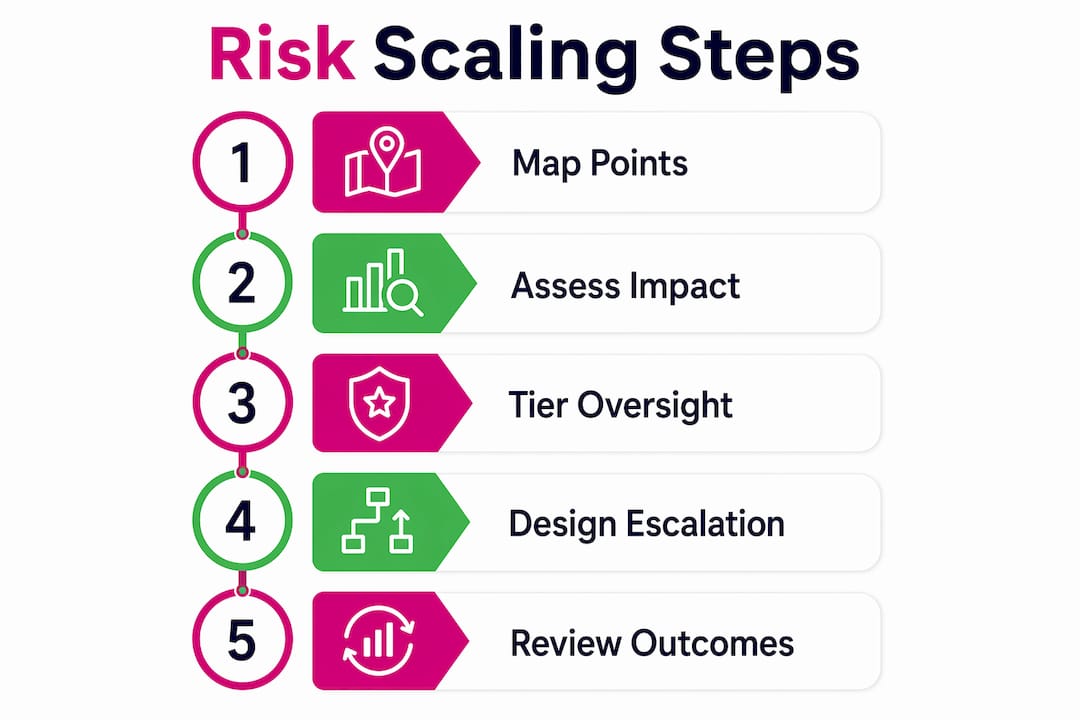
A practical audit follows this sequence:
- Map every automated workflow. List each decision point, the data it consumes, and the action it produces. Identify which steps are reversible and which are not.
- Assess the risk profile of each step. Use the tiered framework above. Assign low, medium, or high impact to each decision.
- Define decision rights. Specify which decisions the system executes autonomously and which require human sign-off. Write these rules down explicitly, not just in code.
- Build exception queues. Any automated action that fails a validation check should route to a human review queue, not fail silently or retry indefinitely.
- Install override capabilities. Every automated system needs a manual kill switch accessible in real time. This is not optional for funded or prop accounts.
- Monitor outcome integrity metrics continuously. Use a real-time dashboard that shows error rates, position deviations, and incident counts, not just trade volume.
Mt4copier supports this approach directly. Its automated trade management across MT4, MT5, and DXTrade includes 18 lot-size and risk management options, automatic lot scaling per client account balance, and sub-0.5-second local execution. Because all trade data stays on one machine with no cloud routing, traders maintain full control over the execution environment. That local architecture is itself a risk control: it eliminates external server latency and cloud routing exposure.
Best practices for automation governance in trading:
- Assign one person as the owner of each automated workflow, responsible for its audit trail.
- Set position-size limits at the account level, not just the strategy level.
- Review escalation logs weekly and update thresholds when market conditions change.
- Test every override and kill switch monthly to confirm they function under live conditions.
- Document every governance rule change with a date and reason.
Pro Tip: Treat your escalation design as a living document. Market volatility changes what counts as “high impact.” Review your tier definitions at least once per quarter and adjust thresholds accordingly.
What are common pitfalls and misconceptions about risk scaling in trading automation?
The most damaging misconception in trading automation is that more automation automatically means more controlled risk. It does not. Automation scales both efficiency and exposure. Without proportional governance, it scales exposure faster.
Governance designed into automation infrastructure from the start industrializes safe scaling. Governance bolted on after deployment creates compliance gaps that compound over time, raising both incident rates and remediation costs. The architecture decision made on day one determines the risk ceiling for every version that follows.
The most common failure modes traders encounter include:
- Measuring activity, not outcomes. Counting trades copied or workflows completed gives no signal about whether the system is functioning safely. Error rates and audit trail completeness are the metrics that matter.
- Uniform human oversight. Applying the same review process to every automated action regardless of impact level burns attention on low-stakes decisions and leaves high-stakes ones exposed.
- Ignoring rate limits. Automated systems that can execute faster than a human can review will eventually produce a sequence of actions that no single alert could have stopped. Rate limits are a governance tool, not just a technical constraint.
- Shadow automation. Traders sometimes run unofficial automated scripts alongside their primary system. These ungoverned workflows create compliance gaps and interact unpredictably with the main system.
- Late escalation design. Autonomous loops without escalation gates must hit exception queues or authorization thresholds to prevent catastrophic failures. Systems built without these gates from the start require expensive retrofitting and carry higher incident risk during the transition.
The cost of ignoring proportional risk scaling is not theoretical. Systems lacking governance oversight create cascading failures and ungoverned workflows that increase operational risk in ways that are difficult to reverse once they have propagated across multiple accounts. For traders managing funded accounts, the consequences include rule violations, account termination, and capital loss. Past results do not guarantee future performance.
What emerging trends shape the future of risk scaling in automation?
The regulatory and technological environment for trading automation is shifting in ways that make risk scaling more urgent, not less. Traders who build governance into their systems now will face fewer forced retrofits as requirements tighten.
Key trends shaping risk scaling in 2026 and beyond:
- Regulatory tightening: Standards like PCAOB AS 2201 and the EU AI Act Article 11 are raising documentation and audit trail requirements for automated decision systems. Traders using automation in regulated environments need to align their governance frameworks with these standards now.
- Explainable AI: The shift toward explainable AI models means governance frameworks must capture not just what a system decided, but why. Context engineering, which integrates diverse knowledge sources into governance layers, is becoming a core competency for teams managing complex automation.
- Dynamic resource allocation: AI automation reduces planning cycle times from quarters to days through automated monitoring and reallocation. For traders, this means risk parameters can be adjusted in near real time as market conditions shift, rather than waiting for a manual review cycle.
- Federated execution models: Centralized governance combined with account-level ownership is replacing the binary choice between fully manual and fully autonomous. Each account or strategy unit operates within defined boundaries set by a central governance layer.
- Proactive escalation design: Human oversight is evolving from reactive interventions to structured, proactive gates triggered by risk thresholds. This shift converts escalation from a last resort into a standard operating procedure.
The role of automation in financial markets continues to expand. Traders who treat risk scaling as a foundational design principle rather than an afterthought will be better positioned to operate within tightening regulatory frameworks while maintaining execution speed.
Key Takeaways
Effective risk scaling in automation requires tiered governance, outcome integrity metrics, and escalation design built into the system from the start, not added after deployment.
| Point | Details |
|---|---|
| Risk grows geometrically | Feedback loops in automation cause compounding failures that linear risk models cannot detect or prevent. |
| Measure outcomes, not activity | Track error rates, audit trails, and incident times rather than trade volume to assess whether automation is working safely. |
| Tier your oversight | Apply high-oversight controls only to high-impact, irreversible decisions to reduce incidents without slowing execution. |
| Build escalation gates early | Autonomous loops need exception queues and authorization thresholds from day one, not after the first failure. |
| Governance must be proportional | Calibrate risk controls to each automation’s specific risk profile to lower compliance cost and improve safety outcomes. |
Why I think most traders get risk scaling backwards
Most traders I have observed treat risk scaling as something they will handle once the automation is working. That instinct is understandable. Getting a system to execute reliably feels like the hard part. Governance feels like paperwork.
The problem is that the architecture decisions made during initial build determine the risk ceiling for every version that follows. A system built without escalation gates cannot have them added cleanly later. The feedback loops are already wired in. Retrofitting governance onto a live system is like installing a circuit breaker after the wiring is inside the walls.
The traders who manage automated systems well share one habit: they treat the governance layer as part of the system, not a constraint on it. They define decision rights before writing the first line of code. They build exception queues before they need them. They test kill switches before they are ever required.
The balance between efficiency and safety in automation is not a compromise. A well-governed system executes faster with more confidence because the trader knows exactly what it will and will not do without supervision. That clarity is itself a performance advantage. For traders using risk management strategies that actually hold up under pressure, governance is the foundation, not the ceiling.
— Rimantas
Mt4copier and controlled automation for multi-account traders
Traders who have built their risk scaling framework need execution infrastructure that respects it. Mt4copier is a locally installed trade copier for MT4, MT5, and DXTrade that runs entirely on a Windows machine or VPS, with no cloud routing and no external server latency.
Its 18 lot-size and risk management options include automatic lot scaling per client account balance, giving traders direct control over how risk is distributed across accounts. The wait for stop loss or take profit feature lets traders define exactly when a copied trade closes, adding a rule-based layer to execution that supports the tiered governance frameworks described in this article. Mt4copier has been active since 2010, serves 3,000+ users, and carries 491 Trustpilot reviews. A 7-day free trial is available. Past results do not guarantee future performance.
FAQ
What is risk scaling in trading automation?
Risk scaling in trading automation is the practice of adjusting risk controls proportionally as automated systems grow in complexity and scope. It prevents compounding failures by ensuring governance keeps pace with execution speed and decision volume.
Why does automation risk grow faster than expected?
Automation risk grows geometrically because one system’s output becomes another system’s input, creating feedback loops that produce emergent behaviors undetectable by standard testing. Traditional linear risk models underestimate this compounding effect.
What metrics should traders use to assess automation risk?
Traders should track outcome integrity metrics such as error rates, audit trail completeness, and incident remediation times rather than activity metrics like trade count. Only 5% of organizations successfully scale automation by focusing on outcome integrity.
How does tiered human-in-the-loop oversight work in practice?
Tiered oversight assigns low, medium, or high supervision requirements to each automated decision based on its impact and reversibility. Structured tiered oversight reduces AI-related incidents by 47% compared to applying uniform controls across all decisions.
What is escalation design and why does it matter for traders?
Escalation design is the practice of building exception queues and authorization thresholds into automated systems so that high-risk actions trigger human review before execution. It converts reactive damage control into proactive governance and is critical for traders managing funded or prop accounts.
