

TL;DR: Trader scaling involves adjusting position size in stages to manage risk and emotional exposure effectively. It emphasizes building positions during confirmation, locking in profits systematically, and increasing size during confirmed trends while maintaining predefined risk limits. Strategic discipline, automation, and clear process adherence are essential for successful scaling in forex and prop firm environments.
Trader scaling is defined as the systematic practice of adjusting position size across multiple entry or exit points rather than committing your full exposure in a single trade. In forex trading, this technique goes by the industry-standard term position scaling, and it serves primarily as a risk and emotional management tool, not a shortcut to larger profits. Scaling reduces timing risk compared to all-in or all-out approaches, which means your account survives the inevitable periods when your read on the market is slightly off. Whether you trade MetaTrader 4, MetaTrader 5, or a prop firm account, understanding position scaling is one of the most practical skills you can build.

Hands marking forex position sizes on papers
What is trader scaling and why does it matter?
Trader scaling, or position scaling, is the practice of entering or exiting a trade in stages rather than as a single block. The core purpose is to reduce the cost of being wrong while preserving the ability to profit when you are right. A trader who enters a full 2% risk position at once is betting entirely on one price level. A trader who scales in over three phases spreads that risk across multiple confirmation points, which gives the market room to breathe without blowing the trade.
Scaling improves trade consistency and survivability rather than purely maximizing profits. That distinction matters because most traders approach it backwards. They think scaling is about getting bigger faster. It is actually about staying in the game longer. The traders who compound accounts over years are not the ones who swing for maximum size on every setup. They are the ones who build exposure only when the market confirms their thesis.
Trading educators such as NexusFi Academy, Apex Trader Funding, and tastylive all publish structured frameworks for position scaling, and their guidance converges on the same point: scaling is a process discipline, not a profit hack.
What are the main trader scaling techniques and how do they work?
Three core techniques define how traders scale positions in practice: scaling in, scaling out, and pyramid scaling. Each serves a different objective, and knowing when to use which one separates disciplined traders from impulsive ones.
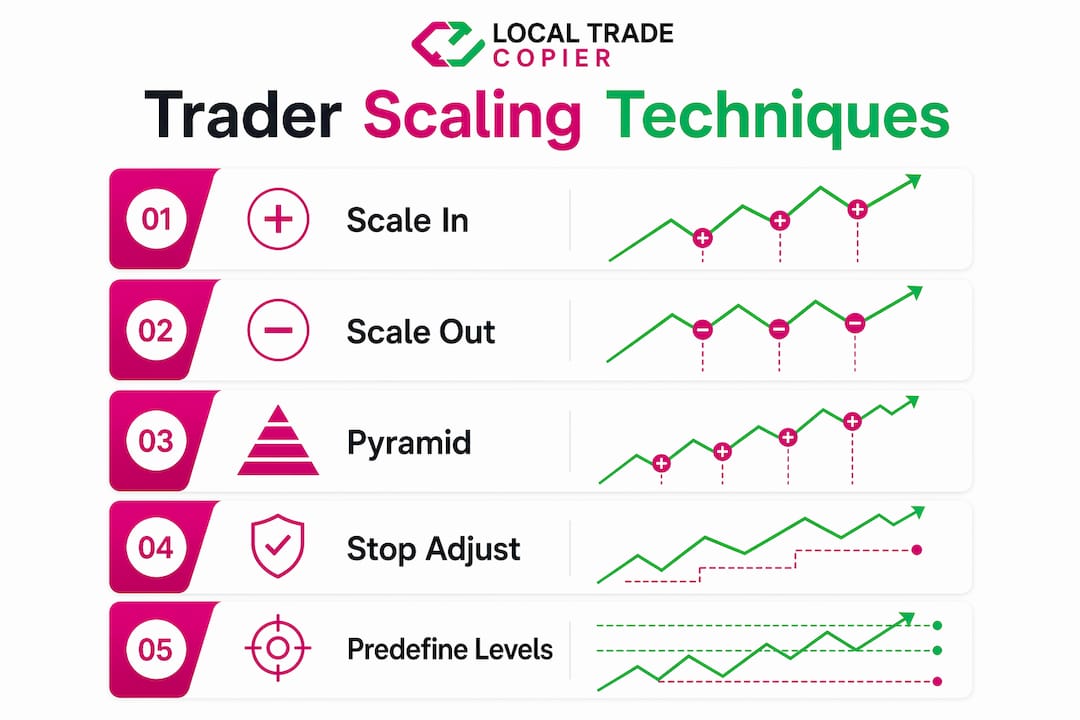
Infographic showing trader scaling techniques steps
Scaling in: building a position in phases
A structured scaling-in approach uses a multi-phase process. The first phase is a probe entry at 25 to 40% of the intended full position. This initial entry tests the thesis with limited exposure. The second phase is a confirmation add at 30 to 40% of the full size, triggered only after the market moves in your favor. The stop is moved to break-even after this first add, which reduces total position risk as size increases. The final phase deploys the remainder once the market has confirmed the direction with a second technical signal.
This approach is the opposite of averaging down. You are adding to a winner, not doubling down on a loser.
Scaling out: locking in profits systematically
Scaling out involves exiting one-third of a position at initial targets (a 1:1 reward-to-risk ratio), another third at extended targets, and trailing the final third to capture the full trend move. Technical triggers like RSI overbought readings, Bollinger Bands, and Fibonacci extensions guide each exit point. This method locks in realized gains while keeping a portion of the trade running for larger moves.
Pyramid scaling
Pyramid scaling starts with the largest entry and adds smaller increments as the trade moves in your favor. The shape of the position mirrors a pyramid: wide base at the start, narrowing additions above. This limits the average entry price from rising too fast while still increasing exposure during a confirmed trend.
Pro Tip: Predefine every scaling level, including entry triggers, add sizes, and stop adjustments, before you place the first order. Traders who decide scaling levels during an open trade almost always let emotion override the plan.
| Technique | Primary objective | Best used when |
|---|---|---|
| Scaling in | Reduce timing risk on entry | Market confirmation is needed before full commitment |
| Scaling out | Lock in gains while holding runners | Trade is in profit with trend continuation potential |
| Pyramid scaling | Increase size during confirmed trends | Strong directional momentum with clear technical structure |
Why is psychological discipline critical in effective trader scaling?
Increasing position size is primarily a psychological challenge, not a mathematical one. The emotional weight of risk grows disproportionately as position size increases. A trader comfortable risking 1% on a single entry often finds that a scaled position at 2% total risk feels three times heavier psychologically. This non-linear emotional amplification is one of the least discussed realities of scaling.
The scaling illusion is the belief that because your percentage risk stays constant, your emotional state will too. It does not. Sequence fear, which is the anxiety that a string of losses will hit precisely when your position is largest, causes traders to exit early or skip confirmation adds entirely. Edge erosion happens when a trader abandons a proven process mid-trade because the larger size triggers panic. Both patterns destroy the statistical advantage that scaling is designed to create.
This is the core distinction risk-focused trading educators draw: adding size without a clear invalidation point is not scaling. It is gambling.
Scale only with data-backed confidence and consistent process adherence. The rule is simple and non-negotiable: never add to a losing trade. Scaling into strength, meaning adding only to winning positions, is the single rule that separates successful scaling from account destruction. Scaling into weakness amplifies losses without a ceiling.
Pro Tip: Treat your probe position as a separate, standalone trade. If it closes at a loss, the trade is over. This mental separation prevents the emotional trap of feeling obligated to add size just because you already have a position open.
Partial positions reduce psychological heat and improve long-term trading sustainability. Entering at 25 to 40% of your intended size means the initial loss, if the trade fails, is a fraction of what a full-size entry would cost. That smaller loss is easier to accept, which keeps your decision-making rational on the next trade.
How do trader scaling strategies integrate with risk management?
Scaling and risk management are not separate disciplines. Scaling is risk management applied at the position level. The distinction worth drawing is between scaling as a risk control tool versus scaling as a leverage escalation tactic. Traders who confuse the two tend to blow accounts during drawdown periods.
Here is a structured framework for integrating scaling with risk management:
- Set a maximum total risk for the scaled position. If your standard single-trade risk is 1%, your fully scaled position should not exceed 2 to 2.5% of account equity. The scaling plan does not override your risk ceiling.
- Define invalidation points before entry. Professional traders predefine maximum loss, size increments, and scaling triggers before placing the first order. Emotional decisions during open trades lead to failure.
- Use trailing drawdown rules during growth phases. Prop firms like Apex Trader Funding apply trailing drawdown limits that tighten as profits grow. Replicating this logic in your personal account protects gains during scaling phases.
- Reduce scaling frequency during drawdowns. When your account is in a drawdown, drop back to probe-only entries. Full scaling plans belong in growth phases, not recovery phases.
- Track equity curve smoothness, not just total return. A well-scaled account produces a smoother equity curve with lower peak-to-trough swings. If your equity curve looks like a sawtooth, your scaling plan is not working as a risk tool.
Effective risk management in trading treats scaling as one layer of a broader system that includes position sizing, stop placement, and drawdown limits working together. Past results do not guarantee future performance, but a structured scaling plan gives your edge the best statistical environment to express itself over time.
What role does trader scaling play in forex and prop firm environments?
Forex markets and proprietary trading firms have made position scaling a formal part of their operational structure. In retail forex, scaling is primarily a personal risk management decision. In prop firm environments, it becomes a contractual framework tied to capital access.
Prop firm scaling plans increase authorized capital by 25% every three to four months when traders hit profit milestones while adhering to risk rules. Growth plans often target capital increases up to $2 million or $4 million, contingent on consistency and drawdown compliance. This structure means scaling discipline is not optional. It is the mechanism by which traders access larger capital. Past results do not guarantee future performance.
Key features of prop firm scaling environments include:
- Daily drawdown limits that cap intraday losses regardless of position size
- Trade number caps that prevent overtrading during scaling phases
- Equity protection rules that automatically reduce exposure when account equity drops below a threshold
- Session restrictions that limit trading to specific market hours to control volatility exposure
Multi-account management and automated risk controls are standard practice for prop traders managing scaled positions under rising capital. Traders running multiple funded accounts simultaneously use position scaling across the portfolio, not just within individual trades. This multi-account scaling approach requires consistent execution across all accounts, which is where automation becomes a practical necessity rather than a convenience.
| Scaling context | Capital access mechanism | Primary risk control |
|---|---|---|
| Retail forex | Personal account equity | Self-imposed risk rules |
| Prop firm funded account | Milestone-based capital increases | Firm-mandated drawdown limits |
| Multi-account portfolio | Aggregate position sizing | Automated lot scaling per account |
Understanding how prop firms help traders scale reveals that the best scaling frameworks combine trader discipline with institutional-grade risk controls. The trader provides the strategy and process. The firm provides the capital and the guardrails.
Key takeaways
Trader scaling is a risk control discipline that requires predefining every entry, add, and exit level before placing the first order, with size increases reserved exclusively for winning positions.
| Point | Details |
|---|---|
| Core definition | Scaling adjusts position size in stages to reduce timing risk and emotional exposure. |
| Scale into strength only | Add size only to winning trades; adding to losers amplifies losses without a ceiling. |
| Psychological amplification | Emotional weight grows disproportionately with position size, requiring a predefined plan. |
| Risk ceiling rule | Total scaled position risk should not exceed 2 to 2.5% even when adding in phases. |
| Prop firm application | Firms increase authorized capital by 25% every 3 to 4 months upon hitting milestones with consistent risk discipline. |
Why most traders get scaling backwards
Traders who approach scaling as a profit acceleration tool tend to run into the same problem. They build a position aggressively during a winning streak, the market reverses, and suddenly they are sitting on a loss that is three times larger than anything the plan was designed to handle. The math looked fine on paper. The psychology collapsed in real time.
Those who sustain growth over multiple years tend to share one habit: they treat every scaling add as a separate risk decision, not a continuation of the original trade. If the confirmation signal is not there, the add does not happen. Full stop. No exceptions for “feeling good about the trade” or “the trend looks strong.” Data triggers the add, or nothing does.
The other pattern worth naming is the drawdown trap. Traders who scale aggressively during growth phases often forget to scale down during drawdowns. Dropping back to probe-only entries when an account is underwater is not weakness. It is the structural discipline that keeps a trader in the game long enough for their edge to recover. Scaling is a skill that rewards patience far more than aggression.
Automation also deserves credit here. Manually managing three-phase scaling across multiple accounts during a fast-moving forex session is genuinely difficult. Tools that enforce predefined rules mechanically remove the moment-to-moment temptation to override the plan. That consistency, applied over hundreds of trades, is where the real compounding happens. Past results do not guarantee future performance, but process consistency gives an edge the best chance to show up.
How Mt4copier supports structured scaling across multiple accounts
Managing a scaling plan across one account is demanding. Managing it across several funded accounts simultaneously is where most traders lose consistency, not because the strategy fails, but because manual execution introduces errors and delays.
Mt4copier is a locally installed Expert Advisor that copies trades from a single master account to multiple MetaTrader 4, MetaTrader 5, or DXTrade accounts in 1 second or faster under normal market conditions, with configurable lot sizing per account. Its eight money management modes include automatic lot scaling per client account balance, which means your scaling plan executes consistently across every account without manual re-entry. For prop firm traders, local execution means all trade data stays on one machine and one IP address, with no cloud routing risk. You can also configure automated stop loss and take profit handling so your scale-out exits trigger exactly as planned, every time. Mt4copier has served 3,000+ traders since 2010 with 491 Trustpilot reviews.
FAQ
What is trader scaling in simple terms?
Trader scaling, also called position scaling, is the practice of entering or exiting a trade in multiple stages rather than all at once. It reduces timing risk and emotional pressure by spreading exposure across confirmed price levels.
Should you scale into a losing trade?
No. The golden rule of scaling is to add size only to winning positions. Scaling into a losing trade amplifies losses without a defined ceiling and is the most common way traders turn a manageable loss into an account-threatening one.
How does scaling differ from using leverage?
Scaling controls how you build or reduce a position in stages. Leverage controls how much buying power you access per unit of margin. The two are separate concepts. Scaling is a risk management process. Leverage is a capital multiplier that increases both potential gains and potential losses.
How do prop firms use scaling plans?
Prop firms like Apex Trader Funding increase a trader’s authorized capital by 25% every 3 to 4 months after hitting profit milestones while staying within drawdown rules. This ties capital access directly to demonstrated scaling discipline. Past results do not guarantee future performance.
What is the biggest mistake traders make with scaling?
Adding size without predefined invalidation points is the most common and costly error. Without a mechanical trigger for each add, emotional decision-making takes over and the scaling plan breaks down at exactly the moment it matters most.
