

TL;DR: Auto lot scaling automatically adjusts trade sizes to maintain fixed risk across multiple accounts, promoting consistent risk management. Traders should set risk percentages before defining stop loss distances to avoid overexposure. Proper implementation includes setting lot caps and monitoring volatility to prevent trading errors during market swings.
Auto lot scaling is the automatic calculation and adjustment of trade lot sizes based on account equity and a fixed risk percentage, so every trade carries the same proportional risk regardless of account size. Forex traders managing multiple accounts, prop firm traders, and independent account managers rely on this method to remove manual sizing decisions from their workflow. The industry standard formula, Lot Size = (Account Balance × Risk%) / (Stop Loss in Pips × Pip Value), drives the calculation. Mt4copier supports this approach with eight money management modes built directly into its Expert Advisor software.
What is auto lot scaling and how does it calculate lot size?
Auto lot scaling is the industry term for proportional position sizing, where the lot size adjusts automatically every time account equity or stop loss distance changes. The recognized formula is Lot Size = (Account Balance × Risk%) divided by (Stop Loss in Pips × Pip Value). Each variable in that formula has a direct effect on the final lot size.

Hands performing forex lot size calculation with calculator
Professional traders typically risk 0.5% to 1% of account balance per trade. That range is not arbitrary. It reflects the statistical reality that a losing streak of 10 trades at 1% risk leaves roughly 90% of capital intact, while a 5% risk per trade can wipe out the same account in fewer than 15 losses.
Stop loss distance is the variable most traders underestimate. A wider stop loss on the same trade, with the same risk percentage, produces a smaller lot size. The formula automatically compensates. Some Expert Advisors update lot sizing on every tick for scalpers who need real-time adjustments as volatility shifts stop loss distances within seconds.
The table below shows how lot size changes across different equity levels and stop loss distances at a 1% risk target on a standard EUR/USD trade with a pip value of $10.
| Account Balance | Risk % | Stop Loss (pips) | Pip Value | Calculated Lot Size |
|---|---|---|---|---|
| $10,000 | 1% | 20 | $10 | 0.50 |
| $10,000 | 1% | 50 | $10 | 0.20 |
| $25,000 | 1% | 20 | $10 | 1.25 |
| $50,000 | 1% | 50 | $10 | 1.00 |
| $100,000 | 1% | 30 | $10 | 3.33 |
Pro Tip: Set your risk percentage before you set your stop loss. Deciding on the stop loss first and then sizing the lot manually is the most common way traders accidentally over-risk a position.
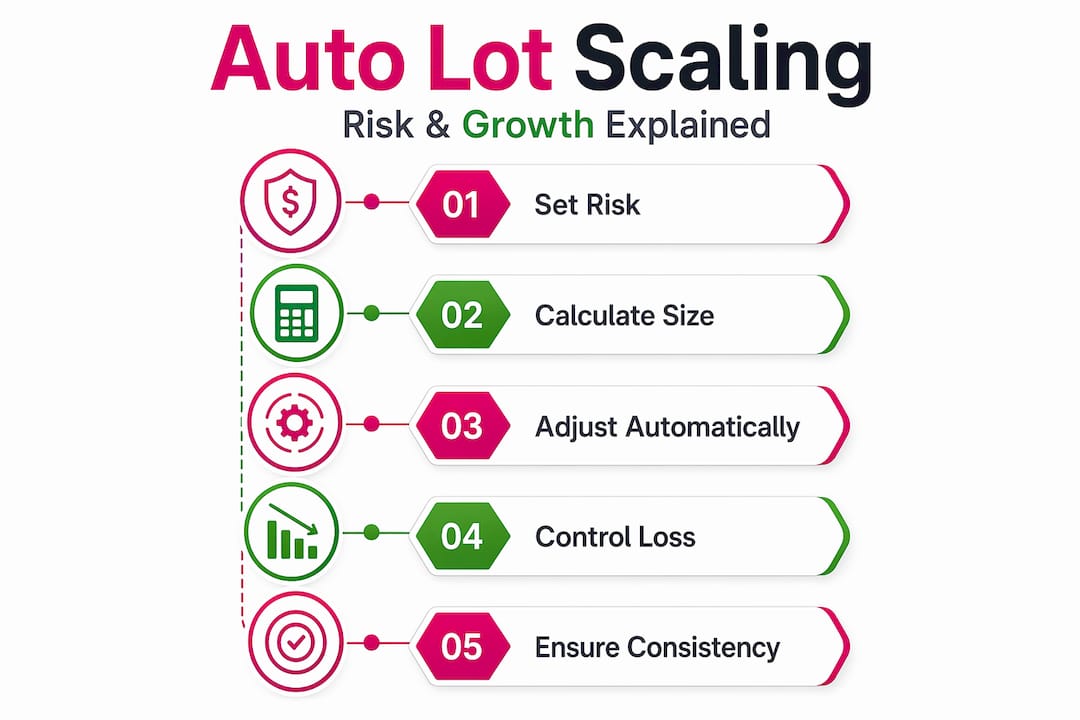
Infographic illustrating auto lot scaling process and benefits
What are the benefits of auto lot scaling for risk and growth?
Auto lot scaling’s primary function is risk control, not growth. Growth is a byproduct of consistent risk control applied over time. Traders who understand this distinction use the method more effectively.
During a drawdown, the formula automatically reduces lot sizes as equity falls. A $50,000 account that drops to $42,000 after a losing streak will produce smaller lots on the next trade, reducing further exposure without any manual intervention. That automatic reduction is what separates proportional sizing from fixed lot sizing, which keeps risk constant in dollar terms even as the account shrinks.
The benefits of auto lot scaling include:
- Drawdown protection. Lot sizes shrink as equity falls, limiting how fast losses compound.
- Proportional growth. As the account grows, lot sizes increase to maintain the same risk percentage, capturing more profit per trade without changing the risk profile.
- Emotional neutrality. The formula makes the sizing decision, not the trader. This removes hesitation and impulsive overriding of position sizes.
- Consistency across accounts. Every account in a multi-account setup carries the same percentage risk per trade, regardless of account size differences.
- Prop firm alignment. Proportional sizing naturally fits within the daily loss limits and drawdown rules most prop firms enforce.
Pro Tip: Traders who overcome Big Number Phobia scale their accounts correctly. The fear of placing a 3-lot trade when you previously traded 0.3 lots is psychological, not mathematical. The risk percentage is identical.
What are the challenges of implementing auto lot scaling?
Volatility is the biggest practical challenge in auto lot scaling. When market volatility expands, stop loss distances widen. A wider stop loss produces a smaller lot size under the formula. That is the correct behavior. The problem arises when traders override the formula during volatile periods because the resulting lot size feels too small.
Dynamic lot scaling amplifies losses just as it amplifies gains. During a poor performance stretch, the formula reduces lots, which is protective. But without hard drawdown stops, a trader can continue placing trades indefinitely, slowly grinding down capital. Industry best practice calls for halting trades after a defined daily loss limit or total drawdown threshold. Past results do not guarantee future performance.
The two main scaling methods differ in structure and behavior:
| Feature | Percentage-based scaling | Fixed-ratio scaling |
|---|---|---|
| Lot size driver | Account equity × risk % | Consistent dollar-profit increment (Delta) |
| Behavior in drawdown | Lots shrink proportionally | Lots reduce based on profit milestones |
| Growth curve | Linear relative to equity | Parabolic as profits accumulate |
| Complexity | Low | Moderate |
| Best suited for | General risk management | Prop firm payout maximization |
Fixed-ratio scaling uses a consistent dollar-profit increment called Delta to trigger lot size increases. This creates a parabolic growth curve that some prop firm traders prefer because it controls drawdown while accelerating payout growth. The tradeoff is that the method requires more precise configuration upfront.
Pro Tip: Always set a max lot cap in your EA or trade copier settings. Without a ceiling, a rapid equity spike can trigger an outsized lot size that exceeds broker margin limits or prop firm position size rules.
A margin of safety buffer built into your risk parameters adds another layer of protection. Setting your risk percentage slightly below your maximum allowed level gives the formula room to absorb volatility without breaching hard limits.
How does auto lot scaling work with trade copying and multi-account management?
Trade copier software typically supports three lot sizing modes: fixed lot, multiplier, and risk-based lot sizing. Risk-based mode is the one that implements auto lot scaling. It reads each client account’s equity and applies the formula independently, so a $10,000 account and a $100,000 account both carry the same percentage risk on every copied trade.
Setting up auto lot scaling in a multi-account copy trading environment follows a clear sequence:
- Define the risk percentage for each client account, typically 0.5% to 1% per trade.
- Set the lot sizing mode in the trade copier to risk-based, not fixed or multiplier.
- Input the stop loss reference so the copier can calculate lot size per account at the moment of trade execution.
- Configure a max lot cap per account to prevent outsized positions during equity spikes or data errors.
- Set daily loss limits aligned with prop firm rules or personal drawdown thresholds.
- Test on a demo account before going live to confirm the formula produces expected lot sizes across all connected accounts.
- Review scaling parameters after any significant equity change, such as a payout withdrawal or a capital injection.
Accounts with different sizes create a specific challenge. If the master account trades 1 lot and a client account is one-tenth the size, a fixed multiplier of 0.1 produces the correct lot size only if the risk profiles match exactly. Risk-based mode removes that dependency by calculating each account’s lot size from its own equity, not from the master’s position size.
Mt4copier handles this through its risk parameter configuration, which lets account managers assign individual risk percentages and max lot limits to each client account. The software runs locally on a Windows machine or VPS, so all calculations happen on one machine with execution in 1 second or faster under normal market conditions and no cloud routing delay. For prop firm traders, local execution also means a single IP address, which avoids the detection risk associated with cloud-based copying services.
Splitting large positions across multiple smaller lots is another practical tool for accounts with lot size limits. Some prop firms cap individual position sizes, and a trade copier that can split a master trade into several smaller client-side positions keeps the risk-based sizing intact without breaching those caps.
Key Takeaways
Auto lot scaling is the most reliable method for maintaining consistent percentage risk across multiple forex accounts, because it ties every lot size decision to a formula rather than a trader’s judgment.
| Point | Details |
|---|---|
| Core formula | Lot Size = (Account Balance × Risk%) / (Stop Loss in Pips × Pip Value) drives every calculation. |
| Risk percentage target | Professional traders target 0.5% to 1% risk per trade to survive extended losing streaks. |
| Primary purpose | Auto lot scaling protects capital during drawdowns first; growth is a secondary outcome. |
| Max lot cap required | Always set a ceiling on lot size to prevent outsized positions during volatility spikes. |
| Multi-account application | Risk-based mode in trade copiers applies the formula independently to each account’s equity. |
Why traders misuse auto lot scaling
The most common mistake is treating auto lot scaling as a growth tool rather than a protection tool. Traders set it up, watch their lots increase as the account grows, and feel good about the compounding effect. Then a drawdown hits, the lots shrink, and they override the formula manually because the smaller size “feels wrong.” That override is exactly where the system breaks down.
The formula is not a suggestion, it is a rule. The moment a trader starts sizing by feel instead of by calculation, they abandon the only thing that makes proportional sizing work. Traders have blown funded accounts not because their strategy failed, but because they manually increased lot sizes during a losing streak to “make back” losses faster.
Big Number Phobia runs in the opposite direction but causes the same damage. A trader who built a $10,000 account up to $80,000 will hesitate to place the 4-lot trade the formula requires, because 4 lots feels reckless compared to the 0.5 lots they started with. The risk percentage is identical, the hesitation is psychological, not mathematical.
The drawdown cap should be treated as a non-negotiable rule, not a guideline. Setting a daily loss limit and a total drawdown threshold before trading begins is essential. When those limits are hit, trading stops. The formula cannot protect an account if a trader keeps trading through it.
How Mt4copier supports auto lot scaling across multiple accounts
Mt4copier gives account managers and prop firm traders a direct path to implementing risk-based lot sizing across every connected account without manual recalculation.
The software’s eight money management modes include full risk-based mode, where each client account receives a lot size calculated from its own equity and the configured risk percentage. Account managers can assign individual risk percentages, set max lot caps, and define drawdown limits per account, all from a single master terminal. Mt4copier runs locally on a Windows PC or VPS, delivering execution in 1 second or faster under normal market conditions with no cloud routing. For traders managing prop firm accounts, that local execution keeps all trade data on one IP address. Mt4copier has served 3,000+ traders since 2010 and holds 491 Trustpilot reviews. A 7-day free trial is available to test the full feature set before committing.
FAQ
What is auto lot scaling in forex trading?
Auto lot scaling is the automatic adjustment of trade lot sizes based on account equity and a fixed risk percentage. The standard formula is Lot Size = (Account Balance × Risk%) / (Stop Loss in Pips × Pip Value).
How does auto lot scaling differ from fixed lot sizing?
Fixed lot sizing keeps the same lot size regardless of account balance changes, while auto lot scaling recalculates the lot size every trade to maintain a consistent percentage risk as equity rises or falls.
What risk percentage should I use with auto lot scaling?
Professional traders typically use 0.5% to 1% risk per trade. This range limits the damage from losing streaks while still allowing meaningful position sizes as the account grows.
Why do I need a max lot cap with auto lot scaling?
Without a max lot cap, a sudden equity spike or data error can trigger an outsized lot size that exceeds broker margin requirements or prop firm position limits. A cap prevents that exposure.
Can auto lot scaling work across accounts with different balances?
Risk-based mode in a trade copier applies the formula independently to each account’s equity, so a $10,000 account and a $100,000 account both carry the same percentage risk on every trade regardless of the master account’s position size.
Recommended
- What Is Trader Scaling? A Forex Risk Management Guide
- What is a LOT in Forex Trading? Lot Sizes Explained
- Most Effective Strategies for Managing Risk in Forex Trading | Trade Copier for MT4 & MT5
- Mitigate forex trading risk for multi-account success
