

TL;DR:
- Account scaling rewards traders who demonstrate discipline by increasing their trading capital or contract limits based on milestones. It requires consistent trading patterns, proper risk management, and understanding whether models increase balance or contract limits. Proper management and verification protect traders from disqualification and ensure sustainable growth.
Account scaling is defined as a systematic policy that increases a trader’s authorized capital or contract limits after meeting verified profit and consistency milestones. In prop trading environments, scaling increments typically include a 25% capital increase every 3–4 months or a balance doubling after an 8% profit milestone. Understanding what is account scaling matters because it changes how you size positions, manage drawdowns, and plan your growth across funded accounts. This guide breaks down the models, rules, and practical strategies you need to scale without losing your account in the process.
What is account scaling in prop trading?
Account scaling in prop trading is a structured promotion system that rewards verified risk management with larger trading capital or higher position limits. Scaling is earned through consistent discipline, not just hitting a profit number. Firms increase capital exposure only after statistical proof of trader discipline. Past results do not guarantee future performance.

The account scaling definition goes beyond simply getting more money to trade. It represents a firm’s decision to trust you with greater exposure based on your track record. Marketing ceilings at top prop firms often reach $1–2 million after multiple successful scaling rounds, but few traders reach those levels due to strict consecutive success requirements. That gap between the advertised ceiling and reality is the first thing every trader should internalize.
Scaling also allows you to keep the same risk-per-trade percentage applied to a larger balance, which compounds your dollar profits as the account grows. A trader risking 1% per trade on a $100,000 account risks $1,000 per trade. After scaling to $200,000, that same 1% becomes $2,000. The math is simple. The discipline required to get there is not.
What are the primary models of account scaling?
Two primary scaling models exist in prop trading: Capital Scaling and Contract Ladders. They work differently, and confusing them leads to poor planning.
Capital Scaling increases the actual account balance after a profit milestone. Your equity grows, and you trade with a larger pool of capital. This model is most common in Forex prop firms. The balance increase directly raises your position sizing capacity when you apply a fixed risk percentage.
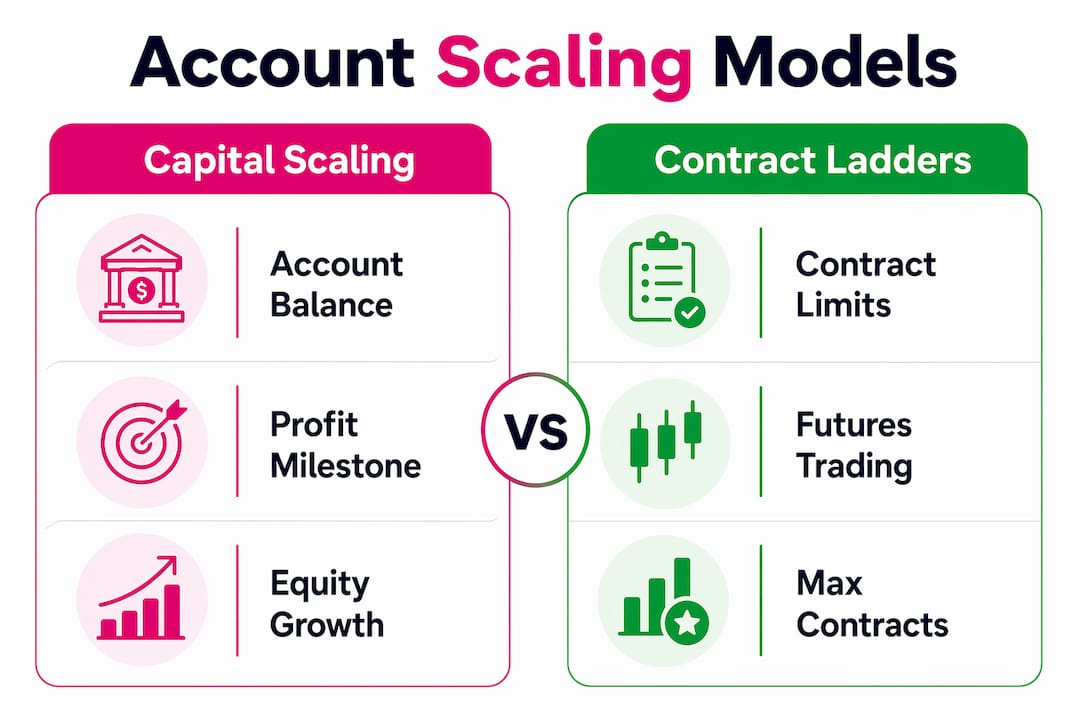
Contract Ladders are more common in Futures trading. The headline balance stays the same, but the firm raises your maximum contract limit based on balance tiers. You are not getting more money. You are getting permission to hold more contracts at once.
| Feature | Capital Scaling | Contract Ladders |
|---|---|---|
| What increases | Account balance | Maximum contract limit |
| Common market | Forex | Futures |
| Risk impact | Larger dollar risk per trade | Higher position concentration |
| Scaling trigger | Profit milestone (e.g., 8–10%) | Balance tier threshold |
| Trader perception | “More capital” | “More contracts” |
Some firms scale contract limits daily based on closing balances, while others scale account balances monthly after milestones. That operational difference matters when you plan your trading calendar. A monthly scaling firm requires you to sustain performance for a full cycle. A daily scaling firm adjusts your limits more frequently, which cuts both ways.
Pro Tip: Always confirm which model your firm uses before you start trading. Traders often confuse balance growth with contract limit growth, and the two require different position sizing approaches.
What rules and milestones govern scaling qualification?
Qualifying for scaling requires meeting profit targets, staying within drawdown limits, and demonstrating consistent trading patterns. Common profit milestones require a minimum 10% net profit with no rule violations and a minimum number of trading days completed. Meeting the profit target alone is not enough.
Typical scaling qualification checklist
- Achieve the required net profit percentage (commonly 8–10%) within the allowed timeframe
- Stay within the firm’s maximum daily and overall drawdown limits throughout the period
- Maintain consistent lot sizing with no erratic spikes in position size
- Complete the minimum number of required trading days
- Avoid any rule violations, including trading during restricted news events if the firm prohibits it
The trailing drawdown rule is the most misunderstood element of scaling. Trailing drawdown floors move upward as your profits grow, which narrows your actual margin for error even as your capital increases. If your initial loss limit is $3,000 and you earn $1,000, the floor moves up by $1,000. Your buffer does not grow with your profits. It stays fixed while your high-water mark rises.
Consistency rules are often the silent killers of scaling eligibility. A single oversized trade that generates a large profit can flag your account as inconsistent. Firms explicitly require stable trading patterns, not just positive results. Failing any one condition disqualifies scaling even if every other metric is green.
Pro Tip: Track your trailing drawdown floor daily in a spreadsheet. Most traders watch their profit number obsessively but ignore the floor moving up beneath them. Knowing your real buffer at any moment is the most important number on your dashboard.
What challenges do traders face when scaling accounts?
The biggest misconception about scaling is treating it as a financial reward rather than a promotion. Scaling is a promotion system that verifies risk management discipline. Firms are not giving you a bonus. They are increasing their own exposure to your trading, which means they need more proof of your reliability before they do it.
One counterintuitive reality: scaling can increase your absolute loss risk even as your capital grows. A larger account with a trailing drawdown floor that has moved up significantly may leave you with less breathing room than your original funded account. A trader who scaled from $100,000 to $150,000 after strong profits may find their actual dollar buffer is smaller than it was at the start. Past results do not guarantee future performance, and a larger account does not mean a safer position.
Scaling plans frequently reset or adjust contract limits when traders move from evaluation to funded accounts. This catches traders off guard regularly. You may have built up a contract limit during evaluation only to find it resets at the funded stage. Reading the transition terms before you pass evaluation is not optional.
Pro Tip: Treat the evaluation-to-funded transition as a new starting point, not a continuation. Re-read the funded account terms as if you had never seen them. The rules often differ from the evaluation phase in ways that affect your position sizing immediately.
Inconsistency caused by erratic lot sizing is a major cause of scaling disqualification even when profit targets are met. A single lucky trade that represents 10x your normal position size can void an otherwise clean month. Firms look at the pattern, not just the outcome. Discipline in trade sizing is not just a risk management tool. It is a scaling prerequisite.
How can traders effectively manage the scaling process?
Effective account growth requires treating scaling as a long-term process with defined rules at every stage. The traders who reach high capital tiers do so by verifying firm-specific scaling terms before committing to a strategy, not after. Knowing the exact milestone, the exact drawdown rule, and the exact consistency requirement before you place your first trade removes ambiguity from your decision-making.
Key account scaling strategies for Forex traders
- Set a fixed risk percentage per trade and never deviate. Consistency in lot sizing is both a risk management practice and a scaling eligibility requirement. Pick a percentage and hold it across every session.
- Monitor your trailing drawdown floor daily. Calculate your real buffer, not just your profit. Know exactly how much room you have before a violation occurs.
- Verify your firm’s scaling model before trading. Confirm whether your firm uses Capital Scaling or a Contract Ladder, and understand how the transition from evaluation to funded affects your limits.
- Use automated trade replication for multi-account management. When running multiple funded accounts, manual re-entry introduces sizing errors. Automated copying tools maintain consistent lot sizes across accounts without human error.
- Plan your trading calendar around the scaling cycle. If your firm scales monthly, structure your risk around a monthly performance window. If it scales daily, adjust your position review frequency accordingly.
- Read the fine print on minimum trading days. Many traders hit their profit target early and stop trading, only to fail the minimum days requirement. Stay active within the rules.
Automated trade copying tools help maintain consistent position sizing across multiple accounts, which directly supports scaling eligibility. When you manage two or three funded accounts simultaneously, manual sizing becomes a liability. A single input error on one account can create an inconsistency flag that costs you a scaling cycle. Removing that human variable is one of the most practical steps a multi-account trader can take.
Multi-account risk management also requires you to treat each account’s drawdown independently. A loss on one account does not offset a gain on another in the eyes of the firm reviewing your eligibility. Each account is evaluated on its own terms.
Scaling is a discipline test, not a prize draw
Account scaling rewarded me with a hard lesson before it rewarded me with capital. I spent months hitting profit targets on a funded account, feeling confident about the upcoming scaling event, only to get flagged for inconsistent lot sizing during a volatile week. The profit was there. The consistency was not. The scaling did not happen.
That experience changed how I think about the entire process. Scaling is not a prize you collect after a good month. It is a promotion you earn by proving you can do the same thing, the same way, over and over, regardless of market conditions. The firms running these programs are not looking for your best month. They are looking for your most repeatable month.
The trailing drawdown mechanic is the part most traders underestimate until it costs them. As your account grows, your floor rises. Your buffer does not expand with your profits. That means a scaling event can actually put you in a tighter position than you were before, which is the opposite of what most traders expect. Understanding this before you scale is the difference between growing your account and blowing it at a higher level.
My advice: before you pursue scaling aggressively, spend two full cycles just documenting your lot sizes, your drawdown floor, and your daily buffer. If the numbers are clean and consistent, you are ready. If they are not, no amount of profit will save your eligibility. Patience and verification are the two most underrated tools in a prop trader’s kit.
— Rimantas
How Mt4copier supports traders managing multiple funded accounts
Traders managing multiple funded accounts face a specific operational problem: keeping lot sizes consistent across every account, every trade, without manual re-entry errors.
Mt4copier’s Local Trade Copier runs entirely on your Windows machine or VPS, copying trades from a single master account to multiple client accounts in under 0.5 seconds. It includes 18 lot size and risk management options, with automatic lot scaling per client account balance. That means each account receives correctly sized positions relative to its own balance, which directly supports the consistency requirements that scaling programs demand. For prop firm traders, local execution also means one IP address and no cloud routing risk. Mt4copier has served 3,000+ traders since 2010. You can explore how stop-loss and take-profit replication works across accounts, or review prop trading best practices for multi-account copying in 2026.
Key Takeaways
Account scaling is a structured promotion system that rewards consistent risk management with larger capital or higher position limits, not a financial bonus for hitting a single profit target.
| Point | Details |
|---|---|
| Core definition | Account scaling increases authorized capital or contract limits after verified profit and consistency milestones. |
| Two primary models | Capital Scaling grows account balance; Contract Ladders raise position limits without changing the balance. |
| Trailing drawdown risk | As profits grow, the drawdown floor rises, narrowing your real buffer even on a larger account. |
| Consistency is required | Erratic lot sizing disqualifies scaling even when profit targets are fully met. |
| Automation reduces errors | Automated trade copying maintains consistent lot sizes across multiple accounts, supporting scaling eligibility. |
FAQ
What is the account scaling definition in prop trading?
Account scaling in prop trading is a policy that increases a trader’s authorized capital or contract limits after meeting profit and consistency milestones. Common thresholds include 8–10% net profit over 1–4 months with no rule violations.
How does trailing drawdown affect scaling eligibility?
Trailing drawdown floors move upward as profits accumulate, which reduces your actual loss buffer even as your capital grows. A larger account after scaling does not mean more room for error. Past results do not guarantee future performance.
What is the difference between Capital Scaling and Contract Ladders?
Capital Scaling increases the actual account balance, while Contract Ladders raise the maximum number of contracts you can hold without changing the balance. Traders should clarify which model their firm uses before trading.
Why do traders get disqualified from scaling despite hitting profit targets?
Inconsistent lot sizing or a single oversized trade can flag an account as non-compliant with consistency rules. Firms evaluate trading patterns, not just profit outcomes.
Do scaling terms change when moving from evaluation to a funded account?
Yes. Scaling plans frequently reset or adjust contract limits at the evaluation-to-funded transition. Traders should read the funded account terms separately before the transition occurs.
Recommended
- What Is Trader Scaling? A Forex Risk Management Guide
- Why use account management in forex? Boost control
- How prop firms help forex traders scale and manage risk
