

TL;DR:
- Privacy in forex automation protects trading strategies and credentials from unauthorized access and exploitation.
- Securing remote access, disabling DLL imports, and utilizing local execution significantly reduce vulnerability risks.
- Prioritizing ongoing operational discipline and privacy-conscious tools maintains trader trust and market stability.
Privacy in forex automation is defined as the protection of your trading strategies, personal credentials, and automated system data from unauthorized access, interception, and exploitation. This is not a compliance formality. For traders running Expert Advisors on MetaTrader 4, MetaTrader 5, or DXTrade, a single privacy failure can expose your entire strategy, drain your accounts, or get your prop firm account flagged. Understanding why privacy matters in forex automation starts with recognizing that your automated setup is a live, internet-connected system processing real capital around the clock. The risks are technical, behavioral, and financial, and they compound fast.
Why privacy matters in forex automation systems
Automated forex trading introduces a specific category of risk that manual trading does not. Your system runs without you watching it, which means any breach can operate undetected for hours. The most common entry points are not exotic exploits. They are basic configuration failures that attackers scan for continuously.
Two analysts discussing forex automation risks in office
90% of cyberattacks on forex trading environments target Remote Desktop Protocol (RDP) misconfigurations. That figure tells you something direct: most traders are not being targeted because of who they are, but because their setup is misconfigured and visible. Attackers use automated scanners to find open RDP ports, then brute-force their way in.
The importance of privacy in forex goes beyond keeping your password safe. Your automated system holds broker credentials, strategy logic, and live position data. If any of that leaks, you lose more than data. You lose your edge.
What are the main privacy risks in forex automation?
RDP and remote access vulnerabilities
Running a trading VPS or home machine with default RDP settings is the most common and most dangerous oversight in forex automation security. Default port 3389 is scanned millions of times per day by botnets. Traders who do not change this port, disable unused remote access, or enforce Network Level Authentication (NLA) are leaving a front door open.
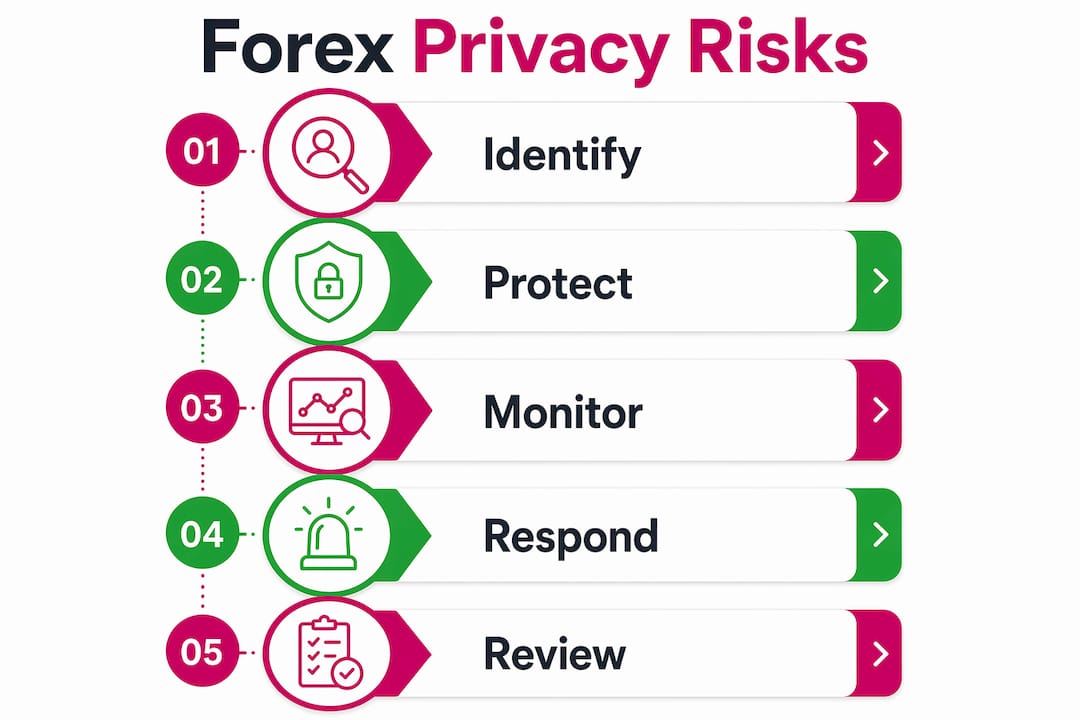
Infographic depicting forex privacy risk management steps
DLL imports in MetaTrader
Allowing DLL imports in MetaTrader exposes your local machine to OS-level risks, including unauthorized credential theft. This is one of the most overlooked attack vectors in automated trading. A malicious DLL loaded by an Expert Advisor can read your keystrokes, access stored passwords, or communicate with external servers without triggering any visible alert.
Cloud metadata exposure
Cloud platforms often collect and monetize metadata about trader behavior, including timing patterns, lot sizes, and adjustment frequency. This data reveals your strategy even when your actual trade logic is hidden. Local execution eliminates this risk entirely by keeping all processing on one machine.
AI tool data leakage
Major financial institutions banned external AI chatbots within 90 days in 2023 after recognizing that proprietary strategy details were leaking into AI training pipelines. If you paste your EA logic or account parameters into a public AI tool, that data can persist in ways you cannot control.
Internal access failures
Internal threats from staff or partners exporting sensitive trading data without proper access controls represent a serious and underestimated risk. Without granular audit trails and hide-by-default policies, you cannot detect unauthorized access until the damage is done.
Pro Tip: Disable DLL imports in MetaTrader unless you have personally reviewed and vetted the source code of every Expert Advisor you run. The performance gain is never worth the OS-level exposure.
How does privacy affect trading performance and trust?
Privacy failures do not stay contained to the technical layer. They ripple into your trading behavior, your broker relationship, and your account balance.
As FX Street has reported, security failures extend beyond compliance checklists, shaping how much traders trust a platform and whether they keep using it.
Privacy breaches cause measurable declines in deposits and increased withdrawals, directly reducing liquidity and trading volume. This is not abstract. When traders lose confidence in a platform’s security, they pull capital. That withdrawal behavior compounds into reduced market depth and wider spreads for everyone still active on that platform.
The behavioral impact is equally significant. Privacy breaches hurt trader-behavior metrics including login difficulty, fund withdrawal delays, and overall platform dissatisfaction. These friction points trigger churn. Once a trader leaves a platform after a security incident, the probability of return is low.
For individual traders, the stakes are more personal. If your strategy leaks, a competitor can front-run your positions. If your credentials are stolen, your account can be liquidated before you even receive a notification. How privacy affects trading is not theoretical. It determines whether your automation keeps working or becomes a liability.
What are the best practices for forex data protection?
Securing your automated trading environment requires layered controls, not a single fix. The following steps address the highest-impact vulnerabilities in order of priority.
Hardening RDP access
- Change the default RDP port from 3389 to a non-standard port above 10000.
- Enable Network Level Authentication (NLA) to require credential verification before a session is established.
- Enforce Multi-Factor Authentication (MFA) on all remote access points.
- Restrict RDP access by IP whitelist so only your known addresses can connect.
Implementing NLA, changing the default port, and enabling MFA addresses the overwhelming majority of automated compromise attempts. These changes take roughly 30 minutes and close the most commonly exploited entry points.
VPN for encrypted sessions
VPNs protect trading sessions by encrypting all data in transit and masking your IP address, reducing your exposure to interception and man-in-the-middle attacks. A VPN is no longer an optional privacy tool. It is a core element of forex automation security, particularly when connecting to a VPS from public or shared networks.
Local execution over cloud routing
Running your trade copier or EA on a local machine or dedicated VPS keeps all trade data on one IP address with no external server routing. This eliminates cloud metadata exposure and removes the risk of a third-party server being compromised. For prop firm traders, local execution also avoids cloud IP detection that can trigger account reviews.
Kill-switch architecture
A tiered kill-switch mechanism in forex automation reduces risk by logically or manually suspending trading under abnormal conditions. This combines drawdown thresholds, connection monitoring, and manual API revocation. If your system detects unusual behavior, a kill switch stops execution before damage compounds.
Pro Tip: Set your kill switch to trigger on both drawdown thresholds and unexpected connection drops. A sudden VPS disconnection during high-volatility sessions is a common attack window.
Security method comparison
| Method | What It Protects | Complexity |
|---|---|---|
| MFA on RDP | Remote access credentials | Low |
| VPN | Session data, IP identity | Low |
| Local execution | Strategy metadata, trade data | Medium |
| DLL import restriction | OS-level access, credentials | Low |
| Kill-switch architecture | Capital under abnormal conditions | Medium |
| Granular audit logging | Internal access, data exfiltration | Medium |
You can review a full forex trading security checklist to map these controls against your current setup.
How are privacy-forward platforms changing forex automation?
The risks of forex automation privacy are driving a structural shift in how traders choose and configure their tools. The direction is clear: away from cloud-first architectures and toward on-device, edge-based processing.
- Local execution preference: Traders managing multiple accounts or prop firm challenges are actively choosing tools that run entirely on their own machine. No cloud routing means no third-party server holds your data, even temporarily.
- Hide-by-default controls: Privacy-forward platforms now offer settings that conceal account numbers, balance figures, and position details from the interface by default. This protects against shoulder-surfing and screen-capture malware.
- Real-time audit logs: Granular logging of every access event, including failed login attempts and file exports, is becoming a baseline expectation rather than a premium feature.
- Privacy-first AI architecture: Inference-isolated AI architectures where data does not persist are now preferred by major financial institutions for preserving proprietary trading information. This trend is moving into retail trading tools as well.
Financial traders are shifting to privacy-forward automation with edge computing and local data processing to protect their trading edge. This is not a niche preference. It reflects a broader recognition that your strategy’s value depends entirely on it remaining yours.
For traders sharing trades securely across multiple accounts, the architecture of the copying tool matters as much as the strategy itself.
Key takeaways
Privacy in forex automation protects your strategy, credentials, and capital by eliminating the technical and behavioral vulnerabilities that automated systems introduce.
| Point | Details |
|---|---|
| RDP is the primary attack vector | Change default ports, enable NLA, and enforce MFA to block the vast majority of automated attacks. |
| Cloud routing exposes strategy metadata | Local execution keeps all trade data on one machine, removing third-party data exposure. |
| Privacy breaches reduce trading volume | Deposit declines and withdrawal spikes follow security incidents, hurting both traders and platforms. |
| DLL imports are an overlooked risk | Disable DLL imports in MetaTrader unless every EA has been personally vetted at the code level. |
| Kill switches limit automation damage | Tiered kill-switch controls stop runaway systems before a breach compounds into capital loss. |
Privacy in forex automation: what i’ve learned the hard way
Traders who have been running automated systems since the early days of EA-based trading have seen this pattern repeat. A trader spends months building a solid EA, then runs it on a VPS with default RDP settings and no MFA. Nothing happens for six months. Then one morning, the account is empty.
The set-it-and-forget-it mindset is the real threat. Automation creates a false sense of security. The system is running, trades are copying, everything looks fine. But the attack surface does not shrink just because the EA is profitable. It grows every day the system stays online without updated controls.
Traders who handle this well share one habit: they treat their trading machine like a financial institution treats a server room. Access is restricted, logged, and reviewed. Passwords rotate. MFA is non-negotiable. DLL imports are off by default.
Traders who get burned share a different habit: they treat security as a one-time setup task. They configure it once, then never revisit it. New EAs get added without vetting. VPN subscriptions lapse. RDP ports stay on default because changing them “seems complicated.”
Privacy in automated forex trading is not a technical checkbox. It is an ongoing operational discipline. The tools exist to do this right. The question is whether it gets treated as a priority before something goes wrong, or after.
Protect your automated trading setup with Mt4copier
If you run automated trades across MetaTrader 4, MetaTrader 5, or DXTrade, the architecture of your copying tool directly affects your privacy exposure. Mt4copier’s Local Trade Copier runs entirely on your local Windows machine or VPS, with no cloud routing and no external server holding your trade data. Every copy executes on one IP address, in 1 second or faster under normal market conditions, with no third-party metadata collection.
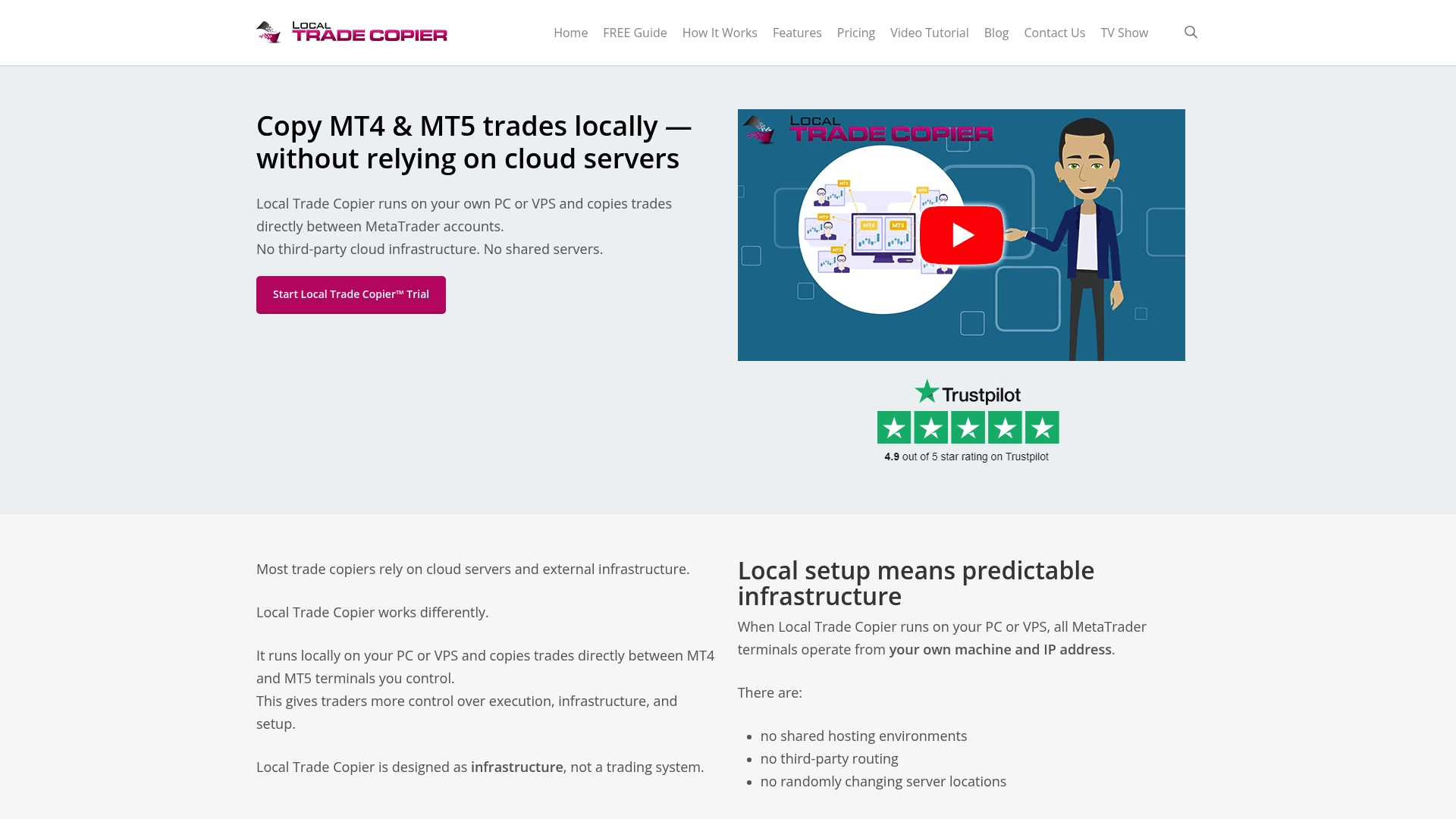
That local-execution model is exactly what privacy-forward forex automation requires in 2026. Combined with VPN usage and strong access controls, it removes the cloud routing risk that exposes strategy data on other platforms. You can review Mt4copier’s trade copier security practices to see how VPS configuration and password discipline integrate directly with the tool. Over 3,000 traders trust it. Start your 7-day free trial and keep your trading data where it belongs: on your machine.
FAQ
What is the biggest privacy risk in forex automation?
RDP misconfiguration is the leading entry point, with 90% of cyberattacks on trading environments targeting it directly. Changing the default port and enabling MFA addresses this risk immediately.
Does using a VPN protect my forex trading data?
Yes. VPNs encrypt session data and mask your IP address, protecting your connection to broker servers from interception and man-in-the-middle attacks.
Can cloud-based trade copiers expose my strategy?
Cloud platforms often collect metadata about trader behavior, including timing and lot-size patterns, which can reveal your strategy indirectly. Local execution tools avoid this by keeping all data on your own machine.
Why should i disable DLL imports in MetaTrader?
DLL imports expose your machine to OS-level access, including credential theft. Unless you have reviewed the source code of an EA yourself, disabling DLL imports is the safer default.
How do privacy breaches affect my trading account directly?
Beyond credential theft, privacy breaches trigger behavioral responses including platform distrust and withdrawal delays that disrupt your ability to manage positions and access capital when you need it most.
Recommended
- How to Share Trades Securely: A 2026 Forex Guide
- Secure Forex Trade Workflow: Your 2026 Practical Guide
