

Drawdown control is the active effort to limit how far a trading portfolio falls from its peak value before recovering. Think of it as a thermostat for risk: it keeps your exposure within the bounds you can actually tolerate, financially and emotionally. For forex traders running trade copier software across multiple accounts, this isn’t abstract theory. One bad sequence of replicated trades can compound losses across every account simultaneously, making portfolio-level risk management far more urgent than it is for a single-account trader.
What is drawdown control and why does it matter?
Drawdown itself is the percentage decline from a portfolio’s highest peak to its lowest subsequent trough before a new high is reached. Drawdown control is the framework you build around that metric to stop it from getting out of hand.
- Capital preservation: Limiting declines protects the base you need to keep trading. A 50% loss requires a 100% gain just to break even, which is why recovery asymmetry makes preventing large drawdowns mathematically more valuable than chasing equivalent gains.
- Portfolio-level focus: Drawdown control operates at the total account level, not trade by trade. It tracks cumulative decline, not individual position outcomes.
- Risk tolerance alignment: The goal is keeping volatility within a range you can hold through without abandoning your strategy.
- Applies to automated and manual trading alike: Any system that replicates trades across accounts needs drawdown controls baked in, not bolted on afterward.
Past results do not guarantee future performance.
How drawdown control applies to forex trading with trade copiers
Forex markets move fast, and leverage amplifies every swing. When you add a trade copier into the picture, replicating positions from one master account to multiple client accounts, a single losing streak hits every account at once. That concentration of risk is the core challenge.
- Correlated losses across accounts: All replicated accounts mirror the same trades, so drawdowns are synchronized rather than diversified.
- Adaptive position sizing: Automated risk controls in trade copier software can scale lot sizes down as drawdown deepens, reducing exposure before losses compound further.
- Market regime filters: Good copier setups include conditions that pause replication during unfavorable market environments, such as high-volatility news events.
- Kill switch protocols: A predefined trigger that halts all trade copying when a drawdown threshold is crossed gives you a hard stop before catastrophic loss.
- Per-account configuration: Each replicated account may have a different balance and risk tolerance, so drawdown limits should be set individually, not uniformly.
Core drawdown control strategies every forex trader should know
The list of drawdown control strategies that actually hold up in live trading is shorter than most guides suggest. These are the ones worth building into your process.
- Reduce risk per trade: Lowering your exposure per trade directly reduces maximum drawdown potential. Cutting risk per trade in half can approximately halve your maximum drawdown, with a proportional effect on returns. Proper position sizing for copy trading is where this starts.
- Diversify across instruments and strategies: Correlated trades amplify drawdowns. Spreading across uncorrelated currency pairs or strategies limits the damage any single losing run can do. A diversified forex portfolio is one of the most practical buffers against synchronized losses.
- Maintain liquidity reserves: Keeping a portion of capital uninvested means you have room to absorb losses without being forced out of positions at the worst moment.
- Avoid excessive leverage: High leverage turns normal volatility into account-threatening drawdowns. Keeping leverage conservative is one of the simplest risk controls available.
- Rebalance periodically: Market movements shift your actual risk exposure away from your intended allocation. Scheduled rebalancing restores the profile you designed.
- Define your kill switch in advance: Set the drawdown level that triggers a full stop before you’re in a losing streak, not during one. Deciding under pressure almost always leads to the wrong call.
Drawdown control vs. individual position risk management
These two concepts get conflated constantly, and the confusion costs traders real money.
- Scope: Position risk management governs a single trade, typically through stop-loss placement and lot sizing. Drawdown control governs the entire portfolio’s cumulative decline.
- Measurement: Position risk is measured in pips or percentage of a single trade. Drawdown control tracks the total portfolio’s peak-to-trough decline over time.
- Recovery time: Individual trade losses resolve quickly. Portfolio drawdowns can persist for weeks or months, and the time to recover matters as much as the depth of the loss.
- Dynamic vs. static: Position risk limits tend to be fixed per trade. Effective drawdown control uses dynamic adjustments that tighten exposure as losses accumulate and ease it as the account recovers.
- Emotional capacity: Drawdown control explicitly accounts for the psychological toll of sustained losses, which position-level rules simply don’t address.
Why behavioral discipline is the hardest part of drawdown control
You can build a perfect drawdown control system and still blow it by overriding your own rules. Behavioral discipline is where most traders actually fail.
- Panic selling locks in losses: Exiting positions during a drawdown because it feels unbearable is one of the most common ways traders turn a manageable decline into a permanent one.
- Overtrading to recover: Increasing position sizes to “make back” losses accelerates drawdown rather than reversing it.
- Rules-based decisions remove emotion: Pre-defined protocols, including specific drawdown thresholds that trigger position reduction or a full stop, take the decision out of your hands when your judgment is least reliable.
- Discipline supports long-term survival: Adherence to pre-defined rules is consistently one of the strongest defenses against excessive drawdowns in volatile markets.
- Behavioral lapses are predictable: Knowing that you will feel the urge to override your rules during a drawdown is itself useful. Building systems that make overriding difficult, such as automated kill switches, compensates for that predictability.
How Mt4copier supports drawdown control across multiple accounts
Mt4copier’s Local Trade Copier is built specifically for traders replicating positions across MT4, MT5, and DXTrade accounts from a single Windows machine or VPS. Its risk management features translate directly into drawdown control at the account level.
- Real-time lot scaling: With 18 lot size and risk management options, Local Trade Copier automatically adjusts position sizes per account based on balance, keeping risk proportional as account equity changes.
- Kill switch and alert integration: Traders can configure thresholds that reduce replication aggressively or halt it entirely when drawdown reaches a defined level. A three-tier approach works well: reduce lot sizes at the first alert level, cut them further at the second, and stop copying entirely at the third.
- Close & Stop features: These lock in profits or cap losses on replicated positions, giving you a hard exit mechanism without manual intervention.
- Per-account drawdown limits: Because each client account can carry different risk settings, drawdown thresholds can be configured individually rather than applied as a blanket rule.
- Prop firm compatibility: Local execution on one machine means one IP address, no cloud routing, and no external latency, which matters for prop firm traders whose accounts are monitored for unusual activity.
- Trusted track record: Active since 2010, Mt4copier has over 3,000 users and 491 Trustpilot reviews.
Pro Tip: Set your kill switch threshold before you go live, not after your first losing week. Define the exact drawdown level that triggers a full copy halt, write it down, and configure it in Local Trade Copier’s settings so the decision is already made.
Past results do not guarantee future performance.
Practical examples of implementing drawdown control with a trade copier
Theory is easy. Here’s how drawdown control actually looks when you’re running a multi-account setup.
A trader running three funded accounts through Local Trade Copier sets each account’s lot scaling to 1% risk per trade based on individual balance. When the master account enters a losing streak, the copier automatically reduces lot sizes on all three client accounts proportionally. At a 5% portfolio drawdown, a Yellow Alert triggers a 50% reduction in copied lot sizes. If the drawdown reaches a second threshold, copying pauses entirely until the trader manually reviews and resets. This approach means no single losing run can cascade into an account-ending event across all three accounts simultaneously.

Another practical application: using the stop-loss and take-profit wait feature ensures that replicated trades don’t close prematurely on client accounts due to timing differences, which can otherwise create unintended drawdown from partial fills or missed exits.
Common challenges and pitfalls in drawdown control with trade copiers
The most common failure isn’t a missing feature. It’s misconfiguration or ignored alerts.
Traders often set drawdown limits too wide because they’re optimistic during setup. A limit that feels conservative when you’re profitable feels brutal when you’re in a losing streak, so you override it. That override is where drawdown control collapses. The second common pitfall is applying uniform lot sizes across accounts with different balances, which means a fixed-lot copy creates wildly different risk percentages per account. Mt4copier’s automatic balance-based scaling addresses this directly, but it only works if you configure it correctly from the start. Finally, traders running prop firm accounts often underestimate how quickly replicated losses can breach firm-imposed drawdown rules, making pre-configured kill switches non-negotiable rather than optional.
How to set drawdown limits based on account size and risk tolerance
There’s no universal number, but there is a logical process. Start with your maximum acceptable loss: the dollar amount you could lose without it affecting your ability to keep trading or your financial stability outside of trading. Convert that to a percentage of your current account balance. That percentage is your hard drawdown limit. For most retail traders, starting with a moderate maximum drawdown limit relative to account equity is reasonable, though your specific tolerance and strategy’s historical behavior should drive the final figure. For prop firm accounts, the firm’s own drawdown rules set the ceiling, and your personal limit should sit comfortably below that ceiling to leave a buffer. Pair your hard limit with a softer warning threshold, perhaps half the hard limit, that triggers position reduction rather than a full stop. That graduated response gives you room to recover without waiting until the damage is already done.
Monitoring and alert systems for drawdown thresholds in multi-account setups
Passive monitoring doesn’t work when you’re running multiple accounts. By the time you notice a problem manually, the drawdown has already deepened. Effective monitoring means setting automated alerts at each tier of your drawdown protocol so the system acts before you have to.
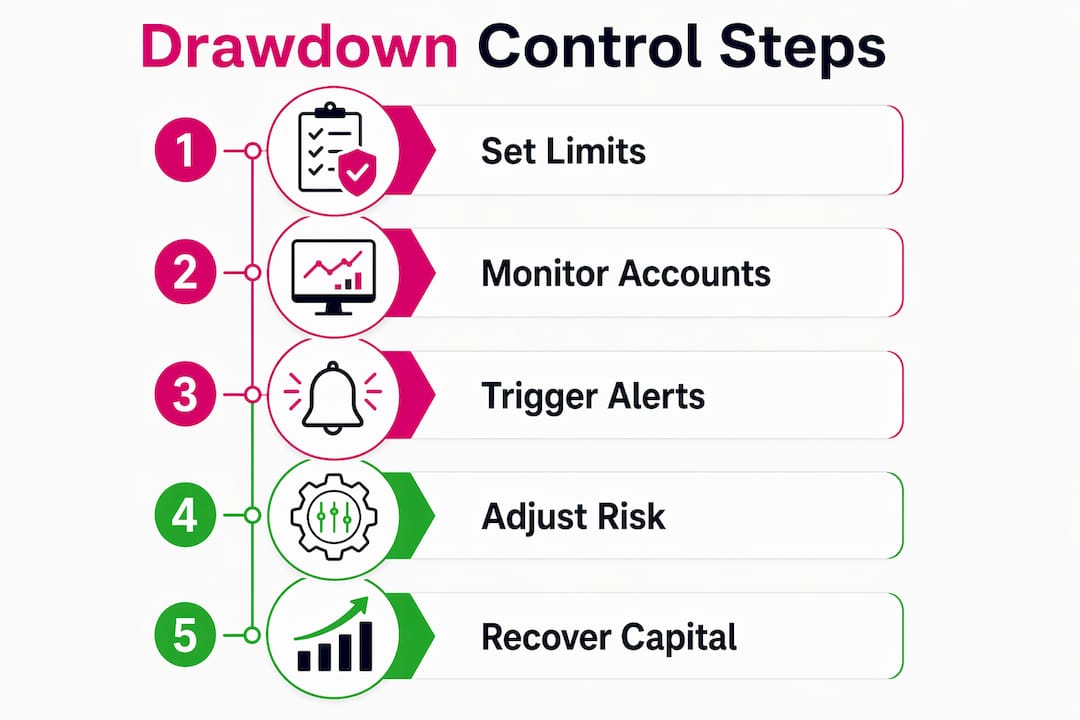
Local Trade Copier’s configuration allows per-account risk thresholds that trigger automatic lot size reductions as equity declines. Pair this with MetaTrader’s built-in alert system, which can send notifications to your phone or email when equity crosses a defined level. For traders managing accounts across MT4, MT5, and DXTrade simultaneously, having alerts fire at the platform level for each account separately is more reliable than trying to watch a consolidated dashboard. The key discipline: when an alert fires, follow the protocol you set in advance. Alerts are only useful if they trigger action, not just awareness.
Key Takeaways
Drawdown control is the single most important risk management layer for forex traders replicating trades across multiple accounts, because losses compound simultaneously across every replicated account when no limits are in place.
| Point | Details |
|---|---|
| Drawdown control definition | Active management to limit a portfolio’s peak-to-trough decline within your risk tolerance. |
| Recovery asymmetry | Preventing large drawdowns is mathematically more valuable than seeking equivalent gains. |
| Position sizing is the primary lever | Reducing risk per trade directly reduces maximum drawdown potential across all replicated accounts. |
| Behavioral discipline matters | Pre-defined, rules-based protocols prevent emotional overrides that turn manageable losses into severe ones. |
| Automate your kill switch | Configure drawdown thresholds in Mt4copier before going live so the system acts without requiring your intervention. |
Recommended
- Essential Forex Trading Rules Every Beginner Needs
- Forex Risk Management Tips That Protect Your Capital
- Risk management in trading: Strategies that actually work
