

TL;DR:
Most traders fail in forex because they lack proper market thinking, not because of poor broker choices or missed signals. Guide explainers build foundational knowledge and discipline crucial for managing risk and avoiding costly mistakes. Combining these explainers with hands-on practice and mentorship accelerates skill development and long-term trading success.
Most traders who fail in forex don’t fail because they picked the wrong broker or missed a hot trade signal. They fail because nobody ever taught them how to think about the market. The role of guide explainers for forex education is far more significant than most beginners realize, and that gap between what traders think they need and what actually builds lasting skill is where most accounts get wiped out. This article breaks down what guide explainers really do, how they shape discipline, and how to use them properly so your learning actually sticks.
Key takeaways
| Point | Details |
|---|---|
| Explainers build foundations first | Quality guide explainers teach leverage, risk rules, and market mechanics before you ever place a live trade. |
| Discipline, not tactics, drives results | 72% to 89% of retail traders lose money due to poor discipline, not lack of strategy. Explainers address this directly. |
| Explainers complement mentorship | Self-paced guides work well for concepts; personalized mentorship adds value when you need live trade reviews and feedback. |
| Integration beats passive consumption | Pairing explainers with demo accounts, trade journals, and community practice accelerates real skill development. |
| Structured learning takes time | Experts recommend 4 to 6 weeks of foundational education before going live. Explainers make that time productive. |
What guide explainers are and why they matter
The term “guide explainer” covers a wide range of forex learning resources: video walkthroughs, written breakdowns, annotated chart examples, and step-by-step articles that take one concept and explain it fully from start to finish. The key word is complete. A guide explainer doesn’t just name a concept. It shows you what it looks like, why it works, and what goes wrong when you ignore it.
This matters because forex is genuinely complex. Concepts like leverage, margin calls, lot sizing, and macro-driven price movement all interact with each other. A beginner reading a two-sentence definition of leverage will use it dangerously. A beginner who works through a well-built explainer on leverage, one that shows the math, the risk scenarios, and the regulatory caps of 1:30 enforced by bodies like the FCA, will actually understand what they’re working with.
Effective forex education guides do three things well. They reduce ambiguity by making abstract concepts concrete. They sequence information logically so that each new idea builds on the last. And they repeat the core principles often enough that those principles start to feel like instincts rather than rules you have to consciously recall mid-trade.
Pro Tip: When evaluating a guide explainer, check whether it explains the “why” behind each rule, not just the “what.” An explainer that tells you to use a stop-loss without explaining the math of risk-to-reward is only half an education.
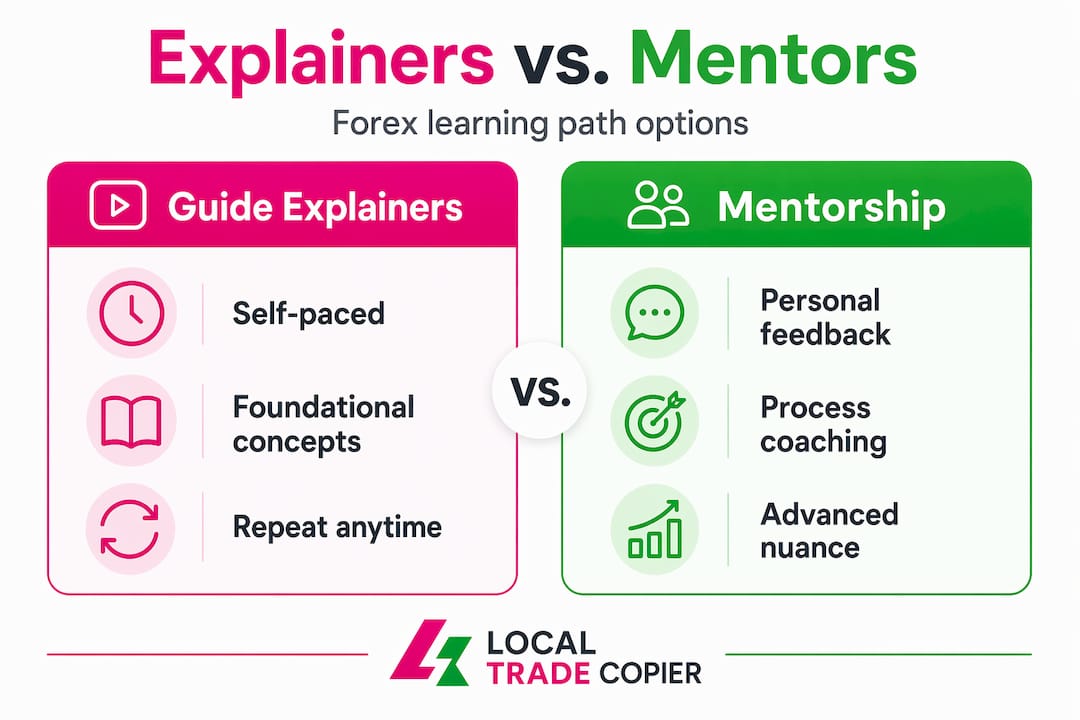
Infographic comparing explainers and mentorship in forex
The importance of forex explainers becomes obvious when you compare what traders know coming in versus what they need to survive the first six months. Most beginners prioritize technical indicators without understanding that macro forces like interest rate decisions and inflation data are what actually move major currency pairs. A good guide explainer addresses that gap before bad habits form.
How explainers build discipline and risk management skills
This is where the real argument for guide explainers lives. Raw technical knowledge is not what separates profitable traders from the rest. Studies consistently show that between 72% and 89% of retail traders lose money primarily because of poor risk management and emotional decision-making. That’s not a knowledge problem. It’s a behavior problem. And guide explainers, when built well, directly target behavior. Past results do not guarantee future performance.
Here’s how the best forex education guides approach this systematically:
- They teach the 1% rule before anything else. The 1% risk rule, which means risking no more than 1% of your total trading capital on any single trade, is used by professional traders and hedge funds worldwide. Beginners who learn this early tend to survive long enough to actually develop skill.
- They walk through stop-loss placement in detail. Not just “place a stop-loss,” but where to place it, why that location makes structural sense on the chart, and how to calculate the resulting position size.
- They address trading psychology directly. The best explainers cover what happens to your judgment after three consecutive losses, why you start chasing trades after a missed setup, and how a written trading plan removes the emotional decision in the moment.
- They show risk-to-reward math concretely. A risk/reward ratio of at least 1:2 means you can be wrong more than half the time and still be profitable over a large sample of trades. That’s not intuitive. An explainer that demonstrates this with actual numbers changes how a trader thinks about winning and losing.
Consistent exposure to this kind of content builds what most experienced traders call process orientation. You stop thinking trade by trade and start thinking in terms of systems. That shift is hard to manufacture through trial and error alone.
Experienced forex educators consistently make the case that structured, repeatable systems focused on clarity and discipline outlast any tactics-first approach.
The value of documented risk management plans is recognized across professional trading. Guide explainers that teach traders to write their rules down, not just read them, are giving traders one of the most underutilized tools in the game. You can also explore risk management strategies for practical frameworks that align with what quality explainers teach.
Explainers vs. mentors and formal courses

Man annotating forex risk management plan
One of the most common questions in the guide to forex education is whether self-paced explainers can replace formal mentorship or structured courses. The honest answer is: it depends on where you are and what you need.
| Learning Method | Best For | Key Limitation |
|---|---|---|
| Guide explainers | Foundational concepts, risk rules, self-paced review | No personalized feedback on your specific trades |
| Forex mentorship | Live trade reviews, personal development plans | Higher cost, limited scalability |
| Structured courses | Sequential, curriculum-based learning | Can be rigid; pacing may not suit all learners |
| Community forums | Real-time market discussion, peer learning | Quality varies widely; misinformation is common |
Mentorship by definition is process-oriented coaching that covers analysis, risk management, and decision-making through personal chart reviews and feedback. That’s extremely valuable, but it’s also expensive and not scalable. You can’t pause a mentor and rewatch the explanation at 0.75x speed.
Guide explainers win on accessibility and repeatability. You can return to the same explainer on position sizing six weeks after you first watched it, and you’ll catch things you missed the first time because your experience level is different. That kind of on-demand reinforcement is something neither mentors nor courses can replicate in the same way.
The role of forex mentors is not diminished by good explainers. The two work best together. Start with explainers to build your conceptual foundation, then bring specific questions and trading examples to a mentor once you have enough experience to ask the right questions.
Pro Tip: Before investing in a paid mentor or course, spend at least four weeks working through free and low-cost explainers on the core topics: market structure, risk management, session timing, and economic fundamentals. You’ll get far more from mentorship if you arrive with a baseline understanding.
Integrating explainers into your learning journey
Knowing that guide explainers matter is one thing. Using them effectively is another. Most traders consume content passively, watching videos while distracted, skimming articles, and moving on without applying what they learned. That approach produces recognition without retention. Here’s how to actually integrate forex learning resources into a system that builds skill:
- Start with foundational topics only. Resist the urge to jump to advanced strategies. Your first four to six weeks should cover market basics, how currency pairs move, what drives price, and risk management principles. Spending that time on foundations before live trading is consistently supported by educational research in forex.
- Take notes as if you’ll teach it. Writing out the key idea from each explainer in your own words forces actual comprehension. If you can’t explain the concept simply, you don’t understand it yet.
- Apply every concept in a demo account the same day. An explainer on stop-loss placement means nothing until you’ve actually placed ten stop-losses on a demo chart and watched what happened. Practice closes the gap between knowing and doing.
- Revisit explainers after real trades go wrong. When a trade doesn’t go as expected, go back to the relevant explainer and identify what you missed. This is how forex tutorials build real skills rather than just surface-level familiarity.
- Use a trade journal alongside your explainer consumption. Document which concepts you’ve studied, how you applied them, and what the outcome was. This creates a feedback loop that accelerates development in ways passive watching never will.
The traders who extract the most value from forex education guides are not the ones who consume the most content. They’re the ones who consume deliberately, apply immediately, and revisit consistently.
Pro Tip: Keep a dedicated “learning log” separate from your trade journal. Every time you work through an explainer, write one sentence about what the concept means in practice. Review that log weekly. Patterns in your own gaps will become visible faster than you expect.
Building emotional discipline alongside technical knowledge is equally critical. The psychology behind trading success is something many explainers address directly, and it’s worth treating it as a core subject rather than a soft supplement to your technical learning.
My take on explainers after years in the field
I’ve watched traders skip past structured guide explainers because they felt slow or too basic. They wanted the edge, the setup, the indicator that separates winners from losers. And almost every one of them came back to the fundamentals after blowing an account or two.
What I’ve learned is that the value of explainers isn’t just in what they teach. It’s in what they prevent. A trader who genuinely understands why the 1% rule exists doesn’t need willpower to follow it in a moment of market excitement. The understanding itself becomes the guardrail. That’s what good explainers build over time.
In my experience, the traders who take explainers seriously, who rewatch, who take notes, who apply what they learn in demo before going live, develop a quality of patience that can’t be manufactured any other way. They’re rarely the most technically gifted. But they’re the ones still trading years later.
My advice: treat quality explainers as primary education, not background noise. Use mentorship to sharpen what you’ve already built. And never confuse consuming information with developing skill. The two require very different kinds of effort.
— Rimantas
Put your education into practice with Mt4copier
Once your trading education reaches the point where you have a tested strategy and a consistent process, the next challenge is execution. Mt4copier’s Local Trade Copier replicates trades across multiple MT4, MT5, and DXTrade accounts in 1 second or faster under normal market conditions, running entirely on your local machine or VPS with no cloud routing.
For traders who have done the educational work and are now managing multiple accounts or scaling a tested system, Mt4copier eliminates the manual re-entry that slows everything down. You can explore the installation guide to see how setup works, or review the stop-loss and take-profit handling features to understand how the copier manages trade exits. A 7-day free trial is available, and no cloud connection is required.
FAQ
What is the role of guide explainers for forex education?
Guide explainers simplify complex forex concepts like leverage, risk management, and market structure into digestible, step-by-step formats. They build the foundational knowledge traders need before placing live trades.
How do forex explainers help with risk management?
Quality forex explainers teach core rules like the 1% risk rule and proper stop-loss placement, helping traders internalize sound risk habits before emotional decision-making under live market conditions becomes a problem.
Are guide explainers better than having a forex mentor?
They serve different purposes. Explainers are scalable, self-paced, and excellent for building conceptual foundations. Mentorship adds personalized feedback and live trade reviews that explainers cannot replicate.
How long should I study with explainers before trading live?
Most forex educators recommend 4 to 6 weeks of structured foundational learning covering market basics, analysis methods, and risk management before opening a live account.
What topics should forex education guides cover first?
Start with how currency pairs move, what macro forces drive price, leverage and margin mechanics, and risk management rules. These foundations prevent the most common and costly beginner mistakes.
Recommended
- What is a trading educator? Role, skills, and impact
- How forex tutorials build real trading skills
- Automate Your Forex Teaching: Step-by-Step Guide
