

TL;DR: Trading privacy safeguards your strategies and personal data from exploitation by bots, competitors, and regulators. Protecting this information prevents front-running, strategy theft, and legal penalties, and is essential in the evolving legal framework. Using local execution tools and privacy technologies helps traders maintain their competitive edge and ensure legal compliance.
Trading privacy is the practice of keeping your trading strategies, transaction intents, and personal financial data confidential to protect your competitive edge and comply with legal standards. Without it, your order sizes, entry timing, and strategy logic are visible to competitors, MEV bots, and AI surveillance tools that can exploit that data in real time. Regulations like GDPR impose fines up to 4% of annual global turnover for serious violations, making privacy a legal obligation as much as a strategic one. Tools like Mt4copier address this directly by running trade replication entirely on a local machine, with no cloud routing and no external data exposure.
Why focus on trading privacy: the core case
Trading privacy is not a compliance checkbox. It is the primary defense between your strategy and everyone who wants to copy, front-run, or report it.

Hands typing on keyboard with financial documents
Every trade you place carries information: your position size, your timing, your stop loss placement. In transparent markets, that information travels. Competitors, automated bots, and regulators all have access to varying degrees of your trading footprint. The traders who protect that footprint consistently outperform those who ignore it, because they prevent others from using their own data against them.
Privacy in trading functions as a strategic moat. Once your strategy logic is visible, it can be reverse-engineered, copied, or exploited. That erosion happens quietly, trade by trade, until your edge disappears entirely.
What risks do traders face without robust trading privacy?
Data exposure in trading creates three distinct categories of harm: financial loss from market exploitation, legal liability from regulatory non-compliance, and loss of competitive advantage from strategy theft.
Financial harm from MEV bots and front-running
MEV bots intercept trades by exploiting transparent transaction intents, and even small slippage fractions compound into significant capital erosion over time. This is not a theoretical risk. Bots scan public mempools, identify pending orders, and execute ahead of them within milliseconds. The trader pays a worse price. The bot captures the difference.
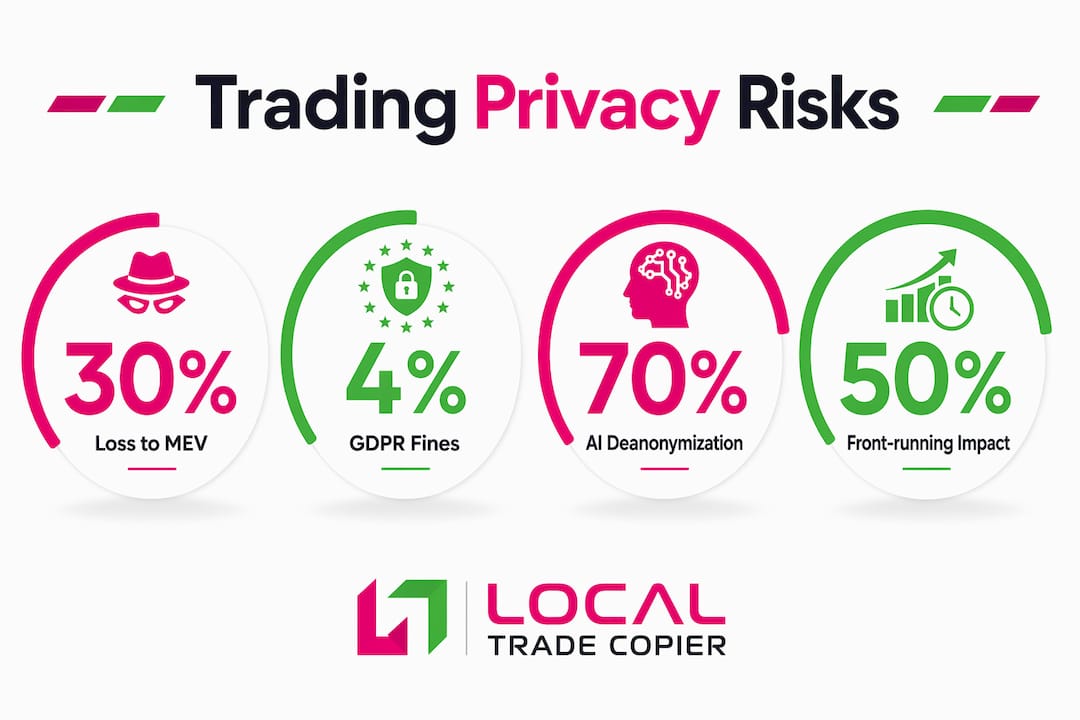
Infographic illustrating key trading privacy risks
On-chain transparency exposes entry and exit timing, position sizing, and strategy logic to attackers who use front-running, sandwich attacks, and arbitrage to reduce your alpha directly. Every trade you place on a public ledger is a data point your competitors can use.
AI-driven deanonymization
Traditional pseudonymity on public blockchains no longer provides meaningful protection. AI models make deanonymization of public blockchain transactions effectively trivial. That means a trader who believes their on-chain activity is anonymous may be fully exposed to any party running modern analytics tools.
The implication is direct: your historical trade data, even if pseudonymous, can be linked back to your identity and strategy with enough AI processing power.
Competitive and legal exposure
Sophisticated traders treat on-chain transparency as a liability. Competitors can front-run or sandwich trades using visible transaction data, eroding alpha over time. Beyond market exploitation, non-compliance with data privacy laws creates legal exposure that can result in fines, audits, and reputational damage.
Key risks of inadequate trading privacy:
- MEV bots exploit visible order intent, causing slippage and capital loss
- AI analytics tools can deanonymize pseudonymous transaction histories
- Competitors can replicate or front-run strategies using public trade data
- Regulatory non-compliance triggers fines and legal liability
- Data breaches expose personal financial information to third parties
How do evolving 2026 data privacy regulations impact traders?
The regulatory environment for trading data has become significantly more complex. Traders operating across jurisdictions now face overlapping obligations from GDPR, CCPA, KYC/AML frameworks, and newer financial regulations like MiCA and DORA.
GDPR and financial data obligations
GDPR applies to any trader or firm handling personal data of EU residents. Serious GDPR violations carry fines up to 4% of annual global turnover. That figure applies to organizations, but individual traders operating as businesses are not exempt. The regulation covers how you collect, store, and share trading-related personal data.
KYC/AML and the privacy tension
KYC and AML frameworks require brokers and trading platforms to collect detailed personal data. KYC enhances regulatory compliance but centralizes and exposes personal data in the process. This creates a direct tension: the more data you share to satisfy compliance requirements, the more exposure you create.
The solution is data minimization. Share only what regulations explicitly require, and nothing more.
| Regulation | Scope | Privacy impact |
|---|---|---|
| GDPR | EU personal data | Fines up to 4% of annual global turnover |
| CCPA | California residents | Right to opt out of data sale |
| KYC/AML | Broker-level identity verification | Centralizes personal financial data |
| MiCA | EU crypto asset markets | Increases reporting and data obligations |
| DORA | EU financial digital resilience | Requires data security and incident reporting |
Pro Tip: Review your broker’s data retention policy annually. Many brokers store trade history and personal data far longer than regulations require, creating unnecessary exposure.
Compliance in forex trading is not static. Regulations update, enforcement priorities shift, and new frameworks like DORA add layers that did not exist two years ago. Traders who treat compliance as a one-time setup will fall behind.
What technologies and methods protect trading privacy effectively?
The most effective technical solutions for trading privacy combine cryptography with selective disclosure. These approaches keep your trade intent confidential while still satisfying regulatory verification requirements.
Privacy-preserving trade execution
Privacy-preserving trade execution uses cryptography and hybrid architectures to keep order details confidential while allowing regulatory verifiability. This means your order size, timing, and direction are encrypted until execution, preventing bots and competitors from acting on that information in advance.
Encrypted mempools serve the same function in blockchain contexts. They hold pending transactions in an encrypted state until they are ready to be processed, removing the window that MEV bots exploit.
Zero-knowledge proofs and selective disclosure
Zero-knowledge proofs allow a trader or system to prove that a transaction is valid without revealing its contents. Selective disclosure models let regulators verify transactions without exposing all details publicly. This is the technical architecture that balances privacy with oversight.
The practical benefit is significant. A regulator can confirm your trade complied with position limits without seeing your full strategy or counterparty details. Your competitive information stays protected while your legal obligations are met.
Key privacy technologies for traders:
- Encrypted mempools: hide pending order intent from public view and bots
- Zero-knowledge proofs: prove transaction validity without revealing trade details
- Selective disclosure: share only required data with authorized parties
- Private transaction relays: route orders outside public mempool exposure
- Local execution environments: keep trade data on one machine with no cloud routing
Pro Tip: Encrypted mempools and zero-knowledge tools address on-chain, blockchain-based trading risk. For forex traders using MetaTrader platforms, the relevant privacy gain is different: local execution removes cloud routing and third-party server exposure. Mt4copier runs on a trader’s own Windows machine or VPS, so trade data never leaves that IP address.
Securing data in AI-driven environments requires layering these technical controls. No single tool provides complete protection. The combination of encrypted execution, local processing, and minimal data sharing creates the strongest defense.
How can traders implement best practices for trading privacy today?
Practical trading privacy does not require a technical background. It requires deliberate choices about which tools you use, how you configure them, and what data you share.
- Use local execution tools. Mt4copier runs entirely on a local Windows machine or VPS, with no cloud routing. Your trade data stays on one IP address. This eliminates the exposure that comes with cloud-based trade copying services that route your orders through external servers.
- Set strong passwords and use a VPS. Trade copier security starts with access control. A strong, unique password on your MetaTrader terminal and a dedicated VPS reduce the attack surface significantly. A VPS also keeps your trading environment isolated from your personal devices.
- Practice data minimization. Share only the personal and trading data that your broker or regulator explicitly requires. Do not volunteer account history, strategy details, or position data beyond what is legally necessary.
- Monitor regulatory updates. GDPR, MiCA, and DORA all updated their guidance or enforcement priorities in recent years. Subscribe to updates from your national financial regulator and review your data handling practices at least once per year.
- Use private transaction relays where applicable. For on-chain trading, private relays route your transactions outside the public mempool, removing the window that MEV bots use to front-run your orders.
- Audit your data footprint. List every platform, broker, and tool that holds your trading data. Identify which ones share data with third parties. Remove access where it is not necessary.
- Integrate compliance by design. Build privacy controls into your trading workflow from the start, not as an afterthought. Traders who protect trade intent preserve long-term competitive advantages. Past results do not guarantee future performance, but protecting your strategy logic consistently reduces the risk of exploitation.
Global data privacy standards vary by jurisdiction, but the underlying principle is consistent: collect less, protect more, and verify only what is required.
Key Takeaways
Trading privacy protects your strategy, your capital, and your legal standing by keeping order intent, personal data, and trade logic confidential from bots, competitors, and unauthorized parties.
| Point | Details |
|---|---|
| MEV bots cause real losses | Transparent order intent lets bots front-run your trades, compounding slippage into significant capital erosion. |
| GDPR fines are severe | Serious violations carry penalties up to 4% of annual global turnover, making compliance non-negotiable. |
| AI deanonymizes public data | Modern AI tools make pseudonymous blockchain transactions effectively traceable, exposing your strategy. |
| Local execution limits exposure | Tools like Mt4copier keep trade data on one machine with no cloud routing, reducing your data footprint. |
| Data minimization is the baseline | Share only what regulations require, and audit every platform that holds your trading data annually. |
Trading privacy is your last real competitive advantage
Trade copying tools have been part of the forex landscape since 2010, and one of the most common mistakes traders make is treating privacy as a technical problem for someone else to solve. It is not. It is a strategic decision made every time a trader chooses a tool, a broker, or a workflow.
The traders who lose their edge fastest are not the ones who make bad trades. They are the ones who let their strategy become visible. Once a competitor or a bot knows a trader’s position sizing pattern or entry timing, it can be used against them systematically. That erosion is rarely visible in the moment. It shows up later, as results quietly deteriorate.
Much of this exposure is self-inflicted. Traders often use cloud-based tools that route orders through external servers, share account history with third-party analytics platforms, and overlook data retention policies that keep personal information stored indefinitely. None of that is necessary.
The privacy layers and legal frameworks that protect traders already exist, along with tools that implement local execution and regulations that limit what brokers can do with trader data. The gap is not in the options available. It is in whether traders choose to use them.
Privacy compliance in 2026 is not optional, and it does not have to be expensive. It comes down to a set of deliberate choices that many traders skip because the consequences stay invisible until they are not.
How Mt4copier keeps your trade data off the grid
For forex traders, the privacy risk that matters most is server-side and broker-side data exposure, not blockchain-specific threats like MEV bots. Mt4copier addresses that risk directly: it replicates trades across MetaTrader 4, MetaTrader 5, and DXTrade accounts using local execution on a Windows machine or VPS. No cloud routing. No external server. Trade data stays on the trader’s own IP address, which matters especially for prop firm traders who need to avoid cloud IP detection.
The security setup for Mt4copier covers strong password configuration and VPS deployment, two of the most effective steps any trader can take to reduce data exposure. Mt4copier has served 3,000+ traders since 2010 and carries 491 Trustpilot reviews. A 7-day free trial is available with no commitment required.
FAQ
What is trading privacy and why does it matter?
Trading privacy is the protection of your order details, strategy logic, and personal financial data from unauthorized access. It matters because exposed trade intent can be exploited by MEV bots, competitors, and AI analytics tools, directly reducing your returns.
How do MEV bots threaten trading privacy?
MEV bots scan public transaction queues for pending orders and execute ahead of them, causing slippage. Even small fractions of a percent in slippage compound into significant capital erosion over many trades.
What GDPR penalties apply to traders?
Serious GDPR violations carry fines up to 4% of annual global turnover. Traders operating as businesses and handling EU resident data are subject to these rules, including how they store and share trading-related personal information.
How does local execution protect trading data?
Local execution keeps all trade data on one machine and one IP address, with no cloud routing. This removes the external server exposure that cloud-based tools create, reducing the risk of interception or data leakage.
What is selective disclosure in trading privacy?
Selective disclosure lets traders share only the data required for regulatory verification, using tools like zero-knowledge proofs. Regulators can confirm compliance without seeing full strategy details or counterparty information.
Recommended
- The Role of Privacy in Trading: Protect Your Edge
- Trader Privacy Explained: Layers, Laws, and Best Practices
- Why Privacy Matters in Forex Automation: 2026 Guide
- Trade Management Workflow: Step-by-Step Guide for 2026
