

TL;DR:
- Trader privacy involves multi-layered protection of trading data, strategies, and financial identities from unauthorized access and exploitation. It encompasses five key layers—intent, value, state, execution, and graph privacy—that require separate security measures to prevent front-running, data leaks, and correlation attacks. Maintaining comprehensive privacy also demands operational best practices, encryption, and compliance with regulations like GDPR to safeguard competitive advantage and legal standing.
Trader privacy is the comprehensive protection of your trading data, strategies, and financial identity from competitors, surveillance systems, and unauthorized parties. The concept goes far beyond a single password or VPN. Five distinct privacy layers cover intent, value, state, execution, and graph privacy, each shielding a different dimension of your trading activity. Front-running bots, strategy copiers, and data brokers all target these layers. Regulations like GDPR add legal weight to the conversation. Understanding what trader privacy actually means is the first step toward protecting your edge in competitive financial markets.
What is trader privacy and why does it matter?
Trader privacy is defined as the multi-layered protection of sensitive trading information to prevent exploitation, preserve competitive advantage, and meet regulatory requirements. The standard industry term for this concept is trading data confidentiality, though “trader privacy” has become the widely used shorthand among retail and professional traders alike.
Every order reveals exploitable metadata to anyone watching the market. That metadata includes your timing, size, direction, and frequency. Competitors and algorithmic systems use this information to trade against you before your order fills, a practice known as front-running.
The stakes are real. Institutions guard their privacy through compartmentalization, strict access controls, and information firewalls to prevent internal leaks. Retail traders rarely apply the same discipline, which leaves them exposed at multiple points simultaneously.
Privacy also carries regulatory weight. Platforms handling EU resident data must comply with GDPR, which mandates data minimization and user consent. Ignoring these requirements is not just a security risk. It is a legal one.
What are the five layers of trader privacy?
Trader privacy in 2026 comprises five key layers, each protecting a different aspect of your trading operation. A breach in any single layer can expose the others through correlation attacks.
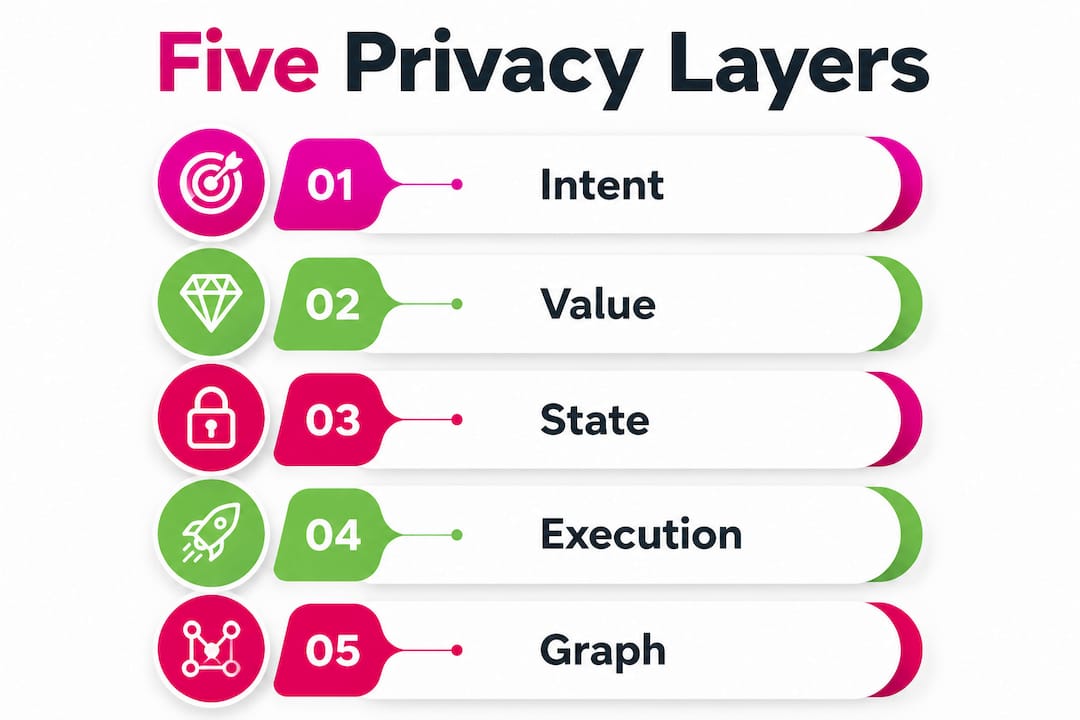
Intent Privacy protects your trading direction before an order is placed. When your intent leaks, front-running bots can position ahead of you and capture the price move you were targeting.
Value Privacy conceals your account balance and trade sizes. Knowing how much capital you control lets adversaries calculate your liquidation thresholds and pressure your positions.

State Privacy hides your open positions and exposure. A counterparty who knows your current state can exploit your stop levels or force a margin call.
Execution Privacy protects the logic of your trading strategy. This is your alpha. Once your entry rules, exit conditions, and timing patterns are visible, they can be copied or traded against.
Graph Privacy anonymizes the relationships between your accounts, wallets, and counterparties. On public ledgers, graph analysis can link multiple accounts back to a single trader even when each account appears independent.
Here is how each layer maps to its primary threat:
| Privacy Layer | What It Protects | Primary Threat |
|---|---|---|
| Intent | Order direction before execution | Front-running bots |
| Value | Account balance and trade size | Liquidation targeting |
| State | Open positions and exposure | Stop hunting |
| Execution | Strategy logic and timing | Strategy copying |
| Graph | Account and counterparty relationships | Correlation attacks |
Pro Tip: Treat these five layers as a checklist, not a hierarchy. Locking down execution privacy while ignoring graph privacy is like securing your front door and leaving the back window open.
How do you ensure trader privacy in 2026?
Practical trader data privacy best practices combine software tools, operational habits, and platform configuration. No single tool covers all five layers. You need a stack.
-
Encrypt your local machine. LUKS2 full-disk encryption protects data at rest. If your VPS or laptop is compromised physically, encrypted storage prevents data extraction. Disk encryption, VPN-Tor-VPN chains, and encrypted API key vaults form the baseline of a 2026 security checklist for active traders.
-
Secure your API keys. Store API keys in an encrypted vault, never in plain text files or browser autofill. Apply withdrawal restrictions to any API key that does not require withdrawal access. A read-only key cannot drain your account even if stolen.
-
Use MetaTrader investor passwords. MetaTrader 4 and MetaTrader 5 both support investor passwords that grant read-only access to an account. Share this instead of your master password when a third party needs to monitor your account.
-
Split your orders. Order-splitting, shell entities, and multi-account setups help traders obscure true trading intent and minimize leakage. Breaking a large order into smaller pieces across different times and accounts makes your intent harder to read from market data.
-
Apply shielded spot trading where available. Shielded spot trading uses delegated wallets and trusted execution environments to hide individual orders and strategy from public ledgers. This technology reduces front-running and conceals trading intent on blockchain-based systems.
-
Harden your VPS configuration. Changing default Remote Desktop Protocol ports and enforcing strong administrator passwords blocks most automated hacking attempts. Most traders leave default ports in place, which makes their VPS a visible target for port-scanning bots.
-
Back up your MetaTrader data folders regularly. Regular backups of MetaTrader data folders, including expert advisors and templates, protect your operational setup after an attack or hardware failure.
For a deeper walkthrough of these steps, the 2026 secure trade workflow guide covers encryption, VPN use, and API key protection in detail.
Pro Tip: Mask sensitive identifiers in your logs and dashboards. Envelope encryption and log masking prevent internal leaks, which are a common and underestimated attack vector in professional trading environments.
How do trader privacy regulations like GDPR apply?
GDPR is the most consequential privacy regulation affecting traders and platforms operating with EU resident data. GDPR requires data minimization and consent, meaning platforms must collect only the data they need and must give users rights like data erasure. Non-compliance carries fines reaching up to 4% of annual global turnover. That figure applies to platforms, but traders who operate managed account services or signal businesses also carry exposure.
The regulation creates a direct tension for traders. Competitive secrecy demands that you share as little as possible. Regulatory compliance demands that you document, disclose, and provide access to data on request. Resolving that tension requires a deliberate approach.
Privacy acts as a double-edged sword in this context. It protects your competitive advantage but invites regulatory scrutiny if used to conceal required disclosures. The practical answer is to separate what you protect from competitors from what you disclose to regulators. These are not the same data sets.
For forex traders, the role of compliance in forex trading covers how GDPR and other regulatory frameworks intersect with daily trading operations. Crypto traders face additional complexity because decentralized systems were not designed with GDPR in mind, and reconciling on-chain transparency with data minimization requirements remains an open challenge.
Key regulatory obligations that affect trader privacy practices include:
- Collecting only the data necessary for the stated purpose
- Providing users with the right to access, correct, and erase their data
- Reporting data breaches within 72 hours of discovery
- Maintaining records of processing activities for accounts with more than 250 employees or high-risk processing
What are the biggest misconceptions about trader privacy?
The most damaging misconception is that privacy and anonymity are the same thing. Privacy masks sensitive financial data from profiling while anonymity disconnects identity entirely. Traders need privacy. They rarely need full anonymity, and pursuing anonymity at the cost of compliance creates legal risk without proportional security benefit.
The second misconception is that protocol-level privacy is enough. Shortcomings in privacy protocols arise from leaks at endpoints like wallets, RPC bridges, exchanges, and human predictability. A privacy coin or encrypted channel does nothing if your wallet address is linked to your verified exchange account. Protecting the “last mile” of your data is as important as the protocol itself.
The third misconception is that privacy is a single feature rather than a portfolio of protections. Traders who install a VPN and consider themselves protected have addressed one layer while leaving four others exposed. Failure in any one layer opens the door to correlation attacks that can reconstruct your full trading profile from partial data.
Platform defaults are another overlooked vulnerability. MetaTrader installations, VPS configurations, and broker APIs all ship with settings optimized for convenience, not security. Assuming the default is safe is the fastest way to get exposed.
Pro Tip: Audit your privacy posture layer by layer using the five-layer framework. Write down what protects each layer today. If any row is blank, that is your highest-priority fix.
Key takeaways
Trader privacy requires protecting five distinct layers simultaneously, because a breach in any single layer exposes the others through correlation attacks.
| Point | Details |
|---|---|
| Five privacy layers | Intent, value, state, execution, and graph privacy each require separate protection measures. |
| GDPR compliance | Non-compliance fines reach up to 4% of annual global turnover, making regulatory alignment non-negotiable. |
| Privacy vs. anonymity | Privacy protects data from profiling; anonymity removes identity entirely. Traders need the former, not the latter. |
| Endpoint hygiene | Protocol-level security fails without securing wallets, RPC bridges, and exchange connections at the last mile. |
| Layered tool stack | Disk encryption, VPN chains, investor passwords, and order-splitting each address different parts of the privacy problem. |
Privacy is a discipline, not a setting
I have been building and supporting trade replication software since 2010, and the pattern I see most often is traders who treat privacy as a one-time configuration rather than an ongoing discipline. They set a strong password, install a VPN, and move on. Then six months later they are running an unpatched VPS with default RDP ports, sharing their master MetaTrader password with a signal subscriber, and wondering why their strategy stopped working.
The five-layer framework changed how I think about this. Once you see privacy as five separate problems, you stop looking for a single solution. You start asking which layer is weakest right now and fixing that one first. That shift in thinking is more valuable than any specific tool.
The regulatory piece is where I see the most confusion among retail traders. GDPR feels like a concern for platforms, not individual traders. But if you run a managed account service or sell signals to EU residents, you are processing personal data. That puts you inside the regulation’s scope whether you realize it or not.
My honest recommendation is to treat privacy as a strategic asset, not a compliance checkbox. Every order you place reveals something about your strategy. The traders who protect that information consistently are the ones who preserve their edge over time. The ones who ignore it eventually find their setups front-run or their strategies replicated by someone who was watching.
— Rimantas
How Mt4copier supports private trade replication
Trade replication introduces its own privacy risks. Copying trades through a cloud server means your order data travels through external infrastructure, creating exposure at every hop. Mt4copier eliminates that risk by running entirely on your local Windows machine or VPS, with no cloud routing involved.
All trade data stays on one machine, one IP address. There is no external server receiving your positions, no third-party cloud logging your strategy, and no latency introduced by routing through an intermediary. For prop firm traders who need to avoid cloud IP detection, this architecture is not optional. It is the requirement. Mt4copier’s account security practices cover VPS hardening, strong password enforcement, and configuration steps that align directly with trader data privacy best practices. Start with a 7-day free trial and see how local execution protects your strategy from the first copy.
FAQ
What is trader privacy in simple terms?
Trader privacy is the protection of your trading data, strategy, and financial identity from competitors, bots, and unauthorized parties. It covers five layers: intent, value, state, execution, and graph privacy.
How does GDPR affect individual traders?
GDPR applies to any trader who processes EU resident data, including those running managed accounts or signal services. Non-compliance fines can reach up to 4% of annual global turnover.
What is the difference between trader privacy and anonymity?
Privacy masks sensitive financial data from profiling while anonymity disconnects your identity entirely. Traders need privacy for competitive protection; full anonymity often conflicts with regulatory compliance requirements.
What are the most common trader privacy mistakes?
The most common mistakes are assuming platform defaults are secure, treating privacy as a single feature rather than a layered system, and neglecting endpoint security like wallet addresses and RPC connections.
Does a VPN fully protect trader privacy?
A VPN addresses network-level privacy but leaves intent, value, state, execution, and graph privacy unprotected. Full trader privacy requires a stack of tools including encryption, investor passwords, order-splitting, and endpoint hygiene.
Recommended
- How to Share Trades Securely: A 2026 Forex Guide
- Prop trading best practices: Multi-account copying in 2026
- Ghost trades in copy trading and how to remove them
