

TL;DR: Operational risk in trading stems from internal failures in processes, people, systems, or external events that cause financial losses. It cannot be hedged like market or credit risk, so internal controls, redundancy, and monitoring are essential defenses, especially for high-exposure trading environments. Proper infrastructure, automation, and disciplined protocols help traders prevent costly operational failures and ensure account preservation.
Operational risk in trading is defined as the potential for financial loss caused by failures in internal processes, people, systems, or external events that disrupt trading activities. The Basel Committee and European Banking Authority both recognize this definition formally, distinguishing operational risk from market risk and credit risk by its internal origin. Unlike a bad trade call or a counterparty default, operational risk lives inside your own infrastructure, your team, and your workflows. For traders managing multiple accounts or running automated strategies, understanding this category of risk is not optional. It is the foundation of any serious trading risk management framework.
What is operational risk in trading and where does it come from?
Operational risk in trading originates from four core sources: human error, process failure, technology breakdown, and external disruption. The Basel framework assigns an 18% beta factor to Trading and Sales, higher than Asset Management at 12% and Retail Banking at 12%. That gap reflects how much more exposed active trading desks are to operational failures compared to other financial activities.

Trader hands typing near risk notes
Human factors
People cause the majority of operational risk events in trading. This includes fat-finger trade entry errors, misplaced stop-loss orders, unauthorized positions, inadequate training on platform tools, and outright fraud. The LIBOR manipulation scandal is the textbook case: unethical trading practices and control lapses at major banks caused systemic market disruption and billions in regulatory fines. Individual traders face the same category of risk at a smaller scale every time they execute a trade manually without a checklist or second review.
Process and technology failures
Process failures include compliance lapses, settlement errors, and broken approval chains. Technology failures cover IT outages, cybersecurity breaches, and API disconnections. In derivatives trading specifically, trade execution errors, model input mistakes, and IT system breakdowns are classified as primary operational risk events. For individual traders, the risks are more personal: internet outages or platform API glitches can prevent a stop-loss from triggering at the right moment, turning a manageable loss into a serious one.
Pro Tip: Build a pre-session checklist that confirms your internet connection, platform login, and open position status before placing any trade. This single habit eliminates a significant share of human-origin operational risk.
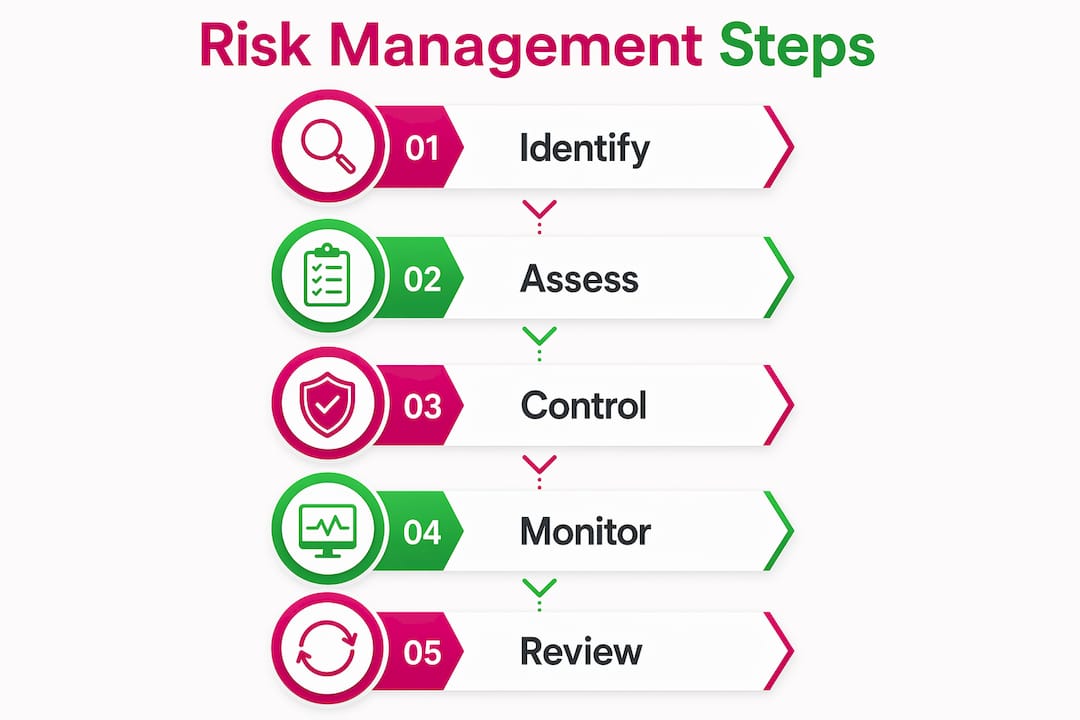
Infographic illustrating risk management steps
How does operational risk differ from market and credit risk?
Operational risk is fundamentally different from market risk and credit risk in one critical way: it cannot be hedged or transferred the way the others can. Market risk is the exposure to price movements. Credit risk is the exposure to counterparty default. Both can be partially offset through derivatives, diversification, or collateral agreements. Operational risk cannot. You cannot buy a hedge against your own platform crashing or your team entering the wrong lot size.
This distinction has direct implications for how you manage each type. Market and credit risk respond to portfolio-level decisions. Operational risk responds to internal controls, process design, and infrastructure investment. The table below shows the key differences clearly.
| Risk type | Origin | Transferable? | Primary defense |
|---|---|---|---|
| Market risk | Price movements | Partially, via hedging | Diversification, position sizing |
| Credit risk | Counterparty default | Partially, via collateral | Due diligence, credit limits |
| Operational risk | Internal processes, people, systems | Rarely | Internal controls, redundancy |
The practical implication for traders is that your risk management strategies for market exposure and your controls for operational exposure require completely separate thinking. Traders who conflate the two tend to over-invest in stop-loss strategy while ignoring the infrastructure failures that prevent those stops from executing in the first place.
What are real-world examples and impacts of operational risk in trading?
Concrete examples make the operational risk definition tangible. Here are the most common failure types traders encounter:
- Trade entry errors. A trader enters 10 lots instead of 1.0, immediately creating an unintended position that exceeds account risk limits.
- Stop-loss misplacement. A stop is set on the wrong side of a key level due to a platform interface error, resulting in a loss far larger than planned.
- Settlement failure. A position fails to close at expiry due to a broker system outage, leaving the trader exposed overnight.
- Platform outage. A broker’s trading server goes offline during a high-volatility news event, making it impossible to exit a losing position.
- API disconnection. An automated strategy loses its connection to the broker mid-session, leaving open trades unmanaged.
The consequences extend beyond individual losses. Unmanaged operational risk causes monetary loss, regulatory penalties, competitive disadvantage, and in severe cases, business failure. For prop firm traders, a single operational failure that violates a drawdown rule can mean losing a funded account entirely. Past results do not guarantee future performance, but the pattern of operational failures causing disproportionate account damage is consistent across trading environments.
Research cited by trading education platforms puts retail trader loss rates between 70% and 90%, with poor process execution, inconsistent controls, and inadequate infrastructure cited as primary contributors rather than flawed market analysis. That pattern points directly at operational risk: most of those losses are not caused by bad market calls. They are caused by essential risk management tactics being deprioritized in favor of entry signals, at the expense of the infrastructure and process discipline that keep trades executing as intended.
What strategies effectively manage operational risk in trading?
Managing operational risk requires a different mindset than managing market exposure. The goal is not to predict failures but to build systems that contain them. Institutional risk management frameworks include position sizing, stop-loss placement, liquidity awareness, trade structuring, drawdown control, and portfolio exposure evaluation. Retail traders can adopt the same logic at a smaller scale.
The core strategies break into three categories:
- Process controls. Document every step of your trading workflow. Use checklists before and after each session. Require dual confirmation for large position changes. These steps eliminate the majority of human-origin errors.
- Redundancy. Run your trading platform on a VPS rather than a home computer. Keep a backup internet connection. Store your trading journal and account credentials in a secure, off-device location. Redundancy and dual authorization are the two most cited practical safeguards in operational risk management literature.
- Technology monitoring. Use automated alerts for platform disconnections, margin level changes, and unusual account activity. In high-frequency trading environments, infrastructure that cannot keep up with market turbulence creates unintended exposures beyond risk limits. The same principle applies to any trader running automated strategies.
Pro Tip: If you manage more than one trading account, manual re-entry of trades across terminals is one of the highest-probability sources of operational error. Automating that replication process removes the human variable entirely.
The table below maps common operational risk events to their practical controls.
| Risk event | Practical control |
|---|---|
| Fat-finger trade entry | Pre-trade checklist, lot size confirmation dialog |
| Platform outage | VPS hosting, broker redundancy |
| API disconnection | Automated reconnect logic, position monitoring alerts |
| Stop-loss misplacement | Stop-loss discipline protocols and pre-trade verification |
| Unauthorized access | Strong passwords, two-factor authentication |
For prop firm traders specifically, the stakes of operational failures are higher than for self-funded accounts. A risk mitigation framework built around local execution, consistent lot sizing, and automated controls is not a luxury. It is a requirement for account preservation.
Key takeaways
Operational risk in trading is an internal threat that cannot be hedged, making process controls, redundancy, and technology monitoring the only reliable defenses.
| Point | Details |
|---|---|
| Authoritative definition | Operational risk covers failures in processes, people, systems, and external events, per the Basel Committee and EBA. |
| Higher exposure in trading | The Basel framework assigns Trading and Sales an 18% beta factor, the highest of any business line. |
| Cannot be hedged | Unlike market or credit risk, operational risk is non-transferable and requires internal controls as the primary defense. |
| Real consequences | Unmanaged operational risk causes financial loss, regulatory fines, and account termination for prop firm traders. |
| Practical defense | Redundancy, dual authorization, automated monitoring, and pre-trade checklists eliminate the majority of operational failures. |
Why most traders underestimate operational risk until it costs them
I have watched traders spend months refining entry signals while running their entire operation on a home laptop with a single internet connection and no backup plan. When the platform disconnects during a news spike, they are surprised. They should not be. Operational risk is the category of trading risk that gets the least attention precisely because it does not feel like trading. It feels like IT, or admin, or someone else’s problem.
The reality is that effective risk management in forex starts with the infrastructure layer, not the strategy layer. Traders with genuinely good market analysis have blown accounts because a stop-loss never triggered due to a connectivity failure. The analysis was right. The infrastructure was wrong. That is a pure operational risk failure, and it is entirely preventable.
Treating a trading setup as a system rather than a collection of tools is the more reliable approach. Every component has a failure mode. Knowing what those failure modes are, and having a response ready before they happen, is professional risk management.
How Mt4copier reduces execution-level operational risk

One of the most direct sources of operational risk for traders managing multiple accounts is manual trade replication. Every time you re-enter a trade across terminals by hand, you introduce the possibility of a wrong lot size, a missed stop-loss, or a delayed entry. Mt4copier eliminates that variable entirely. The software copies trades from a master MetaTrader 4, MetaTrader 5, or DXTrade account to one or more client accounts in 1 second or faster under normal market conditions, running locally on your Windows machine or VPS with no cloud routing. For prop firm traders, local execution means one IP address and no external server latency. For account managers, it means consistent lot sizing across every client account without manual intervention. Learn how secure trade copier setup protects your accounts and reduces the operational vulnerabilities that cost traders the most.
FAQ
What is the standard operational risk definition in finance?
Operational risk is defined as the risk of loss from inadequate or failed internal processes, people, systems, or external events. This definition comes from the Basel Committee on Banking Supervision and is adopted by the European Banking Authority.
How does operational risk affect individual traders?
Individual traders face operational risk through platform outages, API disconnections, trade entry errors, and personal infrastructure failures like power or internet loss. These events can prevent stop-losses from executing or cause unintended position sizes.
Can operational risk be hedged like market risk?
Operational risk cannot be hedged or transferred the way market or credit risk can. The primary defenses are internal controls, process redundancy, and technology monitoring rather than financial instruments.
What are the most common examples of operational risk in trading?
The most common examples include fat-finger trade entry errors, stop-loss misplacement, settlement failures, broker platform outages, and API disconnections during automated strategy execution.
How do institutional traders manage operational risk differently from retail traders?
Institutional traders use formal frameworks covering position sizing, drawdown controls, dual authorization, and dedicated compliance teams. Retail traders can adopt the same principles through checklists, VPS hosting, automated alerts, and consistent risk management practices applied to every session.
Recommended
- Risk management in trading: Strategies that actually work
- What Are Account Management Risks and How to Mitigate Them
