

Copying a trade from one MetaTrader account to another does not depend on whether either broker is an ECN or a market maker. The copier sends the same order to each terminal. What changes is what each broker does with that order: the price it quotes, the commission it charges, how fast it fills and whether it ever requotes. So the same copied trade can produce slightly different results on two accounts. Past results do not guarantee future performance, and a copier only replicates trades. It adds no market logic and does not improve outcomes.
This guide explains the two execution models in plain terms. It then shows where they diverge for copied trades and how to test your own master and client accounts before you rely on them.
TL;DR
- An ECN-style broker routes your order to liquidity providers and usually charges a commission. A market maker quotes its own prices and usually earns through the spread.
- When you copy between brokers, the order is identical but the fill is not: spread, commission and slippage can differ per account.
- Mixing models is fine, but you have to measure the gap between master and client fills rather than assume it is zero.
- Running the copier locally on one machine removes one source of delay, so the differences you see mostly come from the brokers.
- Test with small size, log fills for a week or two, and compare total cost per trade, not just the spread.
What ECN and market maker actually mean
ECN stands for Electronic Communication Network. One broker’s help documentation describes it as a mechanism that connects banks and liquidity providers to form bid and offer prices, while market makers typically use dealing desks to create prices based on their own positions or overall risk exposure.
In practice:
- ECN or raw-spread broker. Your order goes electronically toward liquidity providers. Investopedia’s guide says ECN brokers send orders to liquidity providers rather than passing them to market makers, and generally pair narrower spreads with a fixed commission.
- Market maker (dealing desk). The broker sets its own bid and ask and stands ready to trade with you. According to Investopedia, a market maker may hedge or hold your order and generally earns through the spread.
- STP in between. BabyPips explains that straight-through-processing brokers may rank liquidity-provider quotes and add a markup, while ECN brokers connect participants and are usually paid through commissions. Many retail brokers blend these models.
The labels are marketing as much as engineering. A broker advertising “ECN” may still run a hybrid book, and a market maker may offer a raw-spread account. For copying, the label matters less than the account’s actual pricing and fills, which you can measure.
How each model earns money, and why that matters to you
The revenue model explains most of the behavior differences you will see.
A market maker earns from the spread and from managing the positions it holds. The Bank for International Settlements breaks market-maker revenue into facilitation revenue from bid-ask spreads and inventory revenue from changes in held positions, interest, funding and hedging costs. A broker that takes the other side of your trade has an incentive structure different from yours. That is not automatically harmful, but it is the reason to read disclosures.
An agency or ECN-style broker earns mainly from volume. A company description filed with the U.S. SEC separates agency execution, with revenue from fees, commissions or a markup based on transaction volume, from a principal model whose revenue can include retained spreads and gains or losses on unhedged customer trades.
A U.S. regulatory example shows why the distinction is not academic. In a 2011 order, the CFTC described an agency-style model at FXCM in which the platform displayed the best liquidity-provider prices plus a markup and entered an offsetting trade when a customer order arrived. The same order found that, during the period reviewed, customers suffered negative slippage but were denied positive slippage. That finding concerns one firm in 2008 to 2010. It does not describe every broker today, but it is a good reason to check how your own broker handles price improvement.
Where the models diverge on copied trades
A copier turns one order into several. Each copy lands at a different broker, so each copy meets different conditions. Four things differ most.
Spread and commission: compare total cost
An ECN-style account might show a spread near zero and charge a commission. One broker’s help center gives an example of $3.50 to open and $3.50 to close per 100,000 units, subject to account terms. A market maker account may show a wider spread and no commission. The chart on screen will look different even though the all-in cost could be close.
If your master account is raw-spread and a client account is commission-free, the client’s fills will look “worse” at entry and similar after commission. Compare cost per round trip in dollars, not quoted spread alone. We cover this effect in detail in why spread differences happen when copying trades.
Slippage: the same order, different fill
Slippage is the difference between the price you expected and the price you got. The CFTC’s 2011 order defines it as the price change between order placement and execution and notes that volatile markets can produce materially different fills. One broker’s documentation adds that slippage can increase during volatile periods such as news releases, and that a triggered stop-loss becomes a market order that is not guaranteed to fill at the stop price.
On a copied trade, you now have slippage on the master and independent slippage on each client. Our guide to forex slippage causes, types and fixes walks through the types.
Requotes and rejected orders
FXStreet’s order guide says that when a broker-dealer cannot fill at the desired price, slippage may occur, and if no order is available to match, the order may be requoted at the next possible value. In a dealing-desk setup with last-look or instant-execution logic, a copied order can be requoted or rejected while the master’s order was filled. Then the accounts are out of sync until you notice.
Quote differences between liquidity providers
Graham Capital’s 2021 paper on spot FX execution explains that liquidity providers quote individually to clients using a modeled mid-price plus a spread. The spread depends on currency pair, volatility and client profitability, and quotes can skew with the provider’s own position. In other words, two brokers can legitimately show different prices at the same second. A copier cannot remove that, and it should not try to.
A side-by-side view
| Factor | ECN or raw-spread account | Market maker account | What it means for copying |
|---|---|---|---|
| Typical pricing | Variable spread plus commission | Spread, often no commission | Compare all-in cost per trade |
| Who takes the other side | Liquidity providers | Often the broker | Fill quality can differ on identical orders |
| Spread in fast markets | Can widen and narrow with the book | May be wider or fixed | Entries diverge most around news |
| Requotes | Less common | Possible, depending on execution mode | A copy may fail while the master fills |
| Revenue source | Commission and volume | Spread and position management | Read the broker’s execution disclosures |
| Stop-loss fills | Market order at next available price | Same, but the price source differs | Stop levels may trigger at slightly different moments |
Neither column is “better” for every copy setup. ECN-style accounts tend to suit tight-margin, frequent-entry styles because costs are more transparent. A market maker account can be simpler for small size. Choose by measured results on your own account. If you scalp, our scalping and copy trading setup guide covers the delay and slippage side.
Mixing models: common pairings
Most individual traders end up with some combination. Here is how each pairing tends to behave.
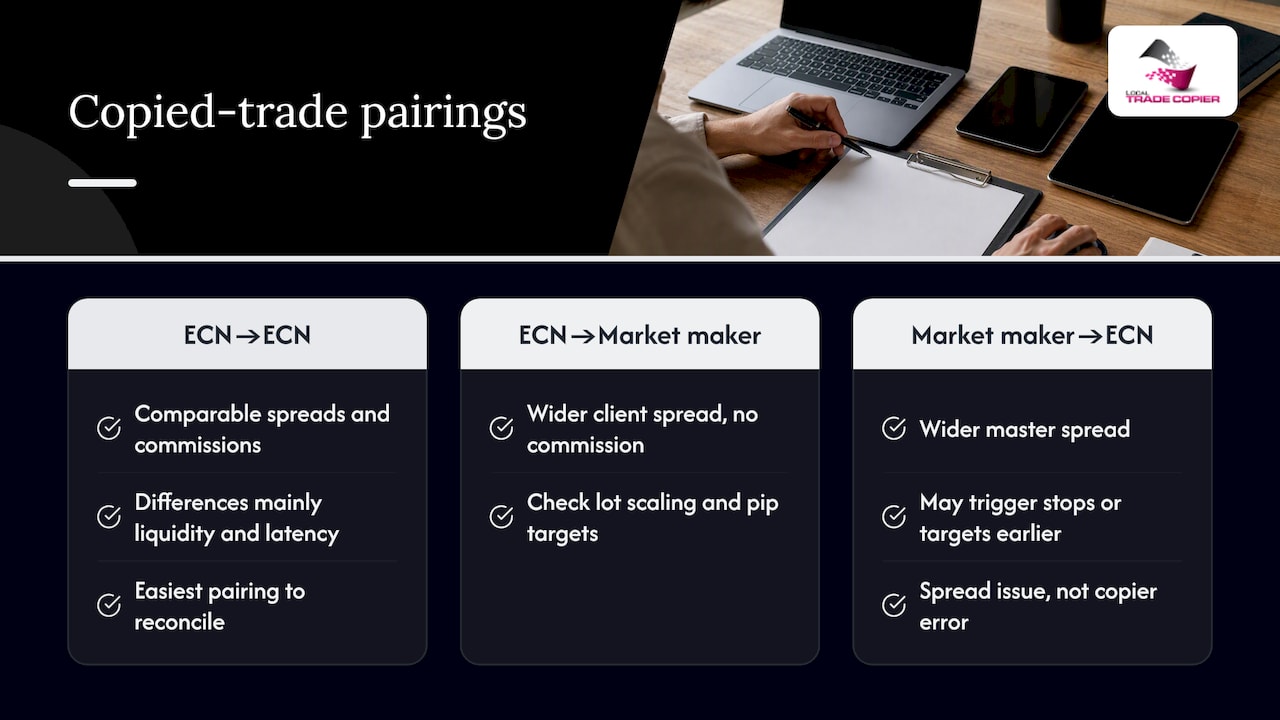
ECN master, ECN clients. Spread and commission structures are comparable, so differences come mostly from liquidity and latency between servers. This is the easiest pairing to reconcile.
ECN master, market maker clients. Client entries often look worse on spread but have no commission. Check that lot scaling and any pip-based take-profit levels still make sense after the spread difference.
Market maker master, ECN clients. The master’s wider spread can trigger a stop or target earlier than a raw-spread client sees it. This is a spread issue, not a copier error, and it is easy to misread as one.
Funded or prop accounts. Some prop firms provide their own accounts with their own execution conditions and rules on automated trading. Read the firm’s rules first. We cover day-to-day handling in prop firm account management tips.
Symbol names and contract sizes also vary. One broker lists EURUSD, another EURUSD.r or EURUSDm. Lot steps and minimum sizes differ. A copier needs a symbol map and sensible lot rounding, or small client accounts may be unable to match the master’s proportions. Our cross-broker trade copying guide covers this.
A related caution comes from a different part of the market. An NFA complaint from 2016 described a front-end system showing long and short positions while the back end netted them, which could increase or even double customer fees and create mismatches on liquidation. That case involved a specific firm, but the lesson applies to copying: if your master hedges and a client account nets, the accounts do not mirror each other. Check whether each account allows hedging.
Our perspective: why the copier is not the variable
We have built trade copying software since 2010, and the most common support question is some version of “why did my client account fill at a different price?” Most of the time the answer is in the broker model, not the copier.
There are two things a copier can control. The first is its own delay. Local Trade Copier runs entirely on your Windows PC or VPS inside MetaTrader, with no cloud routing, so copies are sent in under a second on the same machine and one IP address. The second is how the order looks to the receiving broker, and we offer manual-like entry so copied orders appear as if placed by hand, which matters for accounts whose rules restrict EA trading.
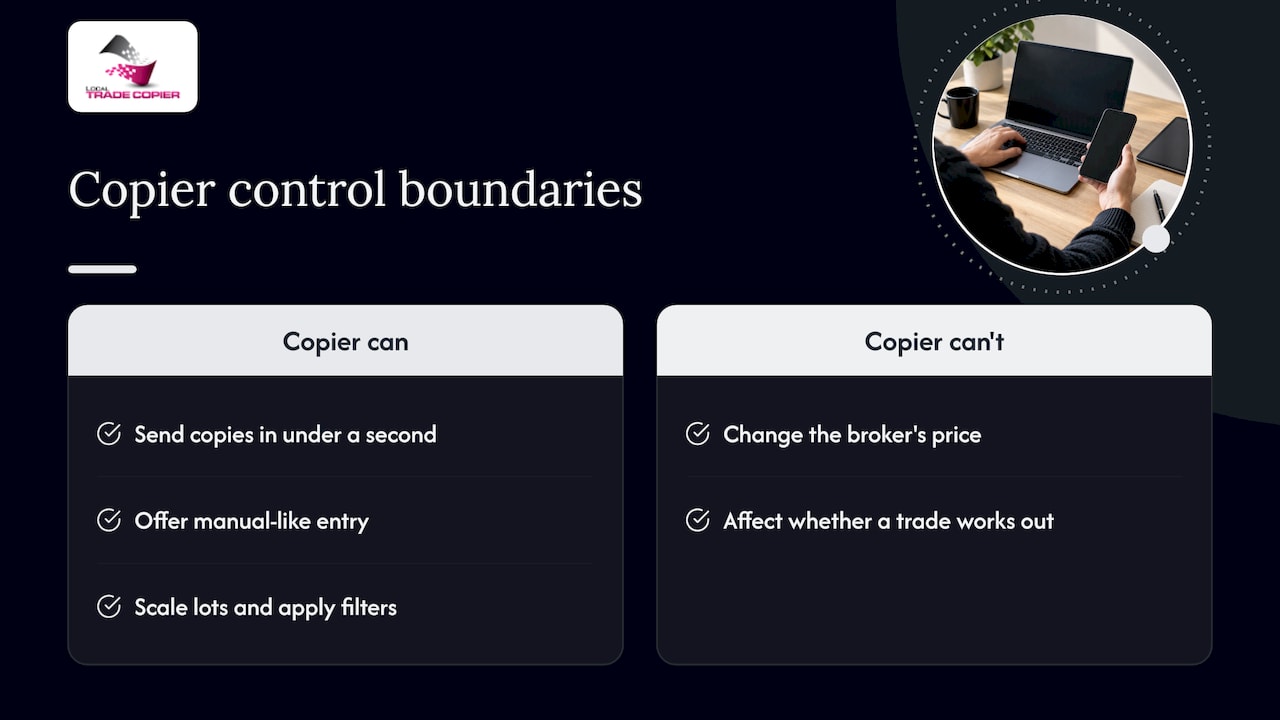
What a copier cannot do is change the broker’s price. We do not think any copier should promise that, and ours does not. It copies existing trades, scales lots per account and applies the filters you set. It has no market logic and does not affect whether a trade works out. That is why we tell customers to treat broker choice as a measurable input and to run a trial before sizing up.
The best setups we see are boring. Same server region, a VPS near the broker, similar account types where possible, and a log that compares master and client fills every week.
— Rimantas
How to test your own accounts
You do not need to guess which model suits you. Run a short controlled test.
- Match the accounts. Use demo or the smallest live size on one master and each client account. Confirm the symbols and lot steps line up.
- Copy a fixed set of trades. Aim for a few dozen across quiet and busy sessions, including at least one scheduled news release.
- Log the data. For every trade, record requested price, fill price, spread at entry, commission and time of fill on each account.
- Compute total cost per lot. Add spread plus commission for each account. Then compare entry slippage separately.
- Count failures. Note every rejected, requoted or delayed copy. One failure during news matters more than ten small differences in a quiet hour.
- Repeat after a change. If you switch brokers, account type or VPS, repeat the test.
Our setup guide shows how to test trade copying without risk. If you suspect the delay is on your side, use the steps in measuring per-account trade delay. For background on speed, see what trade execution speed means.
What to check in a U.S. broker’s disclosures
U.S. retail forex is regulated by the CFTC and supervised through NFA membership. NFA’s regulatory guide notes that members who manage forex accounts for customers must give prospective clients a disclosure document filed with NFA before use. That is a reminder that reading the paperwork is part of the process.
When you compare brokers for a copying setup, look for:
- Order execution description. Does the broker say it acts as principal, agent or both?
- Conflict-of-interest language. Does it say it may take the opposite side of your trades?
- Slippage policy. Does it describe whether positive slippage is passed on as well as negative slippage?
- Commission and swap schedule. Get the full fee table for the exact account type.
- Hedging, scalping and EA rules. Are they allowed on the account you will copy to?
- Registration. Confirm the firm in NFA’s public lookup before depositing.
Our forex broker comparison checklist turns these into a one-page list. Trading leveraged forex carries risk of loss, and past results do not guarantee future performance.
Keeping copies consistent in practice
Once you have chosen your accounts, a few habits keep the differences small.
- Run everything on one VPS. Master and clients on the same machine removes network hops between your own terminals. See our notes on VPS security.
- Use slippage and spread filters. Skip or delay a copy when the client’s spread is far above normal. Our slippage limiting settings explain infrastructure fixes.
- Scale lots by balance. A smaller client account should not carry the master’s raw lot size.
- Avoid copying through news spikes unless you have tested it on every account.
- Review the common mistakes in copy trading pitfalls.
Trying it on your own accounts
Local Trade Copier works across MT4 and MT5, runs on your Windows PC or VPS, and comes with a 7-day free trial, which is enough time to run the test above. Plans are €29 per month for Personal, €89 per month for Manager and €199 per month for VIP, or €290, €890 and €1990 per year. See current plans and pricing or start with the installation guide.
FAQ
Does an ECN broker make copy trading more accurate?
Not by itself. ECN-style accounts usually show tighter spreads and add a commission, so costs are easier to read. Copy accuracy depends on both brokers’ fills, symbol settings and your delay, which is why measuring total cost per trade is more reliable than trusting the label.
Can I copy from an ECN account to a market maker account?
Yes. The copier sends the same order to both terminals. Expect different spreads and possibly different fills, and set lot scaling and filters with that in mind. Check the receiving broker’s rules on hedging and automated trading first.
Why was FXCM banned from U.S. retail forex?
The CFTC’s 2011 order found, among other things, that customers experienced negative slippage but were denied positive slippage during the period reviewed. We do not cover the later history here, so use the CFTC and NFA sites for the full record.
Is a market maker trading against me?
Sometimes, if the broker holds your order rather than hedging it. Investopedia notes market makers may hedge or hold customer orders. That is not inherently improper, but it is why the broker’s conflict-of-interest disclosure is worth reading before you copy to the account.
Sources
- IC Markets Help Centre
- Investopedia: ECN Brokers guide
- Investopedia: Market Makers vs. Electronic Communications Networks
- BabyPips: Dealing Desk and NDD Forex Brokers
- BIS: The economics of market-making
- SEC filing: company description of agency and principal models
- CFTC order: Forex Capital Markets LLC (2011)
- FXStreet Learning Center: Types of Orders
- Graham Capital: Execution in Spot FX
- NFA complaint (2016)
- NFA: Forex Transactions Regulatory Guide
