

An aggregate exposure cap is a trader-configured ceiling that prevents the combined replicated exposure, in lots or notional value, opened across all destination accounts from exceeding a set limit. Traders use one whenever a single master account feeds multiple client, funded, or prop firm accounts and uncapped copying could stack risk faster than anyone account owner intended. If you manage several accounts, skip ahead to the configuration examples or the testing checklist below to put one in place.
TL;DR:
- An aggregate exposure cap should be set based on margin percent when managing accounts across different brokers or with varying balances to prevent drift and ensure fair risk limits.
- Using a hybrid design with global and per-symbol limits helps prevent concentration in a single instrument, especially when partial fills or lot step differences cause exposure drift.
- Testing the cap with simulated orders and small live pilots, along with logging and alerts, is essential to verify correct enforcement before deploying it with real capital.
- Structuring limits slightly below the intended maximum accounts for rounding and lot step variations, reducing the chance of unintended overexposure.
- Local Trade Copier enforces caps locally and supports various configurations, making it suitable for multi-platform and multi-account risk management without altering trade strategies.
Why aggregate exposure caps matter in multi-account copying
Copying a trade to one account is simple. Copying it to ten accounts at once multiplies exposure in a way that is easy to lose track of, especially when lot sizes scale automatically with balance. Without a cap, gross exposure across all destinations can climb well beyond what any single account’s margin was built to absorb, and margin depletion accelerates as soon as a losing streak hits every copied account at the same time.
This becomes critical in three common situations: a trader running several funded prop firm accounts with firm-specific risk rules, an account manager copying to dozens of small client accounts with different balances, and any setup where one master trade fans out faster than a human could intervene.
An aggregate exposure cap prevents several operational failures at once:
- Over-concentration in a single symbol or currency pair across accounts
- Unexpected margin calls when correlated positions move against the book simultaneously
- Partial fill cascades that leave some accounts overexposed while others sit undersized
Past results do not guarantee future performance, and no cap eliminates market risk. It only limits how much exposure the copier is allowed to open in the first place.
Units and metrics: lots vs notional vs margin percent
Choosing the right unit for a cap is not a formality. It determines what the copier actually blocks.
- Lots cap the raw number of standard, mini, or micro contracts copied, which works well when every destination account trades the same instrument at similar size.
- Notional value caps the total currency exposure (price multiplied by contract size), which matters more when accounts trade different symbols with different contract values.
- Margin percent caps exposure relative to each account’s own equity, which is the only unit that scales fairly across accounts of very different sizes.
Broker lot steps and minimum contract sizes constrain the choice in practice. A 0.01 lot step at one broker and a 0.1 step at another means a lot-based cap can leave one account slightly over or under the intended limit, a gap that widens with more destination accounts.
As a rule of thumb, use lots when every account is on the same broker with matching contract specs, notional value when accounts trade multiple symbols, and margin percent whenever the accounts span different brokers or wildly different balances. Mixed environments almost always call for margin percent because it is the only unit that is meaningful account by account rather than in absolute terms.
Designing an aggregate exposure cap: concrete approaches and trade-offs
There is no single correct cap design. The right pattern depends on how many accounts you run, how similar they are, and what rules govern them.
- Global cap. One ceiling applies to total combined exposure across every destination account. It is the simplest to set up and the easiest to audit, and it works well when all accounts trade the same strategy at a similar scale.
- Per-symbol cap. A separate limit applies to each instrument, which stops a single currency pair or commodity from dominating the book even if the global total stays within range.
- Per-account scaled cap. Each account gets its own ceiling proportional to its balance or equity, which respects the fact that a $2,000 account and a $50,000 account should never be exposed to the same absolute risk.
- Hybrid rules. Many setups combine a global ceiling with per-symbol sub-limits, so no single instrument can consume the entire allowance even when overall exposure is within bounds.
Partial fills and differing lot steps are the most common source of drift between the intended cap and the actual result. A hybrid design that checks exposure after each fill, rather than only before the trade is sent, catches this drift before it compounds across dozens of accounts.
Pro Tip: Set your cap slightly below the true limit you are trying to enforce, since rounding to the nearest lot step almost always pushes real exposure up rather than down.
How to configure an aggregate exposure cap in a local trade copier
Turning a design into a working configuration means setting limits at the software level, not just deciding on paper what the numbers should be.
- Set a maximum combined lot or notional value across all destination accounts in the copier’s risk management settings.
- Add per-symbol caps for any instrument prone to concentration, such as a heavily traded index or metal.
- Enable per-account scaling so each destination account’s allowance grows or shrinks with its own balance rather than a fixed number.
Three practical setups illustrate how this plays out. A single trader running several funded accounts typically sets one global cap plus per-account scaling, so no single funded account breaches its own firm’s daily loss rule. An independent account manager with mixed-size clients relies almost entirely on margin percent caps, since client balances rarely match. A prop firm trader enforcing a firm’s own limits sets a conservative global cap well under the firm’s stated ceiling, leaving a buffer for slippage.
Operational notes worth building in alongside the cap itself:
- Combine the cap with stop-loss forwarding so a capped position still closes on the same signal as the master
- Apply order filters to exclude symbols or account types that should never be included in the aggregate total
- Confirm reverse-copying setups respect the same cap logic, since reversed positions still count toward combined exposure
Testing and verifying a cap safely before going live
A cap that looks correct on paper can behave differently once real fills and network conditions are involved. Verify it before trusting it with live capital.
- Run a dry-run or simulated order pass first, checking that the copier calculates combined exposure the way you expect before any real order is sent.
- Pilot the cap on a small subset of accounts, since real partial fills and broker-specific lot steps reveal edge cases that a theoretical check never will.
- Enable logging and alerts for every cap hit, rejected order, and partial fill so you have a record to review rather than a guess.
- Monitor latency between the master signal and the copied order, and reconcile total open exposure against what the cap should have allowed at the end of each session.
Past results do not guarantee future performance, and a passing test today does not guarantee correct behavior under different volatility or broker conditions tomorrow.
Compliance considerations: NFA guidance on PAMM and bunched orders
Traders allocating bunched or PAMM-style orders across multiple accounts operate under specific expectations, even when the trading itself is fully automated by a copier. This is a factual overview, not legal advice, and any specific situation should be checked against current NFA rules or a qualified compliance professional.
- NFA Compliance Rule 2-10 requires that allocations of bunched retail forex orders not exceed the tradable lot quantities permitted by each individual account’s own equity, and that the allocation methodology be documented and disclosed to the counterparty.
- Industry coverage has noted that the NFA has focused attention on PAMM and bunched-order allocation practices, urging managers and brokers to demonstrate allocation fairness and proper reporting.
- Beyond allocation rules, U.S. retail forex trading carries its own structural constraints, including leverage limits and FIFO execution requirements that affect how multi-account copying should be configured in the first place.
An aggregate exposure cap that scales fairly by account equity, rather than allocating a flat lot size to every account regardless of size, is one practical way to align configuration with the spirit of these expectations and reduce operational allocation risk.
Rules I use when setting aggregate caps
I default to margin percent caps whenever accounts span more than one broker, since lot-based caps drift the moment contract specs differ. For prop firm accounts, I set the cap noticeably below the firm’s own stated limit rather than matching it exactly. Local execution matters here because enforcement has to happen before an order leaves the machine, not after. Local Trade Copier’s definitive guide covers this in more depth, including a dedicated chapter on exposure and lot management.
How Local Trade Copier supports aggregate exposure caps
Local Trade Copier is trade replication software: it copies existing trades from a master account to destination accounts and applies no market logic or strategy of its own, so any cap you set governs how much gets copied, never whether a trade is a good idea. It runs entirely on a Windows PC or VPS, which matters for cap enforcement because the decision to block or scale an order happens on the same machine as execution, with no round trip to an external server.

The features map onto the per-account and per-symbol designs covered above:
- Configurable lot sizing, 8 money management modes and per-account risk limits (MaxTrades, LimitTradeCountPerPair, MaxLotSizeAllowed, MarginLimitPercent) for per-account and per-symbol caps; each client account enforces its own limits, and there is no single cap across all accounts combined
- Automatic lot scaling per client account balance, which supports margin-percent style caps across mixed account sizes
- Local execution in about 1 second, which keeps enforcement close to real time rather than lagging behind fast-moving markets
- Cross-platform copying across MT4, MT5, and DXTrade for traders running accounts on more than one platform
The software is active since 2010, with 15,000+ licenses sold and 500+ reviews on Trustpilot and Forex Peace Army combined. A 7-day free trial is available, and current subscription pricing runs from the PERSONAL Plan at €29 per month up to the VIP Plan for up to 15 PCs or VPSs (every plan allows unlimited accounts). Start the trial, follow the installation guide, and configure your first per-account cap (for example MaxLotSizeAllowed or MarginLimitPercent) before committing any live capital.
Primary sources and documentation used in this article
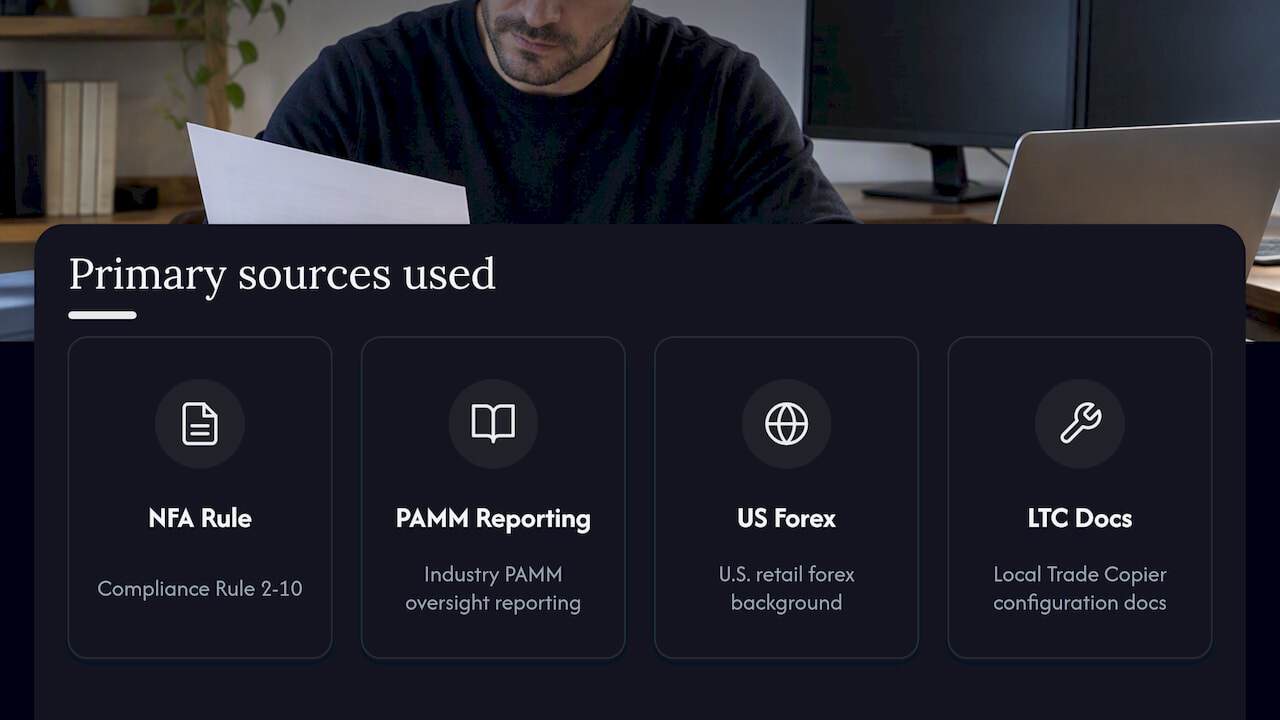
This article draws on NFA Compliance Rule 2-10, industry reporting on PAMM oversight, and background on U.S. retail forex regulation, alongside Local Trade Copier’s own configuration documentation.
Sources
- 9065 – NFA Compliance Rule 2-10: The allocation of bunched retail forex orders for multiple accounts
- U.S. forex broker regulations explained: NFA guidelines and compliance | Investopedia
FAQ
What is an aggregate exposure cap in a trade copier?
An aggregate exposure cap is a limit a trader sets inside the copier to stop the total combined exposure across all destination accounts from exceeding a chosen threshold, measured in lots, notional value, or margin percent. It is enforced by the software itself, not by the trading strategy.
Should I cap by lots or by margin percent?
Margin percent works better whenever accounts differ in size or sit at different brokers, since it scales the limit to each account’s own equity. Lot-based caps are simpler but only stay accurate when every account shares the same broker and contract specs.
Does an aggregate exposure cap affect the underlying trading strategy?
No. A cap only limits how much of a copied trade gets replicated across accounts; it does not analyze the market or alter the master trade’s logic. Local Trade Copier and similar tools apply caps at the replication layer, with no strategy or market decision involved.
How do NFA rules relate to caps on bunched orders?
NFA Compliance Rule 2-10 requires that allocations of bunched orders match the tradable lot quantities each account’s equity permits, and that the allocation method be documented. A well-designed aggregate cap that scales by account equity supports that requirement operationally, though it is not a substitute for compliance review.
How much does Local Trade Copier cost?
Local Trade Copier is offered as a subscription starting at the PERSONAL Plan for €29 per month or €290 per year, with MANAGER and VIP plans for traders who run more PCs or VPSs (every plan allows unlimited accounts). A 7-day free trial is available before committing to a paid plan.
