

TL;DR:
- Many beginner traders struggle by jumping between educational resources without building structured knowledge or habits. Focusing on mastering fundamentals, disciplined demo practice, and sticking to one strategy gradually develops effective decision-making skills. Transitioning gradually to small live trades with strict risk management ensures long-term survival and consistent improvement.
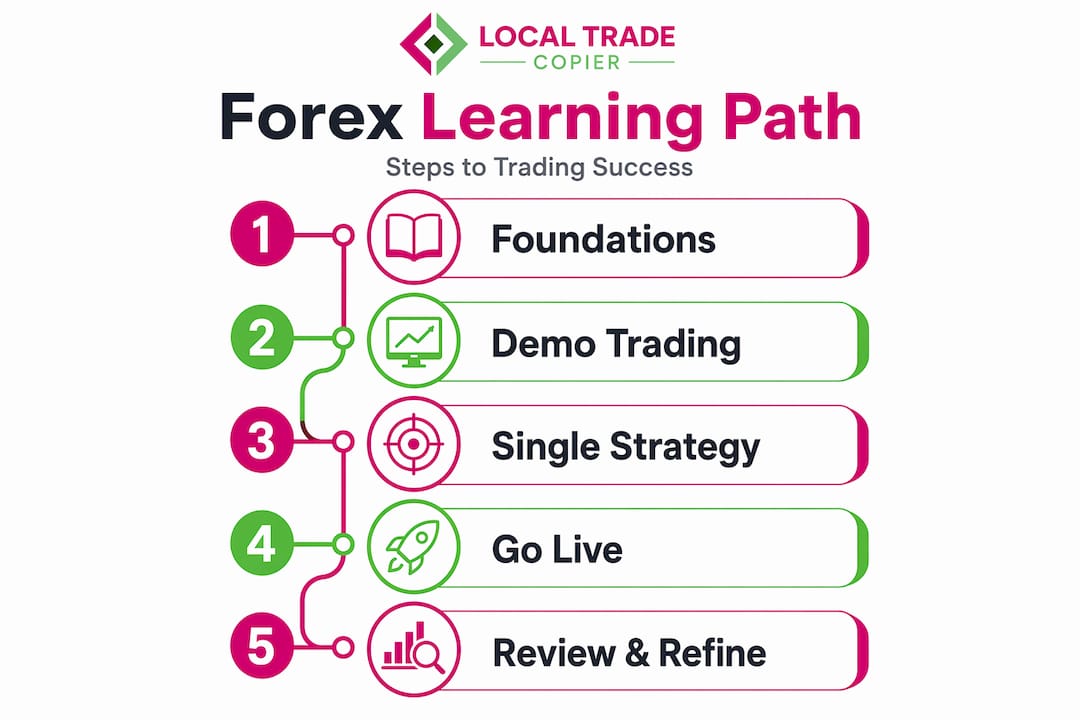
Most beginner traders spend months jumping between YouTube videos, forums, and free webinars, accumulating fragments of knowledge that never quite connect. Teaching forex trading efficiently is not about cramming more information faster. It’s about sequencing what you learn, practicing with structure, and building decision-making habits before you ever risk real money. This guide lays out a clear, step-by-step path from absolute beginner to confident live trader, focusing on what actually accelerates progress and what quietly wastes your time.
Key takeaways
| Point | Details |
|---|---|
| Foundations before strategy | Learn currency pairs, pips, leverage, and risk basics before touching any trading strategy. |
| Demo trading with discipline | Practice 50 to 100 trades on a demo account with realistic capital and strict risk limits. |
| One strategy at a time | Commit to a single beginner-friendly strategy long enough to evaluate it honestly. |
| Small live capital first | Start live trading with micro lots and never risk more than 1 to 2% per trade. |
| Journal everything | Record every trade with entry rationale and emotional notes to spot patterns and improve. |
Teaching forex trading efficiently starts with the right foundations
Before you open a chart or place a single trade, you need to understand what the forex market actually is and how it moves. Skipping this step is the single most common reason beginners plateau early. A structured learning path that begins with market mechanics, price drivers, and risk management before introducing strategy produces faster, more durable progress than jumping straight into setups.
Here are the core concepts every beginner must understand before moving forward:
- Currency pairs: Every forex trade involves buying one currency and selling another. EUR/USD, GBP/JPY, and USD/CAD are examples. The first currency is the base; the second is the quote.
- Pips: A pip is the smallest standard price move in a currency pair, typically the fourth decimal place. Knowing pip value helps you calculate potential gains and losses before entering a trade.
- Lots: A standard lot is 100,000 units of currency. Beginners should start with micro lots (1,000 units) to keep risk manageable.
- Leverage: Brokers allow you to control large positions with a small deposit. Leverage amplifies both profits and losses, so understanding it before using it is non-negotiable.
- Spreads: The spread is the difference between the buy and sell price. It’s a transaction cost you pay on every trade, and it varies by broker and market conditions.
Understanding these mechanics matters because they directly affect every decision you make. A trader who does not understand leverage may unknowingly take a position 50 times larger than their account can safely absorb.
Pro Tip: Before opening a demo account, spend at least one week reading about how each of these five concepts interacts in a real trade. Build a simple reference sheet you can consult during practice sessions.
Here is a quick reference for position sizing based on account size:
| Account size | Recommended lot size | Max risk per trade (2%) |
|---|---|---|
| $500 | Micro (0.01) | $10 |
| $1,000 | Micro (0.01) to Mini (0.1) | $20 |
| $5,000 | Mini (0.1) | $100 |
| $10,000 | Mini to Standard | $200 |
Risk management is not a strategy add-on. It is the framework inside which every strategy operates. Learn it first, and every lesson that follows will make more sense.
How to use demo trading to build real skills
Demo trading gets dismissed as “not real” by many beginners. That is a mistake. Used correctly, a demo account is where you develop the mechanical habits and risk discipline that protect your capital when you go live.

The key is setting up your demo to mirror the live conditions you intend to trade. Using a $500 to $1,000 demo balance with a 1 to 2% risk limit per trade keeps your practice grounded and prevents the overconfidence that comes from trading with an unrealistically large virtual account.
Here is a step-by-step approach to productive demo practice:
- Set a realistic virtual balance. Match it to the amount you plan to deposit when you go live. If you intend to start with $1,000, practice with $1,000, not $100,000.
- Start with micro lots. Practicing with micro lots keeps your focus on process, not on watching imaginary profits pile up.
- Place at least 50 to 100 trades before evaluating results. This sample size is large enough to reveal patterns in your behavior and your strategy’s performance.
- Keep a trading journal from day one. Write down why you entered each trade, what your target and stop loss were, and how you felt during and after the trade.
- Treat demo losses as real. Every time you ignore a stop loss on a demo account, you are training yourself to ignore it on a live account. The habit forms either way.
Trade journaling with entry/exit rationale and emotional notes consistently leads to measurable improvement in discipline over time. Skipping the journal is like going to the gym without tracking your workouts. You may be putting in the time, but you have no way to measure progress.
Pro Tip: After every five trades, review your journal. Ask yourself: Did I follow my rules? Did I move a stop loss? Did I exit early because I was nervous? Patterns in your answers reveal where your training needs to focus.
Picking one strategy and actually sticking to it
The most efficient forex trading methods all share one thing: specificity. Beginning traders who jump between strategies every two weeks never build the repetition required to execute any single method with confidence.
The strategy-hopping trap is real. You try trend following for a week, get a few losses, and switch to scalping. Then scalping feels too fast, so you try breakout trading. Three months pass and you have learned the surface of five strategies while mastering none of them.
Here is what to do instead:
- Choose one beginner-friendly approach. Trend following, support and resistance trading, and breakout trading are all solid starting points. Each has clear rules and does not require advanced indicators.
- Define your entry and exit rules in writing before you start. If you cannot write down the exact conditions that trigger a trade, you do not have a strategy. You have a guess.
- Run at least 50 demo trades using only that strategy. Your goal is not to find the “best” strategy. Your goal is to learn whether you can execute one strategy consistently.
- Only consider adjusting your strategy after consistent evaluation. If you have followed your rules and the results are poor after 50 to 100 trades, then you have earned the right to refine or change. Changing after five losing trades tells you nothing.
Education platforms that explain the reasoning behind trades, rather than just delivering alerts, build the independent judgment that separates profitable traders from followers. The same principle applies here. Understand why your strategy works in certain market conditions, and you will know when to apply it and when to stand aside.
Transitioning to live trading without blowing your account
The jump from demo to live trading is where most beginners stumble. Not because they lack strategy knowledge, but because real money triggers emotions that a demo account simply cannot replicate.
Here is how to manage that transition without letting your emotions drive decisions:
- Start with the minimum deposit your broker allows. Keep live capital small. The point of early live trading is to experience real emotional pressure, not to make significant returns.
- Never risk more than 1 to 2% per trade. This rule exists to keep you in the game long enough to learn. Violating it early is how accounts get wiped in weeks.
- Set your stop loss and take profit before you enter every trade. Not after. Not “if it gets close.” Before.
- Avoid revenge trading. After a loss, the urge to immediately re-enter and “win it back” is powerful and dangerous. It leads to larger positions and ignored rules.
- Check the economic calendar before every session. High-impact news events like Non-Farm Payrolls and central bank decisions create sudden, extreme volatility. Trading through them without awareness is not bravery. It’s avoidable risk.
“The goal of early live trading is not profit. It is survival. Every week you protect your capital is a week you are still in the game learning.”
You can find more on managing risk across accounts as you progress beyond single-account trading. Ongoing review and emotional awareness are not optional extras. They are what separate traders who improve from traders who repeat the same costly mistakes indefinitely.
Review, refine, and scale your trading skills
Progress in trading is not linear. You will have good weeks and bad weeks. What separates the traders who keep improving from those who stagnate is a structured review process.
Here is a practical review routine to follow weekly:
- Review every trade from the week. Did you follow your entry rules? Did your stop loss placement make sense given the setup?
- Categorize outcomes. Separate trades where you followed your rules from trades where you did not. If you lost while following your rules, the strategy needs work. If you lost while breaking your rules, your behavior needs work.
- Note emotional patterns. Did you hesitate on good setups? Did you take trades that were not part of your plan because the market “felt right”?
- Make one small adjustment at a time. Changing multiple variables at once makes it impossible to know what is working. Adjust one thing, test it over 20 to 30 trades, then reassess.
Regular review of journal entries produces measurable improvements in discipline over time. This is not a soft recommendation. It is the mechanism through which skill actually compounds.
Pro Tip: Schedule a 30-minute weekly review session at the same time every week. Treat it like a trade itself. Consistency in your review process builds the same habits as consistency in execution.
Mastery in forex trading is measured in years, not weeks. The traders who succeed long-term are the ones who commit to getting marginally better each month rather than hunting for shortcuts. Patience is not passive. It is an active, deliberate practice.
My take on why most beginners learn the hard way
I have worked with traders across every experience level, and the single most common trap I see is this: people mistake knowing how to use a platform for knowing how to trade.
Opening MetaTrader 4, placing an order, setting a stop loss — those are motor skills. They take an hour to learn. Platforms give access and tools but do not teach patience, strategy, or risk control. Real skill lives in the decisions you make before you touch the platform: whether the setup qualifies, what your risk is, and under what conditions you would exit at a loss.
In my experience, the fastest improvements come from codifying decision processes outside the platform entirely. Write your trade criteria in a document. Describe your strategy in plain language. Define what a valid setup looks like and what disqualifies it. Then, when you sit down to trade, you are executing a plan, not making decisions under pressure.
Demo trading only works if you bring this mindset to it. A demo account with no rules attached is just a video game. With rules, it becomes a training environment where real habits form.
My strongest advice to anyone starting out: do not rush the transition to live trading. The market will still be there in three months. The traders who spend that time building real skills instead of chasing fast profits are the ones who last.
— Rimantas
How Mt4copier supports disciplined execution at scale
Once you have built your forex education foundation, execution becomes the next challenge, especially if you manage more than one account.
Mt4copier’s Local Trade Copier software copies trades from a single master account to multiple client accounts in under 0.5 seconds, running entirely on your local Windows machine or VPS with no cloud routing. What makes it relevant to disciplined traders is the risk management layer built into it. Proportional lot scaling across accounts is not just a convenience feature. It is a risk-control necessity. Fixed lot replication breaks risk parity and can cause oversized drawdowns on smaller accounts. Mt4copier handles this with 18 configurable lot size and risk management options, including automatic scaling per account balance.
For traders ready to execute across multiple accounts, the Local Trade Copier demo shows exactly how the software works in practice. You can also explore account management benefits and how the software supports execution once your strategy is proven. A 7-day free trial is available with no commitment. Past results do not guarantee future performance.
FAQ
What does teaching forex trading efficiently actually mean?
It means following a structured sequence: fundamentals first, then demo practice, then a single strategy, then small live trading. Skipping steps creates knowledge gaps that cost you money later.
How many demo trades should I complete before going live?
Completing 50 to 100 demo trades gives you a meaningful sample size to evaluate both your strategy and your behavior under simulated conditions.
What are the best forex trading techniques for beginners?
Trend following, support and resistance trading, and breakout strategies are the most beginner-friendly options because they have clear, rule-based entry and exit criteria that are easy to test.
Why is a trading journal so important for learning?
Journaling trade rationale and emotions reveals behavioral patterns you cannot see in the moment. It turns individual trades into a feedback loop that steadily improves your decision-making.
How much should I risk per trade when starting live trading?
Never risk more than 1 to 2% of your account on any single trade. This limit keeps you in the market long enough to accumulate the experience and learning that actually produces skill. Past results do not guarantee future performance.
Recommended
- Automate Your Forex Teaching: Step-by-Step Guide
- Forex Trading For Beginners: 3 Profitable Strategies For 2023
- How forex tutorials build real trading skills
- Day Trading: The Basics and How to Get Started
