
Swap differences cause persistent P&L drift between master and client accounts unless your copying method preserves the master account’s overnight fee treatment. Left unmanaged, this drift compounds every night a position stays open, and it shows up as “unexplained” divergence long after execution and slippage have been ruled out.
The one-line verdict: if matching swap policy across accounts actually matters to your operation, run a swap-aware, local copying workflow rather than a cloud or broker-side setup that treats swaps as someone else’s problem. Local Trade Copier is built around that principle. Broker documentation matters here too. Myfxbook’s swap-free broker research shows swap-free accounts often replace overnight interest with flat fees, and FXPesa’s own support notes confirm copy trading isn’t always available on swap-free accounts at all.
- Swap mismatches are the most common cause of overnight-only P&L drift in copied accounts.
- Account type (swap-free vs. standard) matters more than most managers assume.
- Broker policy on copy trading can quietly block or alter a setup you thought was working.
Pro Tip: Before you copy a single trade, pull up both the master and client account specifications side by side and check swap status on every instrument you plan to trade, not just the obvious majors.
A single mismatched swap policy on a pair held for five nights can quietly produce a P&L gap that has nothing to do with execution quality.
Key Takeaways
Swap differences between master and client accounts are the leading cause of overnight-only tracking error in copied forex trades, and matching account types closes most of the gap.
| Point | Details |
|---|---|
| Swap mismatch is the root cause | Divergence that appears only overnight almost always traces back to differing swap policies, not execution. |
| Match account types first | Pair swap-free with swap-free, or standard with standard, before copying any strategy. |
| Local copying preserves swap-native behavior | On-machine execution avoids cloud re-pricing and lets each account keep its broker’s own swap terms. |
| Reconcile swaps nightly | Add a swap-only line to reports to separate drift from slippage within 24 hours. |
| Local Trade Copier fits swap-aware setups | It runs locally across MT4, MT5, and DXTrade with per-client lot scaling and on-machine logging for reconciliation. |
What Causes Swap Differences When Copying Trades?
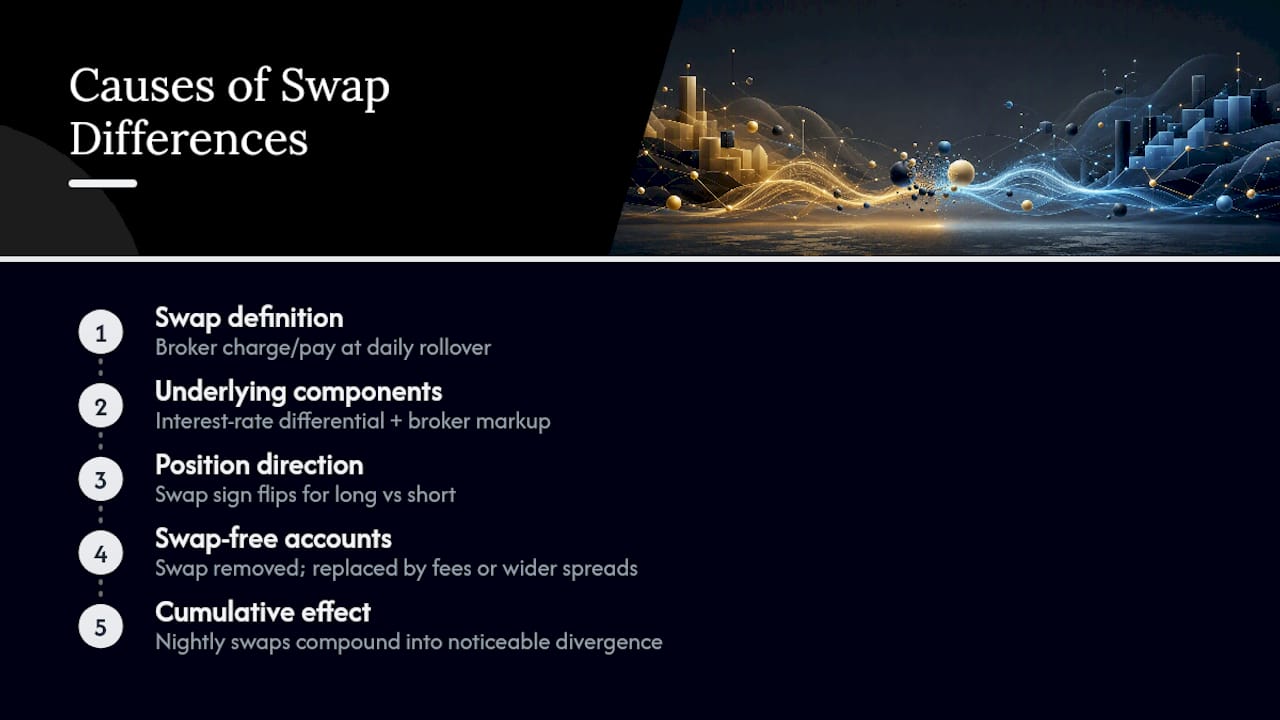
A swap, also called an overnight or rollover fee, is what a broker charges or pays for holding a leveraged FX position past the daily rollover cutoff, usually around 5 PM Eastern Time. It’s built from the interest rate differential between the two currencies in the pair, adjusted by the broker’s own markup, and it flips sign depending on whether you’re long or short.
That swap can be positive or negative, and it lands in your account every single night a position stays open. On its own, a few dollars a night looks trivial. Held for two or three weeks, it stops being trivial.
Example: Say a master account earns some positive swap per lot per night on a long AUD/USD swap, but the client account, at a different broker, pays a smaller positive or even negative swap per lot per night on the same trade. Over multiple nights, this causes a noticeable divergence per lot that has nothing to do with entry price, slippage, or execution speed. It’s pure swap mismatch.
Some brokers sidestep this entirely with swap-free (often called Islamic) accounts, which strip out overnight interest and replace it with administrative fees or wider spreads instead, according to Myfxbook’s broker comparison. Coverage varies. Some brokers apply swap-free status only to select instruments, per Versus Trade’s account documentation.
Pro Tip: Check whether either account, master or client, is flagged swap-free or excludes certain instruments before you turn on copying. This single check prevents most swap-related surprises.
Which Trade Copying Method Handles Swaps Best?
Four broad approaches dominate the market, and each handles swap treatment differently.
Local on-machine copiers run entirely on your Windows PC or VPS and mirror trades directly at the broker terminal level, so swap treatment stays exactly whatever each account’s own broker applies. Cloud/signal services route trade signals through a third-party server, which introduces latency and no direct control over how swaps land on the receiving account. Broker-side PAMM/MAM pools client funds under one master allocation, and swaps often get aggregated or averaged across the pool rather than applied per-trade. Broker-integrated copy platforms sit somewhere in between, usually locked to a single broker’s swap schedule.
- Local copier: fast, swap treatment stays account-native, requires your own machine or VPS.
- Cloud signal: easy setup, but added latency and no swap control.
- PAMM/MAM: simple for pooled capital, but swap aggregation can mask individual account drift.
- Broker-integrated: convenient, but locked to one broker’s terms.
| Method | Execution speed | Swap handling | Account compatibility | Fee model | Lot scaling | Logging/reconciliation |
|---|---|---|---|---|---|---|
| Local on-machine copier | Sub-second, no external hop | Native, per-account | MT4/MT5/DXTrade, swap-free or standard | Subscription | Per-client, automatic | Local logs, full reconciliation |
| Cloud signal service | Depends on server latency | Not controlled, broker-applied | Varies by provider | Subscription or commission | Often manual | Limited, server-side only |
| Broker-side PAMM/MAM | Broker-dependent | Aggregated across pool | Single broker only | Performance fee typical | Allocation-based | Broker statements only |
Note that some brokers restrict copy trading on swap-free accounts entirely, permitting it only on swap-enabled accounts. Confirm this before assuming any method will work on your setup.
Pro Tip: If your master account runs swap-free and your client doesn’t, don’t assume the copier “handles it.” Verify the client’s swap schedule matches what the strategy was designed around.
Why Do Copied Accounts Diverge Overnight?
When two accounts drift apart only during overnight hours and stay aligned during the trading day, the swap policy is almost always the culprit. Five patterns show up repeatedly.
- Swap-free mismatch. Master is swap-free, client is standard, or the reverse.
- Cross-broker swap schedules. Two brokers apply different markups on the same pair, even with identical underlying rates.
- Symbol mismatches. Suffixes or contract specs differ (EURUSD vs. EURUSD.m), which can quietly change swap values, a scenario covered in more detail in MT4Copier’s guide on copying trades with different symbols.
- Leverage or lot-size differences. Bigger effective exposure means bigger nightly swap totals, even on the “same” trade.
- Auto-reverted swap-free status. Brokers can flip an account back to standard swap treatment if they detect extended overnight holding patterns, according to Weltrade’s support documentation.
Run this quick diagnostic when divergence shows up only overnight:
- Compare swap postings line by line between master and client for the same night.
- Check if either account’s swap-free status changed recently.
- Confirm both accounts hold the identical symbol, not a broker-specific variant.
Pro Tip: Add a swap-only line item to your nightly reconciliation report. Isolating swap drift from execution or slippage differences turns a mystery into a five-minute fix.
How Do You Set Up Copying to Avoid Swap Drift?
Configure the setup in this order, and don’t skip steps to save time. Each one closes a specific gap.
- Verify account types on both sides: swap-free vs. standard, and document it.
- Confirm the exact instrument symbols and map any suffix differences, using a checklist for adding client accounts to standardize the process.
- Match lot sizing and scaling rules so exposure, and therefore swap exposure, tracks proportionally.
- Align account-level settings where the platform allows it, including spread priority and margin calculation method.
- Configure the copy method to preserve swap treatment rather than overriding it.
- Schedule automated nightly swap reconciliation so drift gets caught within 24 hours, not 24 days.
Before going live, test with a single pair at one or two lots scaled proportionally to each client, and let it run for 48 to 72 hours while you log every swap posting.
Pro Tip: If you’re using swap-free accounts anywhere in the chain, get the broker’s exact policy in writing, flat fee or conditional, before you copy a single trade. Verbal assurances from support chat don’t hold up when a swap policy quietly changes.
Which Copying Approach Fits Your Swap Situation?
The right method depends on how much swap precision your strategy actually needs.
If strict swap parity and fast execution matter, a local trade copier is the option built for that job. If you’re running a simple signal replication where minor swap differences are tolerable, a cloud signal service can work, with the caveat that you’re accepting some drift by design. If you’re managing pooled capital under one broker, PAMM/MAM handles allocation cleanly but aggregates swap costs across the pool rather than isolating them per account.
| Need | Best-fit approach | Swap handling behavior |
|---|---|---|
| Strict swap parity, fast execution | Local trade copier | Native per-account, no aggregation |
| Simple signal replication, drift-tolerant | Cloud signal service | Broker-applied, not synchronized |
| Pooled single-broker management | PAMM/MAM | Aggregated across the pool |
For managers who need precise replication, Local Trade Copier runs locally with sub-0.5-second execution, per-client lot scaling across 18 configuration options, on-machine logging for reconciliation, and compatibility across MT4, MT5, and DXTrade. Past results do not guarantee future performance, and none of this changes the underlying strategy’s outcomes. It only affects how faithfully that strategy replicates across accounts.
Pro Tip: Don’t pick a copying method based on price alone. Pick it based on whether swap parity actually matters to the strategy you’re replicating.
How Do You Measure Swap-Driven Tracking Error?
Testing takes five steps. Open paired positions on master and client with identical entry and exit windows. Hold overnight for one to five nights. Record every nightly swap posting, spread or slippage figure, and execution timestamp on both sides. Compare intra-day P&L movement (execution driven) against overnight P&L movement (swap driven) to isolate the source of any gap. Repeat the test immediately after any broker policy change.
- Open identical paired trades on master and client accounts.
- Hold for one to five nights, logging every swap posting.
- Separate intra-day P&L change from overnight P&L change.
- Sum swap differences per position to get total swap drift.
- Compare cumulative tracking error against expected swap-neutral performance.
| Metric | Definition |
|---|---|
| Swap drift | Sum of swap differences per position across the test window |
| Execution gap | Latency or slippage difference independent of swap postings |
| Cumulative tracking error | Total absolute P&L difference between master and client over the test period |
Warning: brokers can automatically revert swap-free status if they detect certain holding patterns. If that happens mid-test, stop, document the change, and retest from scratch. Old data won’t reflect the new cost structure.
An Operator’s Take on Reliable Trade Copying
Deterministic replication beats clever replication. I’d rather see a manager run boring, well-logged nightly reconciliation than chase a setup that looks elegant but can’t explain a $12 overnight gap. Local execution earns its keep here: sub-0.5-second copying and on-machine logging turn “why did this diverge” into a five-minute lookup instead of a guessing game. Past results do not guarantee future performance, and no copying setup changes that reality. It only determines whether your records tell you the truth about what happened.
Get Started With a Swap-Aware Local Copier Setup
Local Trade Copier is the practical route if you’re tired of chasing swap-driven drift across broker statements. It installs locally on MT4, MT5, or DXTrade, preserves each account’s native swap and admin fee handling instead of overriding it, and scales lot sizes per client automatically across 18 configuration options.

The 7-day free trial gives you enough runway to run the exact overnight test outlined above: install on a VPS, work through the setup checklist, and log 48 to 72 hours of paired trades before committing. Features that matter specifically for swap-aware copying include on-machine reconciliation logs, manual override of swap propagation where a broker requires it, symbol mapping for mismatched instrument suffixes, and per-client admin fee handling for swap-free setups.
Past results do not guarantee future performance, and this software copies trades only; it has no strategy layer or market logic of its own. If swap parity matters to how you manage client accounts, start with Local Trade Copier’s installation guide and run your own overnight test before scaling to more accounts.
Sources
- 7 Best Swap Free Forex Brokers | Myfxbook
- Can I copy trade on a swap-free account? — FXPesa help center
- What is a swap-free account? — Weltrade support
