

A per symbol trade size cap is the maximum volume you can hold or submit for one instrument, set by whichever party has the tightest rule: the exchange or regulator, your broker, or a prop firm’s house policy. Before sizing any position, check all four layers and use the smallest number. Skipping that check is how orders get rejected or accounts get flagged for breaching a rule you never read.
TL;DR:
- Federal spot-month limits are capped at 25% of the deliverable supply, making them the tightest constraint in the futures contract cycle.
- Platform specifications set volume and margin requirements, with order rejections often caused by exceeding step sizes, maximums, or margin limits.
- Broker-imposed order size caps vary by instrument, with some allowing large orders through facilities like Interactive Brokers’ Large-Size Order option.
- Proprietary trading firms can enforce the strictest caps through per-symbol lot limits and risk rules, which often dictate smaller lot sizes than brokers permit.
- Combining all rules, the maximum trade size requires calculating margin capacity, comparing it with exchange, broker, and prop-firm limits, then choosing the smallest value.
Federal and exchange position limits set the outer boundary
The widest ceiling on position size comes from regulation, not your broker. The CFTC final rulemaking on position limits sets spot-month limits generally at or below a quarter of estimated deliverable supply for covered futures contracts, with non-spot-month limits built on open interest bands, typically at a smaller percentage of the initial tranche of open interest and a lower incremental percentage thereafter. These numbers apply to core referenced futures contracts under federal rules, not to every retail forex pair, but they illustrate the logic every exchange borrows when it builds its own tables.
Exchanges implement these limits by converting related instruments into a single comparable unit. Options get translated into futures-equivalent positions using published delta ratios, and cash-settled contracts linked to the same underlying get aggregated so a trader cannot sidestep a cap by splitting exposure across instruments. The exchange filing process documented in the Federal Register shows how exchanges periodically adjust these per-symbol policies, including exclusions and fee schedule changes tied to specific contracts.
A few mechanics matter for anyone sizing a position near a federal or exchange limit:
- Exchanges publish position limit tables separately from the federal baseline, and those tables can be stricter.
- Bona fide hedging exemptions exist, but they require filing with the exchange before the position is established, not after.
- Aggregation rules apply across accounts under common control, so splitting a position between two accounts you own does not avoid the cap.
The CFTC’s 25% deliverable-supply threshold for spot-month limits is one of the clearest numeric anchors in federal position-limit rulemaking, and it explains why spot-month restrictions are consistently the tightest point in a futures contract’s life cycle.
How broker and platform symbol specs enforce hard caps
Below the regulatory layer sits a more immediate constraint: the symbol specification your platform publishes for each instrument. This is where most rejected orders actually originate, because the platform checks these fields before the order ever reaches an exchange.
Every symbol carries a defined contract size, a minimum volume, a maximum volume, and a step size that dictates the smallest increment you can trade. MetaTrader 5’s margin documentation lays out the core formula: required margin equals volume times contract size, divided by leverage, with initial and maintenance margin fields that can differ by symbol. Hedged positions get a separate treatment under a “hedged margin” setting, which changes how much margin is reserved when you hold opposing positions on the same symbol, a detail that directly affects how much room you have left for additional size.
Brokers add their own ceiling on top of whatever the exchange or platform allows. Interactive Brokers publishes per-currency minimum and maximum order sizes for spot currency pairs, and offers a Large-Size Order Facility for orders that exceed the standard maximum rather than simply rejecting them outright. Crypto venues follow the same pattern: Binance for every listed pair, enforced at order entry regardless of your account balance.
Key fields to pull from any symbol specification before sizing a trade:
- Contract or lot size, which converts lots into units of the underlying.
- Minimum and maximum volume per order, plus the step size between allowed sizes.
- Initial and maintenance margin requirements, and whether hedged margin rules apply.
| Source | Type of cap | Example limit field |
|---|---|---|
| CFTC final rule | Federal position limit | 25% of deliverable supply (spot-month) |
| MetaTrader 5 margin docs | Platform margin and lot rules | Volume times contract size divided by leverage |
| Interactive Brokers order sizes | Broker order maximum | Per-currency minimum and maximum order size |
| Binance | Exchange per-symbol cap | Per-symbol minimum and maximum order amount |
A platform rejection message almost always traces back to one of these fields: an order below the minimum step, above the maximum volume, or one that fails a margin check because hedged margin wasn’t accounted for.
Prop firms often impose the strictest cap of all
Once you clear the regulatory floor and the broker’s technical limits, a prop firm’s own rulebook can still be the binding constraint. Funded account programs commonly publish explicit per-symbol maximum volumes, separate from whatever the broker or exchange allows, along with aggregate exposure rules that cap how much total risk you can carry across correlated symbols at once.
Three mechanics show up repeatedly in how prop firms structure these house rules:
- A hard per-symbol lot cap that applies regardless of your account’s margin headroom, often tighter during high-impact news windows.
- Daily loss limits and trailing-equity reset mechanics that recalculate your allowed drawdown based on a high-water mark rather than your starting balance.
- A distinction between synthetic “buffer” capital and the working capital you’re actually risking, which changes how a percent-of-capital calculation should be framed.
That third point matters more than it looks. A firm that measures your daily loss against trailing equity rather than static balance effectively shrinks your usable risk budget as you gain, which means a per-symbol cap that felt generous at the start of a funded phase can become restrictive later without the posted number ever changing. The practical consequence is straightforward: prop-firm caps frequently force smaller lot sizing than anything your broker or the underlying exchange would otherwise permit, so reading the firm’s own documentation before placing size is not optional.
How to calculate your maximum allowed trade size
Turning four separate rule sets into one workable lot size takes a short sequence of steps. Gather these inputs first:
- The applicable federal or exchange position limit, or the exchange’s published table equivalent for your symbol.
- Your broker’s order maximum for that symbol.
- The symbol’s contract size, from the platform’s specification sheet.
- Your account equity, leverage, and the per-lot margin requirement.
- Any prop-firm per-symbol cap stated in your funded account agreement.
With those in hand, run the calculation in order:
- Compute margin per lot: contract size multiplied by the current price, divided by leverage, following the MetaTrader margin formula.
- Compute max lots by margin: account equity divided by margin per lot.
- Compute max lots by broker or exchange cap: convert the published position limit or order maximum into lots using the symbol’s contract size.
- Take the minimum of the margin-based figure, the broker or exchange figure, and any prop-firm per-symbol cap.
- Adjust downward for spread costs and for any aggregated legs if you’re running correlated positions on related symbols.
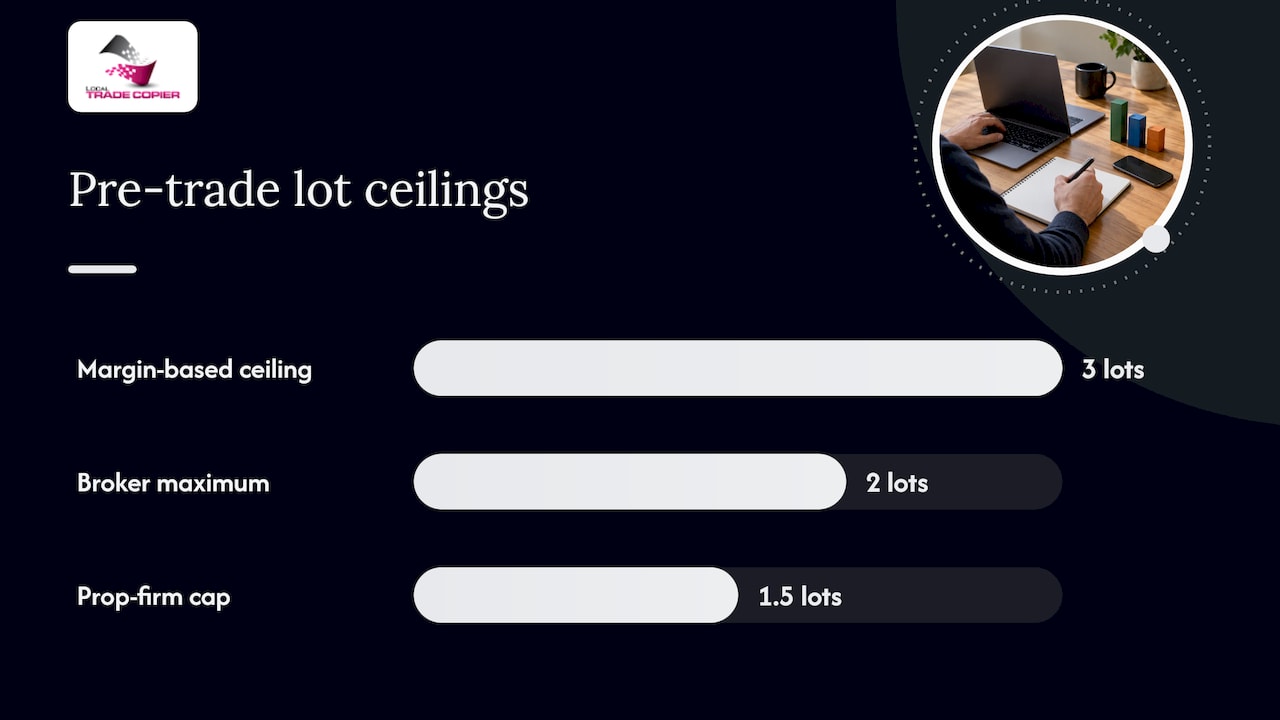
A worked example, using illustrative numbers only: say your account equity is $10,000, leverage is 1:30, and a standard lot on your symbol requires $3,300 in margin. Equity divided by margin per lot gives you three lots as the margin-based ceiling. If your broker’s published maximum order size for that symbol is two lots, and your prop firm’s per-symbol cap is 1.5 lots, the binding constraint is the prop firm’s figure: 1.5 lots, not the three your margin alone would allow. For a practical template on applying a fixed percentage of capital to position sizing, Big Move Algo’s guide to fixed-fractional sizing with ATR walks through a comparable risk-percent approach.
Pro Tip: Run this calculation against the tightest constraint first, then check the others, because starting from the broker maximum and working backward can mask a prop-firm cap you haven’t checked yet.
Before sending the order, verify the four numbers one more time: exchange or federal limit, broker maximum, symbol margin requirement, and prop-firm cap. If any one of them is unclear from the documentation in front of you, treat that as a reason to size down, not a reason to proceed.
Avoiding rejections, rounding errors, and liquidity traps
Most execution failures at the per-symbol level come from a small set of repeatable causes. A platform rejects an order when the requested volume falls outside the step size, exceeds the broker’s maximum, or fails a margin check that didn’t account for an existing hedged position, something MetaTrader’s spread and hedged margin documentation explains in more detail.
Rounding is a quieter source of trouble. Rounding a calculated lot size up to the nearest allowed step can push you past a cap that rounding down would have respected, so the safer convention is always to round down or split the order into smaller pieces that sum to the same intended exposure. Our guide on lot rounding rules for small accounts covers this in more depth, and splitting master trades into multiple client positions is one practical way to stay under a single-order maximum while preserving the economic size of the trade.
A short list of habits that catch most of these problems before they cost you:
- Build a pre-trade check that validates volume against the symbol’s live specification, not a cached one.
- Track aggregate exposure across correlated symbols, not just the single position you’re about to place.
- Test any new sizing logic with a small order before running it at full size.
Pro Tip: Watch exchange notices and open interest figures around contract expiry, since spot-month limits tighten and liquidity can thin out faster than the published cap suggests.
Configuring a trade copier to respect per-symbol caps
Running trades through a locally installed copier adds a layer worth configuring deliberately when per-symbol caps are strict. Because local trade copier software runs entirely on one machine or VPS rather than routing through the cloud, every copied order originates from a single IP address, which matters for prop firms that restrict external routing and often require trades to look like they were placed manually.
A few configuration points are worth checking before copying into an account with tight per-symbol limits:
- Set per-account lot scaling so each client account receives a size appropriate to its own equity, not a flat copy of the master.
- Use symbol filters to exclude instruments where the destination account carries a stricter cap than the source.
- Enable split-position options so a single master trade can be divided to stay under a per-order maximum without changing total exposure.
None of these settings replace reading your broker’s or prop firm’s published rules, but they reduce the chance that a copied trade silently breaches a cap you already know about.
A trader’s checklist before sending a large order
Before any order that pushes close to a symbol’s limit, I run through five checks: the symbol’s margin and lot specification, the broker’s published maximum for that instrument, any prop-firm per-symbol cap, and whether correlated positions elsewhere in the account would push aggregate exposure past a firm’s combined limit. If any one of those checks comes back unclear, the right move is to reduce size or skip the trade entirely, not to assume the platform will catch the mistake for you. Past results do not guarantee future performance, and no calculation here replaces reading your own account’s rules.
— Rimantas
Where Local Trade Copier fits into per-symbol cap management
Checking four layers of rules by hand for every trade gets tedious fast, especially across multiple funded accounts with different caps. Local Trade Copier runs locally on your own machine or VPS, which keeps every copied order on a single IP address, a detail prop firms watching for cloud routing tend to care about.

A few features line up directly with the caps covered above:
- Per-account lot scaling, so each destination account receives a size matched to its own equity and limits.
- Symbol filters, to exclude instruments where a destination account carries a tighter cap than the source.
- Split-order options, for staying under a single-order maximum while keeping total exposure intact.
We offer plans starting with the PERSONAL Plan at €29 per month, with MANAGER and VIP tiers for higher-volume setups. The software copies existing trades and carries no strategy logic of its own, so it assists with respecting the caps you’ve already identified rather than replacing the work of reading your broker’s or prop firm’s documentation. Check our installation guide or watch the demo video to see the configuration options in action before starting a trial.
This article is general information, not a substitute for advice from a qualified financial advisor. Consult a qualified financial professional about your own circumstances before acting on anything here.
FAQ
What is a per symbol trade size cap?
A per symbol trade size cap is the maximum volume you can hold or submit for one instrument, enforced by an exchange or regulator, your broker’s platform, or a prop firm’s house rules. The tightest of these layers is the one that actually governs your order, so checking all four before sizing a trade is the standard practice.
What is the 3-5-7 rule in stock trading?
It is a popular heuristic rather than a regulatory or exchange-mandated rule, so it should be treated as a starting framework, not a fixed standard.
What is the 72 hour rule in stocks?
There is no single, universally recognized “72 hour rule” codified by a major exchange or regulator for stock trading; the phrase is used informally in different contexts, including settlement timing discussions. Traders encountering this term in a specific broker or platform’s documentation should rely on that source’s own definition rather than a general one.
How do I calculate the maximum lot size I can trade on a symbol?
Compute margin per lot using the symbol’s contract size, price, and leverage, then divide account equity by that figure to get a margin-based maximum. Compare that number against your broker’s published order maximum and any prop-firm per-symbol cap, and use the smallest of the three.
Does a trade copier affect per-symbol caps?
A trade copier itself does not change any exchange, broker, or prop-firm cap. What it can do is apply settings like per-account lot scaling and symbol filters so copied orders stay within caps you’ve already identified, which is the role Local Trade Copier is built for.
Sources
- Commodity Futures Trading Commission — Final rulemaking on position limits
- MetaTrader 5 help — margin calculation and hedged margins
- Interactive Brokers — Spot currency minimum/maximum order sizes
- Binance
Recommended
- MT4 Trade Copier limitations with Netting on FIFO accounts
- MT4/MT5 Traders: Avoid 50-Lot Rejections with Max Lot Per Account
- Max Open Trades Copy: What Controls the Limit
- Copying trades with different symbols between MT4 accounts
