

TL;DR:
Effective forex risk management focuses on capital preservation and limiting losses rather than solely seeking winning signals. Proper techniques involve adaptive position sizing, strategic stop placement, and portfolio-level exposure controls to withstand market fluctuations and psychological biases. Automated tools like local trade copiers help enforce consistent risk rules across multiple accounts, supporting long-term profitability and account survival.
Most traders spend months hunting for the perfect entry signal, the ideal indicator combination, or the next high-win-rate strategy. Yet long-term survival and profitability for retail forex traders depends far more on controlling losses than on picking winners. A brilliant strategy with poor risk controls will blow an account. A modest strategy with disciplined risk management can compound steadily for years. This article breaks down exactly how risk management works, why static rules fall short, and how to build a living system that protects your capital when the market turns against you.
Key Takeaways
| Point | Details |
|---|---|
| Preserve trading capital | Robust risk management keeps you in the game and prevents account blow-ups. |
| Go beyond fixed rules | Adaptive frameworks based on market and emotional shifts outperform static risk limits. |
| Effective stop placement | Smart stop-loss settings balance market noise and catastrophic loss prevention. |
| Think portfolio-wide | Managing correlation and total exposure is as important as per-trade rules. |
| Integrate risk and automation | Combining disciplined risk techniques with proper tools boosts consistency and peace of mind. |
Why risk management is the backbone of successful forex trading
Before diving into specific techniques, let’s define why risk management is the foundation that supports everything else in forex trading.
Most traders think about risk in terms of “how much can I make?” rather than “how much can I afford to lose?” That framing alone is a dangerous starting point. The math of trading losses is brutally asymmetric. Lose 50% of your account and you need a 100% return just to break even. Lose 20% and you still need a 25% recovery. Protecting what you already have is always more valuable than chasing the next gain.
Research and practitioner experience consistently confirm that long-term survival and profitability for retail forex traders depends more on limiting losses than on maximizing wins. Catastrophic account blow-ups trace back almost universally to risk control failures, not to strategy logic.
Even the best strategies go through losing streaks. A system with a 60% win rate will still produce runs of five or six consecutive losses on a regular basis. Without defined risk controls, those streaks wipe out weeks or months of gains in a handful of trades. Risk management keeps you in the game long enough for your statistical edge to work.
There is also the psychological dimension. Poor risk controls don’t just drain capital. They drain confidence and decision-making quality. When you lose a large position, the urge to “make it back fast” pulls you toward bigger bets and lower-quality setups. This is how one bad week becomes a blown account. Proper trading discipline and psychology starts with knowing your maximum exposure before you ever click “buy.”
Key reasons risk management is non-negotiable:
- Capital preservation keeps you active. You can’t participate in future opportunities with a zero balance.
- Most blown accounts trace back to risk rule violations, not bad strategy logic.
- Consistent exposure limits reduce emotional volatility, making it easier to follow your plan.
- Risk controls amplify the value of a genuine edge by ensuring you survive long enough to let it play out.
Core principles and mechanics of risk management in forex
With the importance of risk management established, let’s get practical and break down its core moving parts.
Risk management in forex is a system built from four interlocking elements: position sizing, stop-loss placement, risk-to-reward ratios, and portfolio exposure limits. Understanding each one in isolation isn’t enough. They have to work together.
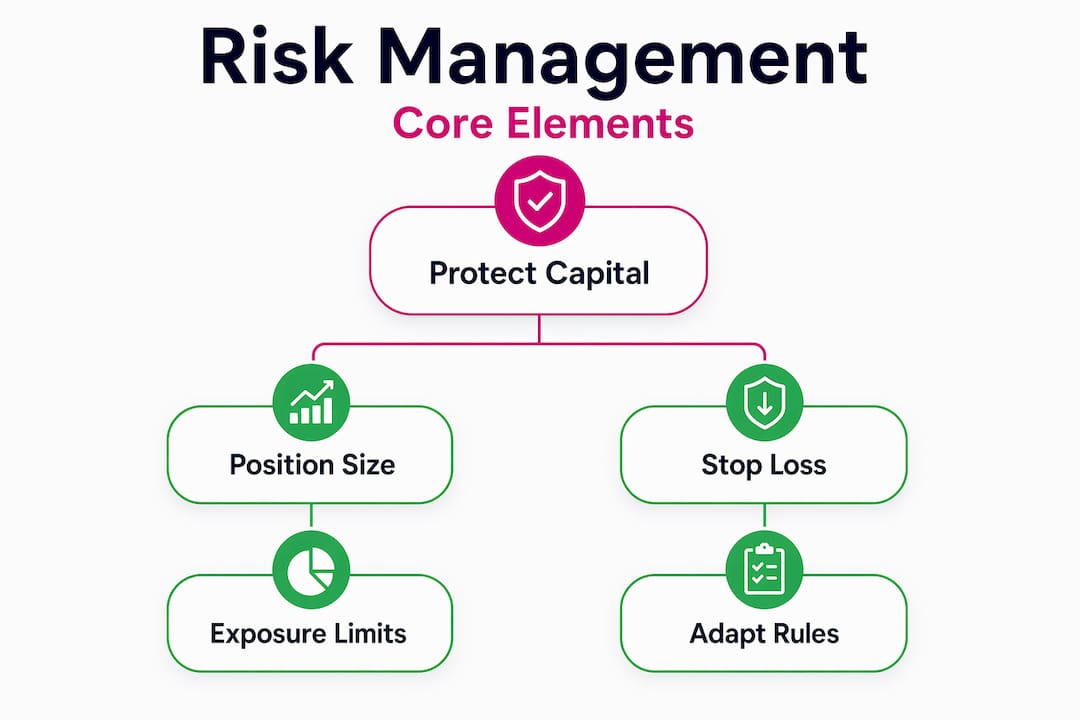
Hierarchy infographic showing forex risk management elements
Position sizing is how you determine the number of lots or units to trade based on the distance to your stop and your maximum dollar risk per trade. If you’re willing to risk $200 on a trade with a 50-pip stop and each pip is worth $10, your maximum lot size is 0.4 lots. This math needs to be automatic, not eyeballed. Getting position sizing right is covered in detail when you think about how to allocate account size correctly across different strategies and instruments.
Stop-loss placement locks in your worst-case outcome before you enter. Without a stop, you’re hoping the market turns around rather than managing risk. Risk-to-reward ratios determine whether your average winner is large enough to offset your average loser. A 1:2 ratio means you only need a 34% win rate to break even. That margin for error matters enormously over hundreds of trades.

Trader setting stop-loss on laptop in kitchen
Portfolio exposure is the one most traders ignore. Managing forex risk across multiple open positions requires understanding correlation. If you’re long EUR/USD, long GBP/USD, and long AUD/USD simultaneously, those aren’t three separate trades. They’re one highly correlated bet on USD weakness. When USD reverses, all three hit their stops at once.
| Risk tolerance | Account size | Max risk per trade | Max open risk | Preferred R:R |
|---|---|---|---|---|
| Conservative | $5,000 | 1% ($50) | 3% ($150) | 1:3 |
| Moderate | $10,000 | 1.5% ($150) | 5% ($500) | 1:2 |
| Aggressive | $25,000 | 2% ($500) | 8% ($2,000) | 1:1.5 |
Steps to set up a basic risk management framework:
- Decide your maximum risk per trade as a percentage of account balance (not equity).
- Calculate position size based on stop-loss distance and per-pip value before every trade.
- Set a daily or weekly maximum drawdown limit. Stop trading when you hit it.
- Check open trade correlations before adding a new position.
- Review your risk-to-reward assumptions monthly against your actual trade log.
- Use hedging strategies where appropriate to offset directional exposure.
- Automate stop-loss placement using stop-loss automation wherever your platform allows.
Pro Tip: Always calculate position size based on your current account balance, not your floating equity. Equity swings with open positions and will cause you to systematically over-size trades during winning streaks and under-size during drawdowns. Balance is the stable number to anchor risk percentages against.
Why static risk controls aren’t enough: Adaptive strategies explained
The basics are essential, but markets and psychology fluctuate, so your risk management system must adjust alongside them.
Here’s the problem with a fixed 1% risk rule: it treats a 10-trade losing streak the same as a 10-trade winning streak. Emotionally and statistically, those are very different situations. Empirical research on retail traders shows that risk-taking behavior changes significantly after gains and losses. Traders tend to become risk-averse after small losses, but dangerously risk-seeking after a run of large gains. A static rule doesn’t account for this shift in psychology or market volatility.
Adaptive risk management means your position sizing and exposure limits respond to recent performance and current market conditions. During a drawdown period or elevated volatility, you reduce size. During a stable, low-volatility regime where your strategy is performing cleanly, you can scale up modestly. This isn’t gambling with your rules. It’s recognizing that a fixed percentage applied blindly ignores context.
| Feature | Static risk management | Adaptive risk management |
|---|---|---|
| Position sizing | Fixed % per trade | Scales with volatility and recent P&L |
| Drawdown response | None | Reduces size after consecutive losses |
| Win streak response | None | Maintains discipline, avoids overconfidence |
| Volatility awareness | Ignored | Incorporated via ATR or similar tools |
| Psychological bias | Unaddressed | Actively countered with rules |
| Long-term survival | Moderate | Significantly improved |
Adaptive risk frameworks allow you to assign different risk percentages to different instruments or time periods, which is a major practical advantage over one-size-fits-all rules.
Pro Tip: Keep a trading log that includes not just trade results, but also your emotional state and recent streak data. If you’ve had three or more consecutive losses, reduce your position size by 25 to 50% until your results stabilize. Review the log weekly. Patterns in your behavior are often the most actionable data you have.
Pairing adaptive rules with automated portfolio rebalancing tools can help enforce these adjustments without relying on willpower in the heat of the moment.
Stop-loss placement and the art of balancing noise with protection
A core tool for risk control is the humble stop-loss. Yet most traders misuse it. Here’s how to get it right.
Stop placement is a precise skill that requires balancing two opposing risks: stops too tight get clipped by normal price noise before your thesis plays out; stops too wide allow losses to grow larger than necessary when you’re simply wrong. Neither extreme is safe.
The right approach uses market structure, not arbitrary pip counts. Place stops beyond a meaningful level, such as a recent swing high or low, a key support/resistance zone, or beyond the average true range of the pair. This way, a stop trigger means the market has genuinely invalidated your trade idea, not just moved randomly.
Signs your stop placement is hurting your results:
- You’re stopped out on more than 40% of winning setups before price moves in your direction.
- Your stop distance doesn’t account for typical daily range on the pair you’re trading.
- You move stops wider after entry because price is getting close. That’s a red flag.
- You use round-number pip counts like 20 or 50 pips with no structural reasoning.
- You avoid using stops entirely on some trades because “it looks too good to lose.”
Stops that are too tight don’t cause a single blowup. They bleed a trader slowly, trade after trade, each stop-out eroding confidence and capital in equal measure. That accumulated damage often sets up the one catastrophic risk decision that finally destroys the account.
A systematic approach beats gut-feel every time. Connecting your stop-loss automation tools to your entry logic ensures stops are placed consistently rather than adjusted emotionally. You should also build stop-loss best practices into your pre-trade checklist so that every position has a defined exit before it’s opened. Tools that support automating trade exits can further enforce this discipline at scale.
Portfolio-level risk: Beyond individual trades
Risk management doesn’t end with individual trades. Let’s zoom out to see how portfolio-level rules protect your entire account.
Single-trade risk controls are necessary but not sufficient. Retail traders using structured risk-first frameworks need to account for portfolio-level exposure, volatility regimes, and event risk in addition to per-trade rules. This is especially critical for account managers running multiple client accounts simultaneously.
Correlated exposure is the hidden multiplier most retail traders underestimate. If six of your eight open trades are long on commodity currencies and commodity prices drop sharply, you’re not experiencing six 1% losses. You’re experiencing one concentrated, correlated shock that could hit 6% or more at once.
Event risk is equally dangerous. Overnight gaps from central bank announcements, geopolitical shocks, or weekend gaps can jump past your stops entirely. A Friday close with heavy exposure is a fundamentally different risk environment than a mid-week daytime position.
Practical steps for portfolio-level risk control:
- Set a maximum total open risk limit, such as no more than 6 to 8% of account capital across all trades simultaneously.
- Use a correlation matrix to identify which pairs move together before adding positions.
- Cut exposure before major news events like Non-Farm Payrolls, central bank decisions, or CPI releases.
- Close or hedge positions before weekends if you’re holding anything with significant overnight gap risk.
- Separate your trading into buckets: trend trades, range trades, and counter-trend trades. Each bucket should have its own maximum exposure allocation.
These are account management best practices that institutional desks apply as standard procedure. Retail traders who adopt them dramatically improve their consistency. Combining this approach with portfolio diversification strategies adds another layer of structural resilience.
What most forex traders get wrong about risk management
Having explored practical systems, let’s challenge some popular beliefs about risk and what really makes traders last in forex.
Here’s the uncomfortable truth: most traders treat risk management as a constraint rather than an edge. They follow the 1% rule because they’ve heard it repeated enough times, then spend the rest of their energy chasing the perfect strategy, the cleanest chart pattern, or the most accurate indicator. The assumption is that risk management is the boring guardrail, and strategy is where real performance comes from.
That assumption is backwards. We’ve seen traders with statistically unremarkable entry systems outperform sophisticated strategy users for one reason: they treat their risk system as a living, evolving framework, not a static rule set that gets checked once and forgotten. They review their exposure weekly. They adjust their per-trade risk after losing streaks. They use the position trading mindset that prioritizes staying in the game over scoring on any individual trade.
The traders who blow up aren’t usually the ones with bad strategies. They’re the ones who had a great strategy, hit a rough patch, and let their risk controls slip under emotional pressure. They widened stops. They added to losing positions. They doubled size to “recover faster.” Every one of these behaviors is a risk management failure, not a strategy failure.
True outperformance in forex comes from adaptive, psychologically-aware risk management that is tuned to your personal behavior patterns and the current market regime. That’s not a comfortable message for people who prefer to believe in magic indicators. But it’s the reality that separates the traders who last from those who don’t.
Take control of your forex risk management with the right tools
Ready to put these strategies into practice? Here’s how to integrate proven risk controls with the help of powerful technology.
Understanding risk management is one thing. Executing it consistently across multiple accounts, time zones, and market conditions is another challenge entirely. Manual re-entry across terminals introduces human error at exactly the moment when precision matters most.

Local Trade Copier is built for traders and account managers who need their risk rules enforced automatically across MetaTrader 4, MetaTrader 5, and DXTrade accounts. With execution speeds of 1 second or faster under normal market conditions, eight money management modes, and automatic lot scaling per account balance, every trade that fires on your master account replicates instantly to client or secondary accounts with the correct position size already calculated. Explore how automated stop-loss execution works within the platform, and review how forex account protection through VPS and secure configurations keeps your entire setup locked down. Start your 7-day free trial and run your risk management system the way it was designed to work.
Frequently asked questions
What is the main goal of risk management in forex trading?
The main goal is to protect your trading capital so you can survive losing streaks and let your strategy’s long-term edge play out. As research confirms, long-term survival and profitability depend on limiting catastrophic losses, not maximizing individual wins.
How much should I risk per forex trade?
Many experts suggest risking no more than 1 to 2% of your trading capital per trade, but the ideal amount adapts based on market conditions and your current account size. Effective risk mechanics treat percentage risk as a starting point, not an unchangeable rule.
Why do traders blow up their accounts despite having a profitable strategy?
Traders typically ignore risk controls or let emotions override their plan under pressure, leading to oversized losses that compound quickly. Catastrophic account blow-ups most often trace back to risk rule violations, not the strategy itself being flawed.
How does correlation affect risk in a forex trading portfolio?
High correlation means multiple positions effectively move as one, concentrating risk beyond what individual position sizing controls can contain. Exposure limits and diversification at the portfolio level are the correct tools to address this problem.
Can automated tools improve my forex risk management?
Yes, automation enforces risk rules consistently and executes exits at the exact moment needed, removing emotional hesitation from the equation. For traders managing multiple accounts, automation is not optional but essential for maintaining discipline at scale.
Recommended
- Most Effective Strategies for Managing Risk in Forex Trading | Trade Copier for MT4 & MT5
- Hedging Strategies: Mitigating Risks in Forex | Trade Copier for MT4 & MT5
- A Forex Trade Management Strategy To Get More Profit
- Master forex trading terms for efficient account management
