

TL;DR:
- Portfolio diversification involves spreading investments across different assets, industries, and regions to reduce unsystematic risk. It focuses on risk management rather than maximizing returns by blending assets with low correlation to offset potential losses. Maintaining true diversification requires monitoring correlations and adjusting positions as market conditions evolve.
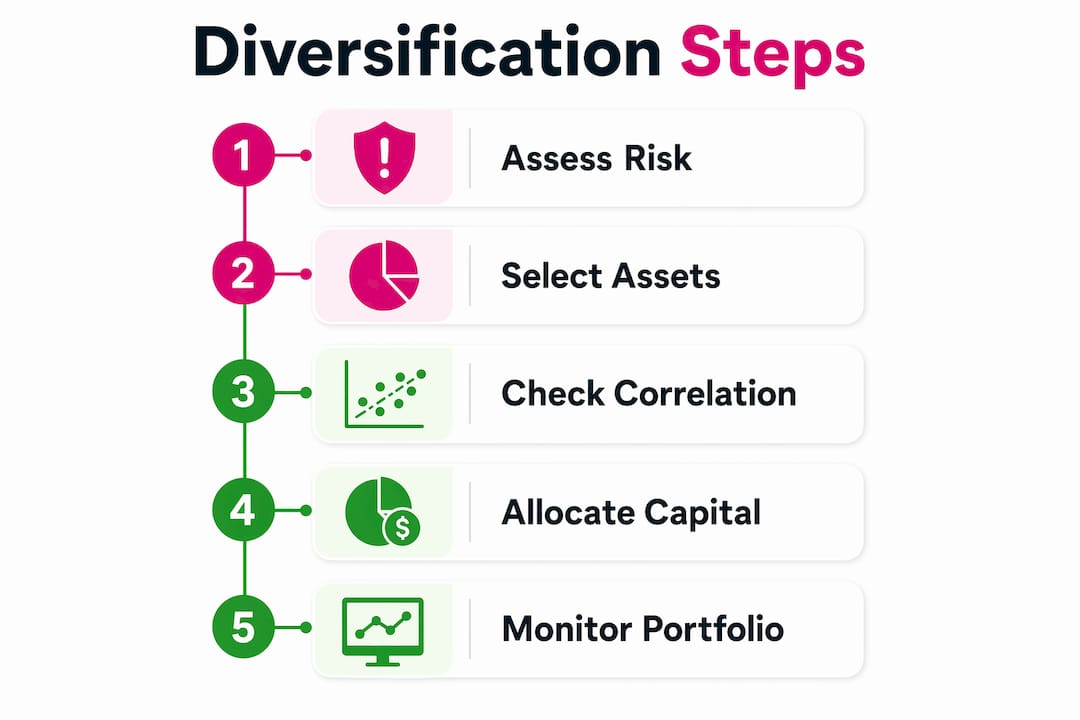
Portfolio diversification is defined as the practice of spreading investments across different asset classes, industries, and geographies to reduce unsystematic risk. Its primary goal is to limit portfolio volatility and reduce the impact of market downturns, not to maximize returns. Every serious investor needs to understand this distinction before building any portfolio. Diversification is risk management first, return optimization second. This guide covers the core concept, the key dimensions of diversification, how algorithmic trading portfolios apply these principles, and how to measure and maintain diversification over time.
What is portfolio diversification and why does it matter?
Portfolio diversification, known in formal investment theory as asset allocation across uncorrelated holdings, works because different assets react differently to the same economic event. When equities fall during a recession, government bonds often rise. When domestic markets struggle, international markets may hold steady. Mixing asset classes blends equities, bonds, real estate, alternatives, and geographic exposures to reduce the risk of catastrophic losses over long horizons.
The core logic is simple. No single economic shock should be able to doom your entire portfolio. If every holding moves in the same direction at the same time, you are not diversified regardless of how many positions you hold. True diversification means blending assets and strategies so that losses in one area are offset, or at least not amplified, by losses in another.
Diversification does not eliminate risk entirely. Systematic risk, the kind that affects all markets simultaneously such as a global financial crisis, cannot be diversified away. What diversification removes is unsystematic risk: the company-specific, sector-specific, or region-specific shocks that hit one part of your portfolio while leaving the rest intact.
What are the main asset classes and diversification dimensions?
A well-diversified portfolio draws from multiple asset classes, each behaving differently under varying economic conditions. The major categories are:
- Equities (stocks): Ownership stakes in companies. High long-term return potential with higher short-term volatility.
- Fixed income (bonds): Debt instruments that pay regular interest. Generally lower volatility than equities and often inversely correlated during market stress.
- Real estate: Physical property or REITs (Real Estate Investment Trusts). Provides income and inflation protection.
- Cash and cash equivalents: Money market funds, Treasury bills. Lowest return but highest liquidity and stability.
- Alternatives: Commodities, hedge funds, private equity, and forex strategies. Often have low correlation to traditional assets.
Diversification within each asset class matters just as much as diversification across them. Within equities, you diversify by sector (technology, healthcare, energy), by market capitalization (large-cap, mid-cap, small-cap), and by geography (U.S., European, emerging markets). A portfolio holding only U.S. large-cap technology stocks is not diversified, even if it holds 50 different companies.
Geographic diversification adds another layer of protection. Developed markets like the U.S. and Germany behave differently from emerging markets like Brazil or Vietnam. Adding international exposure reduces your dependence on any single country’s economic cycle.

Your time horizon and risk tolerance shape how you allocate across these dimensions. A 30-year-old investor can hold a higher equity weighting than a retiree drawing income from the portfolio. Risk tolerance is personal, but the principle of diversifying across asset classes applies regardless of age or account size.
Pro Tip: Check the correlation between your holdings, not just the number of positions. Holding 10 technology stocks is less diversified than holding 5 stocks across 5 different sectors.
How do EA portfolios apply diversification principles?
Algorithmic trading portfolios, built from Expert Advisors (EAs) running on platforms like MetaTrader 4 or MetaTrader 5, require the same diversification logic applied with greater precision. An EA portfolio that runs five strategies all trading EUR/USD on the 1-hour chart is not diversified. The strategies may look different on paper but behave identically in the market.
EA portfolio diversification should cover four distinct axes:
- Strategy type: Trend-following, mean-reversion, breakout, and carry strategies each perform differently across market regimes. Mixing them reduces the chance that all strategies lose simultaneously.
- Asset class: Spread EAs across forex pairs, indices, commodities, and other instruments. EUR/USD and gold often move independently, which is exactly what you want.
- Timeframe: A scalping EA on the 5-minute chart and a swing EA on the daily chart will rarely open trades at the same time or for the same reasons.
- Trading session: Strategies active during the Asian session behave differently from those active during the London or New York session.
Experts recommend starting with a single strategy on a demo account for 2–3 months before adding uncorrelated strategies. This gives you real performance data to compare before committing capital.
Risk allocation across strategies is where most traders make a critical mistake. Equalizing nominal trade sizes across strategies with different volatility leads to unbalanced risk exposure. A high-volatility strategy trading with the same lot size as a low-volatility strategy will dominate portfolio risk. Risk-based position sizing, allocating a uniform percentage of equity risk per trade rather than equal lots, keeps each strategy’s contribution balanced. Past results do not guarantee future performance.
Margin management is equally critical. Margin requirements for portfolios running multiple EAs should be at least three times the sum of all strategies’ margin demands to prevent liquidation under volatility. For example, a total margin demand of $700 across all active strategies requires at least $2,100 in account balance for safety.
Pro Tip: Never assume two EAs are uncorrelated just because they trade different pairs. Run them on a demo account simultaneously and compare their daily P&L before going live.
What quantitative methods measure true diversification?
Intuition fails when measuring diversification. Two strategies that look completely different can be highly correlated in practice. Quantitative analysis removes the guesswork.
Correlation is the key metric. Correlation between daily P&L of strategies is a better measure of diversification than comparing individual trades, which occur at different times. Correlation values range from -1 (strategies move in exactly opposite directions) to +1 (strategies move identically). A value near zero means the strategies are genuinely independent.
| Correlation range | What it means | Action |
|---|---|---|
| Above +0.8 | Strategies are nearly identical | Remove one or replace it |
| +0.3 to +0.8 | Partial overlap in behavior | Reduce allocation to both |
| -0.3 to +0.3 | Genuinely uncorrelated | Ideal for portfolio inclusion |
| Below -0.3 | Negatively correlated | Valuable hedge, use carefully |
Portfolio construction aims for all pairwise correlations below 0.3 to maximize diversification benefit. Correlations above ±0.8 indicate strategies that are almost identical in behavior, even if they use different logic on paper.
A correlation matrix is the standard tool for this analysis. You build it by collecting daily P&L data for each strategy over the same period, then calculating pairwise correlations across all combinations. Software tools that generate correlation matrices from trading history make this process practical for individual traders.
One important caveat: correlations change during market stress. Assets and strategies that appear uncorrelated in normal conditions often move together during a crisis. This is why diversification reduces risk but does not eliminate it. Build your portfolio assuming correlations will rise during the worst market conditions, and size your risk accordingly.
Pro Tip: Use at least 6 months of daily P&L data when calculating correlations. Shorter windows can produce misleading results that overstate diversification.
How to practically manage a diversified portfolio over time?
Building a diversified portfolio is a starting point, not a finished product. Markets change, correlations shift, and individual strategies drift in performance. Active management keeps diversification working.
Key practices for maintaining a diversified portfolio include:
- Set portfolio-wide risk limits. Define the maximum drawdown you will tolerate across the entire portfolio before pausing all activity. Portfolio-wide daily loss limits or “kill switches” prevent aggregate drawdowns from compounding when running multiple independent strategies. This is a non-negotiable control for any multi-strategy setup.
- Rebalance periodically. Over time, winning strategies grow larger and losing strategies shrink, which distorts your original risk allocation. Rebalancing restores target weights and prevents any single strategy or asset from dominating portfolio risk.
- Monitor correlations regularly. Recalculate your correlation matrix every quarter. A pair of strategies that scored 0.2 six months ago may now score 0.7 if market conditions have changed. Act on what the data shows, not what you assumed at setup.
- Review holistic performance. Portfolio success depends on viewing total performance as a whole instead of fixating on individual strategy results. One strategy underperforming while the portfolio holds steady is the system working as designed.
- Use equity tracking tools. Monitoring aggregate equity across all accounts gives you a real-time view of portfolio health. Individual account monitors miss the combined picture.
For traders running diversified forex portfolios, the practical challenge is executing risk controls consistently across multiple accounts and platforms. Manual monitoring across several terminals creates gaps. Automated tools that track portfolio-wide equity and enforce drawdown limits close those gaps reliably.
One underappreciated mistake is treating each strategy’s stop loss in isolation. A 5% drawdown limit on each of five strategies does not cap your portfolio drawdown at 5%. If all five strategies hit their limits simultaneously during a correlated market shock, you face a 25% portfolio drawdown. Portfolio-level controls are the only reliable defense. You can learn more about managing risk across strategies with approaches built specifically for multi-strategy setups.
Key Takeaways
Effective portfolio diversification requires low correlation between holdings, risk-based position sizing, and portfolio-wide drawdown controls to reduce unsystematic risk without eliminating it.
| Point | Details |
|---|---|
| Core definition | Diversification spreads capital across uncorrelated assets and strategies to limit unsystematic risk. |
| Correlation threshold | Keep all pairwise correlations below 0.3 to achieve genuine diversification benefit. |
| Risk-based sizing | Allocate equal equity risk per strategy, not equal lot sizes, to balance portfolio risk contribution. |
| Margin safety rule | Maintain account balance at least three times the total margin demand of all active strategies. |
| Portfolio-wide controls | Set aggregate drawdown limits and use kill switches to prevent compounding losses across strategies. |
Why most traders think they are diversified but are not
The most common mistake I see is traders counting positions instead of measuring correlations. A trader running eight EAs across four forex pairs feels diversified. Then a major central bank announcement hits, all four pairs move in the same direction, and every EA loses simultaneously. That is not diversification. That is concentration with extra steps.
The second mistake is obsessing over individual strategy performance. I have watched traders shut down a perfectly good mean-reversion EA because it had three losing weeks, not realizing it was the only strategy in the portfolio that held steady during the previous trend-following drawdown. When you view each strategy in isolation, you lose the entire point of building a portfolio.
Risk-based sizing is where the real work happens. Equal lots sound fair, but they are not. A high-volatility breakout EA trading 0.1 lots carries three times the risk of a low-volatility carry EA at the same lot size. The math does not care about your intentions. Allocate by risk, not by lot size.
One insight that changed how I think about EA portfolios: average but truly uncorrelated strategies improve the portfolio more than brilliant but correlated ones. You do not need the best strategy. You need strategies that do not move together. That realization shifts the entire selection process from chasing performance to measuring independence. Beginners often make the opposite mistake, and common investing errors like chasing recent winners apply directly here.
Diversification reduces risk. It does not eliminate it. Build your portfolio with that caveat front and center, and you will make better decisions when markets behave badly.
— Rimantas
Running a diversified EA portfolio with Mt4copier
Designing a diversified multi-strategy portfolio is one challenge. Executing it cleanly across multiple accounts is another.

Mt4copier is a locally installed trade copier that replicates trades from a single master account to multiple client accounts across MetaTrader 4, MetaTrader 5, and DXTrade, with sub-0.5-second execution and no cloud routing. For traders running diversified EA setups, Mt4copier supports different risk settings per symbol, which means you can apply the risk-based sizing principles covered in this guide directly at the account level. All trade data stays on one machine, one IP address, with no external server latency. Mt4copier has served 3,000+ users since 2010 and carries 491 Trustpilot reviews. A 7-day free trial is available with no commitment required.
FAQ
What is portfolio diversification in simple terms?
Portfolio diversification means spreading your money across different assets, sectors, and regions so that a loss in one area does not wipe out your entire portfolio. Its primary goal is to reduce unsystematic risk, not to maximize returns.
How many assets do you need for a diversified portfolio?
There is no fixed number, but the quality of diversification depends on correlation, not count. Ten holdings with low pairwise correlations provide better diversification than 50 holdings that all move together.
What correlation level indicates true diversification?
Pairwise correlations below 0.3 between portfolio components indicate genuine diversification benefit. Correlations above 0.8 signal that two strategies or assets are behaving almost identically and should not both be held.
How does EA portfolio diversification differ from standard investing?
EA portfolio diversification applies the same correlation and risk-allocation principles but adds axes specific to algorithmic trading: strategy type, trading timeframe, and session. Risk-based position sizing replaces equal lot sizing to balance each strategy’s contribution to portfolio risk.
Does diversification eliminate investment risk?
Diversification eliminates unsystematic risk, the company-specific or sector-specific shocks that hit one part of a portfolio. It does not eliminate systematic risk, which affects all markets simultaneously. Past results do not guarantee future performance.
Recommended
- Many-To-One Portfolio™ Framework (Merging Multiple Systems)
- Risk management in trading: Strategies that actually work
- Prop trading best practices: Multi-account copying in 2026
