

TL;DR: Forex compliance involves regulatory obligations that protect client funds, prevent financial crime, and ensure fair markets. Regulations such as capital reserves, client fund segregation, leverage caps, and anti-money laundering procedures vary across jurisdictions, with stricter enforcement in top-tier regions; offshore brokers often lack such protections. Automation and clear verification of a broker’s legal entity are essential for traders to ensure safety, while compliance frameworks ultimately serve as a crucial foundation for secure and legitimate market participation.
Forex compliance is defined as the set of regulatory and procedural obligations that brokers and traders must follow to participate legally and ethically in currency markets. The role of compliance in forex is to enforce rules that protect client funds, prevent financial crime, and maintain fair market conditions. Key mechanisms include Know Your Customer (KYC) and Anti-Money Laundering (AML) procedures, leverage restrictions, and mandatory reporting. Regulators such as the Financial Conduct Authority (FCA) in the UK, the Commodity Futures Trading Commission (CFTC) in the US, and the European Securities and Markets Authority (ESMA) in the EU set and enforce these standards. For traders and brokers alike, understanding these frameworks is not optional. It is the foundation of safe market participation.
What are the core regulatory requirements in forex compliance?

Close-up of hands holding regulatory papers
Forex regulatory frameworks share several non-negotiable requirements, regardless of jurisdiction. Capital adequacy rules require brokers to hold minimum reserves. Client fund segregation mandates that trader deposits stay in accounts legally separate from broker operating capital. The FCA requires segregated accounts to protect client deposits if a broker becomes insolvent. This means your money cannot be used to pay a broker’s creditors.
Leverage caps are another defining feature of regulated markets. Under ESMA and FCA rules, major pair leverage is capped at 30:1, minor pairs at 20:1, and a mandatory 50% margin close-out rule applies automatically. These limits exist because retail traders consistently lose money when over-leveraged. Understanding how to manage leverage on MT4 within these regulatory boundaries is a practical skill every trader needs.
Jurisdiction comparison: EU, UK, US, and offshore
Different regulators take meaningfully different approaches to enforcement and trader protection.
| Jurisdiction | Regulator | Leverage cap (majors) | Key protection |
|---|---|---|---|
| European Union | ESMA | 30:1 | Negative balance protection |
| United Kingdom | FCA | 30:1 | Client fund segregation, FSCS coverage |
| United States | CFTC / NFA | 50:1 | FIFO rule, no hedging |
| Australia | ASIC | 30:1 | Margin close-out rules |
| Offshore (e.g., Vanuatu) | None or minimal | Unlimited | No guaranteed protections |
The enforcement gap between top-tier and offshore regulators is significant. FCA fines exceeded GBP 199 million in 2022/23 alone, with active license revocations for compliance failures. Offshore jurisdictions rarely impose comparable consequences, which is precisely why they attract brokers looking to avoid oversight.
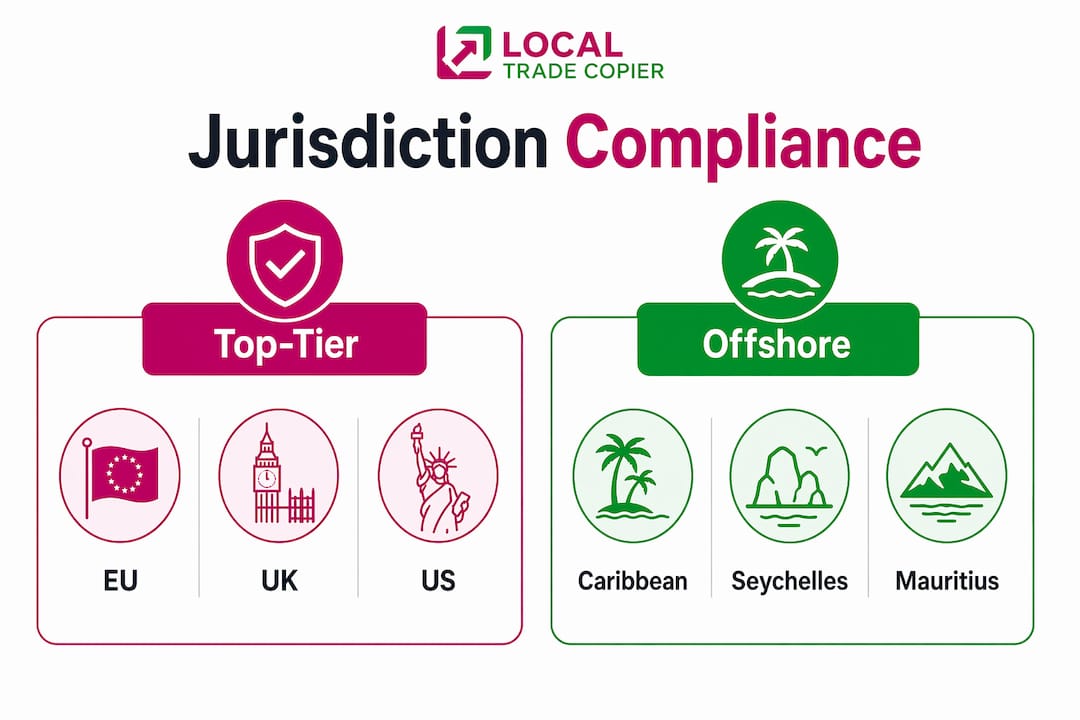
Infographic comparing top-tier vs offshore forex compliance
KYC and AML mandates require brokers to verify client identity before account opening and to monitor transactions for suspicious patterns. These procedures are not bureaucratic formalities. They are the primary defense against money laundering and fraud in a market that processes trillions of dollars daily.
How do forex brokers implement and manage compliance programs?
Broker compliance programs are operational systems, not just policy documents. The most effective programs combine automated workflows with human oversight across every client-facing process.
Here is how a well-structured broker compliance program works in practice:
- Automated KYC onboarding. Brokers use identity verification APIs to check government-issued IDs, screen against sanctions lists, and confirm proof of address in real time. This replaces manual document review that historically caused delays and errors.
- AML transaction monitoring. Automated systems flag unusual deposit patterns, rapid fund movements, or accounts with activity inconsistent with stated trading purposes. Human compliance officers then review flagged cases.
- Introducing broker (IB) management. Multi-jurisdiction brokers must segment IBs by regulatory entity, applying specific commission models and onboarding workflows per region. Cross-border referrals trigger separate compliance obligations that many brokers underestimate.
- Commission and inducement disclosure. Under MiFID II and FCA rules, brokers must disclose all payments to third parties, including IBs and affiliates, that could influence client recommendations. Failure to disclose is a direct compliance violation.
- Record-keeping and audit readiness. Regulators require brokers to retain client communications, trade records, and compliance decisions for defined periods. Audit-ready record systems are a prerequisite for license retention, not an afterthought.
Pro Tip: When evaluating a broker, request their specific regulatory entity name, not just the brand name. A single forex brand may operate multiple legal entities under different regulators, and your protections depend entirely on which entity holds your account.
This point matters more than most traders realize. Different legal entities under one brand can offer dramatically different levels of investor protection and recourse. A broker’s marketing may highlight FCA regulation while routing your account through an offshore subsidiary.
Why compliance matters for forex traders and how it protects you
Compliance frameworks exist primarily to protect retail traders, who are structurally disadvantaged in currency markets. The evidence for this is direct: 70 to 80% of retail traders lose money, with over-leverage identified as a primary cause. Regulatory leverage caps are a direct response to this pattern. Past results do not guarantee future performance, but the structural risk of unregulated leverage is well-documented.
The practical protections compliance provides include:
- Fund segregation. Your deposits cannot be used to cover broker operating costs or pay other creditors in insolvency.
- Negative balance protection. Under ESMA rules, you cannot lose more than your account balance, even in extreme market moves.
- Margin close-out rules. Positions are automatically closed at 50% margin equity, preventing runaway losses.
- Dispute resolution. Regulated brokers are subject to formal complaint procedures and, in the UK, Financial Ombudsman Service oversight.
- Regulatory recourse. If a regulated broker fails, compensation schemes like the UK’s Financial Services Compensation Scheme (FSCS) may cover losses up to defined limits.
Trading with an unregulated broker removes every one of these protections. A significant share of retail forex trading still occurs with unregulated brokers, exposing those traders to higher risk from over-leveraging and poor execution practices. That represents a large portion of the market operating without any formal safety net.
Regulation provides a legal shield, but it doesn’t guarantee execution quality: traders still need to monitor spreads and slippage personally, regardless of a broker’s regulatory status. Verifying a broker’s exact regulated entity rather than relying on brand marketing is the single most important compliance check a trader can perform before depositing funds.
How technology and automation transform forex compliance workflows
Automation has fundamentally changed how brokers meet their compliance obligations. The shift from manual to automated compliance is not incremental. It is structural.
Automating KYC and AML workflows can reduce broker onboarding times by up to 80% and significantly lowers exposure to the regulatory fines that continue to affect firms across the industry. That 80% reduction translates directly into faster client activation and lower operational cost per account. Setup costs for compliant automation platforms have fallen substantially in recent years, putting modern compliance tooling within reach for brokers of all sizes.
Modern compliance technology covers several critical functions:
- Identity verification APIs that cross-reference government databases, PEP (Politically Exposed Person) lists, and sanctions registries in seconds.
- AI-powered AML monitoring that detects transaction patterns associated with layering, structuring, or other money laundering techniques faster than any manual review process.
- Integrated compliance platforms that unify KYC, AML, reporting, and audit trails in one system, reducing the risk of gaps between departments.
- Automated reporting tools that generate regulatory submissions in the format required by specific jurisdictions, reducing manual error.
Manual KYC processes cause errors and delays that increase AML risk and slow client onboarding. For brokers operating across multiple jurisdictions, the compliance burden of manual processes is simply not sustainable at scale. Automation is not a luxury in 2026. It is the baseline for operating a compliant multi-jurisdiction brokerage. You can explore how compliance automation tools are structured across the fintech industry to understand what a modern compliance stack looks like.
Common compliance challenges in forex and how to navigate them
Compliance failures in forex typically fall into predictable categories. Knowing them in advance is the most direct way to avoid them.
Multi-jurisdiction complexity is the most common structural challenge. A broker licensed in the EU, UK, and Australia faces three distinct sets of rules for onboarding, leverage, reporting, and IB management. What is compliant in one jurisdiction may be prohibited in another. Brokers that apply a single global template to all clients routinely create compliance gaps.
Incomplete disclosures are a persistent problem, particularly around IB commissions and order execution models. MiFID II and FCA rules require explicit disclosure of any payment that could influence how a client is directed or advised. Many brokers bury these disclosures in terms and conditions that clients never read.
Insufficient IB supervision creates liability for brokers even when the IB is technically an independent business. If an IB makes misleading claims to recruit clients, the broker can face regulatory action for inadequate oversight. Jurisdiction-specific onboarding and commission models for each IB relationship are the correct structural response.
Pro Tip: Before opening a live account, search the regulator’s public register for the broker’s exact legal entity name. Confirm the license is active, check for any past enforcement actions, and verify which products and client types the license covers.
For brokers building compliance frameworks, the practical steps are straightforward: implement automated KYC from day one, assign a dedicated compliance officer per regulatory jurisdiction, conduct quarterly audits of IB activity, and maintain a complete audit trail for every client interaction. Algorithmic trading tools that operate within defined parameters also reduce the risk of execution-level compliance breaches by removing discretionary human error from the trade process.
Key takeaways
Forex compliance is the structural foundation that separates legitimate market participation from unprotected, high-risk trading, and ignoring it exposes both traders and brokers to serious financial and legal consequences.
| Point | Details |
|---|---|
| Compliance defines safe trading | KYC, AML, leverage caps, and fund segregation are the core mechanisms that protect retail traders. |
| Jurisdiction determines protection | FCA and ESMA-regulated accounts carry legal protections that offshore accounts do not provide. |
| Automation is now standard | Automated KYC/AML cuts onboarding by up to 80% and reduces fine exposure for brokers. |
| Verify the exact regulated entity | Brand-level regulation claims can be misleading. Always confirm which legal entity holds your account. |
| Unregulated brokers carry real risk | A significant share of retail forex trading occurs with unregulated brokers, removing all formal safety net protections. |
Why compliance is the competitive edge most traders overlook
Many traders spend weeks optimizing entry signals and almost no time verifying who holds their money. That imbalance is common, and it can cost traders real capital.
Compliance frameworks are not perfect. Regulation limits structural risk but does not prevent brokers from internalizing order flow. An A-Book versus B-Book execution model is a separate analysis from whether a broker is regulated. A fully FCA-regulated broker can still run a B-Book model where the broker profits from client losses. Compliance status tells you about legal protections. It does not tell you about execution quality or conflict of interest.
The automation shift has also changed the compliance burden for smaller brokers. Compliance platform setup costs that were once prohibitive have come down significantly as modular APIs and SaaS compliance tools have matured. Brokers that invest in this infrastructure early tend to onboard clients faster, face fewer enforcement actions, and attract traders who know what to look for.
For traders, the practical takeaway is straightforward: treat compliance verification as part of the pre-trade checklist, not an afterthought. Check the public register, confirm the entity, and read the execution policy. Regulation is a floor, not a ceiling. Traders who understand that distinction operate with a clearer picture of their actual risk.
Trade smarter with tools built for compliant forex operations
Running a compliant trading operation means more than choosing a regulated broker. It also means using tools that keep your trade data secure and your execution reliable.
Mt4copier is a locally installed trade copier that replicates trades across MetaTrader 4, MetaTrader 5, and DXTrade accounts entirely on your own Windows machine or VPS. No cloud routing means no external server exposure and no third-party data handling. All trade data stays on one machine, one IP address. For prop firm traders and account managers who need clean, on-machine execution, that architecture matters. Mt4copier has served 3,000+ traders since 2010, with trade execution in 1 second or faster under normal market conditions. If you manage multiple accounts and want to understand how stop loss and take profit handling works within the copier, that page covers the exact mechanics.
FAQ
What is the role of compliance in forex trading?
Forex compliance is the system of regulatory rules and internal procedures that brokers and traders follow to operate legally and ethically. It covers KYC/AML verification, leverage limits, client fund segregation, and transaction monitoring.
Why does forex compliance matter for retail traders?
Compliance frameworks protect retail traders through fund segregation, negative balance protection, and formal dispute resolution. Without them, traders have no legal recourse if a broker fails or acts fraudulently.
What regulators oversee forex compliance?
The primary regulators are the FCA in the UK, ESMA in the EU, the CFTC and NFA in the US, and ASIC in Australia. Each sets specific rules for leverage, capital requirements, and client protections within their jurisdiction.
How can traders verify a broker’s compliance status?
Search the regulator’s public register using the broker’s exact legal entity name, not the brand name. Confirm the license is active and check for any past enforcement actions before depositing funds.
What are the biggest compliance challenges in forex?
Multi-jurisdiction complexity, incomplete IB disclosures, and manual KYC errors are the most common compliance failures. Automation and jurisdiction-specific onboarding workflows are the most direct solutions for brokers managing these risks.
Recommended
- Essential Forex Trading Rules Every Beginner Needs
- Secure Forex Trade Workflow: Your 2026 Practical Guide
