

TL;DR:
- Trading resource optimization involves systematically managing capital, costs, time, and risk to maximize trading performance within strict limits. Implementing cost reductions, optimizing trade exits, enforcing risk controls, and automating workflows significantly enhance efficiency and survivability. Focusing on these controllable areas creates a solid foundation for strategy refinement and long-term trading success.
Most traders spend months refining entry signals while barely touching the costs eating their account every week. What is trading resource optimization? It’s the discipline of managing capital, execution costs, time, and risk systematically so your trading operation runs at peak efficiency regardless of market conditions. Unlike strategy tweaking, cost optimization is guaranteed and permanent. This article walks you through every major dimension of trading resource optimization, from cutting execution costs to automating workflows, with practical techniques you can apply immediately.
Key Takeaways
| Point | Details |
|---|---|
| Resources extend beyond capital | Trading resources include execution costs, time, risk capacity, and data quality, not just account balance. |
| Cost savings are guaranteed | Switching to raw-spread accounts and using limit orders delivers immediate net P&L improvement without strategy changes. |
| Exits control your results | Data-driven exit analysis often reveals that holding positions past 60 minutes significantly reduces efficiency. |
| Risk layering protects capital | A three-tier system of per-trade limits, daily loss caps, and portfolio drawdown triggers prevents cascading losses. |
| Automation reduces waste | Trade copying and workflow automation cut manual errors and synchronize execution across accounts with sub-second speed. |
What is trading resource optimization
Trading resource optimization is the structured process of identifying, allocating, and managing every input your trading operation consumes so that you extract maximum performance from each unit of capital, time, and risk exposure. The concept comes directly from constrained optimization in finance. Financial firms balance costs, risks, and position limits simultaneously to support sustainable growth through systematic modeling and monitoring.
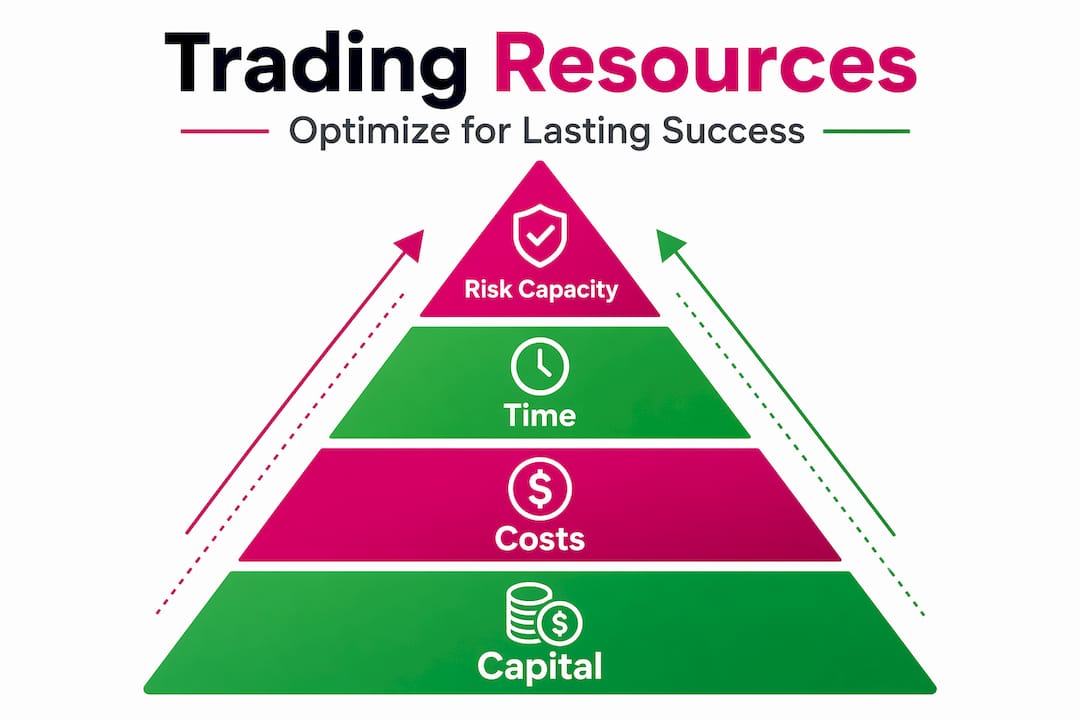
Your trading resources fall into four distinct categories:
- Capital: The cash in your account and how it is allocated across open positions at any given moment.
- Execution costs: Spreads, commissions, slippage, and overnight swap charges that reduce gross P&L to net P&L.
- Time: Hours spent analyzing, executing, and monitoring trades, plus the duration capital sits locked in open positions.
- Risk capacity: The maximum drawdown and loss exposure your account and psychology can absorb without forcing poor decisions.
The key word in all of this is constrained. You are not trying to maximize returns in a vacuum. You are trying to maximize net performance within hard limits on each resource type. That framing changes how you evaluate every trading decision.
“Trading resource optimization must address capital, execution efficiency, and risk limits simultaneously for sustainable growth and consistent results.” — Jane Street Financial Resource Management
Understanding what is resource allocation in trading means recognizing that every open trade consumes multiple resources at once. It ties up margin, generates ongoing cost exposure, and occupies your attention. Optimizing resource management in trading means you account for all of those dimensions together, not just the price chart.
Cutting execution costs without changing your strategy
The fastest, most reliable improvement any active trader can make is reducing the cost per trade. Active traders can save $200 to $800 per month by switching account types, using limit orders, and cutting low-quality setups. The top three tactics alone deliver roughly 80% of those savings.
Here is where to start:
- Switch to ECN or raw-spread accounts. Standard markup accounts embed the broker’s profit directly into the spread you pay. Raw-spread accounts charge a flat commission but expose the true interbank spread, which is often significantly tighter during liquid sessions. The transparency alone helps you track actual cost per trade.
- Use limit orders instead of market orders. A market order accepts whatever price is available at execution. A limit order fills at your price or better, eliminating positive slippage risk entirely and reducing average entry cost on trending setups.
- Trade during peak liquidity windows. The London and New York overlap (roughly 8 AM to 12 PM EST) consistently shows the tightest spreads on major pairs. Trading outside those windows, especially during the Asian session on EUR/USD, often means paying two to three times the normal spread.
- Audit broker tiered commissions. Many ECN brokers reduce per-lot commissions at higher monthly volume thresholds. If you are close to a tier break, concentrating your best setups can push you into a cheaper cost band.
- Track gross versus net P&L separately. You cannot manage what you do not measure. A trade journal that records gross profit alongside fees, swaps, and slippage tells you exactly how much your cost structure is costing you each month.
Pro Tip: Before implementing any cost tactic, run three months of historical trade data through a gross-versus-net P&L analysis. The output will tell you exactly which broker cost is hurting you most, which means you fix the right problem first.
One underappreciated point from the research: most traders optimize strategy parameters first instead of reducing costs, even though cost improvements deliver immediate, permanent gains while strategy optimization frequently leads to overfitting that decays in live markets.
Trade exit timing and capital turnover efficiency
Your entry determines what is possible. Your exit determines what you actually keep. This is one of the most misunderstood aspects of optimizing trading resources, and it deserves more attention than most traders give it.

Data-driven exit analysis shows that traders regularly hold positions far longer than optimal, and that exit efficiency in many setups drops from 62% to 38% after 11 AM. That single statistic suggests that time-based exit rules, or at minimum a hard review trigger at that hour, could meaningfully improve net performance without touching your entry logic.
Here is a practical framework for applying exit optimization:
- Pull your trade duration data. Export your last 100 to 200 trades from your broker or journal. Calculate the average maximum favorable excursion (MFE) by trade duration. You are looking for the point at which letting trades run stops adding value.
- Set time-stop rules. If a trade has not moved meaningfully in your favor within a defined window (often 30 to 90 minutes for intraday setups), close it. Dead capital is not neutral capital. It is eroding your per-trade efficiency ratio.
- Apply trailing stops based on structure, not emotion. A trailing stop anchored to recent swing highs or a moving average pulls you out on momentum loss, not arbitrary price targets. This keeps profitable trades alive longer while preventing full reversals from turning wins into losses.
- Create a holding period rule from your own data. The right holding period is specific to your strategy and the session you trade. Build it from your data, not from generic advice.
| Exit approach | Strength | When to use it |
|---|---|---|
| Fixed take-profit | Simple, consistent | Range-bound setups with clear targets |
| Trailing stop | Captures extended moves | Trending sessions with momentum |
| Time-stop | Frees capital from stalled trades | Any setup with a statistical time edge |
| MFE-based close | Data-driven precision | Traders with 100+ trades of history |
Pro Tip: Review your average trade duration by session every month. If your Asian-session trades consistently underperform after 45 minutes but your London trades run profitably for two hours, you have just found a structural exit rule hiding in your own data.
Risk and capital management as a resource layer
Risk is a resource. That reframe matters because it changes how you treat drawdown. When you run out of risk capacity, you stop trading, just as you stop executing when you run out of margin. Treating capital as a constrained resource with portfolio-level limits prevents the cascading losses that take traders out of the game permanently.
A practical layered defense system looks like this:
- Per-trade risk: Keep each trade between 0.25% and 1% of total equity. Lower risk per trade means more trades before a stop-out, which gives your edge more time to play out statistically.
- Daily loss limit: A 2% to 3% daily cap forces a hard stop on bad days. The worst trading days often follow the second or third loss in a row when emotional decision-making compounds errors.
- Weekly drawdown trigger: A weekly drawdown of 4% to 6% should trigger reduced position sizes or a trading break. This preserves enough capital to return without needing extraordinary recovery performance.
- Portfolio drawdown threshold: At 10% to 15% total drawdown, pause all trading and conduct a structured review. This is not optional. This is the circuit breaker that separates traders who survive years from those who blow accounts.
“Stopping at drawdown thresholds prevents emotional decisions and stops losses from compounding. The pause is the point.” — Risk management frameworks for traders
For deeper context on building these layers into your actual workflow, the layered defense strategies guide covers position sizing and portfolio drawdown rules in practical detail. Trading strategy resource allocation only works when the risk layer is non-negotiable. Past results do not guarantee future performance.
How automation strengthens trading resource optimization
Manual trading across multiple accounts is operationally expensive. Every duplicate entry you make costs time, introduces error risk, and delays execution. Advanced traders reduce this waste by automating workflows, data capture, and trade synchronization to cut latency and eliminate repetitive mistakes.
Practical ways to use automation in your resource management in trading:
- Automated trade copying across multiple accounts eliminates manual re-entry entirely. When one master account executes, all client or secondary accounts follow within milliseconds. That speed matters in fast-moving forex sessions where a two-second delay can mean a significantly worse fill.
- Automated lot scaling adjusts position size on each client account relative to its balance. This is resource allocation in trading applied mechanically so you never have to calculate risk manually per account.
- Cost data capture from execution logs. Many platforms export full trade histories in CSV format. Feeding those into a journal or spreadsheet model automatically gives you gross-versus-net P&L without manual entry.
- Optimizing backtest code and data structures can speed performance by over 180x. This is not just a developer concern. Faster backtesting means you iterate on ideas in hours instead of days, which is itself a form of time resource optimization.
- Monitoring execution quality dynamically. Automation tools that log fill times and slippage per trade give you real data to evaluate broker execution quality. That data feeds back into your cost reduction decisions.
Pro Tip: Do not automate everything at once. Start with the most time-consuming manual task in your current workflow, automate that single step, measure the improvement, and then move to the next. Full automation with poor oversight creates new risks.
The benefits of resource optimization in trading compound when automation handles repetitive tasks and frees your attention for decisions that genuinely require judgment.
My take: stop perfecting your strategy before fixing your costs
I have watched traders spend six months backtesting parameter variations on a strategy that was already profitable, looking for a marginal edge improvement, while paying 40% more in spread costs than they needed to. The math on that is brutal.
In my experience, the traders who build lasting accounts are not the ones with the most sophisticated systems. Behavioral discipline and execution quality consistently outperform pure strategy selection as predictors of sustained profitability. That finding should shift where you spend your improvement hours.
What I have found actually works: fix costs first, then fix exits, then manage risk with hard rules, then worry about entry refinement. The sequence matters because each layer builds on the one below it. Cutting costs improves your survival margin. Better exits improve your capital turnover. Disciplined risk rules keep you in the game long enough for your edge to express itself.
The traders I have seen fail most consistently are the ones who treat resource management in trading as an afterthought. They focus entirely on finding better entries while their cost structure and risk behavior quietly erode everything the strategy earns.
Start with what you can control completely. Costs are controllable. Exits are controllable. Risk limits are controllable. Market direction is not. Build your trading resource optimization framework around those three pillars first, and the strategy refinement work you do after that will actually stick.
— Rimantas
Apply these principles with the right tools
The practical challenge with trading resource optimization is that the manual version of it simply does not scale. Tracking costs, scaling lots, and syncing trades across multiple accounts by hand introduces exactly the kind of operational inefficiency this entire discipline exists to eliminate.
Mt4copier is built for this. It copies trades from a master account to one or more client accounts with sub-0.5-second local execution, 18 lot sizing and risk management options, and automatic lot scaling per account balance. All of it runs on your local Windows machine or VPS with no cloud routing, which means no external latency and no IP exposure risk for prop firm accounts. The trade execution features show exactly how Mt4copier handles stop loss and take profit synchronization to keep every account aligned with your master trade. For traders serious about protecting accounts during automation, the security guide covers VPS setup and access controls in detail. A 7-day free trial is available with no commitment required.
FAQ
What is trading resource optimization in forex?
Trading resource optimization in forex is the process of managing capital, execution costs, time, and risk capacity systematically to maximize net trading performance. It addresses how traders allocate and protect every resource their operation consumes, not just how they pick trades.
What are the main trading resources to optimize?
The four core trading resources are account capital, execution costs (spreads, commissions, slippage), time (both your attention and capital held in open positions), and risk capacity (the drawdown your account and discipline can absorb).
How does cost reduction improve trading performance?
Reducing execution costs improves net P&L immediately and permanently without any change to your trading strategy. Switching to raw-spread accounts and using limit orders are the two highest-impact tactics.
What is a layered risk defense in trading?
A layered risk defense sets three progressively wider limits: a per-trade risk percentage, a daily loss cap, and a maximum portfolio drawdown threshold that triggers a trading pause. Per-trade risk of 0.25% to 1% with a 2% to 3% daily cap forms the first two layers.
How does automation support trading resource optimization techniques?
Automation removes the manual repetition from multi-account trade execution, lot scaling, and cost tracking. This reduces latency, eliminates data entry errors, and frees cognitive resources for decisions that require active judgment rather than mechanical processing.
Recommended
- Trade copying best practices for efficient forex management
- Boost Trading Efficiency with Automated Trade Copying
- What is forex account management: optimize multi-account trading
- Forex trade timing strategies for multi-account traders
