

TL;DR:
- Many daily forex trading errors stem from insecure workflows, such as unmatched confirmations or missed instructions. Building a secure process involves real-time validation, automation, role-based controls, and embedded audit trails to prevent costly mistakes. Regular reviews and automated monitoring ensure long-term integrity, compliance, and resilience against workflow failures.
One missed settlement instruction. One unmatched confirmation. One email approval that landed in the wrong inbox. These are not edge cases in forex trading. They are daily realities for traders and account managers who have not yet built a genuine secure forex trade workflow. The gap between a working process and a secured, auditable one is where costly errors live. This guide walks you through exactly what tools you need, how to build the process step by step, and how to keep it running without breaking under pressure.
Key takeaways
| Point | Details |
|---|---|
| Validate SSIs before confirmation | Pre-send SSI checks are the single highest-impact control you can add to any forex workflow. |
| Automate three-way matching | Automated reconciliation catches breaks at the point of entry, not days later during settlement. |
| Replace email approvals | Email-based approval chains dilute accountability and introduce gaps that orchestration tools eliminate. |
| Embed audit trails by design | Compliance-ready logs should be generated automatically at every workflow step, not reconstructed after the fact. |
| Review KPIs regularly | Tracking unmatched trade rates and resolution times tells you where your workflow is degrading before it fails. |
What a secure forex trade workflow actually requires
Before you build anything, you need the right foundation. Most workflow failures trace back to gaps in data quality, access controls, or tooling. Getting these right first saves you from patching a broken process later.
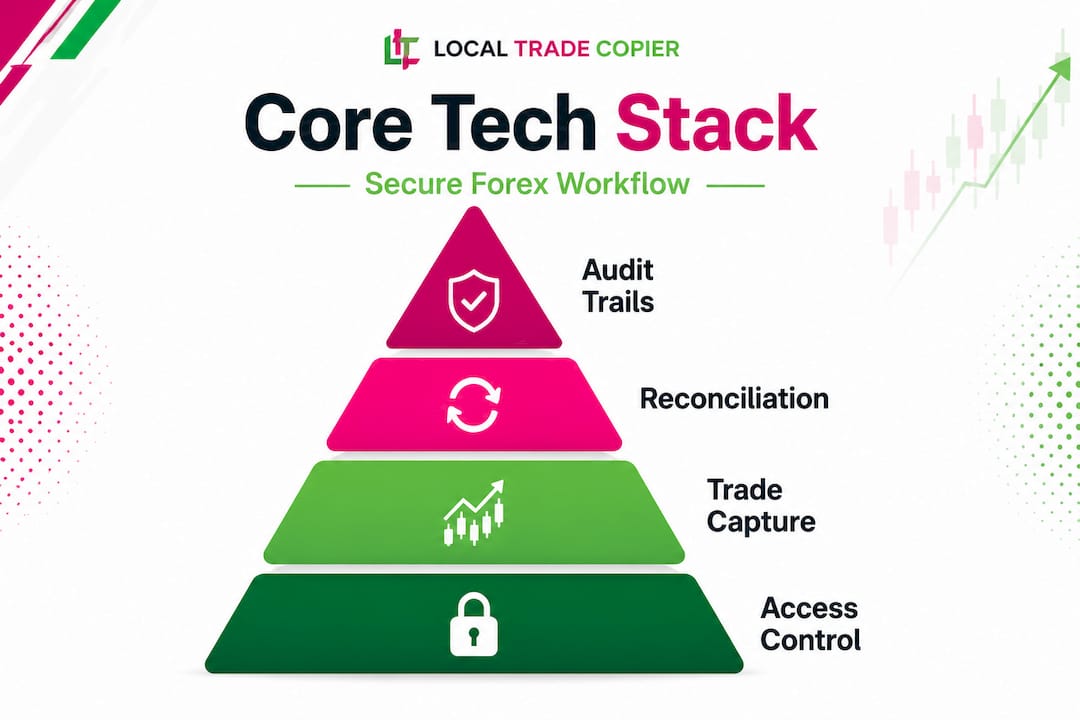
The core technology stack
A minimum viable secure trading process requires four categories of tooling. You need a trade capture system that records deal details at the point of execution. You need a confirmation platform that sends and receives MT300 or electronic confirmation messages. You need a reconciliation engine that compares your records against counterparty records. And you need an audit and exception management layer that tracks every action taken across the lifecycle.
Platforms like FXall, 360T, and Refinitiv feed real-time trade data into automated reconciliation systems that achieve T+0 or T+1 affirmation through three-way matching. Without a real-time data feed, your reconciliation is always working from stale information.
Access controls and role-based permissions
The easiest security gap to close is also the most overlooked. Every user in your workflow should have access to only the functions their role requires. Dealers capture trades. Operations teams confirm and reconcile. Compliance views but does not modify. A single shared login across a trading desk is an audit failure waiting to happen.
Key controls to put in place before you build your workflow steps:
- Role-based access with named user credentials for every terminal
- Dual authorization for trade modifications above defined thresholds
- Immutable audit logs that record every data change with a timestamp and user ID
- Validated SSI databases pulled from a centralized, permissioned source
Pro Tip: Cross-check your SSI database against a third-party reference source at least monthly. Stale settlement instructions are the leading cause of confirmation breaks, and most teams only discover them after a failed settlement.
Regulatory requirements also shape your tooling decisions. Firms must maintain internal audit records that match submitted order data, and those records must be available on demand during regulatory reviews. Building your audit trail into your workflow tooling from day one is far cheaper than reconstructing it later.
| Tool category | Key function | Security benefit |
|---|---|---|
| Trade capture system | Records deal at execution | Single source of truth, no manual reentry |
| Confirmation platform | Sends/receives MT300 messages | Standardized, timestamped confirmation chain |
| Reconciliation engine | Three-way matching against counterparty | Early break detection before settlement |
| Orchestration layer | Routes approvals, exceptions, escalations | Replaces email chains with tracked workflows |
Building the secure workflow step by step
This is where most guides stay vague. The steps below are specific. Each one has a control point built in. Past results do not guarantee future performance, but a well-structured process dramatically reduces the probability of costly errors.
-
Trade capture with real-time validation. When a deal is executed, the trade capture system records the full economic details. At this point, the system should automatically query your SSI database to validate settlement instructions before any confirmation is generated. This is the earliest possible intervention point, and it is the most effective.
-
Pre-send SSI gate. Before the MT300 confirmation message is dispatched to your counterparty, a validation gate checks that your SSI records match the expected counterparty SSI. Pre-send SSI validation reduces unmatched trade rates by intercepting incorrect instructions before they create a confirmation break. Stopping the message at this stage costs seconds. Fixing a break after the message is sent costs hours.
-
Automated three-way matching. Once confirmation messages are exchanged, your reconciliation engine compares three data sets: your internal trade record, the counterparty confirmation, and the settlement instruction details. Automated three-way matching flags discrepancies in real time rather than waiting for end-of-day batch processing.
-
Exception routing and escalation. Any break identified during matching should trigger an automated routing rule, not an email. The exception is assigned to the right team based on break type, with an SLA clock running. Process orchestration replaces email threads with tracked, time-stamped routing that keeps every exception visible.
-
Approval workflows with kill-switch controls. Trades requiring amendment or cancellation should pass through a defined approval chain. For automated trading strategies, rule-based execution controls can disengage automatically when market conditions deteriorate, acting as a kill switch that removes manual decision-making from high-risk moments.
-
Settlement confirmation and logging. Once both sides confirm and settlement is complete, the workflow engine logs the final step with a timestamp, user identifiers, and a link to the full audit trail. Every trade lifecycle step is logged automatically without any manual entry.
Pro Tip: Design your workflow so that every step requires a system action to advance, not a human remembering to click something. Workflows that depend on memory will break under volume. Workflows that depend on system triggers scale without degradation.
The most effective forex trading workflow examples share one characteristic: integrity is built in at data entry rather than checked after the fact. Post-trade manual checks are not a control. They are a cleanup operation.

Troubleshooting common workflow breaks
Even well-designed workflows encounter breaks. The goal is to catch them early and resolve them without manual chaos.
The most common root causes
SSI mismatches account for 70% of confirmation breaks in FX workflows. The other major causes are rate discrepancies, settlement date differences, and stale reference data including holiday calendars that have not been updated.
Here is how to handle each category efficiently:
- SSI mismatches: Route to your SSI database team immediately with the specific field causing the break. Never attempt to manually override an SSI during settlement without dual authorization.
- Rate discrepancies: Compare the original deal ticket against the confirmation line by line. Most rate breaks trace to rounding conventions or a miscaptured decimal.
- Settlement date differences: Check your holiday calendar reference data. A single missing public holiday can shift settlement dates and trigger a break across every trade in a currency pair for that date.
- Unresolved exceptions over SLA: Escalate automatically to the team lead. Manual SLA monitoring fails under volume.
Pro Tip: Never use email to manage trade approvals or exception routing. Email-based approvals introduce risk through missed messages, unclear ownership, and no audit trail. A 30-minute implementation of a ticketing or orchestration tool eliminates this risk entirely.
Tolerance-based matching logic helps your team focus on breaks that actually matter. When your matching engine is configured to ignore discrepancies below a defined threshold, your operations staff spend time on material mismatches instead of chasing rounding differences. This is not a workaround. It is how professional reconciliation systems are designed to work.
Maintaining current reference data is part of the efficient forex workflow discipline that separates teams who rarely see breaks from teams who spend every Friday afternoon untangling settlement failures. Update holiday calendars at the start of each quarter at a minimum. Validate your counterparty SSI records after any counterparty banking change notification.
Verification, audit readiness, and ongoing improvement
Building the workflow is the first step. Keeping it secure over time requires monitoring and structured review cycles.
KPIs that tell you the truth
The metrics that matter most in forex trading security are unmatched trade rate, average break resolution time, and the ratio of pre-send breaks to post-send breaks. If your post-send break rate is higher than your pre-send break rate, your validation gates are not working.
Checklist for periodic workflow review:
- Review unmatched trade rates weekly and trend them over 30-day periods
- Audit role-based access quarterly and remove permissions from inactive accounts
- Validate SSI database accuracy against counterparty notifications monthly
- Update holiday calendars and settlement date reference data each quarter
- Review exception routing rules after any organizational change affecting trade operations
- Test kill-switch and escalation triggers in a staging environment every six months
Automated audit trails embedded in orchestration capture every workflow action with a timestamp and user link, providing traceable evidence without manual reconstruction. This is the architecture regulators expect to see. It is also the architecture that makes your own internal investigations fast and accurate.
Integrated workflow automation can increase compliance review speed by up to 85% through traceable automated approvals and decision logs. The forex trading security checklist built into your periodic review process is what transforms a one-time implementation into a living, improving system.
AI-powered anomaly detection is becoming a practical addition to forex risk management in 2026. These tools flag deviations from normal trading patterns in real time, giving compliance teams an early warning before a break reaches settlement. The key is connecting these detection tools directly to your orchestration layer so that anomalies trigger workflow actions rather than just alerts that sit in an inbox.
My perspective on building this the right way
I have watched traders spend weeks perfecting their entry signals while running their trade operations on a shared spreadsheet and a group email chain. The disconnect is striking. You would not trade without a stop loss, but you will approve a settlement instruction over email with no record of who authorized it.
The uncomfortable truth about most forex trade sharing workflow setups is that they work until they don’t. When volume increases or a counterparty relationship gets complicated, the manual parts collapse first. I have seen operations teams spend entire days reconstructing what happened on a single trade because the audit trail was a string of forwarded emails.
What actually works is treating the workflow as a risk control, not an administrative process. Every manual step is a failure point. Every email approval is an untracked decision. The traders who sleep well at night are not necessarily the ones with the best signals. They are the ones who know that if something goes wrong, they can pull a complete, timestamped log of every action taken on every trade.
Automation does not remove human judgment from your trade management workflow. It removes the parts of the process where human judgment adds no value and introduces only risk. Routing an exception to the right team based on break type does not require a human decision. But resolving that exception absolutely does. Build your system around that distinction and you will build something that holds up.
— Rimantas
How Mt4copier supports a secure forex trade setup
If you are managing multiple MT4, MT5, or DXTrade accounts and copying trades manually between terminals, you are introducing exactly the kind of human error that secure workflow design is meant to eliminate. Mt4copier’s Local Trade Copier runs entirely on your local Windows machine or VPS, with no cloud routing and no external server handling your trade data. Every copy action executes in under 0.5 seconds on a single IP address.
For traders who need to protect prop firm accounts from cloud IP detection, or account managers replicating a single strategy across multiple client accounts, Mt4copier removes the manual reentry step entirely. Lot sizing scales automatically per account balance across 18 configurable risk management options.
Explore the trade copier security guide to see how to protect your accounts and trade copying setup with practical, implementation-ready controls. You can also review the automated forex workflow tutorial to connect your existing strategy to a fully synchronized, locally executed replication setup. A 7-day free trial is available with no commitment required.
FAQ
What is the most common cause of forex confirmation breaks?
SSI mismatches cause 70% of confirmation breaks in FX workflows. Implementing pre-send SSI validation before dispatching MT300 messages is the single most effective fix.
How do automated audit trails help with regulatory compliance?
Automated audit trails log every workflow action with a timestamp and user identifier, providing regulators with traceable, reconstructable records without manual effort.
What KPIs should I track in my forex trade workflow?
Track unmatched trade rate, average break resolution time, and the ratio of pre-send to post-send breaks. These three metrics reveal where your workflow is losing integrity.
Why should I avoid email for trade approvals?
Email approvals have no enforced audit trail, no SLA visibility, and no accountability assignment. Orchestration tools replace email chains with tracked, time-stamped routing that keeps every decision documented and attributable.
Does local trade copying improve workflow security?
Yes. Running trade replication on a local machine or VPS keeps all trade data on one IP address, eliminates cloud routing latency, and reduces exposure to external server failures. This is especially relevant for prop firm accounts where cloud-based copying tools carry detection risk.
Recommended
- Trade Management Workflow: Step-by-Step Guide for 2026
- Optimize automated trading workflow: forex replication guide
- Automate forex trade synchronization: complete how-to tutorial
- The Definitive Guide to Forex Trade Copying
