
Most retail forex traders assume prop firms are just another type of broker. They are not. Prop firms operate differently from brokers, running simulated trading environments where you never actually touch real market execution. That distinction changes everything about how you should approach scaling, risk management, and the tools you use. If you are managing multiple accounts or copying trades across funded accounts, understanding this model is not optional. It is the foundation for building a sustainable, multi-account operation that does not blow up when one firm closes its doors.
Key Takeaways
| Point | Details |
|---|---|
| Prop firms are not brokers | Prop firms offer simulated capital and trade evaluation, not direct market execution like brokers. |
| Scaling via prop firms | Retail traders can manage up to $400K per firm and replicate trades efficiently across accounts. |
| Risk limits are crucial | Successful multi-account setups limit each trade’s risk to 0.25%–0.50% and diversify across firms. |
| Local copiers outperform cloud | Local trade copiers provide superior speed and reliability, minimizing slippage and latency. |
| Most traders fund the winners | With estimated pass rates of 10%–14% (varies by firm), evaluation fees from failed traders fuel prop firm payouts. |
What are prop firms in forex trading?
A proprietary trading firm, or prop firm, gives traders access to simulated capital in exchange for passing an evaluation. You pay an entry fee, prove your trading ability under set rules, and if you pass, you receive a funded account. Profits are split between you and the firm, typically 70/30 or 80/20 in your favor.
This model is fundamentally different from a broker. A broker executes your trades in real markets. A prop firm, in most cases, runs your trades through a simulated environment. Prop firms bridge retail to institutional capital for forex traders, but the path is narrow. Industry data tells the real story.
| Metric | Data point |
|---|---|
| FTMO annual turnover (2023) | $213 million |
| Total rewards paid by FTMO | $450 million+ (as of September 2025, per FTMO’s 10th-anniversary announcement) |
| Estimated industry pass rate | Estimated 10%–14% (varies by firm; no single industry-wide figure is established) |
| Primary revenue source | Evaluation fees |
Those numbers are striking. FTMO’s $213M turnover in 2023 and over $450 million in cumulative payouts as of September 2025 reveal a massive industry, but the sub-10% pass rate tells you where most of the money actually comes from. Failing traders fund the payouts to winning ones.
Here is what separates successful prop traders from the majority:
- They treat each evaluation as a business, not a gamble
- They manage risk per trade at or below 0.5%
- They use consistent, rules-based strategies that survive drawdown limits
- They diversify across multiple firms rather than betting everything on one
- They automate trade replication to reduce manual errors across accounts
For those involved in forex account management, understanding this model is critical before scaling up. The opportunity is real, but so is the structural risk baked into the industry.
How prop firms enable scaling for retail traders
The most compelling reason retail traders turn to prop firms is capital access. A trader with $5,000 in personal capital cannot realistically generate meaningful income from forex. But a trader managing three funded accounts totaling $150,000 or more operates in a completely different league.

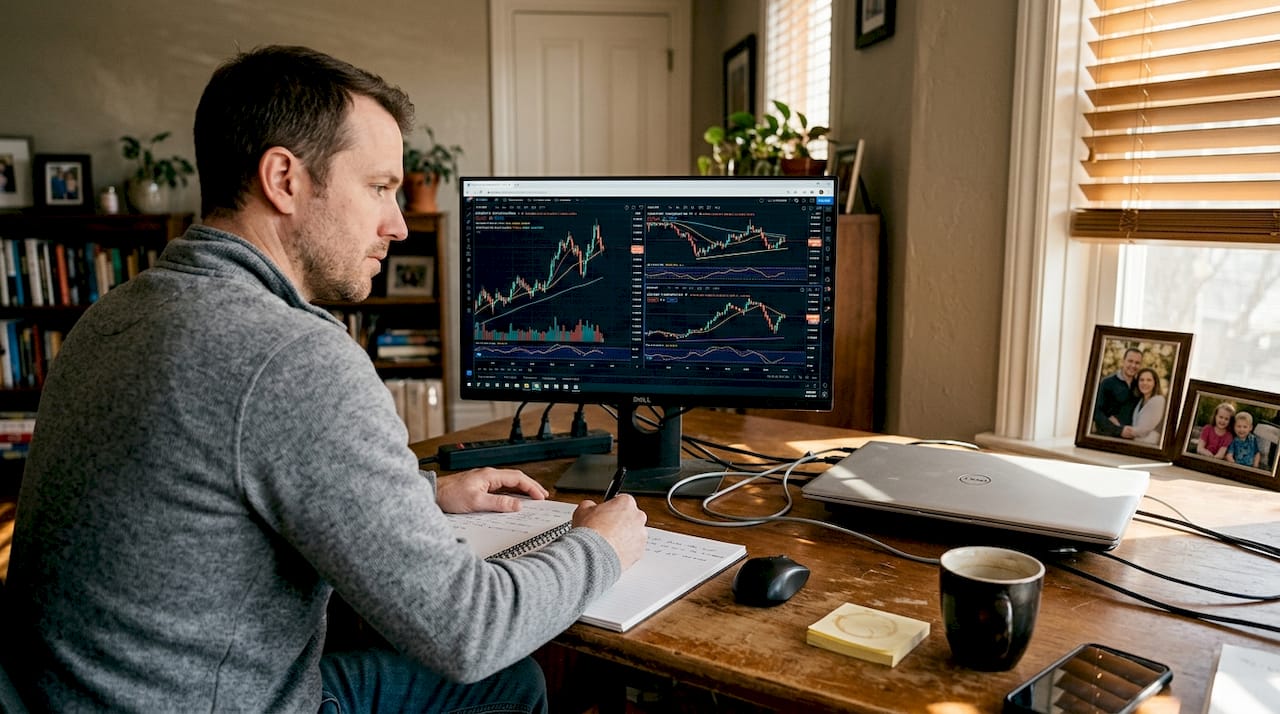
Trader managing multiple forex accounts at workstation
Firms like FTMO allow scaling up to $400K allocation for traders who consistently hit profit targets. Combine that with accounts at two or three other firms, and you can realistically manage $500,000 or more in simulated capital from a single strategy.
Here is a practical step-by-step approach to scaling across prop firm accounts:
- Pass your first evaluation using a conservative, rules-based strategy
- Set up a master trading account on your own broker or demo terminal
- Install a local trade copier on a Windows VPS to replicate trades to each funded account
- Configure lot sizing per account based on each firm’s balance and drawdown rules
- Monitor each account separately for rule violations and daily loss limits
- Reinvest profits into new evaluations to expand your funded account portfolio
| Feature | Local VPS copier | Cloud-based copier |
|---|---|---|
| Execution speed | Sub-0.5 seconds | Variable; typically longer due to external server routing |
| IP address control | Single IP, on-machine | External server IP |
| Prop firm detection risk | Low | Higher at firms that monitor for coordinated IP patterns |
| Reliability during volatility | High | Variable |
| Latency from broker server | Minimal | Can be significant |
The VPS vs. cloud distinction matters more than most traders realize. When you run a local copier on a VPS, all your trade data stays on one machine with one IP address. Cloud copiers route your data through external servers, which can flag accounts at prop firms that monitor for coordinated trading patterns.
Pro Tip: Run your master account and all client terminals on the same Windows VPS. This eliminates latency between the signal source and the receiving accounts, keeping your fills as tight as possible across every funded account.
Understanding the benefits of account management at this scale means recognizing that automation is not a luxury. It is a requirement for running multiple prop accounts without making costly manual errors.
Risk management strategies for multi-account prop trading
All trading involves risk of loss. The risk parameters below are commonly referenced in multi-account prop trading setups and do not guarantee account preservation or profitability.
Scaling capital is exciting. Losing it all in one correlated drawdown is not. When you copy the same trade to five prop firm accounts simultaneously, a single bad trade does not just hurt one account. It hits all five at the same time.
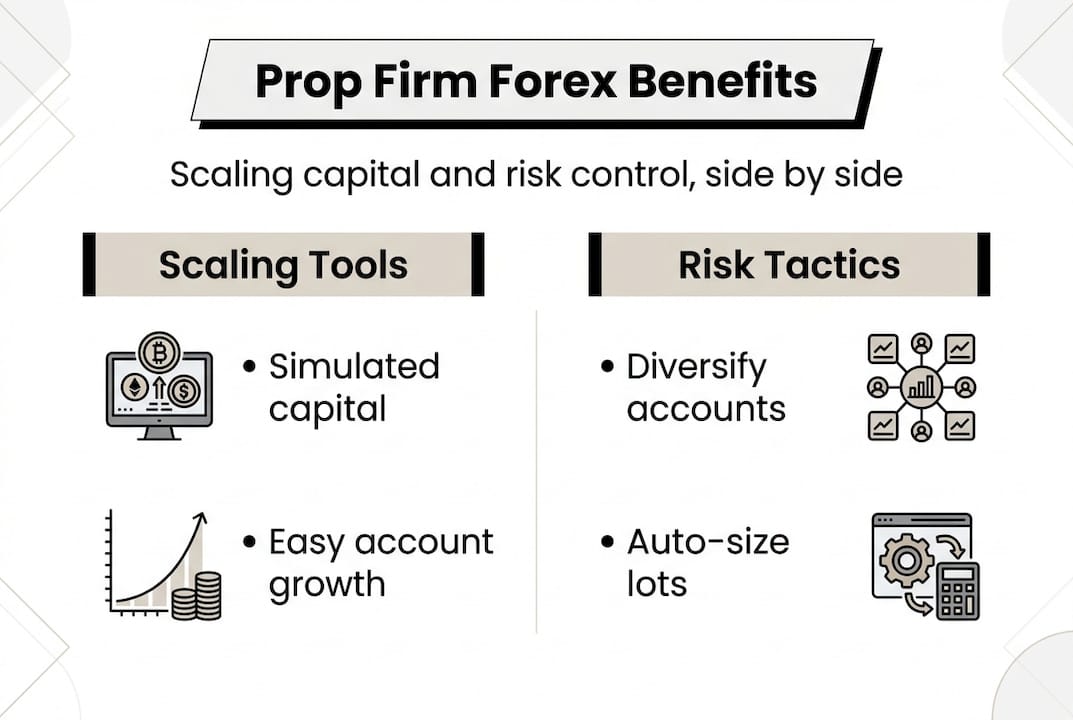
Infographic showing prop firm forex benefits and risk tactics
This is why risk per trade must drop significantly when you go multi-account. Reducing risk to 0.25-0.50% per trade prevents correlated breaches across accounts when a trade moves against you. A 1% loss on one account is manageable. A 1% correlated loss across six accounts simultaneously can trigger daily loss limits on multiple funded accounts in a single session.
Key risk management principles for multi-account prop trading:
- Limit risk per trade to 0.25% to 0.50% of each account’s balance
- Never trade correlated pairs simultaneously across all accounts
- Set maximum daily loss alerts before you hit firm-imposed limits
- Diversify across at least two to three prop firms with different rule sets
- Use different strategies on different accounts where possible
- Keep a cash reserve to fund new evaluations if accounts get breached
The 2024 industry data is a sobering reminder of why diversification matters. According to Finance Magnates Intelligence estimates, roughly 80 to 100 prop firms closed in 2024. Traders who had all their funded accounts with a single firm lost everything overnight. Spreading across firms and geographies is not just smart. It is essential.
Local trade copiers support this discipline directly. With 18 lot size and risk management options available in tools like Local Trade Copier, you can set precise risk parameters per account. Each client terminal gets its own lot size configuration, so a $10,000 account and a $50,000 account receive correctly scaled positions automatically.
Review multi-account copying best practices to build a setup that enforces your risk rules automatically rather than relying on manual checks. And if you want to tighten your overall workflow, efficient trade copying covers the operational side of keeping multiple accounts running cleanly.
Pro Tip: Set your lot sizing to scale automatically with account balance, not fixed lots. As accounts grow through profit splits, your position sizes stay proportional and your risk percentage stays consistent without manual adjustments.
Choosing the right trade copier: Local vs cloud solutions
Once your risk framework is in place, the tool you use to replicate trades becomes a critical decision. Not all copiers are built for the demands of prop trading.
Local copiers are essential for precise replication in prop forex environments. The reason is simple: prop firms enforce tight drawdown limits, and slippage caused by slow execution can push you over those limits on trades that should have been fine. A cloud copier adding one to three seconds of latency during a volatile news event can be the difference between a clean trade and a limit breach.
Here is what to look for when choosing a trade copier for prop firm use:
- Sub-second execution to minimize slippage between master and client accounts
- On-machine operation so all data stays local with a single IP address
- Cross-platform support for MT4, MT5, and DXTrade in a single subscription
- Flexible lot sizing with per-account configuration options
- No external routing to avoid cloud IP detection by prop firms
- Proven track record with real user reviews and active support
During high-volatility events, cloud copiers can introduce execution delays that are difficult to detect under normal conditions but consequential when spreads widen.
Cloud copiers work for casual traders copying a few trades a week with no strict drawdown rules. For anyone managing prop firm accounts with daily loss limits and maximum drawdown thresholds, the margin for error is too small. Local execution removes that variable entirely.
For a detailed breakdown of costs and trade-offs, cloud vs local trade copiers covers the financial and operational differences. If you want to understand how local tools have been hardened specifically for prop firm environments, local copier safety upgrades is worth reading. And when you are ready to get set up, the installing local trade copier guide walks you through the full process.
The uncomfortable truth: What most traders miss about prop firms
Here is something the prop firm marketing rarely highlights: most of the trading is simulated. Prop firms are not true brokers, and regulators in several jurisdictions, including ESMA in Europe, have begun scrutinizing prop trading firms over concerns about their simulated capital model and reliance on evaluation fee revenue.
We have seen traders obsess over copier latency, VPS locations, and platform upgrades while completely ignoring the fact that their risk per trade is 2% across eight correlated accounts. The technology is a tool. Discipline is the actual edge.
The uncomfortable math is this: the sub-10% pass rate means the majority of traders are effectively subsidizing payouts to the minority who succeed. That is not a reason to avoid prop firms. It is a reason to approach them with the same rigor you would apply to any professional trading operation.
Diversify across firms. Enforce strict risk limits. Do not chase the newest platform feature when your risk management is still broken. Tools like managing prop trading accounts exist to support disciplined systems, not replace them.
Take control with efficient local trade copying tools
If you are serious about running multiple prop firm accounts without the manual overhead and execution risk, the right local trade copier makes a measurable difference. Local Trade Copier has been built for exactly this use case since 2010, with 3,000+ active users and 491 Trustpilot reviews backing its reliability.
Start with the install local trade copier guide to get your setup running on a Windows VPS in minutes. Review the prop trading best practices to structure your multi-account risk framework correctly from day one. And if you want to see the tool in action before committing, the demo local trade copier video shows exactly how trade replication works across MT4, MT5, and DXTrade accounts. A 7-day free trial is included.
Frequently asked questions
How do prop firms differ from brokers in forex?
Prop firms use simulated trading and allocate capital based on evaluation performance, while brokers provide direct access to real market execution. Most prop firms generate the majority of their revenue from evaluation fees, not trader profits.
What is the typical risk per trade in multi-account prop trading?
Successful prop traders usually limit risk to 0.25% to 0.50% per trade to avoid triggering correlated drawdown breaches across multiple funded accounts simultaneously.
Why are local trade copiers preferred over cloud-based options?
Local copiers reduce slippage and latency by executing on-machine without external routing, which is critical when prop firm drawdown limits leave little room for execution delays during volatile market conditions.
How can traders protect themselves from prop firm failures?
Diversifying across firms and regions significantly reduces single-point failure risk, especially given that roughly 80 to 100 prop firms closed in 2024 alone. Local copiers help manage this portfolio efficiently from one machine.
Recommended
- Understanding MT4’s role in Forex prop firms in 2026
- How to manage prop trading accounts with trade copying
- Prop trading best practices: Multi-account copying in 2026
- Most Effective Strategies for Managing Risk in Forex Trading | Trade Copier for MT4 & MT5
