

Anti-Martingale copy mode is a reverse-Martingale position-sizing rule applied by a trade copier: it increases trade size after winning trades and reduces it after losses. The approach lets a copier ride winning streaks while pulling back exposure during drawdowns, yet it concentrates risk right at the peak of a streak. Used without caps, resets, and stop-loss discipline, that concentration can erase months of gains in one reversal.
TL;DR:
- The risk of exponential growth in trade sizes with high streaks makes strict caps and resets essential to prevent rapid account depletion.
- Proportional scaling based on account balance is preferred over fixed lot increments to ensure consistent risk across varying account sizes.
- Proper parameter setting, including streak length, multiplier, and escalation cap, is crucial to avoid unintended large positions during winning streaks.
- Testing with slippage assumptions and setting operational limits, such as margin checks and anomaly alerts, helps mitigate live trading risks.
- The system’s effectiveness depends on disciplined implementation of caps, resets, and monitoring, not just the multiplier choice.
What anti-Martingale is and how it differs from Martingale
Anti-Martingale, also called reverse Martingale, is a position-sizing method where you increase your stake after a win and decrease it after a loss. The mechanics are the mirror image of the classic Martingale system: instead of doubling down after a loss to chase a breakeven, you scale up only when the account is already winning, and you shrink size the moment a trade closes red. According to Investopedia’s definition of anti-Martingale, this structure increases bets after profitable trades and roughly halves them after losses, aiming to limit exposure during downturns while letting winners run.
The contrast with Martingale matters because it explains where each system fails. Martingale concentrates exposure during losing streaks, since every loss triggers a larger bet to recover prior losses, a pattern that can wipe out an account during an extended losing run. Anti-Martingale flips that risk profile: exposure grows during winning streaks, so the largest position sizes exist exactly when a reversal is most likely to hurt. ThinkMarkets notes that reverse Martingale can improve survival compared with Martingale by compressing exposure during losing sequences, but it concentrates risk after winning streaks, so exits, caps, and reset rules carry the real design weight.
That concentration risk ties directly to a statistical trap: the hot-hand fallacy. A string of wins in forex does not raise the probability that the next trade wins, unless your edge is genuinely momentum-based. Treating a streak as predictive when it is not is how anti-Martingale sizing turns a normal losing trade into an oversized one. Past results do not guarantee future performance.
How anti-Martingale works inside a trade copier
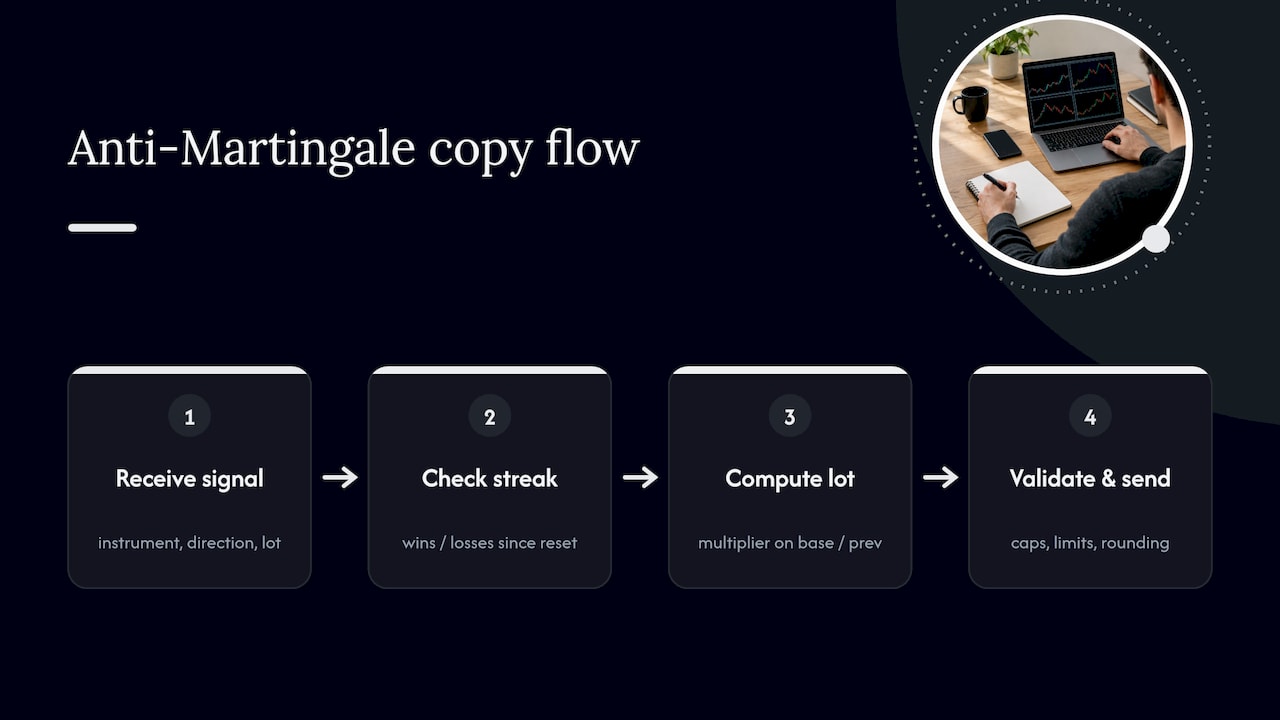
A copier applying anti-Martingale logic has to execute a specific sequence every time the master account opens a trade. First, it receives the master’s trade signal, including instrument, direction, and lot size. Second, it checks the current streak counter for that client account, win count or loss count since the last reset. Third, it computes the new lot size by applying the configured multiplier to either the base lot or the previous trade’s lot, depending on the scaling anchor. Fourth, it validates that result against caps and account-specific limits before sending the order.
The scaling anchor you choose changes the outcome substantially. Proportional scaling, where the multiplier applies to a percentage of current balance, keeps position size aligned with account growth and is safer across client accounts of different sizes. Absolute scaling, where the multiplier applies to a fixed lot increment, is simpler to reason about but can produce wildly different risk exposure between a $5,000 account and a $50,000 account copying the same master. Documentation for custom indicator and EA setups shows implementers generally prefer proportional, percent-of-balance scaling over absolute doubling in multi-account copy environments, precisely because it avoids disproportionate exposure for smaller client accounts.
Production environments also surface edge cases that a whiteboard design rarely accounts for. Partial fills on the master side mean the copier may need to scale a trade that itself was never completed at the intended size. Slippage between master and client execution changes the effective risk per lot. Different brokers enforce different lot minimums and step sizes, so a computed multiplier result sometimes needs rounding that shifts actual exposure. Netting accounts aggregate positions per instrument while hedging accounts allow multiple simultaneous positions, so the same anti-Martingale rule can behave differently depending on account type. Asynchronous copy delays, even sub-second ones, can mean the streak counter updates before or after a related order confirms, so the sequencing logic needs to be deterministic rather than racing the fill confirmation.
Key parameters and safe configuration patterns
Before deploying anti-Martingale copy mode, you need concrete definitions for each parameter rather than a vague “increase after wins” rule.
- Base lot: the starting size before any multiplier is applied, usually tied to account balance or a fixed minimum.
- Multiplier: the factor applied after each qualifying win, commonly in the 1.2 to 2.0 range for conservative setups.
- Streak length: how many consecutive wins or losses trigger a size change, often capped at three to five trades.
- Max escalation cap: the hard ceiling on how large a position can grow relative to base lot.
- Reset conditions: the rule that returns size to base, typically a single loss, a drawdown threshold, or a time-based reset.
The escalation cap deserves particular attention. TradingView’s script documentation for anti-Martingale tools commonly flags a guard check that stops multiplier application once the computed lot would exceed a large multiple of base lot, with escalation beyond 100 times base size treated as a practical alarm threshold in community-maintained scripts. A multiplier of 1.5 applied across an eight-trade winning streak already produces roughly 25 times the base lot, so uncapped exponential growth reaches dangerous territory faster than most traders expect.
Choosing a multiplier relative to account balance means working backward from margin tolerance. A trader running tight leverage on a small account should favor a lower multiplier (1.1 to 1.3) and a short streak length, while an account with conservative leverage and ample margin headroom can tolerate a slightly higher multiplier with a firm cap and strict reset.
Implementing anti-Martingale copy mode with Local Trade Copier
Configuring anti-Martingale behavior inside a copier setup follows a repeatable sequence once the parameters above are defined.
- Enable the Martingale/anti-Martingale mode in the copier’s lot size settings and select the anti-Martingale direction so size increases after wins rather than losses.
- Choose the scaling anchor, either a percentage of current client balance or a fixed lot increment, based on how varied your client account sizes are.
- Set the multiplier and the maximum escalation cap so the system refuses to exceed a defined lot ceiling regardless of streak length.
- Map each client account individually, since automatic lot scaling per client balance lets differently sized accounts receive proportionally sized trades from the same master signal.
- Run the configuration on a demo environment first, reviewing execution logs to confirm the multiplier applied correctly at each step.
Our martingale mode documentation covers the exact fields and examples for setting this up across MT4, MT5, and DXTrade accounts. Local execution matters here: because trade data processes on one machine with sub-0.5-second execution, the sequencing between master signal, streak check, and order placement stays tight, which reduces the chance of a size calculation lagging behind the actual market state. The same configuration components apply whether you are copying MT4 to MT4, MT5 to MT5, or across to DXTrade, since the lot scaling logic sits at the copier layer rather than inside any single platform. We recommend watching the demo video before touching a live account.
Risk controls, testing, and validation before going live
Treat anti-Martingale copy mode as code that needs a test suite, not a setting you flip and forget. Forward-test on a demo account across a range of market conditions, including a deliberately simulated losing streak, to confirm the reset logic actually returns size to base rather than drifting. Backtest with slippage assumptions built in, since a backtest that ignores execution slippage will understate how fast a multiplier compounds in live conditions.
Hard operational controls matter more than clever multiplier choices; see this investuotojo gidas apie stop loss naudojimą for practical risk management techniques. Set a per-account exposure cap independent of the streak-based cap, confirm automatic resets trigger on the conditions you intended, and run the margin-call prevention checks relevant to your account type before scaling any client account live.
Pro Tip: Log every multiplier calculation with its inputs and outputs, so a review after a losing week shows exactly which trade sizes were computed and why.
Monitoring after launch should include anomaly alerts for any lot size that exceeds your configured cap, and a kill switch that disables copying without closing existing positions, so you can stop new escalation while you investigate.
Best practices, common pitfalls, and troubleshooting
The most common operator error is skipping lot normalization across instruments with different contract sizes, which produces oversized or rejected orders. Always confirm broker-specific lot minima before enabling scaling across multiple client accounts.
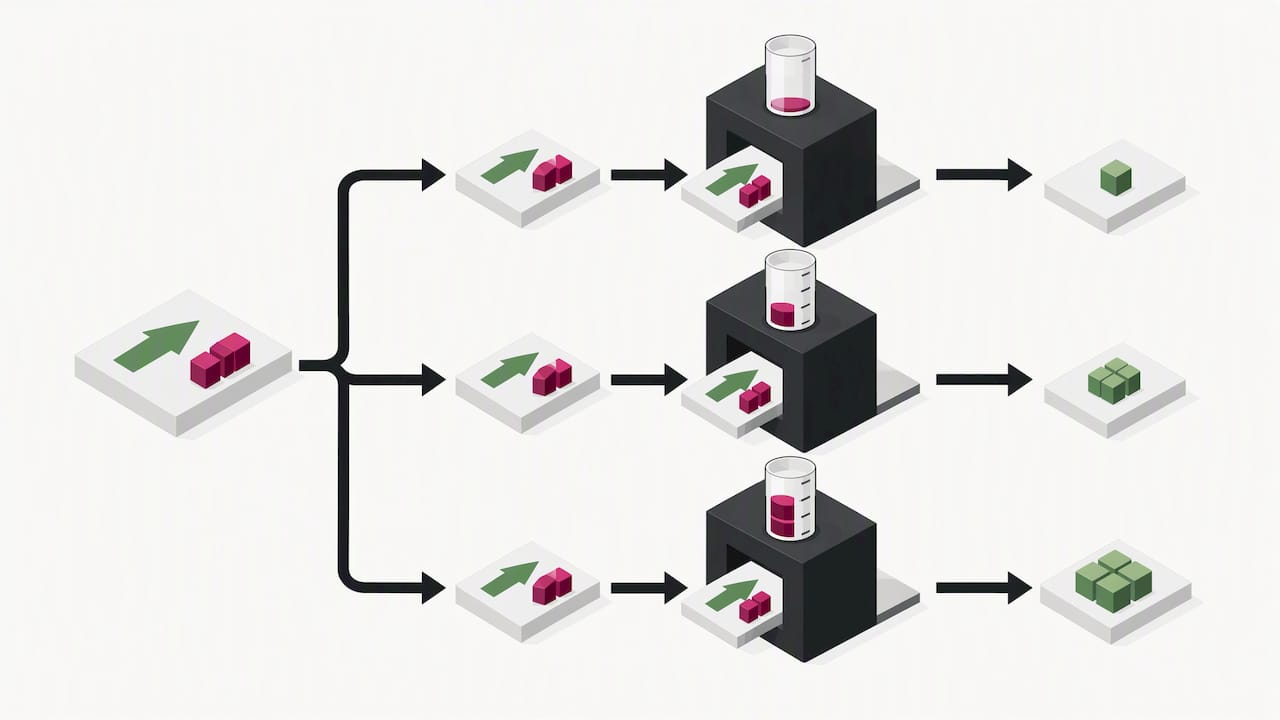
When something looks wrong, reproduce the issue in demo first. Inspect the execution log to verify the multiplier applied at the correct trade, then reconcile executed lots against intended lots to isolate rounding or slippage.
Roll out gradually: start with conservative caps on one or two client accounts, confirm behavior over several sessions, then widen deployment.
Author perspective: when anti-Martingale earns a place in your toolbox
Anti-Martingale fits momentum-driven strategies, where a winning trade genuinely raises the odds the next one works too. It fights against mean-reversion approaches, where a win often precedes a pullback, making bigger size after a streak the worst possible timing.
The parameter that matters most is never the multiplier. It is the cap and the reset. A trader who spends their design effort tuning a 1.3 versus a 1.5 multiplier while leaving the escalation cap loose has the priorities backward. Sizing policy is a separate layer from signal logic, and conflating the two is how a sound strategy gets buried under an unrelated sizing mistake.
— Rimantas
Local Trade Copier: built for this kind of configuration work
Running anti-Martingale copy mode in production means your copier needs to handle lot scaling, caps, and resets without adding its own latency or routing risk to the equation. Local Trade Copier runs entirely on your own Windows machine or VPS, replicating trades across MT4, MT5, and DXTrade with no cloud routing between master and client accounts.

What this gives you for anti-Martingale configuration specifically:
- Automatic lot scaling per client account balance, so proportional anti-Martingale sizing applies correctly across accounts of different sizes.
- Fast local execution, keeping the streak check and order placement tightly sequenced.
- Martingale and anti-Martingale modes built into the lot size settings.
- Cross-platform support for MT4, MT5, and DXTrade under one subscription.
We built this as trade replication software: it copies existing trades and applies the sizing rules you configure, with no strategy layer or market logic of its own. Past results do not guarantee future performance. Read the martingale mode documentation, watch the demo video, and start a 7-day free trial to validate your parameters on a demo account before going live. Pricing details for the Personal, Manager, and VIP plans are available on our site.
This article is general information, not a substitute for advice from a qualified financial advisor. Consult a qualified financial professional about your own circumstances before acting on anything here.
FAQ
What is the 3-5-7 rule in trading?
Definitions vary across sources, so treat the specific percentages as a general framework rather than a fixed standard, and adapt caps to your own account size and leverage.
Is there a TradingView indicator that doesn’t repaint?
Non-repainting indicators exist on TradingView and are typically documented as such in the script description, since repainting refers to a signal changing after the bar closes. Check the specific indicator’s documentation for a non-repaint confirmation rather than assuming one by category, since behavior varies by script and by how it is coded.
What is a copy trading strategy?
A copy trading strategy is a system where one account’s trades are automatically replicated to one or more other accounts, often with adjusted lot sizes to match each account’s balance. The sizing rule layered on top, such as anti-Martingale, determines how the copied trade’s size scales rather than what trade gets copied in the first place.
What is the martingale rule in trading?
The martingale rule increases position size after a loss, typically by doubling the previous stake, aiming to recover prior losses with a single win. Investopedia’s definition contrasts this with anti-Martingale, which instead increases size after wins, since Martingale concentrates risk during losing streaks and can deplete an account quickly without a strict stop-loss rule.
Does anti-Martingale copy mode guarantee better trading outcomes?
No. Anti-Martingale copy mode is a position-sizing rule applied by trade replication software, not a strategy layer that improves trading outcomes. It copies existing trades and scales their size according to the parameters you set, and past results do not guarantee future performance.
Sources
- Anti‑Martingale definition — Investopedia
- Trading forex with the reverse Martingale — ThinkMarkets
- Management — TradingView scripts
- Custom Indicators — EasyStrategyBuilder docs
Recommended
- Martingale Mode in MT4 Local Trade Copier
- Local Trade Copier installation on MT4 and MT5
- Local Trade Copier DEMO on MT4 and MT5
- The use of Magic Numbers with the Local Trade Copier on MT4 platform
