

TL;DR:
- Privacy in trading safeguards a trader’s strategic information, order data, and personal identity from exploitation by others.
- Using privacy-preserving technologies like zero-knowledge proofs and encrypted mempools reduces exposure to front-running, MEV extraction, and data breaches, enhancing trade confidentiality.
Privacy in trading is defined as the protection of a trader’s strategic information, order data, and personal identity from exposure to parties who can exploit that information for profit. Without it, your trade intent becomes a target. Front-running, Miner Extractable Value (MEV) extraction, strategy copying, and data breaches are not theoretical risks. They are active, documented threats that cost traders real money every day. This guide covers how privacy-preserving technologies work, what risks you face without them, how regulations shape your options, and what practical steps you can take to protect your trading activities.
What is the role of privacy in trading?
Privacy in trading protects your economic intent. The moment your order is visible to other market participants before it executes, you lose your edge. That exposure creates an opportunity for others to trade ahead of you, widen your slippage, or copy your strategy outright.

Hands typing on laptop for trading privacy
Crypto market makers are increasingly routing activity away from public blockchains to protect their strategies from extraction. That behavioral shift among professional participants signals how seriously confidentiality in financial trading is now treated. When significant portions of professional order flow deliberately avoid public venues, the importance of privacy in trading is not a niche concern.
Privacy also protects your personal data. Brokers, exchanges, and trading platforms collect account details, transaction histories, and behavioral patterns. A breach of that data can expose you to identity theft, targeted phishing, or regulatory scrutiny you did not invite. The impact of privacy on trading extends well beyond strategy protection.
Pro Tip: If you are managing multiple accounts or copying trades across platforms, every additional connection point is a potential exposure. Keep your execution local whenever possible.
How do privacy-preserving technologies work in trading?
Privacy-preserving trade execution uses cryptographic and structural methods to hide order details from parties who should not see them. The three most relevant technologies for traders are zero-knowledge proofs, encrypted mempools, and private transaction relays.
- Zero-knowledge proofs (ZKPs): A ZKP lets one party prove a statement is true without revealing the underlying data. In trading, this means you can prove a trade is valid and compliant without exposing its size, direction, or timing to the public.
- Encrypted mempools: In blockchain-based trading, transactions sit in a public mempool before confirmation. Encrypted mempools hide transaction details from node operators and bots until the trade is finalized.
- Private transaction relays: These route orders directly to block producers, bypassing the public mempool entirely. Flashbots Protect is one example used in Ethereum-based trading to reduce MEV exposure.
Hybrid cryptographic architectures allow opaque trade processing combined with regulatory transparency. That balance matters. You get confidentiality from other market participants while still satisfying compliance requirements from regulators.
Off-exchange models like dark pools operate on a similar principle. A dark pool is a private trading venue where large orders are matched without displaying them on a public order book. Institutional traders use dark pools to execute block trades without moving the market against themselves. Platforms like GoDark take this further by hiding order book visibility even from node operators, going beyond what traditional dark pools offer.
The benefit across all these methods is the same: reduced front-running, protection against MEV bots, and more stable execution prices.
What privacy risks do traders face in public markets?
Public order books expose your trade intent before execution. Any participant watching the order book can see your size, price level, and direction. That information has value to bots and competing traders who can act on it faster than you.
The four most significant privacy risks in trading are:
- Front-running: A party sees your pending order and places their own order ahead of it to profit from the price move your trade will cause.
- MEV extraction: MEV searchers exploit public transaction visibility to front-run and arbitrage trades, causing losses and privacy compromises. This is especially damaging in derivatives and options trading where timing is critical.
- Strategy copying: If your trading pattern is visible over time, other traders or algorithms can reverse-engineer your approach and replicate or trade against it.
- Data breaches from centralized exchanges: Centralized platforms hold your KYC data, transaction history, and account credentials. A breach exposes all of it.
“MEV is critical to understanding the trade-off between transparency and privacy on blockchains.” — Greeks.live
Decentralized exchanges (DEXs) reduce the risk of centralized data breaches but introduce their own problems. DEXs usually avoid KYC, which enhances privacy but creates tension with regulatory compliance requirements. You gain one type of protection and trade away another.
Experimental research from 2026 shows traders trade off privacy risk with financial incentives, with monetary returns dominating leak avoidance in their decision-making. That finding is important. It means most traders are underweighting privacy risk because the cost is not immediately visible. The loss from a single front-run trade is small. The cumulative cost over months of exposure is not.
Comparing privacy strategies and trading privacy regulations
Not all trading environments carry the same privacy risk. The table below compares the main market types by privacy level, regulatory exposure, and practical trade-offs.
| Market type | Privacy level | Regulatory exposure | Key trade-off |
|---|---|---|---|
| Public exchange (NYSE, Nasdaq) | Low | High (full KYC, reporting) | Liquidity vs. order visibility |
| Dark pool (off-exchange) | Medium-high | Medium (regulated but opaque) | Reduced front-running vs. limited access |
| DEX without privacy tech | Low | Low (no KYC) | Anonymity vs. MEV vulnerability |
| DEX with ZKPs or encrypted mempool | High | Variable | Strong privacy vs. complexity and cost |
| Local trade copier (on-machine) | High | Depends on broker | No cloud routing vs. Windows/VPS required |
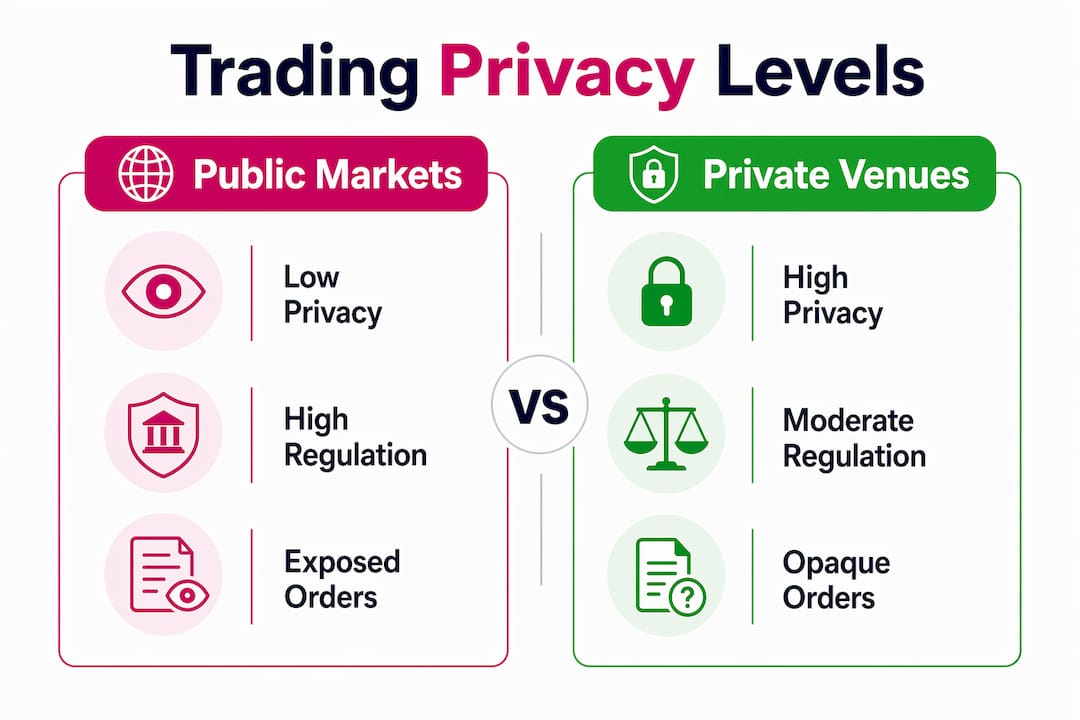
Infographic comparing trading privacy levels
Trading privacy regulations vary significantly by jurisdiction. In the United States, the SEC and FINRA require transaction reporting and KYC compliance from registered brokers. The European Union’s MiFID II framework mandates trade transparency and best execution reporting. These rules create a structural tension: regulators want visibility, and traders want confidentiality.
Privacy-preserving execution balances opacity to market participants with transparency to regulators, fostering both confidentiality and compliance. That balance is the design goal of most modern privacy tech in trading. You do not have to choose between being compliant and being protected from other traders.
Pro Tip: When evaluating a trading platform’s privacy features, ask specifically whether your order data is visible to other users before execution. Many platforms describe themselves as “secure” but mean only that your login credentials are protected, not your trade intent.
Privacy as a strategic necessity has shifted from ideology to infrastructure among crypto institutions, becoming a competitive moat for capital efficiency. That shift is now spreading to traditional forex and derivatives markets. Understanding trader privacy layers and laws gives you a clearer picture of where your exposure actually sits.
How can traders protect their privacy and trading data?
Protecting your trading privacy requires action at three levels: execution environment, data handling, and account security.
Execution environment
- Use a local trade copier instead of cloud-based solutions. Local execution keeps all trade data on one machine, one IP address, with no external server routing. This eliminates the cloud routing risk that can expose your activity to third-party servers.
- Choose brokers and platforms that offer private order routing or dark pool access for larger orders.
- For blockchain-based trading, use private transaction relays like Flashbots Protect to avoid public mempool exposure.
Data handling
- Minimize the personal information you share with trading platforms beyond what KYC regulations require.
- Use encrypted communication channels when discussing trades or strategies with other parties.
- Avoid posting trade screenshots or real-time commentary on public forums. Pattern recognition from public data is a real threat.
Account security
Using a VPS and strong passwords protects trade data and account access from breaches. A VPS isolates your trading environment from your personal machine, reducing the attack surface. Strong, unique passwords combined with two-factor authentication close the most common entry points for unauthorized access.
A full forex trading security checklist covers the specific steps traders should take to lock down their accounts and copy trades safely.
Pro Tip: Run your trade copier on a dedicated VPS rather than your personal computer. This separates your trading environment from your browsing, email, and other software, which are the most common vectors for malware and credential theft.
When it comes to regulatory compliance, selective disclosure is a legitimate strategy. You are required to report what regulators mandate. You are not required to broadcast your strategy to the market. Understanding that distinction helps you stay compliant without sacrificing your competitive edge. Privacy in forex automation is a growing concern as more traders move to automated systems that generate visible, predictable patterns.
Key takeaways
Privacy in trading is a direct defense against front-running, MEV extraction, and data breaches that erode execution quality and expose your strategy to exploitation.
| Point | Details |
|---|---|
| Privacy protects trade intent | Exposing order data before execution enables front-running and MEV attacks that cost real money. |
| Professional market participants avoid public venues | Crypto market makers and institutional traders increasingly route activity away from public order books to protect their strategies from extraction. |
| ZKPs and encrypted mempools are real tools | These cryptographic methods hide trade details from bots and competitors while remaining compliant with regulators. |
| Traders underweight privacy risk | Research shows financial incentives dominate privacy concerns, meaning most traders accept more exposure than they should. |
| Local execution reduces cloud risk | Running a trade copier on a local machine or VPS keeps all trade data on one IP with no external routing exposure. |
Privacy is a competitive moat, not a compliance checkbox
Trade copying software has been in active development since 2010, and the conversation around privacy has changed significantly over that time. Early concerns were largely limited to password security. The threats now run deeper: order flow is a data asset that competing participants actively seek to extract.
The most common mistake traders make is treating privacy as a one-time setup task. Installing a VPN and setting a strong password is not enough. Privacy in trading is an ongoing operational discipline. Every new platform you connect to, every API key you share, every cloud service you route trades through adds to your exposure. The cumulative effect is significant.
The direction institutional markets are moving is worth watching. When large capital allocators start demanding encrypted mempools and ZKP-based execution as standard features, retail traders will benefit from that infrastructure being normalized. For now, most retail traders are operating in environments built for transparency, not protection.
The practical starting point is your execution environment. Trades routed through a cloud server you do not control represent your biggest exposure. That is where to start. Account security measures, KYC minimization, and encrypted communication are important, but they are secondary to controlling where your trade data lives.
Keep your trade data where it belongs: on your machine
If you are copying trades across multiple MetaTrader 4, MetaTrader 5, or DXTrade accounts, the architecture of your setup determines your privacy exposure as much as any software feature.
Mt4copier runs entirely on your local Windows machine or VPS, with no cloud routing and no external server handling your trade data. All execution stays on one IP address, copying trades in 1 second or faster under normal market conditions, with eight money management modes built in. For prop firm traders, that local execution model also avoids the cloud IP detection issues that can flag your account. Mt4copier has served 3,000+ traders since 2010 with 491 Trustpilot reviews. Learn how account security and VPS setup works within the Mt4copier framework, or watch the Local Trade Copier demo to see local execution in action.
FAQ
What is the role of privacy in trading?
Privacy in trading protects your order intent, personal data, and trading strategy from exploitation by front-runners, MEV bots, and data breaches. Without it, your trade details become a resource other participants can profit from before your order even executes.
How does MEV affect trading privacy?
MEV searchers monitor public transaction data to front-run and arbitrage pending trades, causing direct financial losses and exposing your strategy. This risk is highest on public blockchains where mempool data is visible to anyone before confirmation.
What trading privacy regulations apply to forex traders?
In the United States, SEC and FINRA rules require KYC compliance and transaction reporting from registered brokers. The EU’s MiFID II mandates trade transparency and best execution reporting. These frameworks require disclosure to regulators but do not require you to expose your strategy to other market participants.
Are dark pools legal and available to retail traders?
Dark pools are legal, regulated off-exchange venues primarily used by institutional traders for large block orders. Most retail traders do not have direct access, but some brokers offer internalized order flow that functions similarly by routing orders away from public order books.
Does using a local trade copier improve trading privacy?
A local trade copier keeps all trade data on your own machine with no cloud routing, which eliminates the exposure that comes from third-party servers handling your order flow. This is particularly relevant for prop firm traders where cloud IP detection can create account compliance issues.
