

TL;DR:
- Managing multiple prop firm accounts requires systematic risk controls on aggregate exposure and correlations.
- Automated trade copiers enforce discipline, reduce manual errors, and ensure consistent risk limits across accounts.
- Long-term success depends on discipline and process consistency, not market prediction or analysis.
Managing risk across multiple prop firm accounts is nothing like managing a single personal account. You might think that keeping trade sizes small is enough protection, but that assumption breaks quickly when correlated positions stack up across accounts and a single market move wipes multiple funded accounts simultaneously. True risk mitigation in prop trading requires coordinated, systematic strategies that account for aggregate exposure, trade correlation, and cross-account discipline. This guide breaks down exactly how experienced prop traders and account managers approach risk with structured frameworks, practical tools, and enforcement systems that hold up under pressure.
Key Takeaways
| Point | Details |
|---|---|
| Multi-account risk matters | Managing risk across several accounts is more complex and requires centralized strategies. |
| Limit per-trade risk | Keep individual trade risk per account below 0.5% to prevent catastrophic losses. |
| Emphasize aggregate exposure | Monitor the total risk of all open positions to stay within safe limits. |
| Automate with tools | Trade copiers and automation reduce manual errors and enforce rules consistently. |
| Consistency beats prediction | Strict rule adherence over time leads to greater success than guessing market direction. |
The fundamentals of risk in prop trading
Risk management starts with shared language. When you talk about risk per trade, you mean the percentage of one account’s balance you’re willing to lose on a single position. Simple enough. But the concept that catches most multi-account traders off guard is aggregate exposure, which is the total risk sitting open across all your accounts combined at any given moment.
Here’s where it gets complicated. If you’re running four funded accounts and each has a 1% risk per trade open on EUR/USD simultaneously, your real exposure isn’t 1%. It’s 4x your per-account risk, hitting you at once if the market moves against you. That’s not diversification. That’s concentration in disguise.
Trade correlation makes this worse. Two positions in EUR/USD and GBP/USD often move in the same direction because both are correlated to USD strength or weakness. Running correlated trades across accounts without capping aggregate exposure is one of the most common, and most expensive, mistakes in multi-account prop trading.
Key mistakes traders make when scaling across accounts include:
- Copying the same strategy without adjusting lot sizes relative to each account’s balance
- Ignoring correlations between currency pairs and instruments
- Treating each account as isolated rather than as part of a portfolio
- Setting per-account stops without calculating combined drawdown scenarios
- Failing to monitor daily aggregate exposure as positions accumulate
According to prop firm risk management blueprint, most traders who fail prop challenges do so within the first two weeks, not because their strategy is flawed, but because they haven’t built risk rules that scale safely. The solution involves scaling and managing risk at both the account and portfolio level, which changes how you think about position sizing entirely.
“For multiple accounts, use trade copiers, reduce per-account risk to 0.25-0.5%, cap aggregate exposure and correlated positions.” per-account risk guidance
Understanding the benefits of account management in this context means recognizing that professional account management isn’t just about returns. It’s about systematic loss prevention at every level of your operation.
Now that you understand why typical risk rules fall short for multi-account traders, let’s break down the core strategies to address these unique risks.
Top strategies for effective risk mitigation
The most effective approach to multi-account risk isn’t one big rule. It’s a layered system where multiple safeguards work together so that no single failure creates a catastrophic loss.
Setting per-account and aggregate limits
Start with the numbers. Industry practice points to 0.25-1% per trade per account as a safe working range, with a maximum of 6-8R in total open risk across all accounts at once. For prop traders managing three or more accounts, staying at the 0.25-0.5% end of that range per trade is the smarter choice. The lower limit gives you room to weather multiple losing trades without triggering a firm’s drawdown rules.
Here’s a comparison of common risk approaches and how they perform under stress:
| Strategy | Per-trade risk | Aggregate cap | Suitable for |
|---|---|---|---|
| Conservative multi-account | 0.25% | 3-4R | 3+ funded accounts |
| Moderate multi-account | 0.5% | 6R | 2-3 funded accounts |
| Aggressive single account | 1-2% | 8R+ | 1 account, high experience |
| Unmanaged scaling | Varies | None set | High failure risk |
The conservative column isn’t for traders who lack confidence. It’s for traders who understand that the goal is staying in the game long enough for edge to play out.
Managing correlated trades
Before entering any new position, check how it correlates with what’s already open. EUR/USD, GBP/USD, and AUD/USD all tend to move together when USD sentiment dominates. Running long positions across all three simultaneously across multiple accounts is effectively a leveraged bet on USD weakness. Avoid common mistakes by treating correlated pairs as one combined position when calculating aggregate exposure.
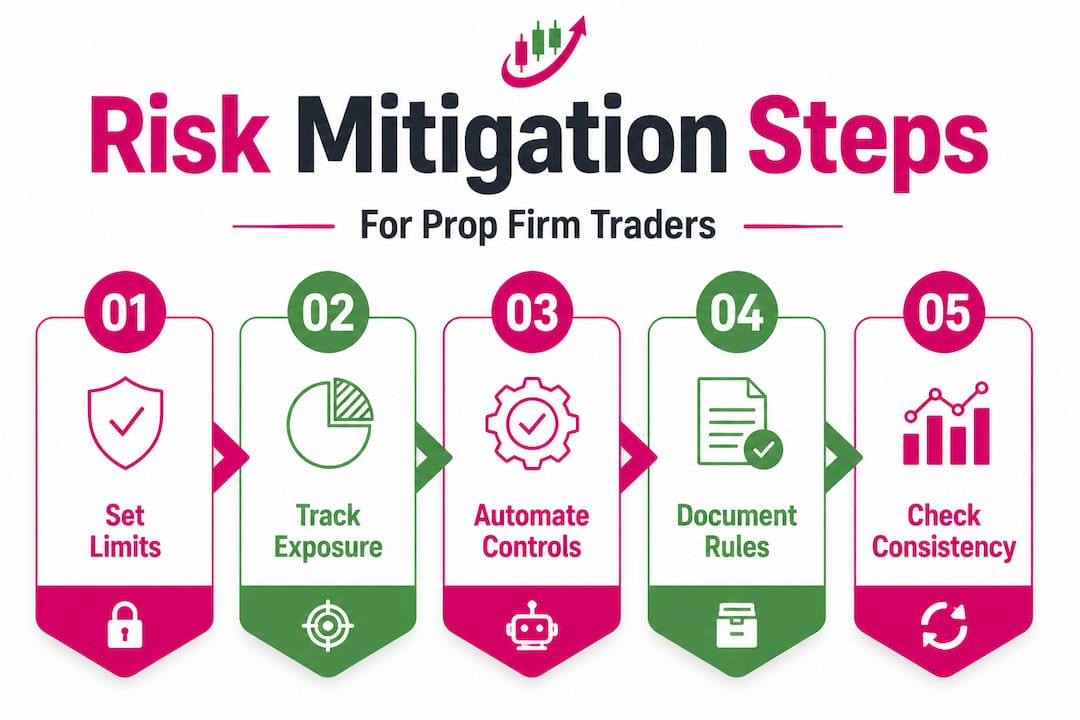
A practical step-by-step approach to implementing risk safeguards:
- Define your maximum per-account risk in writing before trading begins
- Calculate your aggregate R exposure every morning before the session opens
- List all open pairs and identify correlations using a standard correlation table
- Set a hard cap on correlated exposure, for example, no more than 2% combined exposure on USD-correlated pairs across all accounts
- Use trade copying best practices to enforce lot sizing automatically so human error doesn’t override your rules
Pro Tip: Create a simple spreadsheet that auto-calculates your total R exposure as you enter trades. Color-code it red when you exceed 6R. That visual cue is more effective than any mental note you make during a fast-moving session.
Leveraging trade copiers for discipline
This is where automation earns its place. Instead of manually calculating lot sizes for each account before every trade, a trade copier handles it in real time. You define the risk parameters once, and the system enforces them on every trade, every time. The key benefit isn’t just speed. It’s the elimination of the mental shortcuts that lead to oversized positions. The guide on managing accounts with trade copying explains how structured copying replaces impulsive decision-making with repeatable, rule-based execution.

With these core mitigation strategies laid out, let’s look at the tools and automation that help enforce them with less manual effort.
Automating risk controls with technology
Automation doesn’t replace judgment. It protects your judgment from fatigue, emotion, and distraction, which are the three main enemies of consistent risk management.
Why automation matters
Manual execution across multiple accounts introduces latency and error. You might enter a trade on Account A, then spend 30 seconds calculating the lot size for Account B, and by then the spread has widened or the price has moved. That 30-second gap compounds over hundreds of trades. Automation removes it entirely.
The consistency benefit is equally important. When you’re up 5R for the week and feeling confident, your manual position sizing tends to drift upward. Automated tools ignore how you feel. They execute based on the rules you set when you were thinking clearly.
| Tool feature | Manual approach | Automated approach |
|---|---|---|
| Lot size calculation | Human error risk | Rule-based, instant |
| Trade execution speed | 15-60 seconds per account | Sub-0.5 seconds |
| Rule enforcement | Depends on discipline | Consistent every time |
| Correlation monitoring | Periodic manual check | Real-time with tools |
| Drawdown tracking | End-of-day review | Continuous |
According to how copy trading works, the key advantage of automated copying in prop firm environments is that it maintains execution discipline even during high-volatility sessions when manual traders are most likely to make errors.
Core benefits of automation for multi-account prop traders:
- Eliminates manual re-entry of trades across terminals
- Enforces pre-set lot sizing based on each account’s balance
- Copies stop-loss and take-profit levels instantly to all accounts
- Reduces the risk of missing a protective stop during fast markets
- Creates an auditable record of every trade across every account
For trade copier security tips, running your software on a dedicated VPS rather than a personal computer prevents outages from power failures, internet drops, or OS updates from interrupting live trading. A VPS also keeps everything on one IP address, which matters for prop firms that monitor for unusual login patterns.
Pro Tip: When adding risk management to EAs, build in a maximum lot size override. Even if your balance scales up, capping the absolute maximum lot size prevents runaway position sizing if a formula or input error occurs.
The feature of automating SL/TP waiting is especially useful for prop traders because it ensures stop-loss levels are confirmed on every copied account before the trade is considered fully open. Missing a stop on even one account can create unprotected exposure that violates firm rules.
Even with automated tools, traders need structured rules and discipline. Let’s look at how to create and enforce these rules across your operation.
Designing and enforcing robust risk rules
Rules that exist only in your head aren’t rules. They’re intentions, and intentions bend under pressure.
Building a documented risk framework
Start with a one-page risk document that covers every account you manage. Include the per-trade risk limit, the maximum aggregate exposure, the correlation cap, the maximum daily drawdown allowed, and the action you’ll take if any limit is breached. Write it as if you’re handing it to someone who will manage your accounts while you’re unavailable.
Steps to building and enforcing your risk rules:
- Document every risk limit in a written policy before the trading week starts
- Set alerts or automated stops tied to your documented drawdown thresholds
- Review compliance every Friday using trade logs from all accounts
- Adjust limits only during non-trading hours, never in response to a live trade
- Schedule a monthly audit where you compare actual behavior against your written policy
According to drawdown rules explained, trailing drawdown rules used by many prop firms mean your equity high-water mark determines the breach point, not just your starting balance. This makes it critical to reduce position sizes after a drawdown phase, not increase them in recovery mode.
“Cap aggregate exposure and correlated positions.” aggregate exposure guidance
Common enforcement pitfalls to avoid:
- Setting rules but not logging trades to verify compliance
- Adjusting risk limits mid-session based on recent wins or losses
- Treating a prop firm’s maximum drawdown as a target rather than an absolute floor
- Skipping the weekly audit because “things are going well”
- Sharing account credentials across team members without clear access controls
The guide on prop trading best practices outlines why documentation and compliance logging are the behaviors that separate traders who consistently pass prop challenges from those who fail repeatedly despite having solid strategies.
Having covered both foundational strategies and advanced enforcement tools, here’s a unique perspective from industry experience on what most traders get wrong.
Why consistency, not prediction, is your true edge
Here’s the uncomfortable reality that most traders avoid: your win rate matters far less than your consistency of process. We’ve seen traders with 65% win rates blow funded accounts, and traders with 45% win rates hold funded accounts for years. The difference isn’t prediction skill. It’s behavioral consistency in applying risk rules.
The industry obsesses over market analysis. Which pairs to trade. When to enter. What the chart pattern says. But in prop trading, the firm doesn’t care about your analysis. The firm cares about your drawdown. You can be right about the market direction and still lose your account if your position sizing was undisciplined.
“Discipline drift” is the real killer. It starts subtly. You skip the aggregate exposure check one Tuesday because you’re in a hurry. You size up slightly on Thursday because you’re feeling confident after three good days. You don’t log the Friday trades because nothing unusual happened. Within a month, you’re operating on gut feel, not rules, and your risk framework exists only on paper.
The traders who succeed long-term treat their risk rules like a pilot treats a pre-flight checklist. Not as optional steps you skip when you’re experienced, but as the non-negotiable foundation of every session. Experience doesn’t eliminate the checklist. It reinforces why the checklist exists.
Focus on what you can control: lot size, stop placement, aggregate exposure, and correlation limits. These are measurable, manageable, and directly tied to account survival. Market direction is not in your control. Process is. The why process beats prediction principle is what separates traders who build long-term funded account relationships from those cycling through failed challenges.
The single most valuable thing you can do today isn’t find a better indicator. It’s audit your last 20 trades for rule compliance. If you find deviations, that’s the real risk you need to fix.
Next steps: Streamline and secure your prop trading setup
If you’ve recognized gaps in your current risk framework, the next step is closing them with tools built for exactly this environment.

Local Trade Copier is designed for prop traders and account managers who need fast, reliable, local trade execution across MT4, MT5, and DXTrade accounts. With sub-0.5-second copy speed, 18 lot sizing options, and automatic scaling per account balance, it enforces your risk rules at the execution level without cloud routing risks. Running entirely on your Windows PC or VPS means one IP address, no external latency, and no prop firm detection concerns. Learn more about trade copier security, explore the automated SL/TP features that protect every account, and start with the installation guide to get set up with your 7-day free trial.
Frequently asked questions
What is the recommended maximum risk per trade for prop firms?
For prop firms, per-account risk should generally be capped at 0.25-0.5% per trade, especially when managing multiple funded accounts simultaneously. Staying at the lower end gives you the most protection against prop firm drawdown rules.
Why is aggregate exposure important in multi-account prop trading?
Aggregate exposure accounts for all open positions across every account at once, preventing the hidden over-leveraging that occurs when correlated trades stack up across multiple funded accounts. Without this metric, per-account limits give a false sense of protection.
How do trade copiers enhance risk management?
Trade copiers automate execution and apply pre-set lot sizing and risk rules consistently across all accounts, eliminating the manual errors and emotional overrides that undermine discipline during live trading sessions.
What steps should I take if trade copiers fail to replicate a trade?
Check your network connection and platform configuration first, then verify that both the master and client terminals are running and properly paired. Contact your trade copier provider’s support team with trade logs to diagnose the issue quickly.
How can I ensure security when using trade copying technology?
Use a dedicated VPS for uptime reliability, set strong unique passwords for every platform, and keep all EA software updated to the latest version to minimize vulnerability to outages or unauthorized access.
Recommended
- Prop Firm Account Management Tips: Maximize Efficiency
- How prop firms help forex traders scale and manage risk
- Your ultimate prop firm trading checklist for better results
- Prop trading best practices: Multi-account copying in 2026
- Trading rules checklist for prop firm success (2026) | Responsible Trading
