

TL;DR:
- Low-latency infrastructure significantly reduces slippage and improves forex trading profitability.
- Automated trading is dominant and requires stable, consistent technology to maintain an edge.
- Proper multi-account management and fast execution tools are critical for scaling and risk control.
A single millisecond of latency can cost you a fraction of a pip. Multiply that across hundreds of trades per month and you start seeing the real price of slow infrastructure. VPS co-located in Equinix data centers like LD4 achieve 1-5ms round-trip time to brokers, compared to 20-100ms from a home PC, reducing slippage by as much as 1.7 pips per trade. For retail forex traders and account managers running multi-account setups, that gap is not a minor inconvenience. It is the difference between a consistently profitable strategy and one that bleeds money on execution alone. This guide breaks down exactly how technology shapes your trading outcomes and what you need to act on it.
Key Takeaways
| Point | Details |
|---|---|
| Latency is crucial | Milliseconds of difference in execution speed directly affect slippage and trade profits. |
| Automation levels the field | Retail traders can access algorithmic tools, mimicking institutional automation and efficiency. |
| Diversification is scalable | Technology enables genuine risk diversification across multiple accounts and strategies in real time. |
| Master your tech | Success depends on understanding and managing your tech stack, not just trading strategies. |
The evolution of technology in forex trading
Not long ago, retail forex was dominated by phone calls to brokers, manual order entry, and execution delays measured in seconds. Today, the landscape looks entirely different. The market’s total daily turnover has reached $9.6 trillion, and the infrastructure powering it has become relentlessly sophisticated.
The shift is staggering when you look at the numbers:
| Metric | 2016 | 2025 |
|---|---|---|
| Daily FX turnover | $5.1 trillion | $9.6 trillion |
| Spot trades electronified | ~45% | 63% |
| FX swaps electronified | ~38% | 57% |
| Estimated algorithmic share | ~60% | ~85% |
Electronification is not just a buzzword. It means that the vast majority of trades now move through automated systems, matching engines, and algorithmic pipelines. Over 85% of FX volume is algorithmic, driven by AI bots, statistical arbitrage models, and machine learning systems that react to price changes in microseconds.
What does this mean for you as a retail trader or account manager? Several things:
- Platform access is now a competitive weapon. MetaTrader 4 and MetaTrader 5 gave retail traders access to Expert Advisors (EAs), scripting, and automated strategy execution that used to cost institutional money to build.
- APIs democratized strategy deployment. You can connect directly to broker feeds, execute programmatically, and replicate algorithmic trading tools that rival those used in trading desks.
- Cloud and local automation are now both viable. The choice between cloud-routed and locally run systems carries real consequences for latency, privacy, and prop firm compliance.
The rise of AI in forex trading also changed the strategy landscape. Sentiment analysis, pattern recognition, and adaptive position sizing are no longer reserved for hedge funds. Retail platforms now integrate these features directly or through third-party EAs. The question is no longer whether you should use technology. It is whether your technology stack is good enough.
Key takeaway: The forex market has become an electronically dominated ecosystem where your infrastructure quality directly affects your ability to capture the edges your strategy generates.
Latency and trade execution: Why every millisecond matters
With the broad technology landscape established, let’s get specific about the core competitive battleground: execution speed and latency.
Latency is the time it takes for your order to leave your trading terminal, reach the broker’s server, get filled, and send a confirmation back. This round-trip time (RTT) is where most retail traders lose ground without realizing it.
| Setup | Typical RTT | Slippage range per trade |
|---|---|---|
| Home PC (broadband) | 20-100ms | 0.5-2.0+ pips |
| VPS in broker data center | 1-5ms | 0.2-0.5 pips |
| Equinix LD4 co-located VPS | Under 2ms | Near zero slippage |
A VPS co-located near your broker’s matching engine reduces your RTT to under 5ms, directly cutting slippage by 0.2 to 1.7 pips per trade. If you place 100 trades per month with an average slippage savings of just 0.5 pips on EURUSD, at standard lot sizes, you are looking at $50 to $500 in recovered profit per month depending on your lot size. That is real money.
But here is something most articles skip: peak speed is not everything. VPS latency benchmarks show that stable, low-jitter connections consistently outperform setups that achieve a low minimum ping but spike unpredictably. Jitter is the variation in latency over time. A VPS that averages 3ms but spikes to 80ms during market opens is more dangerous than one that holds a steady 8ms around the clock. Consistency matters more than the best-case number.
This principle becomes critical when you are managing multiple accounts simultaneously. In a master-follower or MAM/PAMM setup, every millisecond of delay between the master trade firing and the follower accounts receiving the signal can result in different fill prices across accounts. That inconsistency creates tracking error, client complaints, and compliance headaches. Using a fast local copier eliminates cloud routing from the equation entirely, keeping all signal transmission on a single machine.
Pro Tip: When evaluating a VPS provider for forex, ask for a latency test file or ping tool that measures RTT to your specific broker’s server IP, not just a generic data center ping. The broker’s matching engine location is what matters, not the VPS provider’s headquarters.
Multi-account management amplifies both the benefits and the risks of latency. If you are copying trades from one master account to five client accounts, a 50ms delay on each hop could mean that some client accounts fill at a price that is 2-3 pips worse than the master. Over time, this makes your performance record inconsistent and your risk management unreliable. Getting your infrastructure right is not optional at this scale. It is foundational.
For traders looking at the best forex VPS hosting options, prioritizing providers with co-location in Equinix or Interxion facilities closest to your broker’s matching engine will consistently produce the best execution outcomes.
Automation, AI, and the retail edge
We’ve seen the importance of latency, but technology’s edge does not end at speed. Automation is fundamentally changing how you can trade, and it has opened doors that were firmly shut to retail traders just a decade ago.

Consider this shift: algorithmic trading now represents 85% of FX volume, up from roughly 70% two years ago. That acceleration is not driven only by institutions. Retail platforms have expanded their automation capabilities significantly, and traders who know how to use them have a genuine structural advantage.
Here is what automation gives you that manual trading simply cannot match:
- Emotion-free execution. EAs follow rules without second-guessing. When a signal fires at 3 AM, the trade opens. No hesitation, no fatigue.
- Parallel strategy operation. You can run multiple EAs across different currency pairs simultaneously, something physically impossible to do manually with the same precision.
- Real-time risk management. Automated systems can calculate position sizes, set stops, and trail profits faster than any human reaction time.
- Backtested, consistent behavior. Strategies that have been proven over historical data can execute exactly as designed, every single time.
Research confirms the compounding effect of this precision: every 1ms of latency reduction correlates with approximately 0.1% better execution quality. For active traders running automated trading in forex with 200 or more trades per month, that compounds into meaningful profit preservation.
However, automation also has edge cases you need to understand. Brokers have responded to the rise of latency arbitrage strategies by deploying their own detection systems. Broker AI systems now identify pure latency arbitrage through order timing patterns and position duration analysis. If your EA opens and closes positions in under 200ms on a regular basis, certain brokers will flag and restrict your account, regardless of your strategy’s stated logic.
The practical implication is clear: speed alone is not a sustainable edge. Sustainable edges come from combining reliable infrastructure with genuine strategy alpha. Automation is the delivery mechanism, not the strategy itself. Understanding the impact of AI on forex markets also helps you build strategies that account for how algorithmic market participants behave, rather than fighting against them.
Statistic worth remembering: VPS-based execution reduces slippage costs by roughly $300 per month for accounts placing 100 standard lot trades, when comparing home PC to co-located VPS setups.
Pro Tip: Use a FIX API connection or a platform like cTrader if you need sub-1ms order placement for institutional-style strategies. For the vast majority of EA-based retail strategies, the difference between 1ms and 5ms RTT is negligible compared to the difference between 5ms and 100ms.
Multi-account management: Diversification and synchronization at scale
Beyond single-account advantages, technology unlocks the ability to manage and diversify across multiple accounts simultaneously. This is where the compounding power of good infrastructure becomes most visible.
Here is why multi-account management through technology is not just convenient but strategically essential:
- Real-time synchronization eliminates manual error. Entering the same trade manually across five accounts creates fat-finger risk and timing gaps. Automated copying removes both.
- Proportional lot scaling maintains consistent risk. A $10,000 account and a $50,000 account should not receive the same raw lot size. Automated scaling adjusts position sizes to each account’s balance automatically.
- Strategy diversification reduces correlated drawdowns. Running different timeframes or currency pairs across accounts means a losing period in one does not necessarily correspond to losses in another.
- Performance tracking becomes cleaner. When all accounts execute from the same master signal with minimal slippage variance, your performance attribution is accurate and verifiable.
FX electronification data from the 2025 Triennial Survey confirms that 63% of spot trades and 57% of swaps now execute electronically, creating an ecosystem where automated multi-account strategies are not just possible but expected at the professional retail level.
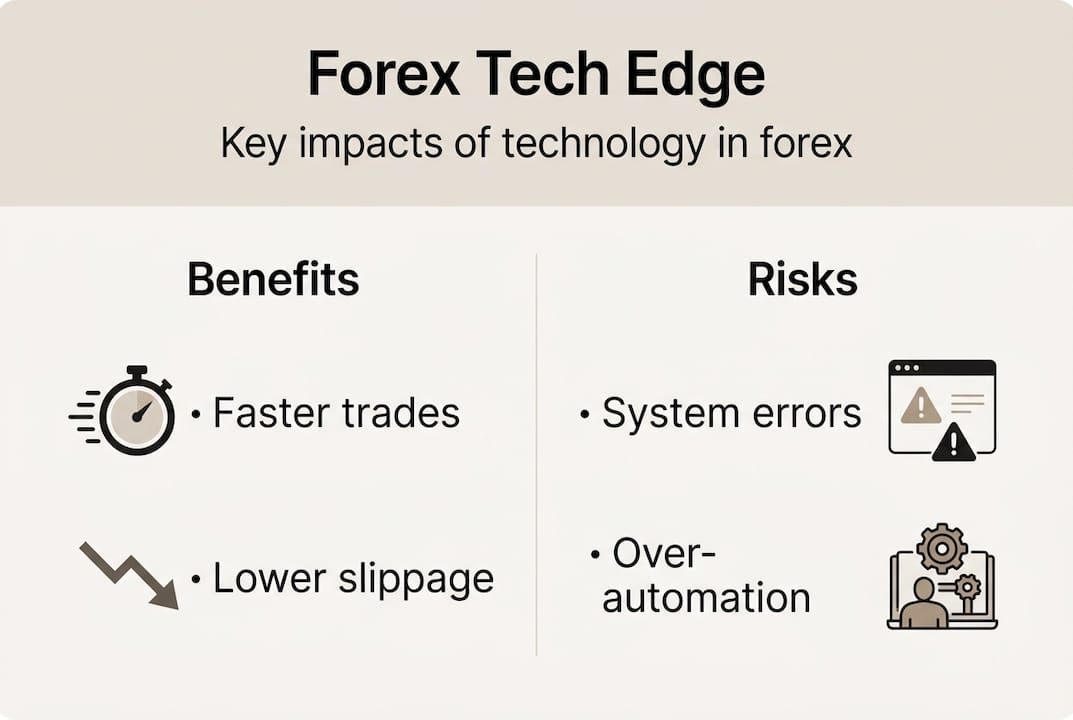
The tools that make this scalable include:
| Tool type | Best use case | Latency sensitivity |
|---|---|---|
| MAM/PAMM | Broker-managed allocation | Moderate |
| Local trade copier | On-machine, multi-terminal copying | High priority |
| Cloud-based copier | Remote signal delivery | Introduces cloud latency |
| VPS-hosted EA | 24/7 automated strategy | Critical |
VPS colocation combined with MAM/PAMM produces the best results for multi-account managers because it ensures under 5ms execution with proportional scaling and minimizes the correlated risk that comes from identical fill prices across accounts. When latency exceeds 50ms, the slippage differential between master and follower accounts starts eroding the entire point of synchronized copying.
For independent account managers who want to understand the full multi-account management benefits in practical terms, the key is building a setup where the signal originates from a single master and reaches every client account on the same machine within sub-500ms. That is achievable locally with the right software, and it completely bypasses the cloud routing problem. You can explore how multi-client copying works in practice to see exactly how a single master drives multiple accounts without manual intervention.
Our view: Why mastering technology is your true edge
Here is a perspective that the broader trading industry rarely states plainly: most retail traders lose not because their strategies are wrong, but because their infrastructure fails to deliver what their strategies require.
We have worked with thousands of traders since 2010. The pattern is consistent. A trader builds or buys a solid EA, backtests it thoroughly, and then wonders why live results lag significantly behind the backtest. The usual culprit is not strategy drift. It is execution degradation. Slippage, latency spikes, internet disconnections, and platform crashes swallow the edge that the strategy was designed to capture.
The traders who consistently perform in line with their backtests share one characteristic: they treat their technology stack with the same rigor they apply to their trading rules. They know their broker’s server location. They measure their actual RTT regularly. They run on stable VPS infrastructure with redundant connections, not on a home PC that competes with streaming video and software updates.
There is also an uncomfortable truth about automation: it is not a substitute for understanding your market. We see traders over-rely on EAs in conditions those EAs were never designed for. A scalping EA optimized for high-liquidity London session hours will behave unpredictably during Asian session thin markets. Automation executes your rules perfectly. It cannot tell you when your rules no longer apply.
The same logic applies to copying strategies. If you are an account manager copying trades to clients, the technology that handles the copying is only as good as the master strategy feeding it. Invest in account management optimization at the strategy level, not just the infrastructure level.
Our honest recommendation: allocate at least as much time to learning your tech stack as you do to refining your trading signals. A 10% improvement in strategy win rate matters far less than eliminating a 1-pip average slippage on 200 monthly trades. Do the math for your own account size and you will quickly see where the leverage is.
The traders who win consistently in 2026 are not necessarily the ones with the best signals. They are the ones whose signals get delivered cleanly, at the right price, to the right accounts, every single time.
Leverage the right tools for your trading success
Armed with this knowledge, you are ready to streamline your trading. The gap between understanding latency and actually eliminating it comes down to the tools running on your machine.
Local Trade Copier is purpose-built for exactly this scenario. It runs as an Expert Advisor directly on your Windows PC or VPS, copying trades from a single master account to multiple MT4, MT5, or DXTrade accounts with sub-0.5-second local execution and no cloud routing. Every trade stays on one machine, one IP address, which matters especially for prop firm accounts where cloud-based copying creates detection risk. You can explore fast trade copying solutions to see how local execution compares to cloud alternatives, review secure trade copying best practices for VPS and password security, and follow the step-by-step trade copier installation guide to get running in minutes. A 7-day free trial is available with no commitment required.
Frequently asked questions
How much does VPS latency impact forex profits?
VPS co-location reduces latency from 20-100ms on home PCs to 1-5ms, cutting slippage by 0.2-1.7 pips per trade, which can translate to hundreds of dollars in recovered profit every month for active traders.
Can retail traders automate all their strategies like institutions?
Retail traders can now access EAs, APIs, and cloud ML tools for robust automation, but they still lack institutional advantages like direct market order book access and proprietary data feeds, so automation should complement, not replace, sound strategy design.
What are the main risks of latency arbitrage techniques?
Broker AI systems actively detect pure latency arbitrage through order timing and position duration patterns, meaning accounts relying solely on speed advantages risk restriction or strategy invalidation by their broker.
How do multi-account management tools help reduce trading risk?
Multi-account tools enable diversified strategies across timeframes and instruments with synchronized real-time execution, so a drawdown in one account or strategy does not necessarily ripple across your entire portfolio.
Recommended
- Advanced forex trading: techniques for risk and speed
- MT4 vs MT5: Key differences for smarter forex trading
- The Technology Behind The Forex Market And Why It’s Important
- How Artificial Intelligence has Changed the Forex Trade
