
TL;DR:
- Forex trade signals indicate entry and exit points but require trader judgment and risk management.
- Signal delivery methods vary in speed and control, with local copiers offering fast, cross-platform copying.
- Effective signal use depends on verified performance, diversification, strict risk caps, and proper infrastructure.
Forex trade signals have a reputation problem. Many retail traders assume a good signal provider means consistent profits, but regulatory data shows the majority of retail forex accounts lose money, making drawdown control and execution discipline more determinative of outcomes than signal selection alone. (Source: ESMA) This guide cuts through the noise. You’ll learn exactly what forex trade signals are, how they’re delivered and copied across MetaTrader 4, MetaTrader 5, and DXTrade, what realistic performance looks like, and how to build a signal workflow that actually protects your account.
Key Takeaways
| Point | Details |
|---|---|
| Manual vs. automated signals | Manual signals rely on trader analysis while automated signals use algorithms for consistent execution. |
| Trade copying methods | MT4, MT5, and DXTrade offer built-in and third-party tools that enable efficient signal copying across platforms. |
| Performance varies | Win rates and returns fluctuate; risk controls are essential to avoid large losses. |
| Provider selection matters | Choose signal providers with proven track records and diversify to enhance reliability. |
| Technology supports, doesn’t replace judgment | Even smart algorithms depend on trader oversight for long-term success. |
What are forex trade signals?
A forex trade signal is a trigger that tells you when to enter or exit a trade. It usually includes a currency pair, a direction (buy or sell), an entry price, a stop loss, and a take profit level. That’s the core of it. What varies is how the signal is generated and who or what generates it.
Manual signals come from experienced traders who study charts, apply technical indicators, and make judgment calls based on market context. Manual signals rely on chart patterns and indicators, while automated signals come from trading algorithms or expert advisors (EAs) designed to remove emotional bias from the process. Both approaches have legitimate uses, and neither is universally better.
Signals can be generated through several methods:
- Chart pattern recognition: A trader spots a head-and-shoulders pattern on EUR/USD and sends a sell signal to subscribers.
- Indicator-based algorithms: An EA fires a buy signal when RSI crosses above 30 and price is above the 200-period moving average.
- Fundamental triggers: A signal service issues a trade alert before a major news release based on expected volatility.
- Machine learning models: Algorithms trained on historical price data predict short-term direction and generate signals automatically.
One thing signals do not do is remove the need for trader judgment. This is the most common misconception. A signal tells you what to do; it doesn’t tell you whether doing it right now makes sense for your account size, your open positions, or your current risk exposure.
Pro Tip: Before subscribing to any signal provider, ask for at least 6 months of verified trade history. Unverified screenshots prove nothing. Look for audited results on platforms like Myfxbook or FX Blue.
Signals are a tool, not a strategy. The traders who use them profitably treat them as one input among several, not as a replacement for thinking.
How trade signals are delivered and copied on MetaTrader and DXTrade
Understanding what signals are is one thing. Getting them into your live account fast and accurately is another challenge entirely. Delivery methods vary significantly in speed, reliability, and the level of control they give you.
Here are the most common delivery and copying methods, ranked by how much manual effort they require:
- Built-in MT Signals tab: MetaTrader 4 and MT5 both have a native signals marketplace. You subscribe, and trades are copied automatically to your account. It’s simple, but you have limited control over lot sizing and no cross-platform support.
- MQL5 marketplace EAs: You purchase or rent an EA that generates signals internally and places trades directly. No external subscription needed, but you’re dependent on the EA developer’s logic.
- Telegram copiers: A signal provider sends trade alerts via Telegram, and a copier EA reads those messages and places trades on your MT4 or MT5 terminal. Cross-platform copying via Telegram supports MT4, MT5, and DXTrade with symbol mapping, lot scaling, and risk controls.
- Local Trade Copier: A master account places trades, and the copier replicates them instantly to one or more client accounts on MT4, MT5, or DXTrade, all on the same machine with execution of 1 second or faster under normal market conditions.
| Method | Speed | Control | Cross-platform | Setup effort |
|---|---|---|---|---|
| MT Signals tab | Medium | Low | No | Low |
| MQL5 EA | Fast | Medium | No | Medium |
| Telegram copier | Medium | High | Yes | Medium |
| Local Trade Copier | Very fast | Very high | Yes | Low to medium |
For traders running MT4 alongside DXTrade accounts, MT4 to DXTrade copying is one of the most practical setups available. The MT4-to-DXTrade integration handles symbol mapping automatically, which solves one of the most common headaches when copying across different broker environments. You can also sync trades from MetaTrader to DXTrade with full lot scaling per account.
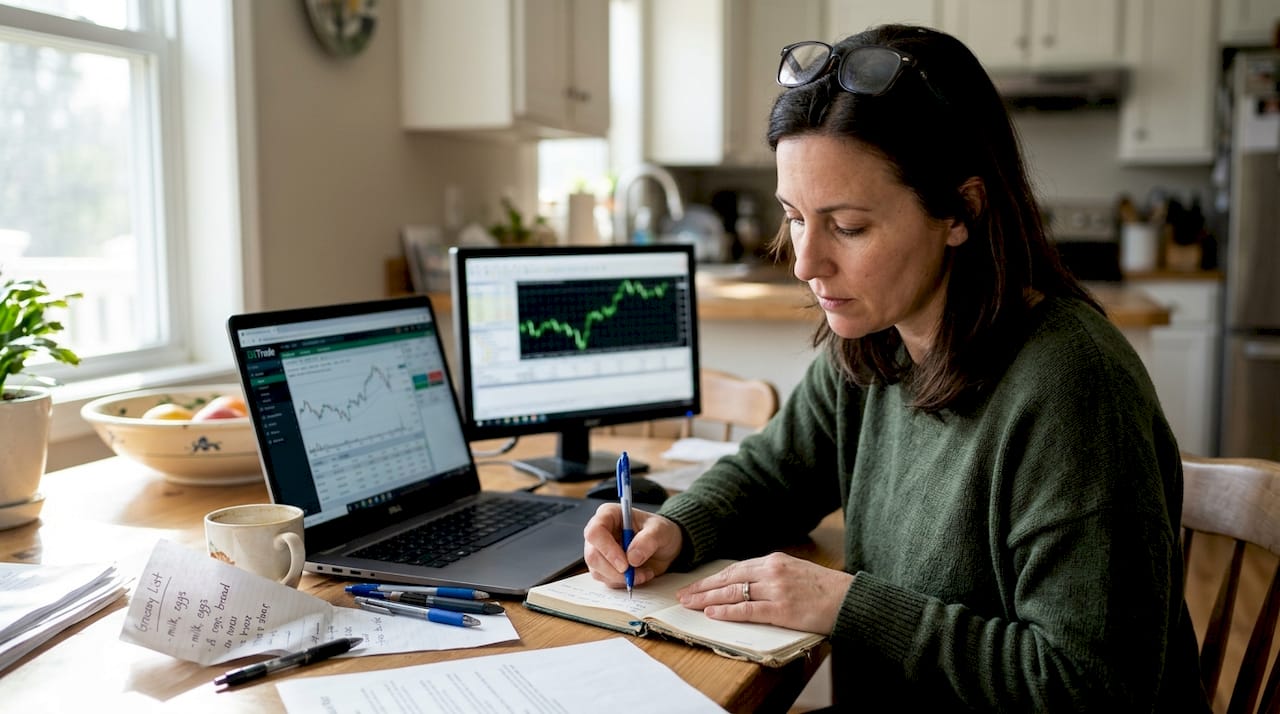
Multitasking trader comparing DXTrade and MT4 screens
Pro Tip: Always test any new copier setup on a demo account before committing real funds. Even a well-configured copier can behave unexpectedly if symbol names differ between your master and client brokers.
Performance and risks of forex trade signals
Let’s talk numbers. Signal performance data from Acuity Trading’s simulated signal reviews shows that monthly returns vary significantly by asset class and market conditions. In their September 2025 simulated review, FX Crosses led performance at +6.03% across 98 trades while Commodities posted -5.01%, with win rates and drawdowns varying substantially across asset classes. All Acuity performance figures are simulated and do not reflect actual trading results.
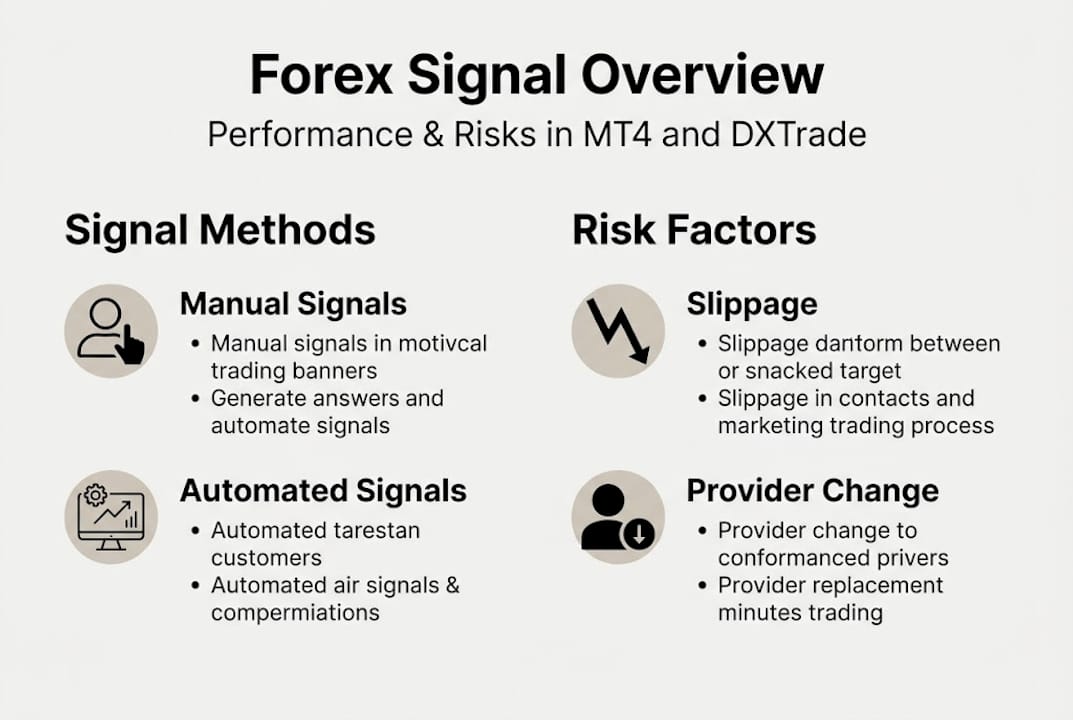
Infographic showing forex signals performance and risks
That range tells you something important: signals are not consistent. The same provider that returns 34% in one month can draw down 28% the next. This is not a flaw in the data; it’s the reality of forex trading.
The most common risks you’ll face when using trade signals include:
- Slippage from signal delays: If a signal arrives late, your entry price may be significantly worse than the provider’s.
- Symbol mismatches: A signal for “EURUSD” may need to be mapped to “EURUSDm” or “EURUSD.” on your broker’s platform.
- Provider strategy changes: A signal service can quietly change its approach without notifying subscribers, and over-reliance on a single provider can lead to serious losses if that happens.
- High drawdown during volatility: News events can spike drawdowns far beyond what historical data suggests.
- No 24/7 coverage without a VPS: If your machine goes offline, trades can be missed or left unmanaged.
A practical way to visualize signal risk:
| Risk factor | Impact level | Mitigation |
|---|---|---|
| Signal delay/slippage | High | Use local copier, fast VPS |
| Symbol mismatch | Medium | Configure symbol mapping |
| Provider strategy change | High | Monitor regularly, diversify |
| High drawdown | High | Cap risk at 1% per trade |
| Machine downtime | Medium | Use Windows VPS |
The trade copier demo is a useful starting point to see how execution speed and symbol handling work before you go live. Checking cross-platform compatibility ahead of time prevents most symbol mismatch issues.
Past performance, whether actual or simulated, is not indicative of future results. Forex trading involves significant risk of loss and is not suitable for all investors.
Smart approaches to signal selection and risk management
Given the performance data and risks above, how do you actually build a signal workflow that holds up? Start with provider selection, then layer in risk controls.
Here’s a practical checklist for evaluating signal providers:
- Verified track record: Look for audited results with at least 6 months of history, not just cherry-picked screenshots.
- Drawdown history: A provider with a 40% historical drawdown is not safe to follow at full lot size regardless of their win rate.
- Trade frequency: High-frequency scalpers carry more slippage risk than swing traders who hold positions for hours or days.
- Transparency: Does the provider explain their methodology? Vague descriptions are a red flag.
- Responsiveness: Can you contact the provider if something goes wrong? Signal services that disappear when questioned are not worth the risk.
For risk management, experts consistently recommend capping risk at 1% per trade, diversifying across multiple signal providers, and testing copier setups in demo before going live. Signals enhance efficiency but should not replace your own judgment.
On the technology side, ML models like Logistic Regression and LSTM networks show superior risk-adjusted returns compared to simple momentum strategies, but rising market efficiency limits how long any edge lasts. Interestingly, simpler models often outperform complex ones in live conditions because they overfit less to historical data.
Diversification tips worth applying:
- Use two or three signal providers with different trading styles (trend following, mean reversion, news-based).
- Spread signals across different currency pairs to reduce correlation risk.
- Limit any single signal provider to no more than 30% of your total risk budget.
Pro Tip: Simpler signal logic often beats complex algorithms in live trading. If a provider can’t explain their edge in plain language, the edge probably isn’t real.
For traders using MetaTrader bots for DXTrade, the trade copier installation process is straightforward and takes less than 30 minutes for most setups.
What most guides miss about forex signals
Here’s the uncomfortable truth: most signal guides focus entirely on finding the “best” provider, as if the right subscription solves everything. It doesn’t. The traders who lose money on signals are rarely victims of bad signals alone. They’re victims of their own execution, their own overleveraging, and their own failure to monitor what’s happening in their accounts.
Signals are convenient for retail traders but become genuinely risky when followed blindly. The 50% win rate reality means you need strong risk management to be profitable, not a better signal. Your judgment about position sizing, correlation between open trades, and when to pause copying during unusual market conditions matters more than the signal source itself.
The MT4 to DXTrade user manual is a good example of how proper setup documentation supports better decision-making. Technology handles execution; you still handle strategy.
Machine learning and advanced signal generation are real improvements, but they’re not a shortcut around market efficiency. The traders who use signals well treat them as structured inputs to their own decision process, not as a replacement for it.
Boost your trading efficiency with proven trade copier solutions
If this guide has clarified how signals work and where the real risks live, the next step is making sure your copying infrastructure is solid. Weak execution erases good signals fast.
](https://mt4copier.com)](https://mt4copier.com)](https://csuxjmfbwmkxiegfpljm.supabase.co/storage/v1/object/public/blog-images/organization-20479/1773294400737_mt4copier.jpg)
Local Trade Copier has been helping retail traders and account managers copy trades across MT4, MT5, and DXTrade since 2010, with 3,000+ active users and 491 Trustpilot reviews backing its reliability. The software runs entirely on your machine, with no cloud routing and execution of 1 second or faster under normal market conditions. You can watch the trade copier demo to see exactly how fast and clean local execution looks, follow the trade copier installation guide to get set up in under 30 minutes, and use the copier troubleshooting resource if trades ever stop copying as expected. A 7-day free trial is included with every subscription.
Frequently asked questions
What is the difference between manual and automated forex trade signals?
Manual signals come from experienced traders analyzing charts and indicators, while automated signals are generated by algorithms or EAs designed to remove emotional bias from trading decisions.
How are trade signals copied between MetaTrader 4, MetaTrader 5, and DXTrade?
Signals are copied using built-in platform tools, MQL5 marketplace subscriptions, or third-party copiers. Local Trade Copier supports cross-platform copying across MT4, MT5, and DXTrade with symbol mapping, lot scaling, and configurable risk controls.
What risks should I watch for when using forex trade signals?
Common risks include slippage from signal delays, symbol mismatches between platforms, provider strategy changes without notice, and high drawdowns during volatile market conditions; always test in demo first.
Are machine learning models reliable for forex signal generation?
ML models show better risk-adjusted returns than simple momentum strategies, but rising market efficiency limits their edge; simpler models often outperform complex algorithms in live trading conditions.
Should I rely solely on forex trade signals for my account management?
Signals enhance efficiency but should never replace active monitoring and your own judgment; always apply risk controls, diversify across providers, and review performance regularly.
Recommended
- MT4 to DXTrade Copier Video Tutorial – Instantly Copy Trades
- MetaTrader Trade Copier Syncs With DXTrade | MT4Copier
- MetaTrader Bots and Indicators for DXTrade I MT4 Copier
- Were You Forced to Switch to DXTrade? | MT4 Copier
