

Balance-based lot sizing scales each client’s lots by client_balance ÷ reference_balance × master_lot, which scales lot size in proportion to account balances. It is only safe when you normalize for contract size, leverage, and volume step first. Before you copy a single order, check the symbol specification, the available margin, and the broker’s volume rules on one pilot account.
TL;DR:
- Before copying, normalize each raw lot for contract size, leverage, and broker volume steps, then verify free margin under that account’s symbol rules.
- A calculated lot such as 0.137 may be rejected unless it matches the broker’s volume step and minimum and maximum limits.
- When a small balance rounds to zero, choose a minimum lot floor that raises exposure or a monetary risk cap that skips the trade.
- Balance based sizing stays stable through floating losses, unlike equity based sizing, but it can overlook open exposure and leave free margin thin.
- Test on a demo or one pilot account, including different contract sizes, tiny balances, margin limits, and deposit currencies, before enabling live copying.
How does the balance-based lot sizing formula work?
The core calculation is proportional: scaled_lot = master_lot × (client_balance / reference_balance). Each term has a job:
- master_lot: the volume the master account opens on the trade.
- reference_balance: the balance you treat as “1x”, usually the master account’s balance or a fixed figure you choose and document.
- client_balance: the current balance of the account receiving the copied trade.
- Result: a raw lot size that still has to be normalized before an order can be sent.
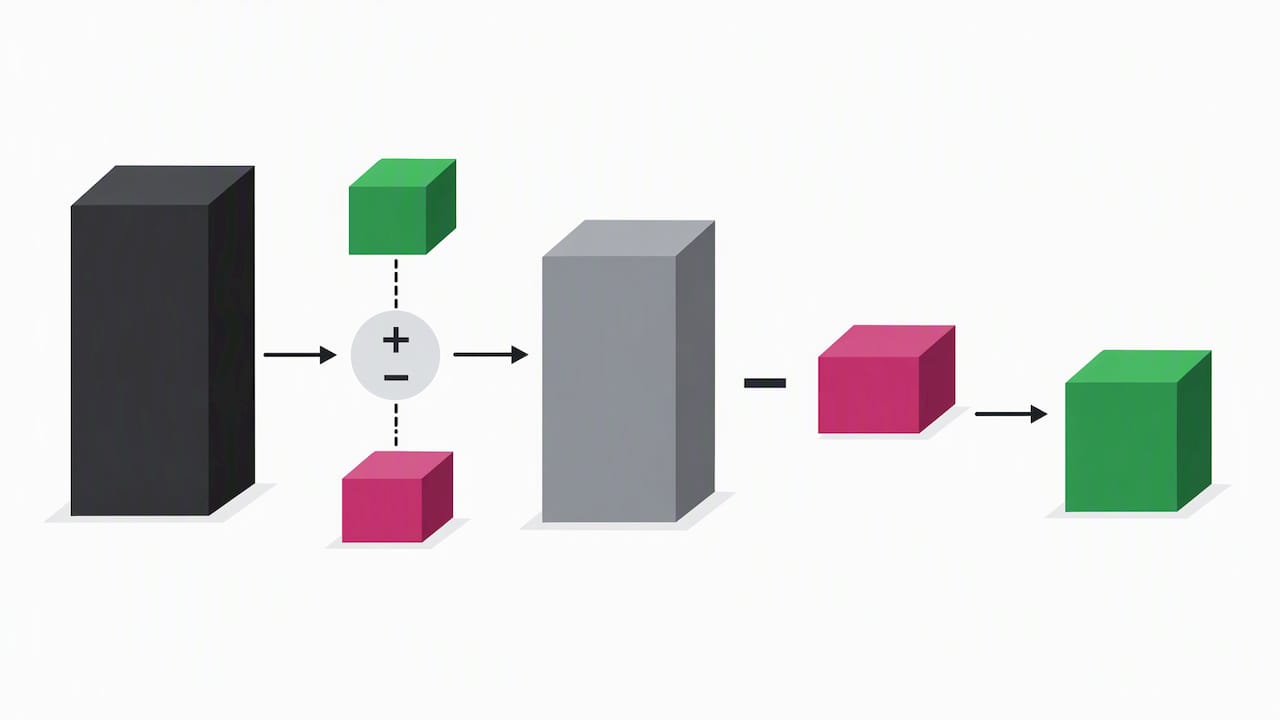
That raw number is not the exposure. MetaTrader’s documentation gives retail forex margin as volume in lots × contract size ÷ leverage, subject to the broker’s calculation mode and symbol settings. Two clients with the same scaled lot but different leverage reserve different amounts of margin, and a lot on one symbol is a different notional amount than a lot on another.
The platform’s own formula: volume in lots × contract size ÷ leverage sets the margin reserved for each position, so a scaled lot must be checked against each account’s leverage and symbol specification.
Balance and equity also differ. Balance excludes floating profit and loss, while free margin reflects open positions. An account with a large balance but several losing open trades can have far less free margin than the formula assumes, so a lot that looks affordable on paper can be rejected at execution. The MetaTrader trading guide also notes that lot volume drives both potential profit or loss and the margin reserved.
What should account managers check before enabling automatic scaling?
Run these steps for each client account, in order:
- Capture the client’s current balance and set the reference balance and master lot you will use. Write both down.
- Calculate the proportional lot, then normalize it to the symbol’s volume step and its minimum and maximum limits, which you can read in the platform’s Market Watch symbol specifications.
- Verify that the account has enough free margin for the scaled volume under the broker’s margin rules, converting margin into the deposit currency when the symbol is quoted in another one.
- Apply a monetary risk cap and a per-trade safety limit so a large balance ratio cannot produce an oversized order.
- Test the whole chain on a demo or a single pilot account before any live client is switched on.
- Record the settings you chose: reference balance, rounding rule, caps, and any account-specific exceptions.
Step 3 deserves careful attention, because a technically correct lot can still fail if there is insufficient margin. If you want more detail on the individual checks, our guide to proportional lot sizing checks for funded traders walks through them for MT4 and MT5.
Pro Tip: Run the pilot with the smallest client first. If the formula works under tight margin and coarse volume-step conditions, test it on the other accounts before expanding.
How do you make a calculated lot valid?
A calculated lot like 0.137 is not a tradable volume. The requested size must be rounded to the broker’s volume step and stay between the symbol’s minimum and maximum, as the MetaTrader mobile trading help explains when it describes how lot volume maps to a symbol-defined number of base units. These rules decide whether the order exists at all:
- Round to the volume step. If the calculated lot does not match the broker’s volume step, round it to a valid volume. Pick one rounding direction, round down if you want to stay conservative, and apply it everywhere.
- Handle tiny accounts deliberately. A small balance can round to zero. Choose between a minimum-lot floor, which raises exposure above the proportional target, or a monetary risk cap, which may skip the trade. Both are legitimate. Leaving it undefined is not. We cover this in more depth in our lot rounding rules for small accounts.
.** One lot of a currency pair, one lot of a metal, and one lot of an index CFD represent different notional amounts, so the same lot number produces different exposure across symbols. - Split oversized orders. When a scaled lot exceeds the per-order maximum, send it as several orders that sum to the target, and check that the combined size does not push the account into a higher margin band.
Which margin, leverage, and regulatory controls should you document?
Leverage multiplies the monetary effect of every scaled lot, in both directions. The CFTC customer advisory on forex explains that OTC forex trades on margin, that leverage amplifies gains and losses, and that traders may be liable for losses beyond their deposit.
Takeaway: with a 2% margin, a $100,000 position needs only $2,000 in the account, which is why a balance-scaled lot must never be treated as a safety measure on its own.
Regulatory guidance points in a consistent direction:
- Know the capital at risk. The CFTC’s forex fraud guidance says risk capital should not be money needed for living expenses or savings.
- Disclose leverage honestly. NFA’s forex regulatory guide expects clear disclosure of risk, and leverage should never be presented as an advantage without equally prominent risk disclosure.
- Keep suitability records. Document your sizing basis, assumptions, rounding behavior, and any exceptions before replication begins, so clients know the rules.
- Write down your caps. Rounding rules, monetary limits, and per-trade ceilings belong in the same document.
Past results do not guarantee future performance.
What goes wrong in practice, and how do you fix it?
Three failures show up repeatedly in testing:
- Rounding to zero. A small account’s proportional lot falls below the minimum step and the trade never opens. Fix it with a minimum-lot floor or a monetary-risk cap, and decide which in advance.
- Margin shortfall. The proportional lot needs more initial margin than the account has free. Pre-check margin, then cap the lot or copy only part of the position.
- Mismatched dollar risk. A stop-loss placed at the same distance as the master’s does not preserve the intended monetary risk on a client with a different deposit currency or leverage. Calculate the loss in the client’s own currency before approving the setup.
How does balance-based sizing compare with equity-based and fixed-lot methods?
Each method answers a different question about what “the same” trade means across accounts.
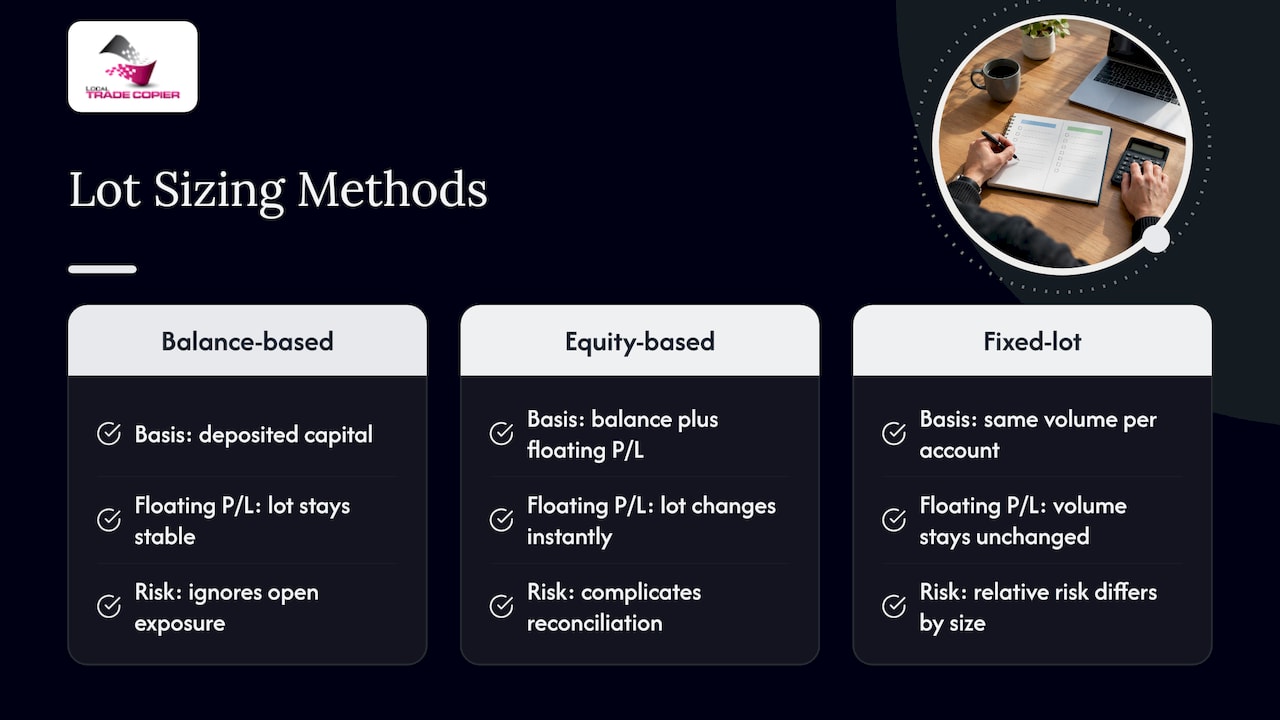
Balance-based sizing scales by deposited capital. It is stable: floating profit and loss do not move the lot, so sizes stay predictable during a drawdown. The tradeoff is that it ignores open exposure, so free margin can be thin even when the balance looks healthy.
Equity-based sizing scales by balance plus floating profit and loss. It reacts instantly, shrinking size when open trades lose and growing it when they gain. That responsiveness also makes lots change from trade to trade for reasons unrelated to the master’s decisions, which complicates reconciliation.
Fixed-lot copying sends the same volume to every account, regardless of size. It is simple and transparent, and our guide on copying with the same lot size shows how to set it up. It also means a small account carries the same lot as a large one, so relative risk differs sharply.
Pick balance-based when clients hold different deposits and you want comparable relative exposure with predictable sizes. Pick fixed-lot when accounts are similar and you prefer simplicity. Consider equity-based only if you accept sizes that drift with open positions. Whichever you choose, the checks in the earlier sections still apply.
How should lot sizes adjust as balances change?
Balances move after every deposit, withdrawal, and closed trade, so decide when your scaling re-reads them. Three approaches work:
- Recalculate per trade. Each new copied order uses the client’s current balance. This keeps exposure aligned but means lots drift as results accumulate.
- Recalculate on a schedule. Refresh the reference ratio weekly or monthly, and hold it constant in between. Sizes stay steady and easy to explain to clients.
- Recalculate on events. Update only after deposits or withdrawals, which change the capital base without reflecting trading performance.
Two guardrails keep any of these safe. First, set a maximum and minimum multiplier so a sudden balance jump cannot inflate a lot beyond what you reviewed. Second, keep monetary caps in force no matter what the ratio says. Our explainer on auto lot scaling describes how automatic scaling reads balances, and our note on allocating account size covers how to choose the reference figure. Document the rule you picked, because a client who sees lots change without explanation will ask why.
How do you test a balance-based setup in Local Trade Copier?
Test small, then widen. A reliable sequence:
- Start on a demo or one pilot account. Confirm the scaled lot matches your hand calculation for several symbols, including one with a different contract size.
- Force the edge cases. Use a tiny balance to trigger rounding to zero, and a large ratio to trigger the maximum lot and margin checks. Confirm the floor, cap, or skip rule behaves as written.
- Check margin before and after. Compare free margin with the scaled order’s requirement so you see rejections in testing, not with a client.
- Verify across currencies. If a client’s deposit currency differs from the master’s, confirm the monetary risk matches your expectation.
- Watch the copy timing. Confirm entries, modifications, and closes arrive as expected. Our demo video shows the scaling in action, and the installation page covers setup on MT4 and MT5.
- Log everything. Keep a record of settings and results so you can reproduce any outcome.
Move to live accounts one at a time, and only after the pilot behaves exactly as documented.
How does Local Trade Copier handle balance-based lot sizing?
Local Trade Copier offers automatic lot scaling based on each client account’s balance, running on your own Windows machine or VPS. You can watch the settings work in the demo, follow the installation guide, and compare subscription options on our pricing page, including a free trial.
To be clear about scope: we provide replication infrastructure only. It copies existing trades and has no market logic, strategy layer, or influence on outcomes. Past results do not guarantee future performance. Start your trial on one account, run the checklist above, and expand once the numbers match.
What operational lessons shaped this checklist?
My advice is to trial your settings on a single account and write down every assumption: the reference balance, the rounding rule, and the caps. When something surprises you later, that document is what lets you find the cause quickly.
— Rimantas
This article is general information, not a substitute for advice from a qualified financial advisor. Consult a qualified financial professional about your own circumstances before acting on anything here.
FAQ
What is balance-based lot sizing in forex?
It scales each account’s trade volume by the ratio of its balance to a reference balance, multiplied by the master’s lot. The result is a proportional starting size, which must still be normalized to the broker’s volume step, limits, and available margin before an order is sent.
Is balance-based lot sizing the same as risk-based sizing?
No. A balance-scaled lot is not a fixed-risk position, because monetary risk also depends on contract size, price, leverage, and the stop distance. Verify that a client’s resulting lot preserves the dollar risk you intended, as the MetaTrader margin documentation implies when it ties margin to volume and leverage.
What happens if the scaled lot rounds to zero?
The trade will not open on that account unless you set a rule. Common choices are a minimum-lot floor, which slightly raises exposure, or a monetary risk cap that skips the trade. Decide in advance and document it.
Do I need to disclose leverage risk to clients?
Regulatory guidance expects clear risk disclosure and suitability records. The CFTC forex advisory warns that leverage amplifies losses, so document your sizing rules and risks for each client. Past results do not guarantee future performance.
Sources
- Margin Calculation: Retail Forex, Futures – For Advanced Users – Trading Operations – MetaTrader 5 Help
- Customer Advisory: Eight Things You Should Know Before Trading Forex | CFTC
- Forex Frauds | CFTC
