
TL;DR:
Risk management is essential for profitable trading, relying on adaptive controls that respond to market changes. Traders must use dynamic position sizing, monitor drawdowns, and adjust risk based on volatility to protect long-term capital. Consistent discipline, automation, and ongoing review are crucial to maintaining effective risk frameworks.
Risk management is the single most important skill separating profitable traders from those who blow their accounts. Most traders assume it means picking a fixed percentage, slapping on a stop-loss, and calling it a day. That assumption is dangerous. The traders who stay in the game year after year use dynamic, adaptive controls that respond to changing market conditions, volatility shifts, and the unique pressures of managing multiple accounts or prop firm challenges. This guide breaks down what evidence-backed risk management really looks like in practice.
Key Takeaways
Risk disclosure: Trading foreign exchange involves significant risk of loss and is not suitable for all investors. The strategies and frameworks described in this article are for educational purposes only and do not constitute financial advice. Past results do not guarantee future performance.
| Point | Details |
|---|---|
| Risk management is dynamic | Effective controls must adapt to market changes and volatility, not just apply static percentage rules. |
| Position sizing is crucial | Calculating trade size based on risk per trade and account balance helps limit losses and manage exposure. |
| Track drawdowns and limits | Constantly monitor drawdowns and set measurable risk limits to avoid catastrophic losses and enable recovery. |
| Workflows matter for multiple accounts | Clear, repeatable workflows apply risk controls consistently for traders managing several accounts or prop firm capital. |
| Automation enhances risk control | Automation tools streamline risk management, reducing manual errors and supporting disciplined trading. |
What is risk management in trading?
Risk management in trading is not just a rule you set and forget. It is the full system of decisions, calculations, and behavioral habits that determine how much of your capital you expose on any trade, how you react when things go wrong, and how you protect your account over the long run.
Three core terms define the foundation:
- Risk per trade: The fixed dollar or percentage amount you are willing to lose on a single position. Most professionals keep this between 0.5% and 2% of total account equity.
- Drawdown: The peak-to-trough decline in your account balance. A 10% drawdown requires an 11.1% gain to recover. A 50% drawdown requires a 100% gain. The math gets punishing fast.
- Position sizing: The calculation that tells you exactly how many lots or units to trade based on your stop-loss distance and account balance.
Position sizing, at its core, is the calculation that tells you how much capital to risk on a single trade, expressed as a dollar or percentage amount, and it sits at the foundation of every structured risk framework.
For prop firm traders, these concepts carry extra weight. Firms impose hard drawdown limits, daily loss caps, and minimum trade requirements. Breaking any of these ends your account. Understanding how managing risk in forex works at a mechanical level is not optional. It is the price of staying funded.
Risk management also protects account performance in a statistical sense. Even a strategy with a 60% win rate will hit losing streaks. A proper risk framework ensures those streaks do not destroy your capital before the edge plays out.
Core components of effective risk management
Now that you know what risk management means, let’s break down the nuts and bolts of controlling risk in real accounts.
Position sizing determines trade size by considering account size and risk tolerance, and calculating risk per trade translates directly into concrete lot sizes. Here is how to do that calculation step by step:
- Define your account balance. Example: $10,000.
- Set your risk percentage per trade. Example: 1%, which equals $100 at risk.
- Identify your stop-loss distance in pips. Example: 50 pips on EUR/USD.
- Calculate pip value. On a standard lot, each pip on EUR/USD is worth $10. On a mini lot, $1.
- Divide your dollar risk by the pip value times the stop distance. $100 / (50 pips x $1 per pip on mini lot) = 2 mini lots.
That is your position size. Simple math, but most traders skip it and trade by feel.
| Account balance | Risk % | Dollar risk | Stop-loss (pips) | Position size |
|---|---|---|---|---|
| $10,000 | 1% | $100 | 50 | 2 mini lots |
| $25,000 | 0.5% | $125 | 30 | ~4 mini lots |
| $5,000 | 2% | $100 | 40 | 2.5 mini lots |
When you manage multiple accounts, this calculation must run independently for each account. The same trade signal may warrant a 1-lot entry on a $50,000 account and a 0.1-lot entry on a $5,000 account. Manually tracking this across multiple terminals is where errors compound. Features like setting risk by symbol or allocating account size automatically let you separate risk profiles per account, removing the room for human error.
Pro Tip: Never use a fixed lot size across all accounts. What looks like a conservative trade on a large account can be account-threatening on a smaller one. Always size relative to balance, not habit.
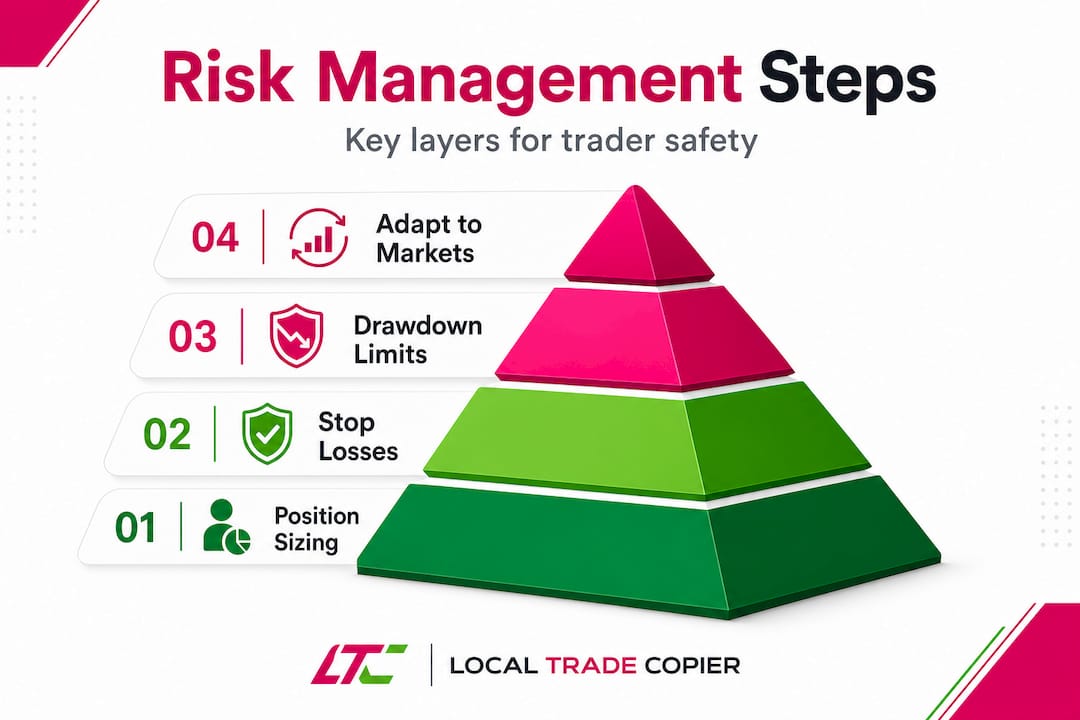
Infographic showing core risk management steps pyramid
Why fixed-percentage rules can fail: Adapting to market regimes
But not all risk control systems are equal. Using a fixed percentage might sound smart until the market changes.
A “market regime” describes the current behavior of a market: trending, ranging, high volatility, or low volatility. A 1% risk rule may be perfectly calibrated for a calm, trending EUR/USD environment. That same 1% can represent a wildly different real-world risk exposure when volatility doubles during a news event or central bank decision.
Risk management should behave as a system that adapts to market regimes, not just as fixed percentages. This means actively measuring volatility, such as using Average True Range (ATR), and adjusting your position sizing or stop placement to match current conditions.
Here is a direct comparison of fixed versus adaptive approaches:
| Scenario | Fixed 1% rule | Adaptive approach |
|---|---|---|
| Low volatility, tight spreads | Possibly over-sized position | Reduced stops, larger relative size |
| High volatility, news spike | Same lot size, but stop blown instantly | Wider stops or reduced position size |
| Trending market | Acceptable performance | Trailing stops engaged, size increased |
| Choppy, ranging market | Repeated small losses at fixed stops | Tighter size or paused trading |
The fixed approach gives traders a false sense of control. You see “1%” on your screen and feel protected. But when EUR/USD ATR doubles because the Federal Reserve announces a surprise rate decision, that 1% becomes a completely different risk exposure in practice.
Pro Tip: Check the ATR on your trading timeframe before every session. If ATR is 50% above its 20-period average, reduce your position size proportionally. Your percentage stays the same on paper, but your real-world exposure stays consistent.
Prop firm traders in particular need to absorb this lesson. Risk strategies for prop firm traders built around adaptive volatility controls have a dramatically better survival rate through challenge phases than those relying on rigid rules. You can also combine ATR-based sizing with advanced risk techniques to create a layered system that is both fast and responsive.
Benchmarks, drawdowns, and recovery: Measuring and managing risk over time
Adaptive risk management gets you halfway there. The next step is tracking risk and building for recovery.
Drawdowns are not just bad luck. They are mathematically inevitable, even for profitable strategies. The critical insight most traders miss is that drawdowns are path-dependent. Two strategies with identical average returns and identical win rates can produce very different drawdown depths depending on the order of winning and losing trades. A long string of early losses with the same eventual recovery looks very different emotionally and financially than an evenly distributed set of losses.
- Set a maximum drawdown limit before you start trading, not after you have already lost 15%.
- Monitor drawdown in real-time, not just at month-end statements.
- Account for both absolute drawdown (from starting balance) and relative drawdown (from peak balance).
- Plan recovery targets that are realistic: a 20% drawdown requires 25% to recover, not 20%.
Research on equity drawdown patterns confirms that drawdowns are path-dependent and that recovery timelines vary significantly based on drawdown depth.
Professional trading operations enforce measurable exposure limits and monitor drawdowns continuously, applying the same discipline retail traders benefit from adopting at the individual account level. Treating each week or month as an isolated event disconnects you from the cumulative picture.
Understanding forex copying and recovery periods becomes especially important when you copy trades across multiple accounts. A drawdown on one account can compound across all copied accounts if your copying rules do not account for individual account health. Similarly, hedging against drawdowns is a practical tool during high-risk periods.

Team tracking drawdowns on trading floor whiteboard
Pro Tip: Create a personal “circuit breaker” rule. If your account hits a 5% drawdown in a single week, stop trading for the rest of that week. Reset. Review. This forces a pause before small losses become catastrophic ones.
Turning strategy into practice: Applying risk management across multiple accounts
Once you understand individual risk, it is time to apply these rules to a portfolio of trading activities.
Translating risk per trade into scalable rules across different accounts is key for real operational success. Here is a practical step-by-step workflow:
- Document your risk rules in writing. Define your max risk per trade, max daily loss, and max drawdown before opening a single position.
- Assign each account its own risk profile. A funded prop account may run at 0.5% risk per trade while a personal account runs at 1.5%.
- Automate position sizing wherever possible. Manual calculation under pressure leads to errors.
- Separate your master and client accounts clearly. Know exactly which account is generating signals and which ones are receiving them.
- Review performance weekly, not just when things go wrong. Drawdown patterns and win rate changes often signal strategy drift before it becomes a real problem.
- Build in escalation rules. If daily loss exceeds 2%, close all open trades and walk away for the day. Automate this if your platform allows it.
For prop firm traders, maximizing account efficiency means more than just profitable trades. It means staying within daily loss limits, meeting minimum trading day requirements, and scaling up position sizes gradually as the account grows.
Pro Tip: Keep a simple spreadsheet that logs every trade with entry, exit, lot size, stop-loss, and dollar risk. After 50 trades, patterns in your risk discipline become undeniable. It is much harder to rationalize breaking rules when you can see the trend in black and white.
The uncomfortable truth about risk management most traders ignore
Here is something that rarely makes it into trading guides: knowing the rules is not the hard part. Following them when it costs you something is.
Across the trading community, the pattern is consistently documented. A trader sets up clean risk rules during demo testing or a calm market period. Then volatility spikes, or a trade gets close to hitting its stop, and the rules quietly get bent. The stop gets moved. The position size gets doubled to “make back” yesterday’s loss. The circuit breaker rule gets quietly ignored “just this once.”
This is not a knowledge problem. It is a process and habit problem. The traders who outperform over years are not necessarily smarter or better at reading charts. They have built systems that make it harder to break their own rules than to follow them. They use automation for position sizing. They set firm daily loss limits with actual consequences. They treat a 2% risk rule the same way a pilot treats a pre-flight checklist: every single time, with no exceptions for bad weather or a tight schedule.
The other uncomfortable truth is that dynamic risk management requires ongoing effort. It is not a set-it-and-forget-it system. Markets change. The volatility environment that shaped your risk rules in 2024 may be completely different in 2026. A risk framework built around advanced trade management should be reviewed regularly, not just when something goes wrong.
The traders who treat risk management as a living process rather than a static checklist are the ones still trading profitably five years later. That is not theory. That is the observable difference between accounts that survive and accounts that do not.
Streamline your risk management workflow with the right tools
Effective risk rules are only as good as your ability to execute them consistently across every account, every session, and every market condition.
Local Trade Copier removes the biggest source of execution error: manual replication across multiple terminals. With a copying speed of 1 second or faster under normal market conditions, eight money management modes, and automatic lot scaling per account balance, your risk framework runs the same way on every account without relying on your attention or discipline in the moment. The wait-for-SL/TP setting ensures copied trades carry the stop-loss and take-profit values you configured on the master account, replicating your defined parameters to every client account, while running on a local machine or VPS keeps your operation secure and your risk minimal. Learn more about security and risk minimization to see how local execution protects prop firm accounts from cloud detection risks. Try it free for 7 days and see how much cleaner your risk workflow becomes.
Frequently asked questions
What is the most important risk rule for forex traders?
Never risk more than 1 to 2% of your capital on a single trade, adjusted for current market volatility. Position sizing determines trade size by accounting for both account balance and risk tolerance, making it the most foundational calculation in any trading plan.
How should I handle risk management when trading for a prop firm?
Use strict, measurable risk limits and monitor your exposures in real-time to stay within firm guidelines. Measurable limits and continuous monitoring are the standard approach firms use to keep all exposures within acceptable ranges.
Are fixed risk percentages always safe in volatile markets?
No. Fixed percentages ignore actual market volatility, which means your real-world exposure changes even when the percentage on your screen stays the same. Risk management must adapt to market regimes, not just track a static number.
What is a drawdown and why should it matter to me?
A drawdown is the peak-to-trough decline in your account, and it matters because recovery math is asymmetric: larger drawdowns require disproportionately larger gains to recover from. Drawdowns can be deep and long even with a diversified approach, making early monitoring critical for protecting your capital.
Recommended
- Most Effective Strategies for Managing Risk in Forex Trading | Trade Copier for MT4 & MT5
- Essential risk mitigation strategies for prop firm traders
- Hedging Strategies: Mitigating Risks in Forex | Trade Copier for MT4 & MT5
- Advanced forex trading: techniques for risk and speed
