
TL;DR:
- Algorithmic trading executes trades faster, more consistently, and scales easily across multiple accounts.
- Trade copying automates strategy deployment, reducing errors and increasing efficiency for multi-account management.
- Effective risk management, infrastructure stability, and manual oversight are crucial for long-term success.
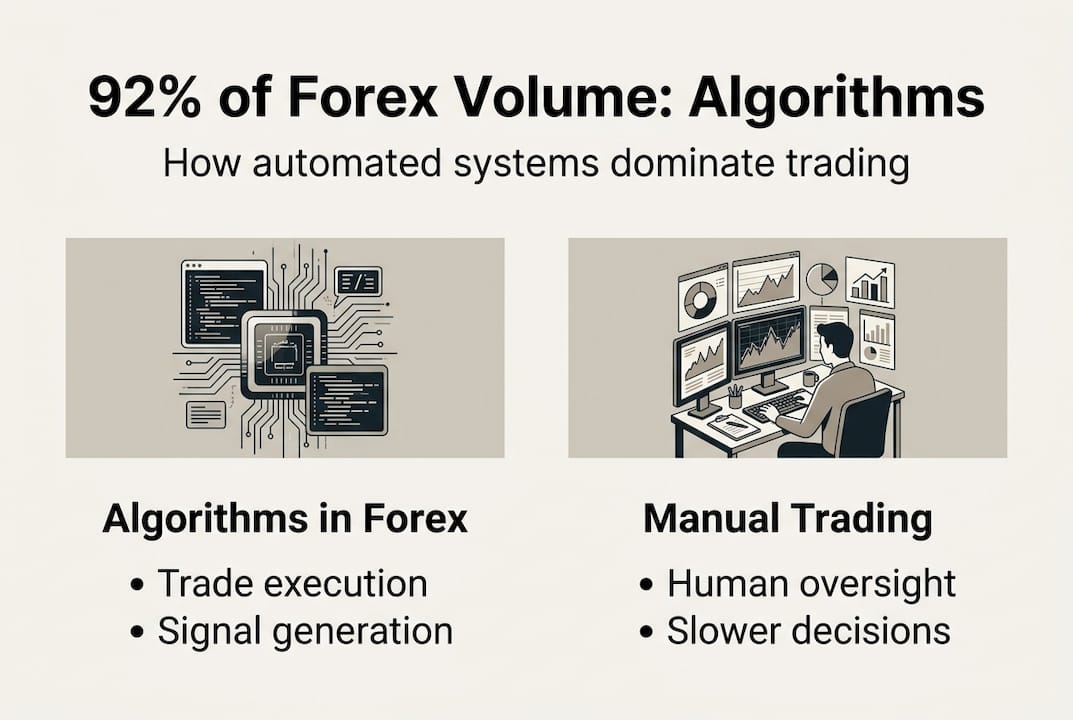
Over 92% of forex trading volume is now driven by algorithms, yet most retail traders still picture a lone figure staring at charts and clicking buy or sell. The reality is far more automated, and far more accessible than you might think. Whether you manage one account or twenty, understanding how algorithmic trading works, and how trade copying fits into that picture, can change how you operate. This guide breaks down the core concepts, the most effective strategies, and the practical tools that help you scale a proven edge across multiple accounts without drowning in manual work.
Key Takeaways
| Point | Details |
|---|---|
| Algorithms drive forex | Over 90% of forex trades are made by algorithms, offering efficiency and speed. |
| Diverse strategies | Retail traders use trend, arbitrage, and AI-driven strategies to automate their trades. |
| Trade copying empowers managers | Trade copiers allow instant, scalable execution of strategies across client accounts. |
| Risk management is critical | Automation brings risks such as flash crashes, so strong safeguards and monitoring are essential. |
| Workflow outperforms code alone | Success depends on reliably managing accounts, not just algorithm design. |
What is algorithmic trading?
At its core, algorithmic trading leverages computers to execute orders using pre-programmed instructions based on variables like price, timing, volume, and market conditions. Instead of a trader manually watching for a signal and clicking a button, a computer detects the condition and fires the order in milliseconds. No hesitation, no second-guessing, no coffee break.
What separates algorithmic trading from manual trading is not just speed. It is consistency. A human trader might skip a valid signal because of anxiety after a losing streak. An algorithm does not have that problem. It follows the rules every single time, which makes performance far more predictable over a large sample of trades.
Here is why algorithms outperform manual execution in most high-frequency or multi-account scenarios:
- Lightning-fast execution: Orders fire in under a millisecond, capturing prices that disappear before a human can react.
- Emotion-free decisions: No fear, no greed, no revenge trading after a drawdown.
- Scalability: One algorithm can monitor dozens of currency pairs simultaneously.
- Transparent logic: Every rule is written in code, making it auditable and testable.
- Backtestability: You can run the strategy against years of historical data before risking a single dollar.
The basic workflow follows three steps. First, the algorithm generates a signal based on market data. Second, it sends an order to the broker. Third, built-in risk checks verify position size and exposure before the trade goes live. That loop can repeat thousands of times per day without any human input.

For independent account managers, this matters because algorithmic trading benefits extend well beyond individual accounts. Once a strategy is coded and tested, deploying it across multiple accounts becomes a systems problem, not a trading problem. And systems problems have repeatable solutions.
Popular algorithmic trading strategies in forex
Common strategies include trend following, arbitrage, market making, HFT, and momentum methods, each with its own logic, toolset, and ideal user profile. Understanding which strategy fits your situation is more important than chasing whichever one performed best last quarter.
Here is a quick breakdown of the leading approaches:
- Trend following: Buys when price is rising, sells when falling. Simple, durable, widely used.
- Arbitrage: Exploits price differences between brokers or instruments. Requires ultra-low latency.
- Mean reversion: Bets that price will return to its average after an extreme move.
- Market making: Places both buy and sell orders to profit from the spread. Requires deep liquidity.
- High-frequency trading (HFT): Executes thousands of trades per second. Institutional territory.
- AI-driven strategies: Uses machine learning to detect non-linear patterns in price data.
| Strategy | Description | Required tools | Typical user |
|---|---|---|---|
| Trend following | Follows price momentum over time | Moving averages, EAs | Retail traders, managers |
| Arbitrage | Exploits cross-broker price gaps | Low-latency infrastructure | Institutional desks |
| Mean reversion | Fades extreme price moves | Bollinger Bands, RSI | Retail algo traders |
| Market making | Quotes both sides of the market | Direct market access | Prop firms |
| AI/ML strategies | Learns from historical patterns | Python, data pipelines | Quant developers |
A practical momentum example: when a 20-day moving average crosses above a 50-day moving average, the algorithm enters long. When it crosses back below, it exits. That logic is simple enough to code in MetaTrader’s MQL4 or MQL5 in an afternoon.
AI and ML are now used in 50% of recent studies on trading systems, which signals a clear direction for where the field is heading. Still, machine learning models carry their own risks, especially overfitting to historical noise.
Pro Tip: Always backtest your algorithm on a separate, out-of-sample data set. If it only works on the data it was trained on, it is not a strategy. It is a memory.
For independent account managers using MetaTrader, these strategies become deployable EAs. Pairing them with trade copying best practices means a single tested EA can drive results across every client account simultaneously.
Trade copying: Making algorithmic strategies work across accounts
Once you have a working algorithm, the next challenge is scale. Running the same strategy manually across ten accounts is not a workflow. It is a full-time job with a high error rate. Trade copying solves that.
Trade copying works by linking a master account to one or more follower accounts. When the master executes a trade, the copier replicates it instantly across all connected accounts, with proportional lot sizing based on each account’s balance or your custom rules. Trade copiers enable efficient copying from master to follower accounts with sub-1-second latency and proportional lot sizing, which makes them the natural infrastructure layer for any multi-account algorithmic setup.
Here is how a typical trade copying workflow runs:
- The algorithm on the master account generates a signal and opens a trade.
- The trade copier detects the new position within milliseconds.
- It calculates the correct lot size for each follower account based on pre-set rules.
- Orders are sent to all follower accounts simultaneously.
- Risk checks confirm each order stays within the defined exposure limits.
- The copier monitors open trades and replicates any modifications or closures.
Comparing manual duplication to algorithmic copying makes the case clearly:
| Factor | Manual duplication | Algorithmic trade copying |
|---|---|---|
| Execution speed | 5 to 30 seconds | Under 0.5 seconds |
| Accuracy | Error-prone | Consistent |
| Scalability | Limited by human capacity | Unlimited accounts |
| Lot sizing | Manual calculation | Automatic per account |
| Emotional risk | High | None |
Understanding how trade copiers work in practice shows why this is not just a convenience tool. It is a performance infrastructure decision. For managers running forex account cloning setups or operating a master account copier across multiple clients, the difference between manual and automated copying shows up directly in results.
Pro Tip: Set individual risk limits per follower account rather than applying one global setting. A client with a $500 account and a client with a $50,000 account should not carry the same absolute exposure.
Risks, limitations, and smart safeguards with algorithmic trading
Algorithmic trading is powerful, but it is not bulletproof. Understanding where it can fail is just as important as knowing where it succeeds.
The major risks every algorithmic trader should plan for:
- Mechanical errors: Bugs in code, broker API changes, or connectivity drops can cause missed trades or runaway positions.
- Liquidity shocks: In thin markets, algorithms can move price against themselves or fail to fill at expected levels.
- Overfitting: A strategy that looks perfect on historical data may collapse in live conditions.
- Regulatory shifts: Regulatory changes can affect algorithmic tools and broker permissions without warning.
- Feedback loops: Multiple algorithms reacting to each other’s orders can amplify volatility rapidly.
Flash crashes and feedback loops are a direct result of uncontrolled algorithmic behavior. The 2010 Flash Crash wiped nearly $1 trillion in market value in minutes before partially recovering. Circuit breakers exist precisely because algorithms, left unchecked, can create self-reinforcing spirals.
Smart safeguards to build into any algorithmic setup include circuit breakers that pause trading after a defined loss threshold, risk throttling that caps daily exposure regardless of signal count, and walk-forward testing that validates performance on rolling out-of-sample windows rather than a single historical period.
Manual oversight still matters. No algorithm should run completely unattended for extended periods. Broker conditions change, spreads widen during news events, and execution quality can shift. A daily check-in on system health is not optional.
For retail traders, algos reduce spreads by 0.28 basis points on average, but latency and transaction costs remain real barriers. Choosing the right platform and keeping your setup close to your broker’s servers matters. Reviewing trade copier limits and optimizing your MetaTrader setup before going live reduces the chance of a technical surprise costing you real money.
The overlooked reality: It’s not just about the algorithm, but the workflow
Most traders obsess over their entry and exit logic. They tweak parameters endlessly, run thousands of backtests, and chase marginal improvements in win rate. What they underestimate is how often the workflow around the algorithm determines actual profitability.
System uptime, broker connectivity, trade copier reliability, and notification setups are not glamorous. But a perfectly coded strategy running on an unstable VPS with no alerts will underperform a mediocre strategy running on a rock-solid infrastructure with real-time monitoring. We have seen this pattern repeatedly over 15 years of working with traders.
Independent account managers who outperform their peers are rarely the ones with the most sophisticated algorithms. They are the ones who have solved allocation, monitoring, and redundancy. They know instantly when something breaks. They have backup connections. They test their entire stack, not just the strategy.
For anyone managing multiple MT4 accounts, the workflow layer is where scale becomes sustainable. Pro Tip: Treat your monitoring and notification setup with the same rigor you apply to your algorithm parameters. An alert that fires 30 seconds after an anomaly is worth more than a strategy tweak that improves your Sharpe ratio by 0.1.
Put algorithmic trading and trade copying into action
If you are ready to move from theory to execution, the right infrastructure makes all the difference. Local Trade Copier has been helping retail traders and independent account managers automate trade replication across MetaTrader 4, MetaTrader 5, and DXTrade since 2010, with over 3,000 active users and 491 Trustpilot reviews backing its track record.
Whether you are running a single algorithmic strategy across personal accounts or managing a full client book, Local Trade Copier handles the copying layer with sub-0.5-second local execution and 18 configurable lot sizing options. Start with the what is MT4 copier overview to understand how it fits your setup, walk through the forex copier installation guide to get running fast, or head directly to the trade copier shop to start your 7-day free trial.
Frequently asked questions
Is algorithmic trading legal for retail forex traders?
Yes, algorithmic trading is fully legal for retail forex traders in most jurisdictions, but regulatory shifts can affect tools and broker permissions, so always verify your broker’s specific terms and your local regulations before deploying.
What skills do I need to start algorithmic trading?
You need basic trading knowledge, familiarity with MetaTrader or a similar platform, and ideally some experience with EAs or automation tools. Algorithmic trading is accessible via MetaTrader EAs and Python, so you do not need a computer science degree to get started.
Are trade copiers profitable over the long term?
Results vary, but 48% of copier setups remain profitable for over 90 days, with the strongest performers combining solid underlying strategies with disciplined per-account risk controls.
What’s the biggest risk with algorithmic trading?
Liquidity shocks and mechanical errors top the list. Flash crashes caused by algorithms amplifying a liquidity vacuum show how quickly uncontrolled systems can spiral, making robust risk management and active monitoring non-negotiable.
Recommended
- Algorithmic Trading in Forex: Automating Your Success
- Why professional traders rely on automation: 92% of Forex
- Optimize automated trading workflow: forex replication guide
- The use of Magic Numbers with the Local Trade Copier on MT4 platform
