

Size equity grants from a bottoms-up hiring plan, not a copied benchmark. Map your next 12 to 18 months of hires, assign each role a grant range, sum the total, add a refresh buffer, and express the result as a percentage of fully diluted shares. Then check that number against market benchmarks and confirm it clears Rule 701 and 409A requirements before you send a single offer letter.
TL;DR:
- Building an equity plan should prioritize future hires with a bottoms-up model based on a detailed headcount roadmap and role-specific ranges, not copying benchmark percentages.
- A hybrid sizing approach, combining ownership percentage, dollar value, and share count, offers the most practical and adaptable method for private companies over time.
- Accurate and current 409A valuations and clear compliance with Rule 701 are essential to avoid tax penalties and legal issues, especially as grants increase in size or frequency.
- Negotiating a precise, data-backed option pool size before negotiations prevents giving away excessive ownership dilution during funding rounds.
- Clear communication of grant details, including fully diluted percentages, strike prices, and vesting terms, along with ongoing tracking and refresh modeling, supports fair and legal equity compensation.
Why You Need Clear Equity Grant Guidelines
Ad hoc equity decisions catch up with you fast. The fifth engineering hire finds out the third one got twice the grant for a similar role, and now you have a morale problem and, potentially, a legal one. Standardized grant guidelines fix that before it starts.
There are three reasons this matters more than most founders assume:
- Fairness and retention. Inconsistent grants, made under deal pressure or founder gut feel, create resentment once employees compare notes, and they almost always compare notes.
- Cap table health. The size of your option pool directly affects your pre-money valuation and how much dilution founders absorb in each round, so headcount planning tied to real hiring needs keeps the cap table honest.
- Compensation philosophy alignment. A company that leans heavily on cash needs a smaller, more targeted pool than one competing on equity upside against better-funded rivals.
Equity risk assessment is not a one-time exercise. It is a recurring check on whether your grant guidelines still match your hiring reality, your burn rate, and your competitive position for talent.
Pro Tip: Write your grant guidelines down as a role-and-level matrix before you make your next hire, not after. Retrofitting fairness after three inconsistent offers is far harder than building it in from the start.
Ownership Percent, Value-Based, or Share Count: Which Sizing Method Fits?
Every company sizing equity lands on one of three base methods, or some blend of them. None is universally right. Each breaks down in a specific, predictable way.
Ownership-based sizing expresses a grant as a percentage of the company, such as 0.25% for a senior engineer. It is intuitive for candidates to understand, but it is also the method most vulnerable to denominator confusion. A 0.25% grant means something very different depending on whether it is calculated against issued-and-outstanding shares or against the fully diluted share count, which includes the option pool, warrants, and convertible securities. Offers should almost always be expressed on a fully diluted basis, because issued-and-outstanding figures systematically understate future dilution and can mislead a candidate about what they are actually getting.
Value-based sizing translates equity into a dollar figure, framing a grant as “$150,000 in equity value” rather than a raw percentage. This resonates with candidates who think in comp packages, but it only works if your 409A valuation is current and defensible. A stale 409A produces a strike price that either overstates the deal (if the valuation has since dropped) or triggers compliance headaches (if it has since risen sharply and the grant should have been repriced).
Share-count sizing hands out a fixed number of shares or options, such as 10,000 options. It is simple to administer in a spreadsheet, but it breaks down the moment your valuation moves quickly between hires. A 10,000-share grant made in January means something very different by September if you have closed a new round. This method works best for narrow cases, senior hires with negotiated custom terms where the number itself is the anchor point in the negotiation.
Startup option pools typically fall between 10% and 20% of fully diluted shares, and where you land inside that range should trace directly back to your hiring plan, not to whatever a competitor’s careers page implies.
In practice, the method that holds up best over time is a hybrid: build your grant sizes bottoms-up from the hiring plan, then sanity-check the resulting numbers against ownership percentage benchmarks for each role and stage. This is the approach Carta recommends, and it is the one that survives contact with a board meeting.
- Ownership-based: intuitive, but demands denominator clarity every time.
- Value-based: good for comp-package framing, dependent on a fresh 409A.
- Share-count: simple, but fragile against fast valuation changes.
- Hybrid bottoms-up: the practical default for most private companies.
How to Build a Bottoms-Up Model for Equity Based Sizing
This is the actual mechanics of equity based lot sizing for a workforce, treating each hire like a line item with a cost, rather than guessing a pool percentage and working backward.
- Build a 12 to 18 month headcount roadmap. List every planned hire by role, level, and expected start quarter. Include replacements and promotions, not just net-new seats.
- Assign a role-level equity range to each seat. Use benchmark data as your starting point (see the table below), then adjust for your stage and how competitive the role is in your market.
- Sum the planned grants and add two buffers. Add a separate refresh budget line for existing employees due for additional grants, plus a 10% to 15% opportunistic buffer for hires you have not yet identified but will likely need.
- Convert the total to a percentage of fully diluted shares. List every item in your denominator explicitly: common stock, preferred stock (as-converted), the existing option pool, warrants, and any convertible notes or SAFEs on an as-converted basis.
Here is a simplified starting range by role and level, adapted from the kind of benchmarks compensation teams use to anchor a bottoms-up model, generally expressed as fully diluted percentage at early stage:
Role-level ranges vary meaningfully by stage, so treat this table as a starting point to adjust, not a fixed rulebook. A Series B company hiring its tenth VP grants far less equity per role than a two-person seed startup hiring its first.
Three operational habits keep this model usable month after month. Keep a live grant ledger that records every offer against the remaining pool balance in real time. Use cap table software rather than a static spreadsheet once you pass a handful of active grants, since manual tracking is where dilution errors creep in. And update your 409A valuation whenever a material event occurs, a new financing round, a significant revenue shift, so strike prices stay defensible.
Pro Tip: Model the refresh buffer as its own line item, separate from new-hire grants. Founders who blend the two consistently underestimate how much pool capacity ongoing refreshes eat up over 18 months.
Which Benchmark Data Sources Should You Trust?
No single benchmark source is complete on its own, so triangulating between at least two is the difference between a defensible number and a guess dressed up as data.
- Carta publishes equity data drawn from the cap tables it administers, strong for stage-specific pool sizing and headcount-driven planning, useful for cross-checking role ranges against real private-company grants.
- Public surveys and law-firm blogs, including Flux’s option pool guidance and Cooley GO, add practitioner context that raw data sets miss, particularly around negotiation norms.
Adjust every headline number for your own stage, geography, and function before you use it. A benchmark drawn mostly from San Francisco Series C companies will overstate what a bootstrapped regional seed startup should grant, and a sample skewed toward engineering roles will understate what you need for a first VP of Sales. The practical move is to run your bottoms-up model first, then hold it against two independent benchmark sources. If your number lands wildly outside both, that is your signal to revisit assumptions, not to abandon the model.
How Should You Size and Negotiate Your Option Pool?
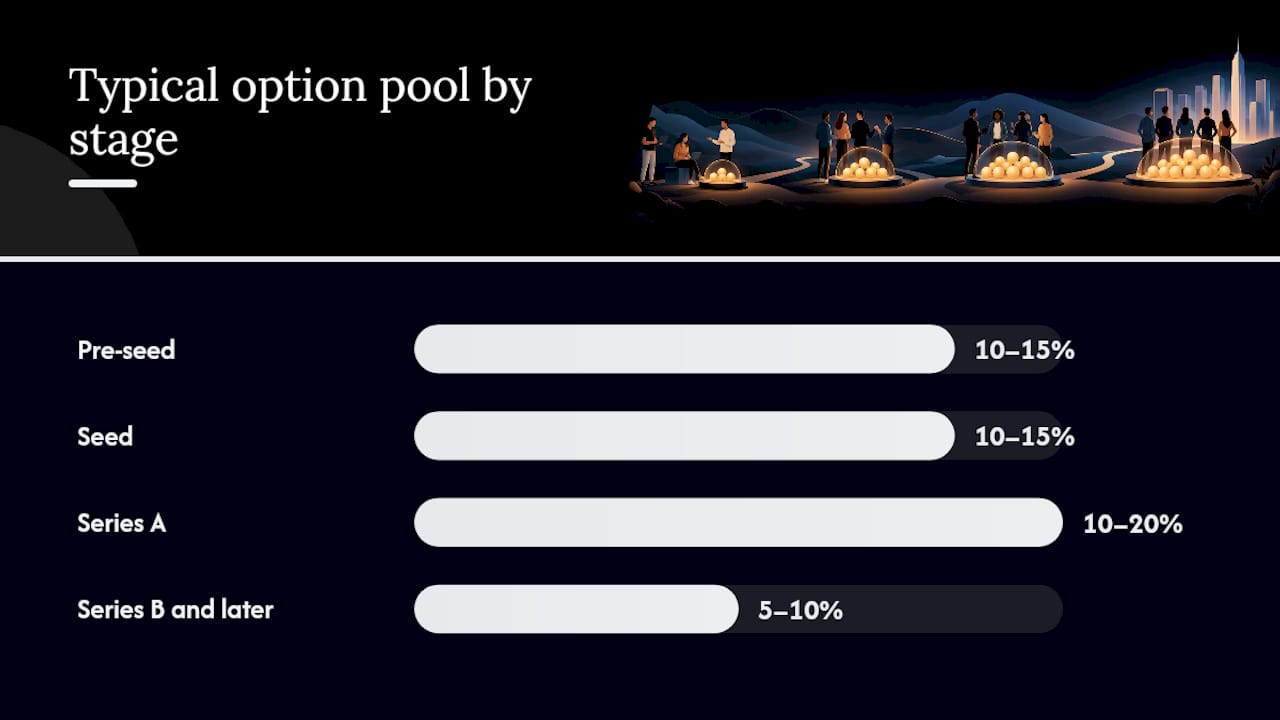
Pool size is where founders lose the most ground to investors, mostly because they walk into the negotiation without their own number.
Typical pool sizing by stage looks roughly like this, expressed as a percentage of fully diluted shares set aside for future grants:
| Stage | Typical pool range |
|---|---|
| Pre-seed | 10% to 15% |
| Seed | 10% to 15% |
| Series A | 10% to 20% |
| Series B and later | Refreshed as needed, often 5% to 10% top-up |
These ranges commonly run between 10% and 20% of fully diluted shares at any given stage, but the number that actually matters is the one your hiring plan produces.
Here is the mechanic founders underestimate: investors typically require the option pool to be created or topped up pre-money, meaning it comes entirely out of the existing shareholders’ side of the cap table before new investor money is added. A larger pool at this stage means more dilution falls on founders and current employees, not on the incoming investor.
- A bigger requested pool increases your effective pre-money dilution, even though the headline valuation looks unchanged.
- Investors often anchor to a round-number benchmark (commonly 15%) regardless of your actual hiring plan.
- A bottoms-up model, hiring plan, role ranges, refresh buffer, gives you a specific, defensible number to counter an oversized ask.
Walking into a term sheet negotiation with a spreadsheet that says “we need 12.4%, here is exactly why” beats walking in with a vague sense that pools are “usually around 15%.” Negotiating the pool size is one of the few places in a financing round where preparation directly converts into founder ownership retained.
Compliance Flags: Rule 701 and 409A for U.S. Private Companies
Two compliance checkpoints sit underneath every U.S. equity grant, and skipping either creates real exposure.
Rule 701 is the primary federal securities-law exemption that lets private companies issue compensatory equity without full registration. It applies to grants made under a written compensatory benefit plan, but it comes with quantitative limits and an enhanced-disclosure threshold: once aggregate sales under the exemption in a 12-month period cross a set dollar amount, the company must provide additional financial disclosures to grant recipients. Fast-growing companies issuing large or frequent grants hit this threshold sooner than they expect.
409A valuations set the fair market value used to determine strike prices for stock options. A stale or aggressive 409A creates two problems: options priced too low can trigger tax penalties for recipients, while options priced too high make the grant less attractive without any real benefit. Refresh your 409A after material events, financings, major revenue shifts, or roughly annually at minimum.
- Confirm every equity plan document is board-approved before any grant is issued under it.
- Verify your 409A is current relative to your last material corporate event.
- Track cumulative Rule 701 issuances against the 12-month disclosure threshold.
- Loop in securities counsel before any grant structure that deviates from your standard plan.
None of this is optional paperwork. It is the legal scaffolding that keeps a clean grant program clean.
How to Present Equity Offers Clearly to Candidates
An offer packet that only states a share count invites confusion and, eventually, a difficult conversation. Include the full picture every time.
- Grant size in shares, plus the equivalent fully diluted percentage stated explicitly.
- Strike price, tied to the most recent 409A valuation.
- Vesting schedule and cliff, stated in plain terms (see the next section for how these interact with sizing).
- Basic tax considerations, flagged generally, with a note to consult a tax advisor for specifics.
When you show scenario tables illustrating potential future value, state your assumptions explicitly, valuation growth is a hypothesis, not a promise, and always include the disclaimer that past results do not guarantee future performance. Never present a scenario as a projection of what the grant will be worth; present it as one possible outcome among several, dependent on vesting completion, future fundraising, and eventual liquidity.
Pro Tip: Say “this is what your grant could be worth if the company’s valuation reaches X” rather than “this grant will be worth X.” That single word swap prevents most of the misunderstandings that surface later in exit conversations.
Refresh Grants and Keeping Your Pool Governable
A pool that looks generous on paper is useless if nobody tracks what has already been promised against it. Refresh grants deserve their own line item and their own burn forecast, separate from new-hire grants, because founders routinely underestimate how much refresh activity eats into available capacity.
- Model refresh grants as an ongoing annual line item, not a one-time adjustment.
- Define a role-and-level grant matrix with clear approval authority, so no single manager improvises a grant size mid-negotiation.
- Maintain a live grant ledger connected to your cap table software, and check remaining reserve before every new offer goes out.
Governance is what keeps a well-sized pool from quietly running out six months early.
What Are the Tax Implications of Equity-Based Compensation?
The tax treatment of equity compensation depends heavily on the instrument, and getting this wrong creates real cash consequences for employees, not just paperwork issues.
Incentive stock options (ISOs) can qualify for favorable long-term capital gains treatment if holding-period requirements are met, but they can also trigger the alternative minimum tax on exercise, a detail many first-time option holders never see coming. Non-qualified stock options (NSOs) are taxed as ordinary income at exercise on the spread between strike price and fair market value, regardless of whether the shares are sold. RSUs are taxed as ordinary income at vesting, whether or not the recipient sells the shares immediately, which can create a cash-flow problem if the shares are illiquid.
None of this is a substitute for individual tax advice, and equity communications should say so plainly. What comp teams can control is the strike price accuracy that flows from a current 409A valuation, since an outdated valuation distorts the tax math for every option holder downstream. Getting the 409A right is as much a tax-protection measure for employees as it is a compliance requirement for the company.
Why Vesting Schedules Matter for Equity-Based Sizing
The grant size on paper only matters if the vesting schedule lets an employee actually earn it, which is why vesting terms belong inside your sizing conversation, not bolted on afterward.
The standard structure remains four-year vesting with a one-year cliff: nothing vests until the employee’s first anniversary, then a chunk vests immediately, and the remainder vests monthly or quarterly afterward. This structure exists to protect the company from granting meaningful equity to someone who leaves within months, and it directly affects how you should think about grant size. A larger grant with a longer cliff and slower early vesting can be a more conservative choice than a smaller grant with faster vesting, even though the headline number looks bigger.
Sizing and vesting interact directly with your refresh strategy too. If early grants vest fully after four years with no new grants issued, you create a retention cliff exactly when a valuable employee has the least remaining reason to stay. Building refresh grants into year three, ahead of that cliff, is a sizing decision as much as a scheduling one.
Stock Options vs. RSUs vs. Other Equity Instruments
Not every instrument behaves the same way, and choosing the wrong one for your stage creates avoidable friction.
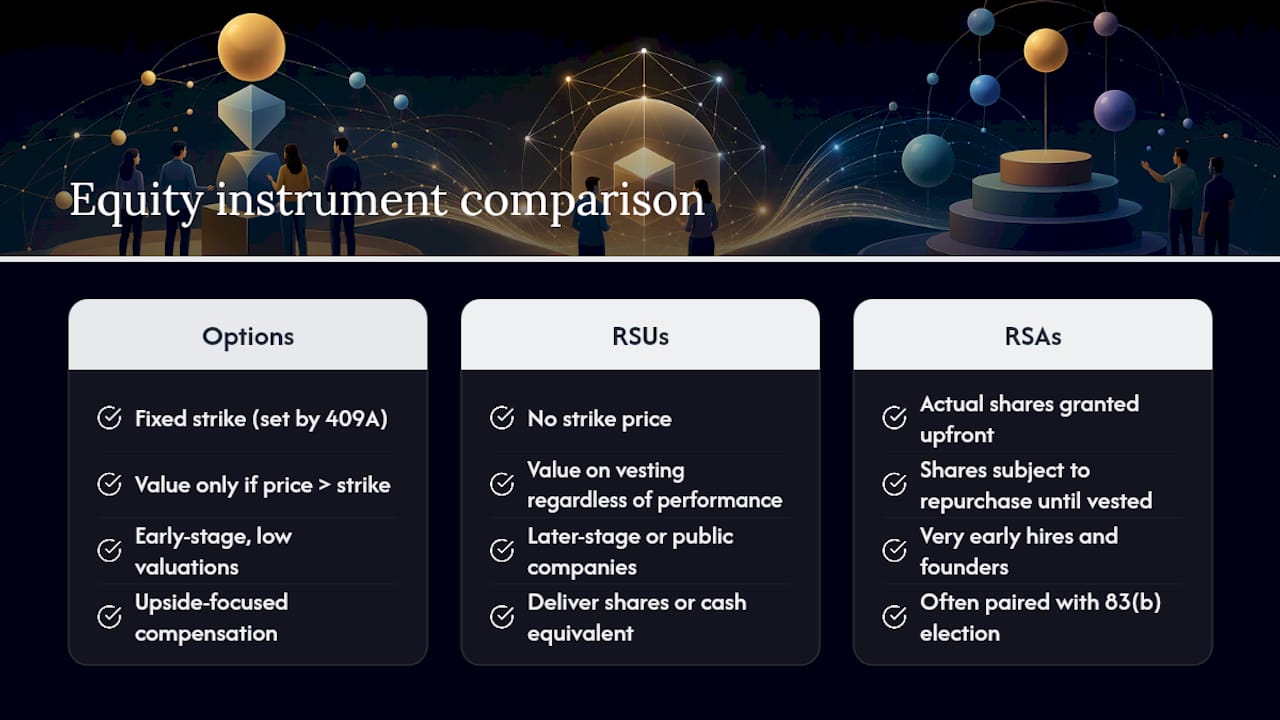
Stock options (ISOs or NSOs) give the holder the right to buy shares at a fixed strike price, set by your 409A valuation. They only carry value if the company’s share value rises above that strike price, which makes them well suited to early-stage companies where upside potential is the primary pitch and current valuations are low.
Restricted stock units (RSUs) are a promise to deliver shares (or their cash equivalent) once vesting conditions are met, with no strike price involved. They carry value immediately upon vesting regardless of company performance since the grant date, which makes them more common at later-stage or public companies where share price is already substantial and options would require a large cash outlay to exercise.
Restricted stock awards (RSAs) grant actual shares upfront, subject to a vesting-based repurchase right if the employee leaves early. They are most common for very early hires and founders, often paired with an 83(b) election to lock in favorable tax treatment while share value is still low.
Choosing between these is largely a function of stage and valuation, not preference. Early-stage companies with low share prices generally favor options; later-stage private companies with higher valuations increasingly lean on RSUs to avoid burdening employees with a large exercise cost.
Negotiation Strategies and Common Pitfalls in Equity Discussions
Most equity negotiation problems trace back to one of two mistakes: the company shows up without a defensible number, or the candidate is left to guess what their grant actually means.
On the company side, the fix is preparation. Walk into every offer conversation already knowing the role’s grant range, the fully diluted percentage it represents, and the reasoning behind it, so you are explaining a system rather than defending an improvised number. Candidates who sense a grant was pulled out of thin air push harder, and reasonably so.
On the candidate side, the most common pitfall is comparing raw share counts across companies with wildly different valuations and share structures, a hundred thousand options at one company can be worth less than ten thousand at another. Encourage candidates to ask for the fully diluted percentage and the most recent 409A valuation rather than fixating on the share number alone.
A frequent internal pitfall: caving to a candidate’s requested number without checking it against your role-level matrix. One exception becomes the precedent the next five candidates will point to.
What Experienced Comp Teams Get Right
The best comp teams reserve their largest grants for genuinely scarce hires, an early technical co-founder-equivalent, a VP who unlocks a new market, and stay conservative elsewhere with a clear refresh pathway instead. On option-pool size, the strongest negotiating position is always a specific number backed by a hiring plan, not a round percentage borrowed from a benchmark deck. Before any offer goes out: confirm the fully diluted math, confirm 409A currency, confirm board approval, confirm the role sits inside your matrix.
— Rimantas
Sources
For deeper reading on the mechanics covered here: Cooley GO on fully diluted denominators and negotiating option pools, Carta’s option pool guidance, Flux’s pool sizing breakdown, and Cooley GO’s Rule 701 explainer for compliance specifics. Readers interested in adjacent modeling approaches for equity allocation can also review CR Equity AI’s research on tokenized investment structures.
This article is general information, not a substitute for advice from a qualified financial advisor. Consult a qualified financial professional about your own circumstances before acting on anything here.
- Why private companies should know about Rule 701: options, RSAs and RSUs | Cooley GO
- How to Size Your Startup’s Option Pool | Flux
FAQ
What Does “Equity-Based” Mean?
“Equity-based” refers to compensation or sizing decisions tied to ownership stakes in a company, shares, options, or RSUs, rather than cash alone. In hiring and compensation, equity-based sizing means calculating grants as a share of company ownership, typically expressed on a fully diluted basis, rather than a flat dollar figure.
Is 1% Equity in a Startup Good?
It depends entirely on stage, role, and timing. A 1% grant at the seed stage for an early, high-impact hire is meaningful and sits near or above the VP-level range in early benchmarks, while the same 1% at a Series C company with dozens of employees would be extraordinarily high and well outside typical role ranges.
Is 30% Equity Good?
A 30% stake is enormous by almost any standard and would typically only apply to a co-founder at formation, not an employee hire. For context, total option pools across most private companies run between 10% and 20% combined for every future employee, so 30% for a single person is far outside normal practice outside of founding equity splits.
What Are the Four Types of Equity?
The four instruments most private companies use are incentive stock options (ISOs), non-qualified stock options (NSOs), restricted stock awards (RSAs), and restricted stock units (RSUs). Each carries different tax treatment and vesting mechanics, which is why the right choice depends on company stage, valuation, and the specific hire.
