

Managing multiple forex accounts simultaneously can amplify returns by 200% or more when automated correctly, yet poor latency or risk controls can wipe out gains in seconds. Professional traders and account managers face constant pressure to replicate trades flawlessly across dozens of investor accounts while maintaining compliance, minimizing slippage, and scaling risk intelligently. This guide explores PAMM, MAM, and LAMM systems, automated trade copying technology, common pitfalls like overleveraging and broker mismatches, and proven optimization strategies to enhance performance and profitability in multi-account forex trading environments.
Table of Contents
- Key takeaways
- Understanding forex account management: core systems and mechanics
- Automated trade copying solutions for efficient multi-account management
- Challenges, risks, and optimization strategies in forex account management
- Practical applications: maximizing returns with professional forex account management
- Explore advanced trade copier solutions for forex account management
- FAQ
Key Takeaways
| Point | Details |
|---|---|
| PAMM MAM LAMM basics | PAMM MAM and LAMM are account management systems that allocate trades across sub accounts to scale a manager’s reach. |
| Automation for scaling | Automated trade copying is essential to reproduce trades across many accounts quickly and consistently. |
| Risk and latency factors | Latency, slippage, and broker mismatches can erode gains if risk controls are not properly applied. |
| Benchmarks and fees | Performance benchmarks guide strategy choices and help shape fee structures for multi account trading. |
| Manual plus copy trading | Combining manual trading with copy trading can enhance skill and overall results. |
Understanding forex account management: core systems and mechanics
Forex account management refers to professional traders overseeing multiple investor accounts using PAMM, MAM and LAMM systems for optimized returns. These structures enable a single manager to execute trades that automatically replicate across sub-accounts, each representing an individual investor’s capital. The allocation method determines how trade sizes scale based on each investor’s equity, balance, or fixed lot preferences.
PAMM (Percentage Allocation Management Module) pools all investor funds into one master account. PAMM pools investor funds and allocates profits/losses by percentage; MAM allows flexible individual allocation methods. When the manager opens a position, each investor’s share of profit or loss is calculated as a percentage of their contributed capital. This creates transparency and simplicity, but investors have limited control over individual trade sizes or risk settings.
MAM (Multi-Account Manager) operates differently by maintaining separate sub-accounts for each investor. The manager can allocate trades using flexible methods: by lot size, equity percentage, balance percentage, or custom formulas. This granularity allows tailored risk profiles per investor, making MAM ideal for account managers serving clients with varying risk appetites and capital levels. You can adjust lot multipliers, stop loss variance, and take profit settings per account.
LAMM (Lot Allocation Management Module) allocates trades strictly by fixed lot ratios. If the master account trades 1.0 lot and an investor account has a 0.5 ratio, it receives 0.5 lot. LAMM suits scenarios where investors want predictable, proportional exposure without dynamic equity-based scaling. It’s simpler than MAM but less flexible for managing accounts with fluctuating balances.
Here’s a comparison of the three systems:
| System | Allocation Method | Investor Control | Best For |
|---|---|---|---|
| PAMM | Percentage of pooled funds | Low (passive) | Transparent pooled investing |
| MAM | Lot, equity, balance, custom | High (customizable per account) | Active managers with diverse clients |
| LAMM | Fixed lot ratio | Medium (fixed proportion) | Predictable proportional exposure |
Allocation methods used across these account types include:
- Percentage allocation: scales trades based on investor’s share of total capital
- Lot allocation: assigns fixed or variable lot sizes per sub-account
- Equity-based allocation: adjusts trade size dynamically as account equity changes
- Balance-based allocation: scales trades based on account balance at trade open
Understanding these mechanics is essential before implementing MT4 trade copier basics or other automation tools. Each system has distinct regulatory, technical, and operational requirements. For deeper technical details, review PAMM MAM LAMM features to match your management style and investor base.
Automated trade copying solutions for efficient multi-account management
Local and VPS-based trade copiers such as MT4Copier and FXBlue enable real-time automated replication supporting scaling and compliance features. These tools sit between your master trading account and multiple follower accounts, instantly replicating every order, modification, and closure. Speed and reliability are critical: even milliseconds of delay can cause slippage or missed entries during volatile market conditions.
Local trade copiers install directly on your computer or VPS, eliminating reliance on third-party cloud servers. This architecture enhances security, reduces latency, and gives you full control over execution logic. VPS hosting near your broker’s data center further minimizes network delays, ensuring trades reach follower accounts almost simultaneously with the master.
Key automation features the best copiers offer include:
- Real-time trade execution with sub-second latency
- Equity or balance-based lot scaling to match account sizes
- Compliance delay settings to avoid simultaneous entries flagged by prop firms
- Stop loss and take profit variance to create unique order patterns per account
- Symbol mapping for brokers with different instrument naming conventions
- Reverse copying to hedge or inverse strategies
Platform support spans MT4, MT5, and increasingly DxTrade, covering the majority of retail and institutional forex brokers. Advanced copiers integrate risk controls like maximum lot size caps, drawdown limits, and time-based trade filters to prevent catastrophic losses during news events or system errors.
Pro Tip: Use VPS near broker servers to reduce latency and slippage risk. A VPS located in the same data center as your broker can cut execution time from 50ms to under 5ms, dramatically improving fill quality during fast markets.
For account managers juggling dozens of investor accounts, automated trade copier setup streamlines onboarding and ongoing management. You configure each follower account once with its lot multiplier, risk percentage, and compliance settings, then let the copier handle all subsequent replication. This eliminates manual order entry errors and frees you to focus on strategy development and client communication.
Recent trade copier safety improvements address prop firm compliance requirements, such as randomized entry delays and unique stop loss placement. These features help traders pass evaluation rules while maintaining consistent risk-reward ratios across accounts. For prop traders specifically, explore copy trading for prop firms to understand rule variations and optimal copier configurations.
Automation is not optional for serious multi-account management. Manual replication across 10+ accounts introduces unacceptable error rates and time costs. The right copier technology transforms account management from a tedious, error-prone chore into a scalable, professional operation.
Challenges, risks, and optimization strategies in forex account management
Slippage and latency cause hidden costs; overleveraging and strategy drift harm returns; compliance flags are common in copy trading. Even with robust automation, multi-account management faces persistent operational and strategic risks that can erode profitability or trigger regulatory issues.
Slippage occurs when the execution price differs from the intended price, typically during high volatility or low liquidity. In multi-account setups, slippage compounds: the master account may fill at one price while follower accounts fill seconds later at worse prices. Latency, the delay between master order and follower execution, directly drives slippage. A 100ms delay during a news event can result in 5-10 pip slippage per trade, destroying edge over time.
Broker mismatches create subtle but significant problems. Spread differences mean identical strategies perform differently across brokers. Symbol naming inconsistencies (EURUSD vs EURUSDm) require manual mapping. Execution speed, margin requirements, and swap rates vary, causing follower accounts to diverge from master performance even with perfect replication logic.
Overleveraging is the silent killer in copy trading. A master account trading 0.10 lots per $1,000 may be conservative, but a follower with $500 copying at 1:1 ratio is risking double the percentage per trade. Without equity-based scaling, smaller accounts blow up during normal drawdown periods. Always scale lot sizes proportionally to account equity, not absolute lot counts.

Strategy drift happens when you blindly copy a manager whose approach has changed. A scalper who shifts to swing trading without notice can wreck accounts sized for frequent small trades. Monitor strategy consistency and be prepared to disconnect or adjust parameters when the manager’s behavior changes.
Best practices to minimize risks and optimize returns:
- Host your copier on a VPS within 5ms latency of broker servers
- Use equity-based lot scaling with 1-2% risk per trade maximum
- Enable compliance delays (50-200ms randomized) for prop firm accounts
- Map broker symbols accurately and test with micro lots before going live
- Set maximum lot caps to prevent runaway position sizing during equity spikes
- Monitor daily for unusual slippage patterns or execution delays
- Diversify across 3-5 uncorrelated strategies to reduce single-point failure risk
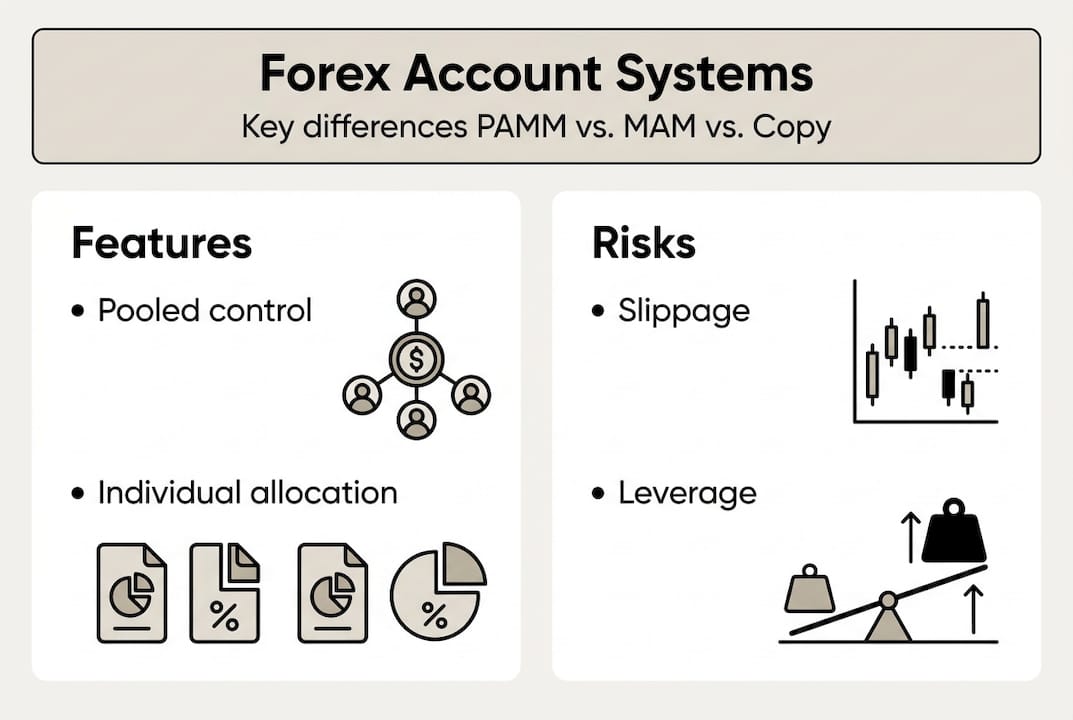
Here’s how PAMM, MAM, and copy trading compare:
| Feature | PAMM | MAM | Copy Trading |
|---|---|---|---|
| Control | Low (pooled) | High (individual settings) | Medium (follower adjusts parameters) |
| Fees | Performance + management | Performance + management | Subscription or per-trade |
| Transparency | High (pooled statements) | Medium (individual reports) | High (real-time replication) |
| Flexibility | Low | Very High | High |
| Performance | Uniform across investors | Varies by allocation method | Varies by lot scaling and latency |
Pro Tip: Favor strategies with profit factor above 1.5 and cap risk at 1-2% per trade. Profit factor (gross profit divided by gross loss) is the single best predictor of long-term viability. Strategies below 1.5 rarely survive extended drawdowns, while those above 2.0 offer sustainable edge.
For deeper risk mitigation tactics, review risk management strategies and copy trading cost analysis to understand fee structures and their impact on net returns. The difference between a 2% monthly return and a 1.5% return after fees compounds dramatically over years.
Practical applications: maximizing returns with professional forex account management
Use MAM with equity-based allocations, diversify 3-5 strategies, cap per-trade risk; hybrid manual and copy trading yields best long-term results. Translating theory into practice requires systematic setup, continuous monitoring, and disciplined adjustment processes.
Setting up efficient MAM equity-based allocation on VPS or local setups involves several steps. First, install your trade copier software on a VPS located near your primary broker’s data center. Configure the master account with your core trading strategy, ensuring you have clear entry, exit, and risk rules documented. Add follower accounts one by one, assigning each an equity-based lot multiplier (for example, 0.01 lot per $100 equity). Test with micro positions for 1-2 weeks to verify execution quality and slippage levels before scaling to full size.
Recommended diversification and risk capping strategies:
- Allocate capital across 3-5 uncorrelated strategies (scalping, swing, trend following)
- Limit any single strategy to 30% of total managed capital
- Cap per-trade risk at 1-2% of account equity across all follower accounts
- Use time-based filters to avoid trading during major news events
- Implement maximum daily loss limits (3-5% of equity) with automatic shutdown
Performance metrics are your compass. Evaluate managers and strategies using profit factor (above 1.5 preferred), maximum drawdown (under 20% ideal), average trade duration, and win rate consistency over at least 6 months. A strategy with 55% win rate, 1.8 profit factor, and 15% max drawdown is far superior to one with 70% win rate, 1.2 profit factor, and 30% drawdown. The latter will eventually blow up.
Hybrid manual plus copy trading offers the best of both worlds. You develop discretionary skill by manually trading a portion of your capital, learning market nuance and timing. Simultaneously, you copy proven strategies to capture consistent returns and diversify your approach. This combination accelerates learning while providing income stability.
“Profit factor above 1.5 separates sustainable strategies from temporary luck. Combining manual discretion with automated copying allows traders to adapt to changing markets while maintaining systematic edge, yielding superior long-term results compared to either approach alone.”
Daily monitoring and adjustment process:
- Check execution logs each morning for slippage or failed orders
- Review equity curves for unusual drawdown spikes or performance divergence
- Verify lot scaling is functioning correctly across all follower accounts
- Adjust risk parameters if market volatility has increased significantly
- Document any manual interventions or strategy changes in a trading journal
- Run weekly performance reports comparing master vs follower account returns
For comprehensive guidance, explore the definitive trade copying guide and review PAMM performance benchmarks to calibrate your expectations and identify top-performing managers. Benchmarking against industry leaders helps you spot weaknesses in your own approach and adopt proven techniques faster.
Consistency trumps complexity. A simple equity-based MAM setup with solid risk controls outperforms elaborate multi-strategy architectures plagued by execution errors and over-optimization. Focus on reliable replication, disciplined risk management, and continuous incremental improvement.
Explore advanced trade copier solutions for forex account management
Efficient multi-account management demands specialized tools designed for speed, compliance, and flexibility. MT4Copier provides locally installed trade copying software that replicates trades across MetaTrader 4 and MetaTrader 5 accounts without relying on cloud servers, ensuring maximum security and minimal latency. Features like compliance delay randomization, equity-based lot scaling, and symbol mapping address the exact challenges discussed throughout this guide.
Whether you manage a handful of investor accounts or dozens of prop firm challenges, the right copier configuration can mean the difference between consistent profitability and frustrating losses. Explore the trade copier wait sl tp feature to understand how delayed stop loss and take profit placement helps you pass prop firm rules while maintaining risk control. Review the detailed trade copier installation guide to set up your system correctly from day one, avoiding common configuration errors that cause execution failures. For traders prioritizing speed, the fast trade copier for MT4 delivers sub-second replication optimized for scalping and high-frequency strategies.
Leverage these specialized tools to implement the optimization strategies covered in this article, transforming your multi-account management from a manual burden into a scalable, professional operation.
FAQ
What is the difference between PAMM and MAM accounts?
PAMM pools investor funds into a single master account with profit allocation calculated by percentage of contributed capital. MAM maintains separate sub-accounts for each investor, allowing flexible allocation of trades by lot size, equity percentage, or balance. PAMM offers simplicity and transparency but less individual control, while MAM suits active managers needing customized risk settings per client.
How can automated trade copying reduce risks in managing multiple forex accounts?
Automation ensures real-time, consistent trade replication across all follower accounts, eliminating manual entry errors and delayed executions. Features like equity-based lot scaling automatically adjust position sizes as account balances fluctuate, maintaining consistent risk percentages. Compliance delay settings and stop loss variance prevent simultaneous order patterns that trigger prop firm flags, reducing regulatory and operational risks.
What are common challenges in multi-account forex management and how to overcome them?
Common challenges include slippage from latency delays, mismatched broker spreads and symbol names, overleveraging due to improper lot scaling, and strategy drift when managers change approaches without notice. Use VPS hosting within 5ms of broker servers to minimize latency, implement equity-based scaling with 1-2% risk caps, map symbols accurately, and monitor performance daily to detect drift early. Diversifying across 3-5 uncorrelated strategies further mitigates single-point failure risks.
What performance metrics should I use to evaluate forex account managers?
Prioritize profit factor above 1.5, maximum drawdown under 20%, and consistent performance over at least 6 months. Profit factor (gross profit divided by gross loss) predicts long-term viability better than win rate alone. Review average trade duration to ensure the strategy matches your capital allocation timeframe, and verify the manager’s approach hasn’t changed significantly during the evaluation period.
Can I combine manual trading with automated copy trading effectively?
Yes, hybrid approaches yield superior long-term results by combining discretionary skill development with systematic edge capture. Trade a portion of your capital manually to learn market nuance and timing, while copying proven strategies on other accounts for consistent returns and diversification. This combination accelerates learning, provides income stability during your manual trading learning curve, and allows adaptation to changing market conditions while maintaining automated baseline performance.
Recommended
- Benefits of Forex Account Management | Local Trade Copier
- Trade Multiple Accounts on MT4 and MT5 | Local Trade Copier
- Copy Forex trades from one MT4 master into 3x MT4 clients
- Sales Page | #parent_title
