

MetaTrader 4 still commands roughly 85% of retail CFD trading volume in prop firms despite the availability of newer platforms like MT5 and cTrader. This dominance challenges the common assumption that newer always means better. For prop traders and account managers, understanding why MT4 remains the backbone of Forex prop trading is essential to optimizing trade copying strategies, managing multiple funded accounts, and staying compliant with strict risk rules. This article clarifies MT4’s unique advantages, compares it with MT5, and shows how to leverage trade copying tools to maximize your prop firm performance in 2026.
Table of Contents
- Why MT4 Remains The Core Platform In Forex Prop Firms
- Comparing MT4 And MT5: Why Forex Prop Firms Still Rely On MT4
- How Prop Firms Leverage MT4 For Trade Copying And Risk Management
- Practical Tips For Traders And Account Managers Using MT4 In Prop Firms
- Optimize Your MT4 Prop Firm Trading With Proven Trade Copier Solutions
- Frequently Asked Questions
Key takeaways
| Point | Details |
|---|---|
| MT4 dominates prop firms | MT4 remains the preferred platform for many Forex prop firms due to stability, simplicity, and extensive EA support. |
| Profit sharing ranges widely | Prop firms typically offer profit splits of 50-90% with strict drawdown and risk controls. |
| Expert Advisors enable automation | MT4’s EA ecosystem allows automated strategies that comply with prop firm rules when avoiding prohibited techniques like martingale. |
| MT5 adoption grows slowly | Some prop firms adopt MT5 for advanced features, but MT4’s simplicity and community support keep it dominant for Forex-only operations. |
| Trade copiers optimize management | MT4 trade copiers synchronize trades across multiple funded accounts, ensuring consistent execution and risk alignment. |
Why MT4 remains the core platform in Forex prop firms
MetaTrader 4’s interface is intuitive enough for new traders to master quickly, yet powerful enough for veterans to deploy sophisticated strategies. This balance makes it ideal for prop firms that need to onboard traders rapidly while maintaining high performance standards. The platform’s stability is legendary. Crashes and glitches are rare, which is critical when every second of downtime can cost funded traders their profit splits or violate drawdown limits.
MT4 serves as the core trading platform for many prop firms, especially Forex-focused ones, due to its user-friendly interface, stability, comprehensive charting tools, automated trading via Expert Advisors, and wide availability of technical indicators. The charting suite includes over 30 built-in indicators, nine timeframes, and unlimited chart windows. Traders can layer multiple indicators, draw trend lines, and analyze price action with precision. This depth supports the technical analysis strategies most prop firms encourage.
Expert Advisors are MT4’s secret weapon. These automated scripts execute trades based on predefined rules, removing emotional decision-making and ensuring consistency. Prop firms often require traders to demonstrate disciplined risk management, and EAs help enforce stop losses, position sizing, and entry conditions automatically. The MQL4 programming language behind EAs is mature and well-documented, making it easy to find or customize scripts that fit specific prop firm rules.
The MT4 community is massive. Thousands of free and paid EAs, indicators, and plugins are available on forums, marketplaces, and developer sites. This ecosystem means traders can find tools for nearly any strategy without coding from scratch. For account managers juggling multiple funded accounts, this plug-and-play flexibility is invaluable. A what is mt4 trade copier setup can replicate trades across accounts instantly, leveraging MT4’s architecture for speed and reliability.
“MT4’s low resource requirements and strong EA support make it the go-to platform for prop firms that prioritize manual and automated trading flexibility.”
Key advantages of MT4 in prop firm environments:
- Lightning-fast execution speeds reduce slippage and improve fill rates
- Minimal system requirements allow traders to run multiple instances on standard hardware
- Extensive broker support ensures compatibility with nearly every prop firm’s infrastructure
- Proven track record over two decades builds trader confidence and reduces learning curves
- Robust backtesting engine lets traders validate strategies before risking funded capital
Comparing MT4 and MT5: Why Forex prop firms still rely on MT4
MetaTrader 5 launched in 2010 with promises of superior speed, multi-asset support, and advanced features. Yet MT4 holds roughly 85% of retail CFD volume share, and prop firms have been slow to fully migrate. The reasons are both technical and cultural. MT5’s multi-asset capabilities are impressive. It handles stocks, futures, and options alongside Forex, making it attractive for prop firms that want to diversify beyond currency pairs. Execution is faster thanks to improved order processing and a more efficient codebase. Backtesting on MT5 is more accurate, with support for multi-currency testing and real tick data.
The MQL5 programming language is more modern than MQL4, offering object-oriented programming, better debugging tools, and native support for complex data structures. For developers, this is a significant upgrade. However, for traders and account managers, the benefits are less obvious. MT4’s simplicity is its strength. The interface is cleaner, the learning curve is gentler, and the EA library is far larger. Prop firms shifting to MT5 cite faster execution, better backtesting, and MQL5 capabilities, but MT4 persists for Forex simplicity, community EAs, and low resource demands.
Many prop firms run dual setups, offering both MT4 and MT5 to traders. This approach lets Forex purists stick with MT4 while advanced traders experiment with MT5’s features. For account managers, this creates complexity. Managing trades across both platforms requires compatible tools. A mt4 and mt5 safety improvements aware trade copier can bridge the gap, synchronizing strategies across platform versions without manual intervention.
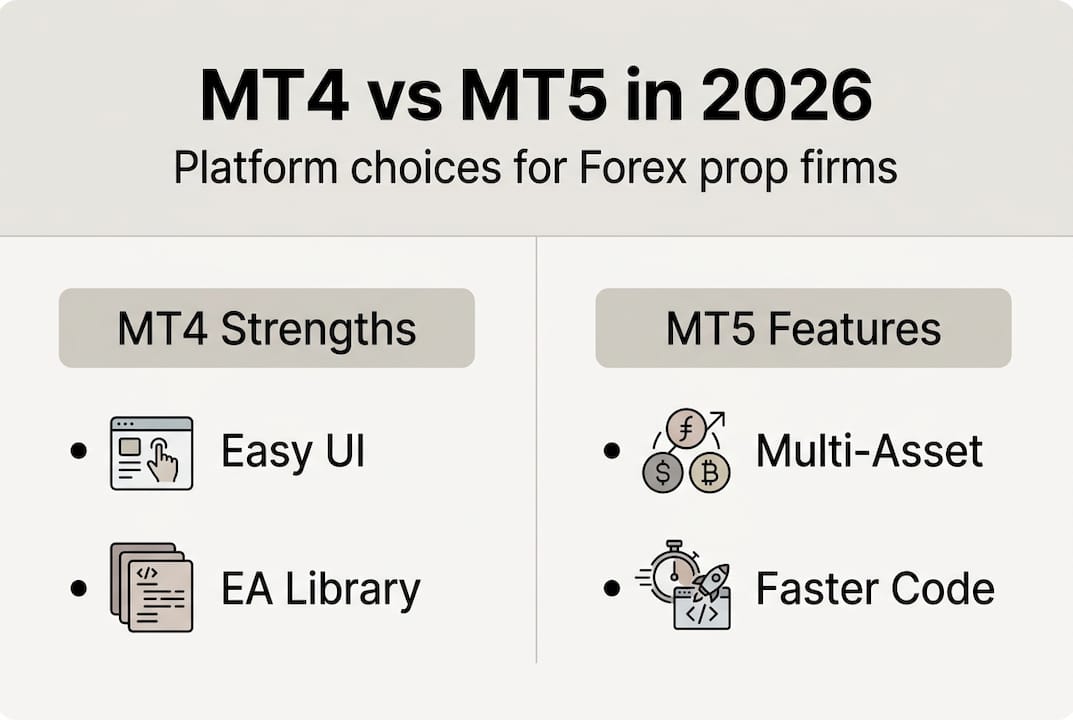
| Feature | MT4 | MT5 |
|---|---|---|
| Asset classes | Forex and CFDs only | Forex, stocks, futures, options |
| Execution speed | Fast | Faster |
| Programming language | MQL4 (simpler) | MQL5 (advanced, object-oriented) |
| Backtesting | Good | Superior (multi-currency, real ticks) |
| Community support | Massive EA library | Growing but smaller |
| Resource usage | Very low | Low |
| Hedging | Allowed | Restricted (netting system) |
| Timeframes | 9 | 21 |
The hedging difference is critical. MT4 allows traders to open opposing positions on the same pair, a technique many prop traders use for risk management. MT5’s netting system closes opposing trades automatically, which can disrupt strategies. This alone keeps many Forex-focused prop firms loyal to MT4. For traders who rely on hedging to navigate volatile markets, MT4 is non-negotiable.
Another factor is stability. MT4 has been battle-tested for over 20 years. Bugs are rare, updates are infrequent, and behavior is predictable. MT5, while mature, still receives regular updates that occasionally introduce breaking changes. Prop firms value consistency, and MT4 delivers it. A trade copier demo video often showcases MT4 setups because they are universally understood and supported.
How prop firms leverage MT4 for trade copying and risk management
Prop firms provide funded accounts after traders pass evaluation challenges, typically with profit-sharing ratios of 50-90% and strict risk rules like maximum drawdown limits. MT4’s architecture makes it ideal for managing these accounts at scale. Account managers use trade copiers to replicate strategies across multiple funded accounts, ensuring consistency and reducing manual workload. Here’s how the process works:
- Install a local trade copier on a master MT4 account where the primary strategy runs.
- Configure the copier to connect to one or more slave accounts (the funded prop accounts).
- Set risk parameters like lot size multipliers, stop loss adjustments, and symbol filters to match each account’s rules.
- Monitor synchronization in real time to ensure trades copy accurately without slippage.
- Adjust settings as needed to comply with prop firm drawdown limits and position size restrictions.
This workflow allows account managers to trade once and profit multiple times. The copier handles the technical details, freeing the manager to focus on strategy. Compliance is critical. Prop firms ban certain EA strategies like martingale (doubling down after losses) and grid trading (opening multiple positions at fixed intervals). These techniques can violate drawdown rules and lead to account termination. Account managers optimize via MT4’s EA ecosystem for automated strategies compliant with prop rules, using copiers for multi-account management and risk alignment.
Manual strategies are equally supported. Some traders prefer discretionary trading, analyzing charts and executing trades based on intuition and experience. MT4’s one-click trading and hotkey support make manual execution fast. When combined with a trade copier, a single manual trade on the master account replicates instantly across all slaves. This flexibility is why prop firms favor MT4. It accommodates both automation enthusiasts and manual purists.
Profit splits and risk parameters vary by firm. A typical setup might offer 80% profit sharing with a 10% maximum drawdown limit. Traders must stay within these boundaries or lose their funding. MT4’s built-in risk management tools, like guaranteed stop losses and trailing stops, help traders protect capital. When paired with a mt4 trade copier overview, these tools scale across accounts effortlessly.
Pro Tip: Avoid EAs that use martingale or grid strategies in prop firm accounts. Even if they perform well in backtests, they violate most prop firm rules and will get your account flagged or terminated. Stick to strategies that respect fixed lot sizes and predefined stop losses.
Trade copier safety improvements have made modern copiers more reliable. Features like trade confirmation, error logging, and automatic reconnection reduce the risk of missed trades or synchronization failures. For prop traders managing high-value funded accounts, these safeguards are essential.
Practical tips for traders and account managers using MT4 in prop firms
Choosing the right EA is the first step. Look for scripts with verified track records, transparent logic, and compliance with prop firm rules. Avoid black-box EAs that don’t disclose their strategy. Test any EA thoroughly on a demo account before deploying it on funded capital. Backtesting is useful, but forward testing on live market conditions reveals how the EA handles slippage, spread widening, and news events.
Regularly test your trade copier to ensure synchronization accuracy. Run side-by-side comparisons between master and slave accounts, checking that entry prices, lot sizes, and stop losses match. Even small discrepancies can compound over time, leading to performance drift. A fx account cloning setup should replicate trades with near-zero latency and perfect accuracy.
Optimize MT4’s low resource footprint for faster execution. Close unnecessary chart windows, disable unused indicators, and limit the number of EAs running simultaneously. MT4 serves many prop firms due to low resource requirements and strong EA support, making it ideal for manual and automated trading. A lean MT4 instance executes trades faster and reduces the risk of crashes during high-volatility periods.
Avoid prohibited strategies like martingale and grid trading. These techniques might work in certain market conditions, but they violate most prop firm rules and can trigger immediate account closure. Stick to strategies that use fixed position sizing, predefined stop losses, and logical risk-reward ratios. Prop firms reward consistency and discipline, not high-risk gambling.
Pro Tip: Maintain strict risk discipline to pass prop firm challenges. Use a maximum of 1-2% risk per trade, set stop losses on every position, and avoid overleveraging. Prop firms design their challenges to filter out reckless traders, so proving you can manage risk is more important than chasing big wins.
Use a fast trade copier to manage multiple funded accounts efficiently. Speed matters. A slow copier introduces latency, causing slave accounts to enter trades at worse prices than the master. This slippage erodes profits and can push accounts into drawdown. Modern copiers execute in milliseconds, ensuring all accounts benefit equally from the master strategy.
Key best practices for MT4 prop trading:
- Keep detailed logs of all trades and EA activity for performance reviews and troubleshooting
- Update your MT4 platform and EAs regularly to benefit from bug fixes and security patches
- Use VPS hosting to ensure 24/7 uptime and eliminate internet connection issues
- Diversify strategies across multiple EAs to reduce reliance on any single approach
- Monitor prop firm rule changes and adjust your setup proactively to stay compliant
If your copier fails to replicate trades, consult a trade copier troubleshooting guide. Common issues include incorrect account credentials, firewall blocking, or mismatched symbol names between broker servers. Most problems are fixable within minutes if you know where to look.
Optimize your MT4 prop firm trading with proven trade copier solutions
Managing multiple MT4 accounts in a prop firm environment demands reliable, fast, and secure trade copying technology. Local Trade Copier offers a locally installed solution that synchronizes trades across accounts without relying on third-party cloud servers, giving you full control over your data and execution speed. The software is designed specifically for prop traders and account managers who need to replicate strategies across funded accounts while maintaining strict compliance with risk rules.
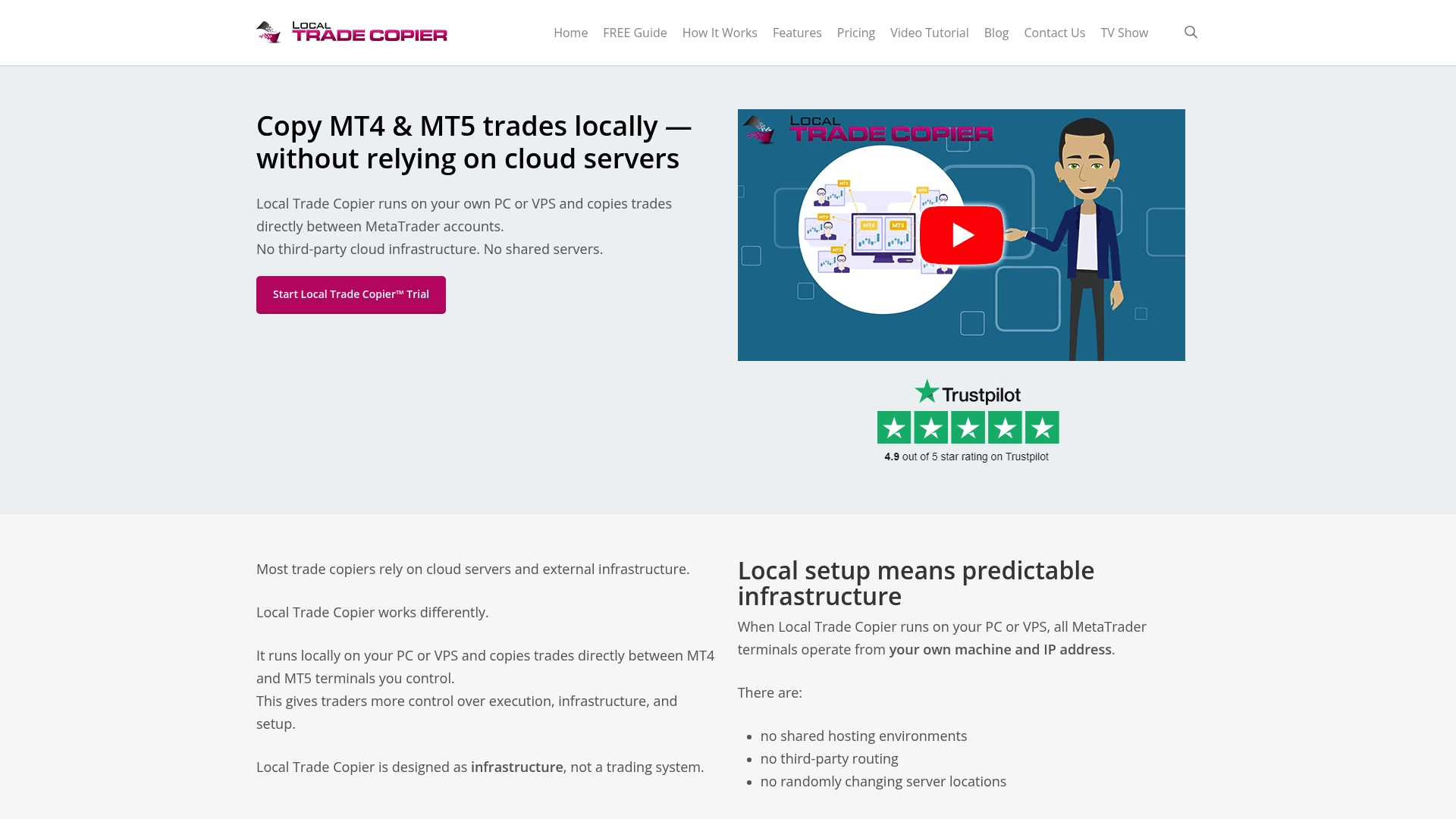
Installation is straightforward with comprehensive local trade copier installation guides that walk you through setup step by step. Advanced features like trade copier stop loss handling ensure your risk parameters replicate accurately across all accounts, protecting your capital and keeping you within prop firm limits. Watch the trade copier demo video to see how quickly you can deploy the system and start managing multiple accounts with confidence.
Frequently asked questions
Why do Forex prop firms prefer MT4 over newer platforms?
MT4’s simplicity, stability, and massive EA library make it ideal for Forex-only prop firms. The platform has been refined over two decades, eliminating bugs and optimizing performance. Traders can find tools for any strategy without custom coding, and the low resource requirements allow running multiple instances on standard hardware.
How do trade copiers work with MT4 in prop firm accounts?
A what is mt4 trade copier setup replicates trades from a master account to one or more slave accounts in real time. The copier monitors the master for new positions, then opens identical trades on the slaves with adjustable lot sizes and risk parameters. This automation ensures consistency across funded accounts and reduces manual workload for account managers.
Can I use MT4 and MT5 simultaneously in a prop firm?
Yes, many prop firms offer both platforms, allowing traders to choose based on their strategy needs. MT4 excels for Forex-only trading with extensive EA support, while MT5 provides faster execution and multi-asset capabilities. Account managers can use compatible trade copiers to synchronize strategies across both platforms without manual intervention.
What are the most common mistakes traders make with MT4 in prop firms?
Using prohibited strategies like martingale or grid trading is the top mistake. These techniques violate most prop firm rules and lead to account termination. Other errors include overleveraging, ignoring stop losses, and failing to test EAs on demo accounts before deploying on funded capital. Maintaining strict risk discipline is essential to pass challenges and retain funding.
How does MT4’s hedging feature benefit prop traders?
MT4 allows opening opposing positions on the same currency pair, which many traders use to manage risk during volatile markets. This hedging capability is restricted in MT5’s netting system, making MT4 the preferred choice for Forex prop traders who rely on this technique. Hedging lets traders lock in profits or limit losses without closing positions prematurely.
Recommended
- Local Trade Copier Updates MT4 and MT5 Versions with New Tools for Prop Firm and Retail Traders | Trade Copier for MT4 & MT5
- Checkout Page | Trade Copier for MT4 & MT5
- How Forex Copy Traders Create Portfolio of Best Strategies
- How To Use Trade Copier – mt4copier.com Blog
