

Managing multiple prop trading accounts demands surgical precision in risk control while maintaining operational speed that keeps you competitive. Automated trade copying promises to solve the efficiency problem, but without proper safeguards, it introduces new vulnerabilities that can trigger rule violations or account flags. This guide walks you through the complete framework for preparing your infrastructure, executing trades with embedded risk controls, and verifying performance while maintaining the psychological discipline that separates successful prop traders from those who flame out. You’ll learn how to balance automation’s speed advantages with the manual oversight that keeps your accounts compliant and profitable.
Table of Contents
- Key takeaways
- Preparing to manage prop trading accounts: tools and prerequisites
- Executing trade copying strategies while managing risks
- Verifying performance and maintaining discipline in prop account management
- Enhance your prop trading with advanced trade copying software
- How to manage prop trading accounts FAQs
Key Takeaways
| Point | Details |
|---|---|
| Test before live | Extensive demo testing and documenting failure modes helps catch rule violations before risking live capital. |
| Diversify timing and sizing | Varying copy execution times and position sizes reduces the likelihood of detection and mirrors discretionary trading behavior. |
| Implement risk controls | Set a maximum daily drawdown and automatic position sizing that aligns with firm limits to protect capital. |
| Prepare with firm rules | Document the prop firm’s rules and technology requirements to guide copying parameters and avoid violations. |
Preparing to manage prop trading accounts: tools and prerequisites
Successful prop account management starts long before you execute your first copied trade. Your preparation phase determines whether automation becomes a force multiplier or a liability generator.
Start by thoroughly understanding your prop firm’s specific rules and the technology they use to enforce them. Each firm implements different detection systems, drawdown calculations, and prohibited practices. Some firms explicitly ban trade copying, while others permit it with specific conditions around timing variance and position sizing. Document these rules in a checklist format so you can reference them when configuring your copying parameters.
Selecting reliable trade copying software forms your operational foundation. Your platform must offer granular control over lot sizing, timing delays, and stop loss management. Local trade copier features like customizable slippage tolerances and symbol mapping prevent the synchronization errors that cause rule violations. Cloud-based copiers introduce latency and third-party dependencies that can fail during high-volatility periods when precision matters most. Local installation gives you direct control and eliminates external points of failure.
Risk management protocols need definition before live trading begins. Establish your maximum daily drawdown threshold, typically 3-5% for prop accounts with strict rules. Configure automatic position sizing that scales with account equity while respecting firm limits. Build in manual rotation capabilities so you can vary which accounts receive which trades, creating the natural variance that mimics discretionary trading patterns.
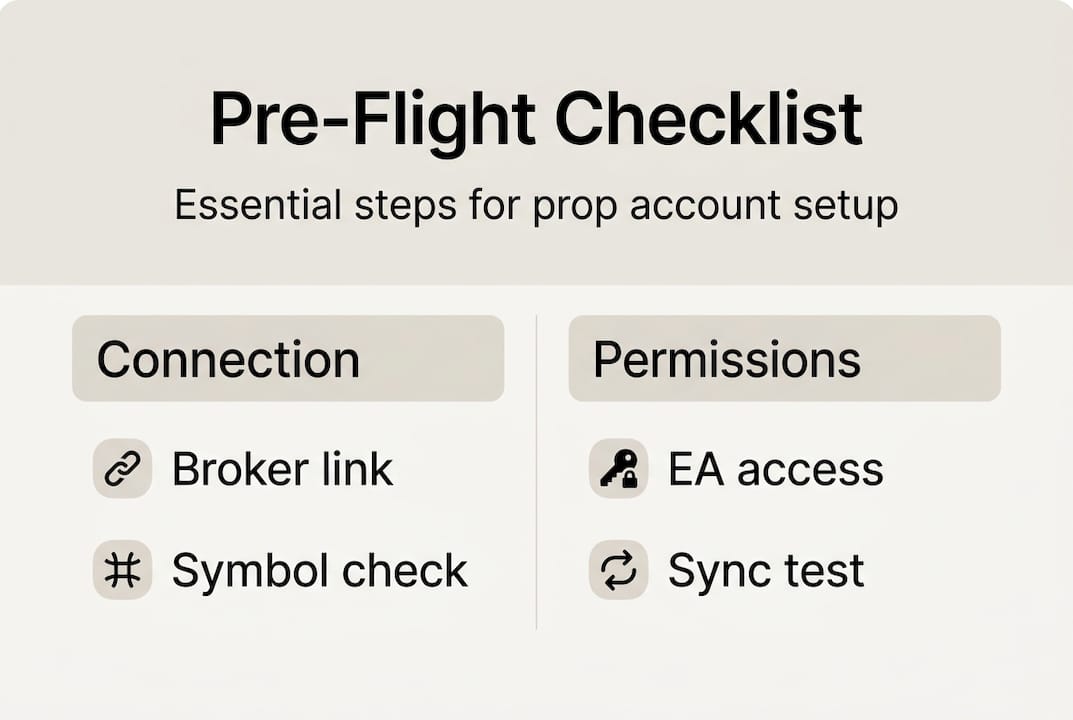
Pro Tip: Create a pre-flight checklist covering broker connection stability, EA permissions, symbol availability, and spread conditions. Run through this list every trading session to catch configuration drift before it costs you.
Your tool stack should include real-time monitoring dashboards that display all account metrics simultaneously. This visibility lets you spot divergence between master and slave accounts immediately. Set up alerts for unusual slippage, rejected orders, or equity drawdowns exceeding your thresholds. These early warning systems give you time to intervene manually before automated processes compound errors.
Testing your automated system extensively before live deployment separates professionals from amateurs. Manual rotation preferred over copying for risk diversification; automation saves time but requires rigorous testing to avoid synchronization failures. Run your copier on demo accounts for at least two weeks, simulating various market conditions including news events, weekend gaps, and low liquidity periods. Document every failure mode you discover and adjust your parameters accordingly. This testing phase typically reveals 5-10 configuration issues that would have triggered rule violations in live trading.
Essential preparation checklist:
- MetaTrader 4 or 5 platforms installed on dedicated VPS for stability
- Trade copying software with local installation and granular controls
- Documented prop firm rules with specific copying parameters allowed
- Risk management calculator for position sizing across multiple accounts
- Real-time monitoring dashboard with automated alert thresholds
- Two weeks minimum demo testing with documented failure modes
| Tool category | Minimum requirement | Recommended upgrade |
|---|---|---|
| Platform | MT4/MT5 on local PC | Dedicated VPS with 99.9% uptime |
| Copier software | Basic lot multiplication | Advanced timing delays and symbol mapping |
| Monitoring | Manual account checking | Automated dashboard with mobile alerts |
| Risk calculator | Spreadsheet formulas | Integrated position sizing EA |
Executing trade copying strategies while managing risks
With infrastructure prepared, execution quality determines whether your prop accounts thrive or trigger compliance flags. The goal is creating trade flow that appears discretionary while maintaining automation’s efficiency advantages.
Implement manual rotation alongside your automated copying to introduce natural variance. Rather than copying every trade to every account simultaneously, rotate which accounts receive which setups. This creates divergent trade histories that avoid the identical pattern problem. For example, if you manage five prop accounts, copy your morning trades to accounts 1, 3, and 5, then switch to accounts 2 and 4 for afternoon setups. This rotation mimics how a discretionary trader would naturally vary their execution across accounts.
Adjust trade timing and position sizes to further differentiate your accounts. Copying risks flags for identical patterns; experts recommend variance in timing/sizing and pre-news flats to mimic manual trading. Build in random delays of 30-180 seconds between master execution and slave copying. Vary your lot sizes by 10-20% across accounts using different risk percentages. These small variations compound to create significantly different trade fingerprints that pass compliance screening.

Flat all positions before major scheduled news events to reduce volatility risk during copying. News spikes create slippage and requotes that can cause divergent fills across your accounts. If your master account gets filled at one price but slaves experience 5-10 pip slippage, you’ve created immediate performance divergence that’s hard to manage. Going flat 15-30 minutes before high-impact releases eliminates this risk entirely.
Pro Tip: Use copying trades different symbols functionality to test how your copier handles instrument variations. Some prop firms offer slightly different symbol names or contract specifications that can cause copying failures if not mapped correctly.
Follow this execution sequence for each trading session:
- Verify all account connections and EA permissions before market open
- Check economic calendar for high-impact news in your trading timeframe
- Execute master trades with your standard strategy and risk parameters
- Monitor slave account copying in real-time for fill quality and slippage
- Apply randomized timing delays and lot size variations per your rotation schedule
- Flat all positions 15-30 minutes before scheduled high-impact news releases
- Resume copying after news volatility subsides and spreads normalize
- Document any synchronization failures or unusual slippage for pattern analysis
- Adjust copying parameters based on observed market conditions and firm feedback
- End-of-day review comparing all account performance metrics for divergence
Constantly monitor your copied trades and adjust parameters to prevent synchronization failures from compounding. Set up alerts that notify you immediately when slave accounts don’t receive expected trades or when fills diverge by more than your acceptable slippage threshold. This real-time oversight lets you switch to manual intervention mode before small issues become account-threatening problems.
Position sizing requires special attention when managing multiple prop accounts with different equity levels. Use allocate account size logic that scales lots proportionally while respecting each firm’s maximum position limits. A $100,000 account shouldn’t receive the same absolute lot size as a $10,000 account, but the risk percentage should remain consistent with your overall strategy. Build in maximum lot caps that prevent any single trade from exceeding 2-3% account risk regardless of your calculation formulas.
Verifying performance and maintaining discipline in prop account management
Execution quality means nothing without systematic verification and the psychological discipline to follow your rules when emotions push you toward deviation.
Use real-time tracking dashboards that display all critical metrics simultaneously. Monitor daily drawdown percentages, open position exposure, and profit/loss trends across all accounts. Prop firms enforce rules via tech (real-time tracking, auto-stops), contrasting retail where discipline is self-imposed; structured environments yield higher success (33% vs retail sub-10%). This technological enforcement removes the human discretion that typically leads to rule violations. Configure automated stop features that halt trading when you hit predefined thresholds, preventing the emotional override that destroys accounts.
Maintain a disciplined trading routine that treats prop trading as a professional job rather than a side activity. Set specific trading hours, prepare your workspace, and follow a consistent pre-market routine. This structure creates the psychological framework that supports rule adherence during stressful market conditions. Professional prop traders report that routine consistency matters more than strategy complexity for long-term survival.
Psychological discipline key: Stop after 2-3 losses, journal emotions; pros treat trading as job with routines. Implement a mandatory pause after consecutive losses to prevent revenge trading and emotional decision making. After two losing trades in a row, step away from your screens for at least 30 minutes. After three consecutive losses, stop trading for the day entirely. This circuit breaker prevents the cascading loss patterns that blow up accounts during drawdown periods.
Keep a detailed trading journal that logs both objective metrics and subjective emotional states. Record your entry reasoning, position sizing logic, and how you felt during the trade. After each session, review this journal to identify patterns in your decision making. You’ll often discover that your worst trades correlate with specific emotional states like frustration, overconfidence, or boredom rather than strategy failures.
Verification checklist for daily review:
- Compare actual fills across all accounts against expected parameters
- Calculate daily drawdown percentage and compare to firm limits
- Document any synchronization failures or unusual slippage events
- Review emotional journal entries for patterns correlating with poor trades
- Verify all open positions match your intended exposure and risk levels
- Check for any compliance notifications or warnings from prop firms
Understanding the structural advantages prop firms provide helps maintain motivation during challenging periods. The 33% success rate prop traders achieve versus retail’s sub-10% performance stems directly from technological rule enforcement and professional structure. When you feel tempted to override your stop loss or take revenge trades, remember that the rules protecting you from yourself are your competitive advantage.
| Metric | Retail traders | Prop firm traders | Advantage source |
|---|---|---|---|
| Success rate | Under 10% | 33% | Technological rule enforcement |
| Average account life | 3-6 months | 12+ months | Mandatory risk limits |
| Emotional override | Self-discipline only | Automated stops | System prevents deviation |
| Professional structure | Optional | Required | Routine consistency |
Recognize that why prop firms ban profitable traders often relates to copying detection rather than performance issues. Firms want to ensure their capital supports genuine trading skill rather than pure signal replication. Your variance strategies and manual rotation protocols directly address this concern by demonstrating discretionary overlay on top of systematic execution.
Leverage local trade copier safety improvements that specifically address prop firm compliance requirements. Features like randomized timing, variable lot sizing, and symbol-specific rules help you maintain the appearance of discretionary trading while keeping automation’s efficiency benefits. Regular software updates often include new safety features responding to evolving firm detection methods.
Enhance your prop trading with advanced trade copying software
Implementing these strategies requires software built specifically for the demands of prop trading account management. Our local trade copier installs directly on your MT4 and MT5 platforms, eliminating cloud dependencies that introduce latency and failure points during critical market moments.

The platform includes trade copier stop loss features that let you configure account-specific risk parameters while maintaining centralized control. Set different stop loss distances for each slave account based on their equity levels and firm rules, all managed from a single master interface. This granular control prevents the one-size-fits-all approach that creates compliance issues.
Local trade copier installation takes under 10 minutes with our step-by-step guide, getting you from download to first copied trade in a single session. The software runs locally on your VPS or PC, giving you complete control over your trading infrastructure without monthly cloud fees eating into your profits. Watch our local trade copier demo video to see exactly how the variance features and safety controls work in live market conditions before you commit.
How to manage prop trading accounts FAQs
How can I avoid my trade copying being detected by prop firms?
Introduce variance in timing (30-180 second random delays), position sizing (10-20% variation), and account rotation (don’t copy every trade to every account). Flatten positions before major news events and ensure your copying software supports symbol-specific mapping to handle different broker contract specifications.
What is the best way to size positions when copying trades to multiple accounts?
Use proportional scaling based on account equity while respecting each firm’s maximum position limits. A $100,000 account should receive 10x the lots of a $10,000 account if both are trading at 1% risk per trade. Always cap maximum lots to prevent any single trade exceeding 2-3% account risk regardless of calculations.
How often should I test and update my trade copying setup?
Run comprehensive demo testing for two weeks minimum before live deployment, then conduct weekly reviews of synchronization quality and slippage patterns. Update your copying parameters whenever you notice fill quality degradation or after prop firms update their rules. Most professionals do quarterly full system audits even when everything appears functional.
Can automated copying replace manual oversight entirely in prop trading?
No, automated copying requires active monitoring and manual intervention capabilities. Use automation for execution speed and consistency, but maintain real-time dashboards and alert systems that let you switch to manual mode immediately when synchronization issues appear. The most successful prop traders blend automation efficiency with discretionary oversight.
What psychological practices improve success managing prop trading accounts?
Implement mandatory trading pauses after 2-3 consecutive losses to prevent revenge trading. Keep a detailed journal logging both trade metrics and emotional states to identify patterns. Treat trading as a professional job with consistent hours and pre-market routines rather than an opportunistic side activity. The structure itself becomes your competitive advantage.
Recommended
- How to Copy Trades Between Two or More MT5 Trading Accounts
- How To Copy Trades From Selected MetaTrader 4 Master Accounts
- MT4 Trade Copier limitations with Netting on FIFO accounts
- Easy Way to Copy Trades of Equal Lot Size for All Accounts
