

Many traders trust forex signal copying blindly, assuming it guarantees profits without understanding how trades replicate, what risks lurk beneath automation, or how costs erode returns. This misconception leads to poor provider choices, inadequate risk controls, and disappointing outcomes. Forex signal copying can streamline multi-account management and diversify strategies, but only when you grasp its mechanics, challenges, and best practices. This guide clears the confusion by explaining what forex signal copying truly entails, how it functions across platforms, the nuances affecting performance, and actionable steps to implement secure, cost-effective copying for your trading operation.
Table of Contents
- What Is Forex Signal Copying? Defining The Concept And Platforms
- Mechanics And Risk Controls In Forex Signal Copying
- Challenges, Performance Nuances, And Empirical Outcomes Of Forex Signal Copying
- Best Practices For Secure, Efficient, And Cost-Effective Forex Signal Copying
- Explore Advanced Forex Trade Copying Solutions With MT4Copier.com
Key takeaways
| Point | Details |
|---|---|
| Definition and platforms | Forex signal copying automates trade replication from master traders to follower accounts via MT4/MT5 copiers, broker systems like eToro, or social trading networks. |
| Mechanics and controls | Copying includes proportional or fixed lot sizing, automatic execution of opens and closes, with risk controls like allocation caps and drawdown stops. |
| Performance realities | Around 48% of copiers remain profitable over 90 days, with slippage and fees reducing returns by 5-15% compared to master accounts. |
| Cost awareness | Performance fees, spreads, and latency collectively erode net profits, making provider selection and fee structure critical to success. |
| Best practices | Use low-latency VPS hosting, diversify across 3-5 providers, monitor accounts regularly, and test strategies on demo accounts before live deployment. |
What is forex signal copying? Defining the concept and platforms
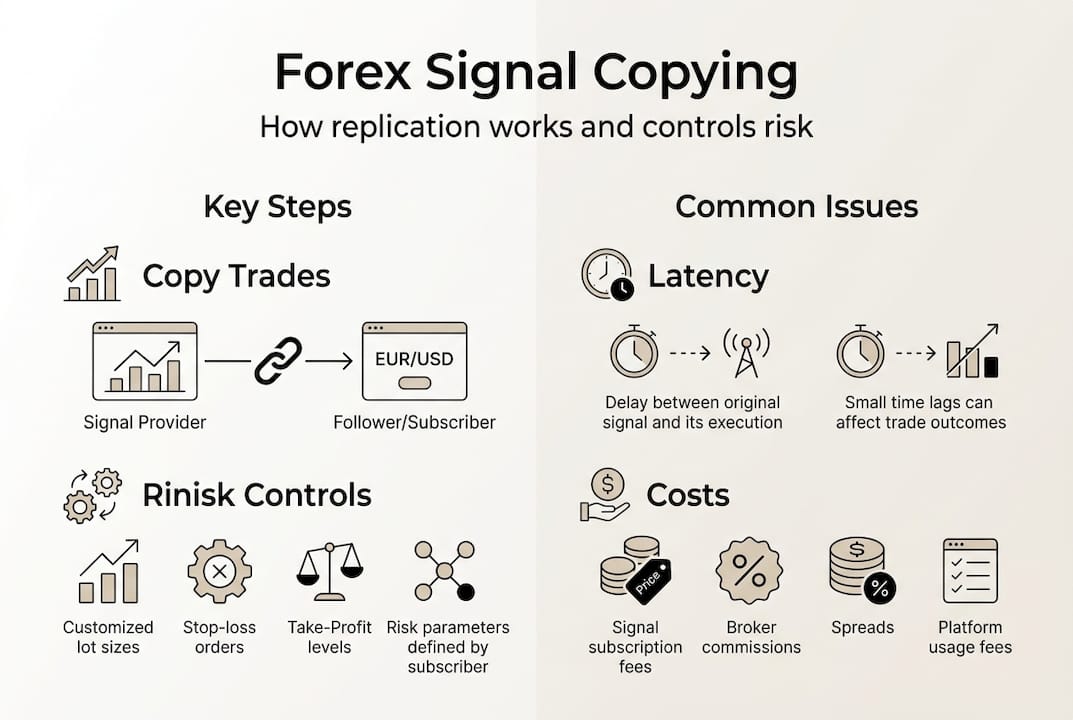
Forex signal copying automates the replication of trades from a master trader to one or more follower accounts in real time. When the master opens, modifies, or closes a position, the system instantly mirrors those actions across linked accounts. This technology eliminates manual order entry, reduces human error, and allows traders to manage multiple accounts efficiently. Forex signal copying operates through various platforms, each offering distinct features and levels of control.
Three main categories dominate the landscape. First, broker-native systems like eToro integrate copying directly into their trading environment, making setup simple but limiting flexibility. Second, MT4/MT5 expert advisors and dedicated copiers provide granular control over lot sizing, risk parameters, and execution logic. Third, PAMM and MAM account structures enable professional account managers to allocate trades proportionally across client accounts. Each method suits different needs, from casual traders seeking passive income to prop firms managing dozens of accounts simultaneously.
Choosing the right platform depends on your priorities. If you value privacy and speed, locally installed copiers like those offered by MT4Copier.com eliminate reliance on third-party servers. If you prefer simplicity and social features, broker-native systems provide user-friendly interfaces. For professional managers, PAMM/MAM structures offer legal frameworks and transparent reporting. Understanding these distinctions helps you select a solution aligned with your security requirements, account count, and desired level of customization.
Key platform features to evaluate include:
- Execution speed and latency
- Lot sizing flexibility (proportional, fixed, or dynamic)
- Risk controls (allocation caps, stop loss settings, pause functions)
- Compatibility with your broker and trading environment
- Cost structure (subscription fees, performance fees, spreads)
Understanding the basic definition leads us to examine the detailed mechanics and feature sets that make forex signal copying effective. The definitive guide to trade copying explores these technical aspects in greater depth, covering installation, configuration, and optimization strategies for multi-account setups.
Mechanics and risk controls in forex signal copying
When a master account executes a trade, the copying software detects the action within milliseconds and replicates it across follower accounts. This process includes opening positions at market or pending orders, modifying stop loss and take profit levels, and closing trades when the master exits. Proportional or fixed lot sizing determines how follower accounts scale positions relative to the master. Proportional sizing maintains the same risk percentage, adjusting lots based on each follower’s balance. Fixed sizing applies a constant lot multiplier, useful when followers want consistent exposure regardless of account size.
Risk controls prevent catastrophic losses and give traders granular authority over their accounts. Allocation percentage caps limit how much of a follower’s capital participates in copying, preserving reserves for other strategies or emergencies. Maximum drawdown stops automatically pause copying when cumulative losses reach a predefined threshold, protecting accounts from runaway strategies. Pause functions let traders halt replication instantly during high-impact news events or when they detect strategy drift. These safeguards transform copying from a passive activity into an actively managed risk mitigation tool.

Automation speeds execution and removes emotional decision making. Manual copying introduces delays, errors, and inconsistencies that degrade performance. Automated systems execute trades in fractions of a second, minimizing slippage and ensuring followers benefit from the same entry prices as masters. This precision matters especially in fast-moving markets where every pip counts. However, automation also requires careful setup and ongoing monitoring to catch configuration errors or unexpected market conditions.
Pro Tip: Test your copying setup on demo accounts for at least two weeks before deploying live capital. This practice reveals configuration issues, latency problems, and broker-specific quirks without risking real money. Monitor both master and follower accounts daily during the test phase to confirm trades replicate accurately.
Critical mechanical considerations include:
- Order type compatibility (market, pending, stop, limit)
- Symbol mapping (ensuring master and follower brokers use identical currency pair names)
- Partial close handling (how the system manages fractional position exits)
- Trade comment preservation (maintaining master’s notes and identifiers)
- Reverse copying (mirroring trades in the opposite direction for hedging strategies)
With this understanding of mechanics, we can now explore common challenges, costs, and nuances that affect performance. Risk management for forex copying provides advanced techniques for optimizing lot calculations and protecting accounts during volatile periods.
Challenges, performance nuances, and empirical outcomes of forex signal copying
Latency and slippage create unavoidable gaps between master and follower execution. Even with fast servers, 2-5 pip differences commonly occur due to network delays, broker routing, and market liquidity variations. These discrepancies accumulate over hundreds of trades, causing follower returns to trail master performance by 5-10%. In high-frequency strategies or scalping systems, this degradation intensifies, sometimes rendering profitable master accounts unprofitable for followers. Choosing low-latency hosting and brokers with fast execution mitigates but never eliminates this challenge.
Costs erode net profits more than most traders anticipate. Performance fees typically range from 20-40% of gains, while spreads and commissions apply to every trade. Subscription fees for copying software add fixed monthly expenses. Collectively, these costs reduce net returns by 5-15% compared to the master’s gross performance. A master delivering 10% monthly gains might translate to only 6-7% for followers after accounting for all fees. Understanding this reality helps set realistic expectations and emphasizes the importance of selecting cost-effective providers and platforms.
Empirical data reveals mixed outcomes. Studies show 48.48% of copiers profitable over 90 days in cryptocurrency markets, with Solana strategies achieving 59% win rates and forex signals averaging +8.87% monthly returns. However, these figures mask wide variance. Top performers generate consistent gains, while poorly chosen providers drain accounts rapidly. Diversification across 3-5 signal sources mitigates single-strategy risk, smoothing equity curves and reducing exposure to any one trader’s mistakes or changing market conditions.
Pro Tip: Allocate no more than 20% of your capital to any single signal provider. This diversification strategy limits damage from strategy drift, over-leveraging, or outright fraud while allowing you to capture gains from multiple uncorrelated approaches. Rebalance allocations quarterly based on performance metrics.
The following table compares typical performance outcomes across different copying scenarios:
| Scenario | Average Monthly Return | Win Rate | Drawdown Risk | Cost Impact |
|---|---|---|---|---|
| Single high-leverage provider | 12-18% | 45-55% | High (30-50%) | Moderate (10-15%) |
| Diversified 3-5 providers | 6-10% | 55-65% | Moderate (15-25%) | High (15-20%) |
| Conservative low-leverage | 3-6% | 60-70% | Low (5-15%) | Low (5-10%) |
| Scalping/HFT strategies | 8-15% | 50-60% | Very High (40-60%) | Very High (20-25%) |
Transparency separates legitimate providers from scams. Reputable signal sources publish verified track records, disclose risk parameters, and allow demo testing. Avoid providers promising guaranteed returns, displaying only winning trades, or pressuring immediate deposits. Thoroughly vet each candidate by reviewing third-party performance data, checking regulatory status, and testing on demo accounts for at least 30 days. This due diligence protects capital and increases the likelihood of selecting consistently profitable strategies.
Having examined challenges and data, let’s look at how to apply this knowledge securely and cost-effectively for multi-account management. Copying forex signals offers practical insights into configuring systems for optimal performance and minimal risk exposure.
Best practices for secure, efficient, and cost-effective forex signal copying
Low-latency VPS hosting forms the foundation of reliable copying. Virtual private servers located near your broker’s data center reduce execution delays to single-digit milliseconds. This proximity minimizes slippage and ensures follower trades execute as close to master timing as possible. Choose VPS providers offering 99.9% uptime guarantees and fast network connections. Avoid running copiers on home computers or shared hosting, which introduce instability and lag that degrade performance.
Regulatory oversight protects your capital. FCA and ASIC regulated brokers maintain segregated client funds, adhere to strict operational standards, and provide recourse mechanisms if disputes arise. Unregulated brokers may offer attractive spreads or bonuses but expose you to counterparty risk, fund misappropriation, and limited legal protections. Verify broker licenses through official regulatory websites before depositing funds or connecting copying systems.
Diversification spreads risk across uncorrelated strategies. Allocate 10-20% of your capital to each of 3-5 signal providers operating different trading styles, timeframes, and currency pairs. This approach reduces the impact of any single provider’s drawdown or strategy failure. Monitor correlations between providers monthly. If two or more begin moving in lockstep, consider replacing one to maintain true diversification. Rebalance allocations quarterly based on rolling performance metrics, shifting capital toward consistently profitable sources.
Regular monitoring catches problems before they escalate. Review follower accounts daily for unusual activity, unexpected losses, or trades that don’t match the master. Set alerts for drawdown thresholds, equity drops, or margin level warnings. Monthly audits should compare follower performance against master results, calculating the impact of slippage, fees, and execution quality. If discrepancies exceed acceptable ranges, investigate configuration issues, broker problems, or provider reliability concerns.
Implementing these best practices involves several concrete steps:
- Select a VPS provider with servers near your broker’s location and subscribe to a plan offering at least 2GB RAM and 99.9% uptime.
- Open accounts with FCA or ASIC regulated brokers, verifying licenses on official regulatory websites before depositing funds.
- Identify 3-5 signal providers with verified track records, low correlations, and transparent risk disclosures, allocating 10-20% capital to each.
- Install and configure your copying software on the VPS, testing thoroughly on demo accounts for two weeks before going live.
- Set risk controls including allocation caps, maximum drawdown stops, and pause triggers aligned with your risk tolerance.
- Establish daily monitoring routines and monthly audit processes to track performance, costs, and execution quality across all accounts.
The following table outlines recommended allocation strategies based on account size and risk tolerance:
| Account Size | Number of Providers | Allocation Per Provider | Risk Level | Monitoring Frequency |
|---|---|---|---|---|
| Under $5,000 | 2-3 | 30-40% | Conservative | Daily |
| $5,000 to $25,000 | 3-4 | 20-30% | Moderate | Daily |
| $25,000 to $100,000 | 4-5 | 15-20% | Moderate | Daily |
| Over $100,000 | 5-7 | 10-15% | Aggressive | Twice Daily |
Avoiding high performance fees preserves more of your gains. Negotiate fee structures when possible, favoring flat monthly subscriptions over percentage-based performance fees. Test providers on demo accounts for 30-60 days to validate their claims before committing live capital. This testing phase reveals execution quality, strategy consistency, and customer support responsiveness without financial risk.
With these best practices in place, you’re better positioned to integrate forex signal copying effectively into your multi-account strategy. The local trade copier installation guide and trade copier demo video walk you through setup procedures, ensuring your system operates securely and efficiently from day one.
Explore advanced forex trade copying solutions with MT4Copier.com
If you’re ready to implement secure, efficient multi-account copying, MT4Copier.com provides the technology foundation to do so. The platform offers robust software that replicates trades across multiple MT4 and MT5 accounts without relying on third-party cloud servers. This local installation enhances security, eliminates latency from external routing, and gives you complete control over your copying environment. Features include customizable risk controls, proportional and fixed lot sizing, and remote management capabilities that let you monitor and adjust settings from anywhere.
Advanced tools like the wait for stop loss or take profit feature enhance copying precision by ensuring follower trades close only when the master’s exit conditions trigger, not due to minor price fluctuations or broker discrepancies. The installation process takes minutes, with step-by-step guidance and support resources available. The demo video showcases real-world setups, configuration options, and performance monitoring techniques. Explore these solutions to streamline your forex account management, reduce operational costs compared to cloud-based alternatives, and maintain the privacy and speed that professional traders demand.
FAQ
What platforms support forex signal copying?
Forex signal copying operates across three main platform types. Broker-native systems like eToro integrate copying directly into their trading interface, offering simplicity but limited customization. MT4 and MT5 expert advisors or dedicated copiers provide granular control over execution, lot sizing, and risk parameters. PAMM and MAM account structures enable professional managers to allocate trades proportionally across multiple client accounts with transparent reporting. Each platform suits different needs, from casual traders to prop firms managing dozens of accounts. The local trade copier installation offers detailed guidance for setting up MT4/MT5 copying systems.
How does risk management work in forex signal copying?
Risk controls in signal copying include several layers of protection. Proportional lot sizing adjusts follower positions based on account balance, maintaining consistent risk percentages. Allocation caps limit how much capital participates in copying, preserving reserves for other strategies. Maximum drawdown stops automatically pause copying when losses reach predefined thresholds. Pause functions let traders halt replication instantly during high-risk events or strategy drift. These controls reduce exposure and help maintain account stability during volatile markets. The risk management guide explores advanced techniques for optimizing lot calculations and protecting capital.
Can forex signal copying guarantee profits?
No copying system guarantees profits. Empirical data shows around 48% of copiers remain profitable over 90-day periods, with performance varying widely based on provider quality, market conditions, and risk management. Factors like slippage, latency, performance fees, and spreads reduce follower returns by 5-15% compared to master accounts. Diversification across 3-5 uncorrelated providers improves success odds but can’t eliminate risk. Proper due diligence, demo testing, and ongoing monitoring increase profitability chances while managing downside exposure.
What costs should I expect when copying forex signals?
Copying costs include multiple components that collectively impact net returns. Performance fees typically range from 20-40% of gains, though some providers charge flat monthly subscriptions. Spreads and commissions apply to every trade, varying by broker and currency pair. Software subscription fees for copying platforms add fixed monthly expenses. VPS hosting costs $20-50 monthly for reliable low-latency servers. Combined, these expenses reduce net profits by 5-15% compared to the master’s gross performance. Choosing cost-effective providers and negotiating fee structures preserves more of your gains and improves long-term profitability.
Recommended
- Copy Forex trades from one MT4 master into 3x MT4 clients
- Benefits of Forex Account Management | Local Trade Copier
- FX Account Cloning™ Setup: Trade Forex On Many Accounts
- Sales Page | #parent_title
